
Bisous, Zoo Bisous! Welcome to Tuesday Zoosday! This is the fourth installment in the feature’s first series, Animal Alphabet Soup! Each week we’ll cover an animal starting with each letter of the (English) Alphabet! Enjoy!
You can keep tabs on the Alphabet Soup series here.
—Ranger Beau
Thirty years ago, my friends and I were engrossed in the arrival of Pokémon. Part of the appeal, at least for me, was that the lovable monsters depicted in the game resembled real world animals. At some in my adventure, I happened on a critter called Dewgong. “Wait a second!” I said. “That’s literally already an animal name! It’s the other name for manatee!” I’d been mistaken on two accounts, though: the animal isn’t a manatee (though it is closely related) and it wasn’t spelled like it’s punny video game counterpart. I had to lookup Dugong to find out about my errors.
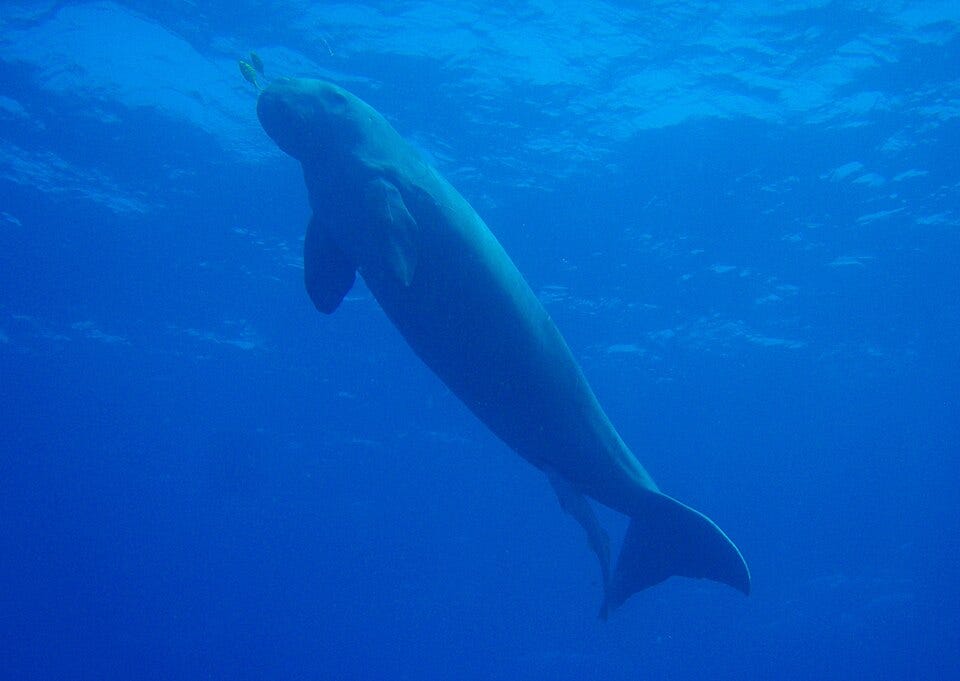
I can’t remember where I first learned about dugongs, but it was in Florida. My dad had a childhood fondness for Anna Maria Island off Florida’s west coast, and we took a few family vacations there. We visited several animal attractions, where I met alligators, a talking crow, a laughing kookaburra, and of course the dugong’s cousin, the manatee. Compare the below image with the above to see how similar they are:
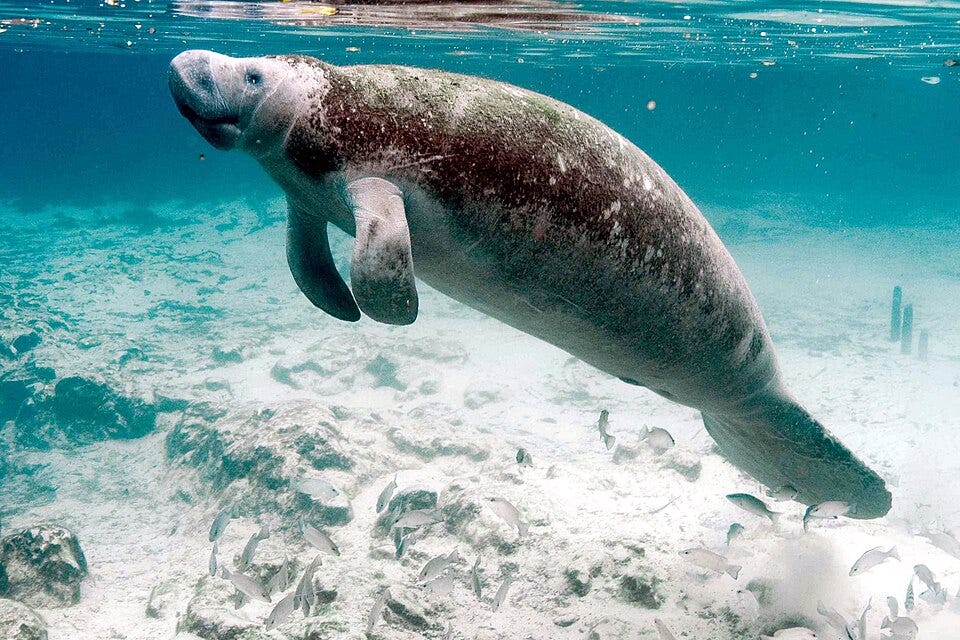
Dugongs and manatees both have the “fusiform” bodies that most totally aquatic mammals have, where legs have evolved into a powerful tail and the forelimbs are broad paddle-like flippers. Both have bristly muzzles on their blunt snouts that they use to forage for their favorite food, sea grass. In fact, both animals are also the only totally herbivorous marine mammals alive today. It’s likely you’ve heard the term sea cow to describe them, but that’s more than just a cutesy nickname: the Cebuano word dugung from which it derives its name literally means cow of the sea!
Dugongs are distinct from their cousins in a few ways though. You probably already noticed the primary difference when looking at the photos above. That’s right, the dugong has a fluked tail that more closely resembles a whale or a dolphin, while the manatee has a big fan-like paddle of a tail. The other major physiological difference is their snout shapes: dugongs feed almost exclusively near the ocean floor, and so have downturned jaws that help them practically vacuum up the grasses they enjoy, while manatees have flexible snouts that help them grab at plants at a variety of depths. Manatees tend to grow slightly larger than dugongs, but the difference is only a foot or two in length and a couple hundred pounds.
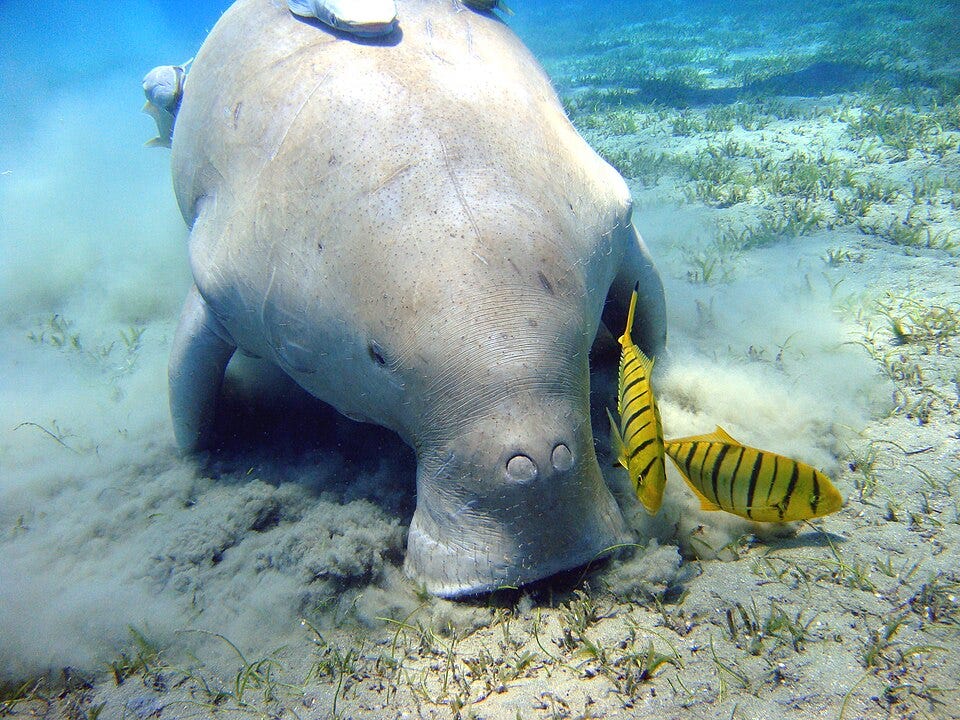
Manatees will happily travel between salt and fresh water to feed, and are often found hanging out near estuaries. The Amazonian species actually spends its entire time living in the freshwater river for which it is named. Dugongs, on the other hand, spend all of their time in saltwater, and while their cousins’ different species are localized to certain regions, the dugong has impressive range. They are found all along the eastern coast of Africa, from the Red Sea near Egypt to the waters off Madagascar. They are in the Persian gulf, around India and Sri Lanka, and all over the waters between Southeast Asia, Indonesia, and Australia.
Dugongs prefer warm shallow waters. Unlike whales who have lots of blubber to help them deal with colder and deeper waters, dugongs only have a bodyfat percentage of 4%. Most of their bulk (up to 20%!) comes from an impressively large digestive tract that generates heat. Their intestinal tracts are so long (and because their diet is so low in fiber) that food spends almost an entire week inside the dugong before it’s passed. Another reason for their bulk is their massive set of lungs, which run from the back of their throats to their kidneys. These allow the sea cow to hold its breath for up to six minutes, and it typically feeds at a depth of about 30 feet. Dugongs have some of the densest bones in the animal kingdom, which serves as a ballast against the buoyancy of their lungs and making it easier to linger near their feeding meadows.
Mermaid myths are found in cultures all over the world and many, many stories are attributed to dugong and manatee sightings. From a distance, and on rolling waves and among sea spray, these creatures look vaguely human-shaped on top with a fishlike tail on bottom. The stories are so common, marine biologists have grouped manatees and dugongs in the order Sirenia, named after the Sirens of Greek myth, mermaids who doomed sailors. There are too many stories to list here, but many legends suggest that it’s bad luck to harm or kill a dugong. If a fisherman catches one in his nets, he is to free it immediately and perform a cleansing ritual.
But their semi-mystical nature also makes them sought after for folk cures. Their thick bones are thought by some cultures to contain magical evil-warding properties, and are used to scrimshaw protective talismans. Being totally aquatic, dugongs have adapted to excrete a thick mucous when their eyes are exposed to air. These secretions, called “dugong tears” are believed to be an important ingredient in love potions. A story from Kenya says dugongs were once human and turned into sea cows as a form of punishment for living too lavishly. Another story from Okinawa warns that eating dugong meat will grant you long life—truly, a curse, for you must then watch all of your loved ones perish before you.
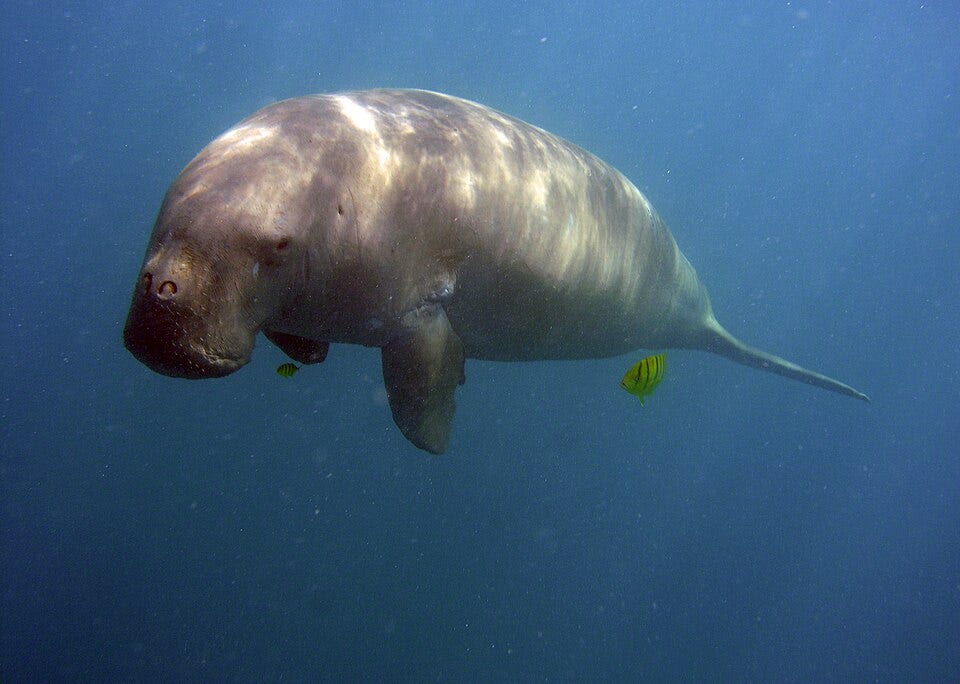
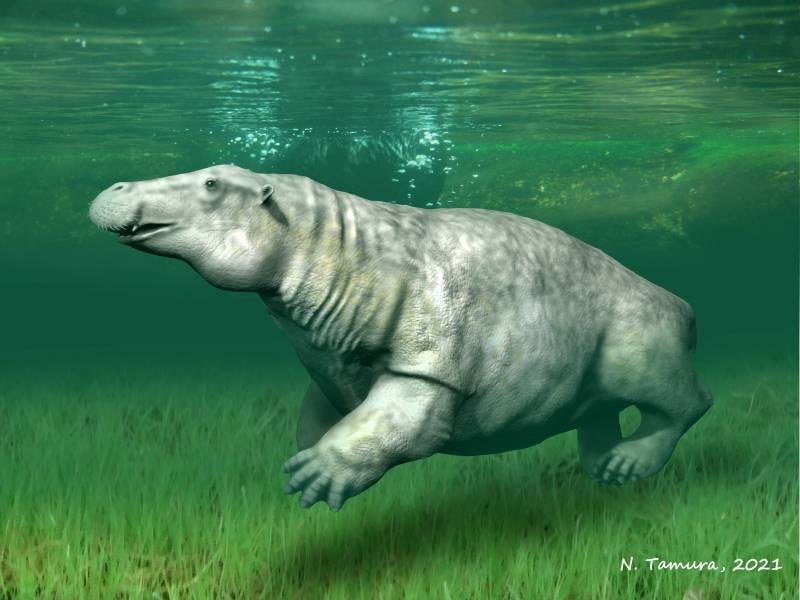
If I asked you, “what living animal is most closely related to the dugong?” you’d probably know that I am asking you because I have a surprising answer. It can’t be the obvious candidates: whales, dolphins, perhaps the walrus. Maybe it’s the otter? Not a terrible guess…but the correct answer is the elephant! Now you can kinda see it, can’t you? Around 50 million years ago, there were pig-sized mostly-aquatic mammals, that lived in the shallows of the Tethys sea. It’s thought that over time, dugongs and manatees branched off from these guys as they spent more time in the water and began developing fins in the front, and eventually losing their hind legs in favor of paddle-tails.
About a month ago, research from a study involving dugongs in the waters off Bahrain shows these docile mammals have a potentially huge impact on oceanic carbon capture. Because dugongs eat so much sea grass, they cause the meadows where they live to grow at almost double the normal rate. In addition to euphemistically “redistributing nutrients” in their environment, the growth promoted by dugongs helps reduce carbon in the atmosphere. Sea grasses are much more efficient than rainforests at carbon sequestration because as the leaves and root systems settle, the carbon absorbed by the grasses are trapped in the sediment at the bottom of the ocean instead of being released into the air. While only 0.2% of the ocean floor is covered in seagrass meadows, these fields account for nearly 20% of all the ocean’s carbon reclamation. As we work to combat human affected climate change, these seagrass beds are an important tool to control carbon.
Unfortunately, dugongs face a ton of negative pressure from humans. We know they prefer warm, shallow waters where humans tend to frequent, putting them at risk with boat collisions and pollution. Studies show that dugong populations are becoming increasingly fragmented, resulting in less genetic diversity and putting the species in danger of extinction. Dugongs are protected by many governments but poaching is still a problem—dugongs are sought after for their meat, oil, and bones, and their slow-moving, docile nature makes them easy targets. They also have pretty poor close-range vision and are prone to getting stuck in fishing nets. Populations around China and the Mediterranean have already disappeared.
Dugongs live long lives (some estimates suggest up to 70 years!) and it takes them up to a decade to reach sexual maturity. As they calve so slowly and infrequently, their breeding rates can’t keep up with their mortality rates. There are a number of initiatives to help these gentle grazers, including the World Wildlife Foundation and the Dugong & Seagrass Conservation Project.
By and large our sea cow friends are doing well, but we’re not on a great path. The good news is there’s still time backtrack, and the better news is if we help them, they’ll help us!
Exciting new paper on Dugong Impacts on Oceanic Carbon Capture
Paper on Protosiren (the dugong’s walking ancestor!) discovery
That’s it for this week, Zoo Bisous! Who do you think we’ll meet next week, for E?
Catch up on previous editions of the soup here:
Tuesday Zoosday
Tuesday Zoosday: Animal Alphabet Soup
·
May 26

I think if you know me well, you know that I am an animal enthusiast. In fact, the very first time I had to answer the question “What do you want to be when you grow up?” in Kindergarten, I responded with “Zookeeper!” (by the first grade, my answer had changed, dubiously, to “t-shirt designer”)
Comments
Nothing yet. Say the first thing.
Sign in to join the conversation.