
Bisous, Zoo Bisous! Welcome to Tuesday Zoosday! This is the third installment in the feature’s first series, Animal Alphabet Soup! Each week we’ll cover an animal starting with each letter of the (English) Alphabet! Enjoy!
You can keep tabs on the Alphabet Soup series here.
—Ranger Beau
Does everyone go through a dinosaur phase? I feel like that’s something every kid does, but perhaps I am projecting. I am still going through my dinosaur phase, and suppose I will until I shuffle off the proverbial coil. I remember visiting the ocean for the first time, at about the age of six, and seeing a pelican soar overhead. My heart skipped a beat because I thought I was seeing a pteranodon. My mind caught up to my imagination and I noticed the feathers, but I will never forget those few seconds of awe I felt where I believed I was seeing something that had supposedly died tens of millions of years ago.
At that time, too, I had understood dinosaurs to be reptiles. There were murmurs that dinosaurs actually had a lot in common with birds—you might remember the intro to Jurassic Park where Sam Neill as Dr. Alan Grant points out that “‘raptor’ means ‘bird of prey’.” Today, we understand that all modern birds are dinosaurs. It’s kind of hard to think of that robin in your backyard that way though isn’t it? But if you asked me to name an extant bird that is most like its ancient forebears, it would be harder for me to name a better example than the Cassowary.
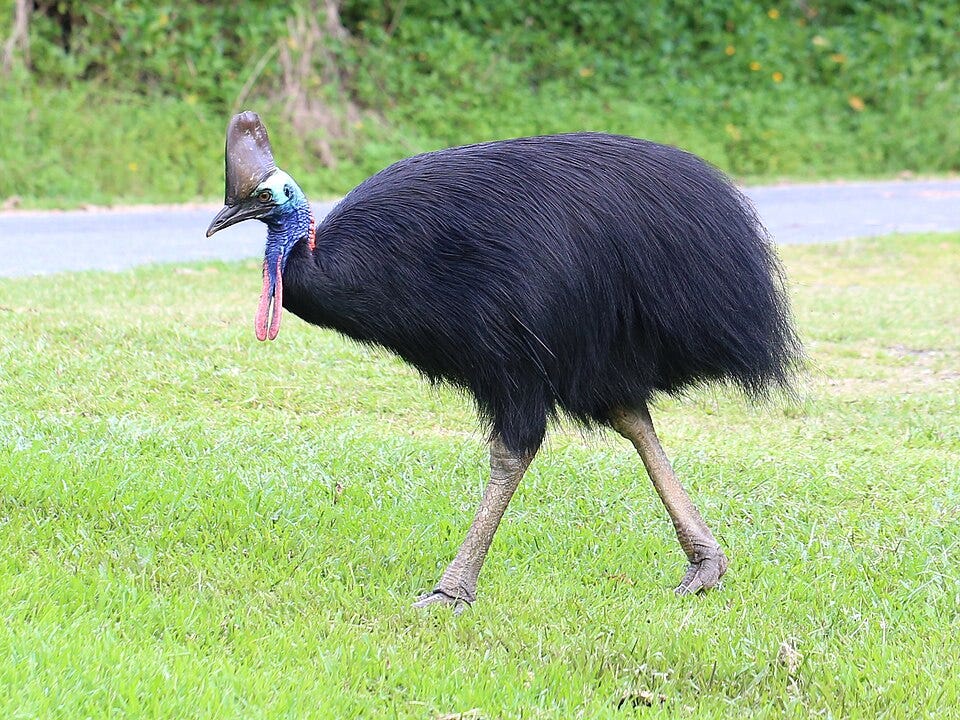
There are actually three species of Cassowary: the Northern Cassowary (so named for its habitat on New Guinea’s north side), the Dwarf Cassowary, and the Southern Cassowary—I’m sure it will surprise you to find out these guys live in New Guinea’s southern region, but they also live in parts of Indonesia and (perhaps somewhat confusingly) on Australia’s north coast. Cassowaries belong to a group of flightless birds called ratites: you may notice similarities to its famous and more abundant relatives, Africa’s ostrich and Australia’s emu. It’s also related to South America’s Rhea and New Zealand’s diminutive kiwi. All of these ratites belong to class of animals called Palaeognathae; Palaeo meaning “old” in Greek and “gnathae” meaning jaw. Modern birds (neognathae) have a hinge-like jaw mechanism, but the palaeognaths have a more complicated interlocking jaw mechanism that more closely resembles their reptilian ancestors, hence the name.
Now you may have noticed that these flightless birds appear on a bunch of different continents (Africa, Asia, Australia, South America). How did they all get there? You might know that at one time or another, all the Earth’s continents were smashed together into one landmass called Pangaea. The supercontinent started to break apart about 200 million years ago, so you might think all of the ratites’ predecessors emerged before the split and that’s how they ended up where they are today. It’s not so simple! Ratites and their immediate ancestors started to show up in fossils around 60 million years ago, well after the continents broke apart; they certainly couldn’t swim across the oceans either! The current evidence suggests that ratites, including cassowaries, actually had ancestors who could fly, and each species evolved away from flight!
You might think losing the ability to fly might be a drawback, but one thing that’s common about this strange evolutionary path cassowaries and their ilk have taken is they have grown much larger than other birds. Cassowaries are the third tallest birds in the world (emus beat ‘em by a couple inches, and ostriches have about a foot on cassowaries), and they’re second heaviest bird, with them averaging around 60kg (or 130lbs if you’re an imperialist). In other words, cassowaries are about as big as an average human female.
They’ve evolved extremely thick and powerful legs, which allow them to hit up to 30mph at a sprint and can leap 7 feet straight up. Cassowaries are powerful swimmers and are often seen cruising around rivers and sometimes even in the ocean!
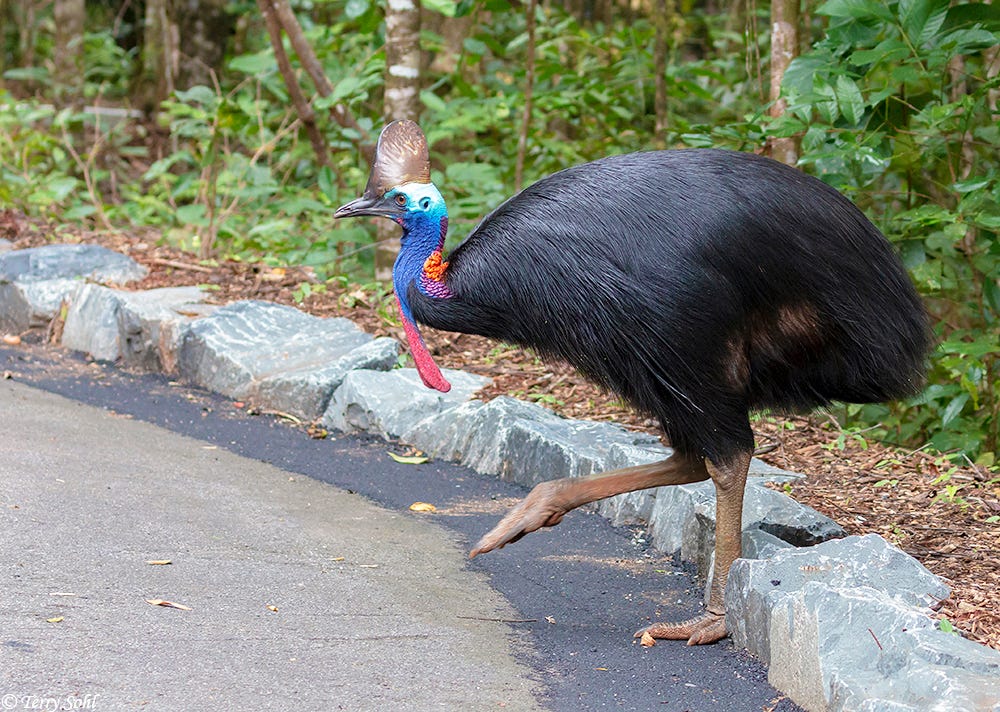
If you take a close look at the above photo, you probably notice the wicked claws. Cassowaries are equipped with a 5-inch blade on their inside toes. If you’ve seen Jurassic Park, you saw the wicked claws of the Velociraptors (really, Utahraptor or Deinonychus would be more appropriate name for those animals)
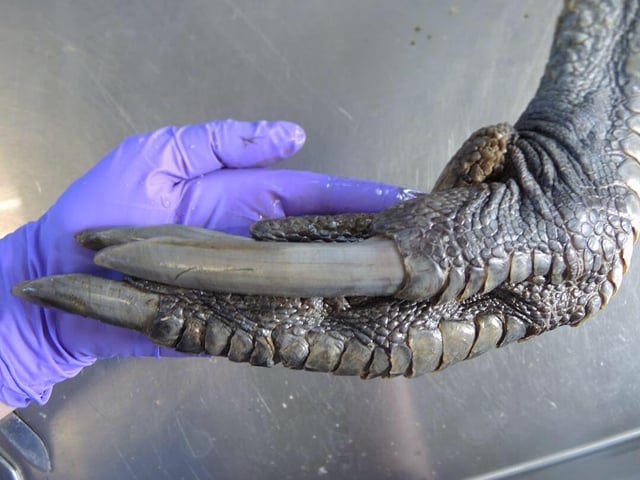
Combined with their incredibly leg strength, these stiletto-like weapons could do quite a bit of damage to just about any living creature. For this reason, cassowaries are often called “the most dangerous bird in the world” but I don’t think that’s a fair name; there have only been two deaths attributed to cassowaries since the 1930s, and about three quarters of all cassowary attacks happen because the birds have been fed by humans or a human has wandered into their territory. Dangerous to be sure, but they aren’t going out of their way to hurt people. Besides, the ostrich kills about two people every year, it’s really the most dangerous!
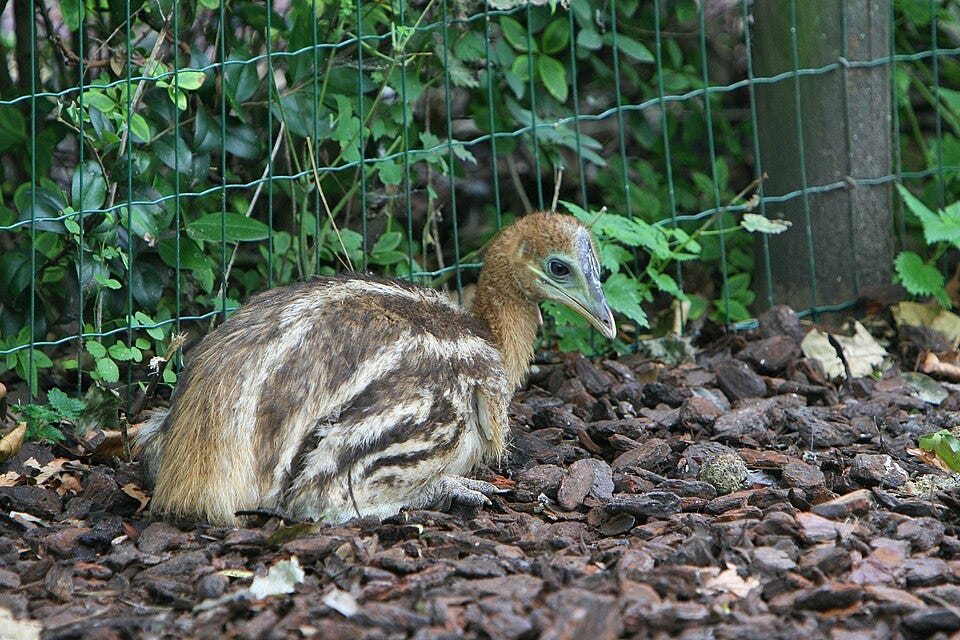
One of my favorite things about the cassowary is its coloring. Sapphire blue skin around its face gives way to goldenrod at the base of its neck. A brilliant scarlet wattle dangles at the front of its throat (the northern species has one, the southern two, and dwarf cassowaries have none). It has two keen golden eyes capable of seeing into the ultraviolet spectrum, and a coat of glossy feathers. You may notice from the photos that the cassowary’s covering is unlike almost every other bird’s you’ve ever seen: it looks a bit like quills, doesn’t it? You’ve probably seen a feather and noticed a spine running down the middle, the rachis, with fine, threadlike protrusions on the side called barbules. Cassowaries evolved away from growing barbules, favoring the rachi, which are thought to provide a sort of armor for the birds as they race through the rainforests.
But above all of that, you’ll see the cassowary’s most distinctive, most dinosaur-like feature: a domed crest called a casque, a term originating from French which means “helmet”. In fact, the cassowary derives its name from Malaysian: kasuari, where kasu- means horn, and -weri means head—the hornhead!
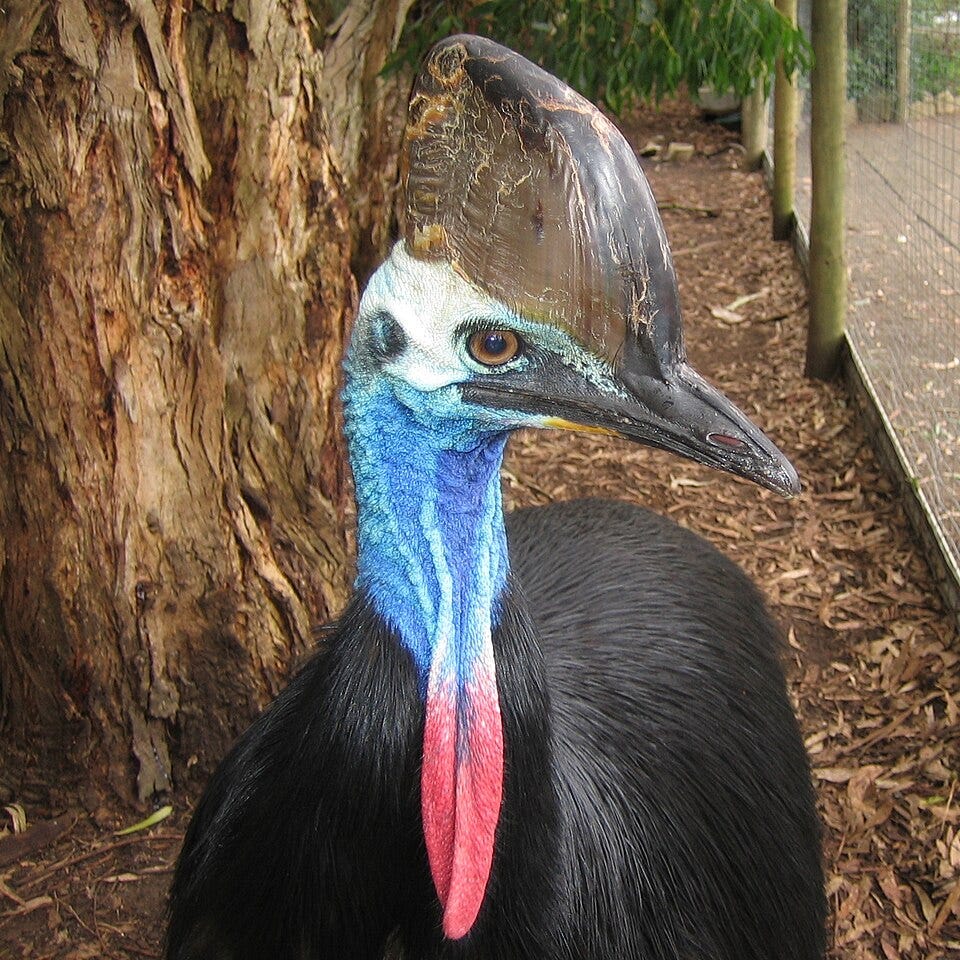
There are a lot of theories about the use of this casque, and the truth is probably a combination of the lot. Socially, the casque works kind of like antlers on a deer or moose; a well developed crest signals to others your dominance and/or status as a potential mate. Cassowaries also live in dense forests, and there is some belief that the casque helps navigate the underbrush and to protect their heads from the heavy fruit the birds prefer to eat. Just a few months ago, researchers published a paper showing that the crests fluoresce under UV light, suggesting it helps the birds locate each other and identify members of their own species.
Cassowaries are also known for their deep “booming” calls; at frequencies almost too low for humans to hear, they travel through dense forests remarkably well. Like hadrosaurs, some biologists think the casque is used as a kind of resonator to help produce such sounds, but as cassowaries also bellow and bark (sounds eerily similar to those made by the raptors in Jurassic Park’s kitchen scene), it seems the casque is less important to vocalizing than originally thought. The primary purpose seems to actually be thermoregulation. A dense network of capillaries in the casque would allow the birds to release excess body heat, a difficult problem to solve in tropical environments. Unfortunately, because of its difficult-for-humans habitat, and because there are only a few thousand wild cassowaries, studying this theory has proven tricky. It’s kind of hard to understand the thermoregulating power of soft tissues (like capillaries) using only bones.
Unlike many other birds, cassowaries are not very social and lead shy, solitary lives. They really only come together for reproduction, where a female will only stay with her mate long enough for him to build a nest and her to lay eggs. The father will then begin incubating her clutch of a 3-5 (green!) eggs and the mother heads off to find a new partner. Papa cassowary will incubate the eggs for about seven weeks and he alone will care for the chicks, feeding them fruit pulp and small insects until they are old enough to establish territory of their own, a process that takes 9-18 months.
The International Union for the Conservation of Nature does not consider any of the three cassowary species endangered, citing stable populations, but the southern cassowary is considered endangered by the Australian government, with estimates of fewer than 5000 of the birds in the wild. Like the binturong we talked about last week, cassowaries are important “fruit dispersers” for their home rain forests, and, like the binturong, could be in trouble due to dramatic habit loss. An organization in Queensland, Australia, is dedicated to protecting these magnificent birds; check out the Community for Coastal and Cassowary Conservation (C4). With just a little bit of care, maybe we can keep these living dinosaurs around a little longer. Some kid, somewhere, deserves to have their heart skip a beat when they see one for the first time, don’t they?
TetZoo’s Darren Naish’s Articles on Ratite evolution
Audobon article about the thermoregulation capabilities of the casque
That’s it for this week, Zoo Bisous! How do you think we’ll meet next week, for D?
Catch up on previous editions of the soup here:
Tuesday Zoosday
Tuesday Zoosday: Animal Alphabet Soup
·
May 26
I think if you know me well, you know that I am an animal enthusiast. In fact, the very first time I had to answer the question “What do you want to be when you grow up?” in Kindergarten, I responded with “Zookeeper!” (by the first grade, my answer had changed, dubiously, to “t-shirt designer”)
Comments
Nothing yet. Say the first thing.
Sign in to join the conversation.