
I FIND MYSELF annoyed by lamentations on the loss of solitude that I find on the Internet: claims that our dependence on social media, and the Internet itself, is eroding the capacity to spend time in solitude. For me, the most grating take is the sort that promotes solitude as a way to be with yourself, or to discover yourself. I don’t think about solitude this way. If I want to learn about who I am, I spend time with my family and friends. This shows me more about who I am, and how I work, than sitting around by myself.
But, to be clear, I need solitude. I can’t function without it. I basically turn into a werewolf if I don’t have a regular dose of it. But I’m never alone there.
I call my solitude “writing”, because that’s what it often leads to, or culminates in. But I also use it to read, and sometimes to just stare at trees or birds or objects on my desk. And what I’m doing there, especially when I’m reading, is encountering the voices of other people in a very particular sort of way. It’s a space for being with others. Even the big other: otherness itself.
SOLITUDE REMINDS ME how small I am and how big, and wild, and wise, and dangerous the world of others is.
Solitude is where I draw voices up, from my memory. Or imagination. It’s where I listen carefully to voices from the past, in the books that I read. It’s where I actually take the time to listen to the non-human voices that sound in the world all around me.
Solitude is deeply social, but the difference between the sociality of solitude and being with other people in the flesh is that there is a dark and closed dimension to these other social presences, in solitude. I listen to them. But they don’t usually listen to me. I try to speak back to them, but they don’t hear me. We are in a social relation, but it’s difficult, ethereal, and often opaque.
The social relationship I have with the people I engage with in solitude verges on the parasocial, except those voices conjured me, even if they didn’t expect me. Most of them wanted a reader and I became that, for them.
Writing is the missive I create, in response to them, and in the absence of their response. Everything I’ve ever written has been a secret note to some specific person or set of people (often long dead) who I can’t speak with directly but who I have met, in solitude.
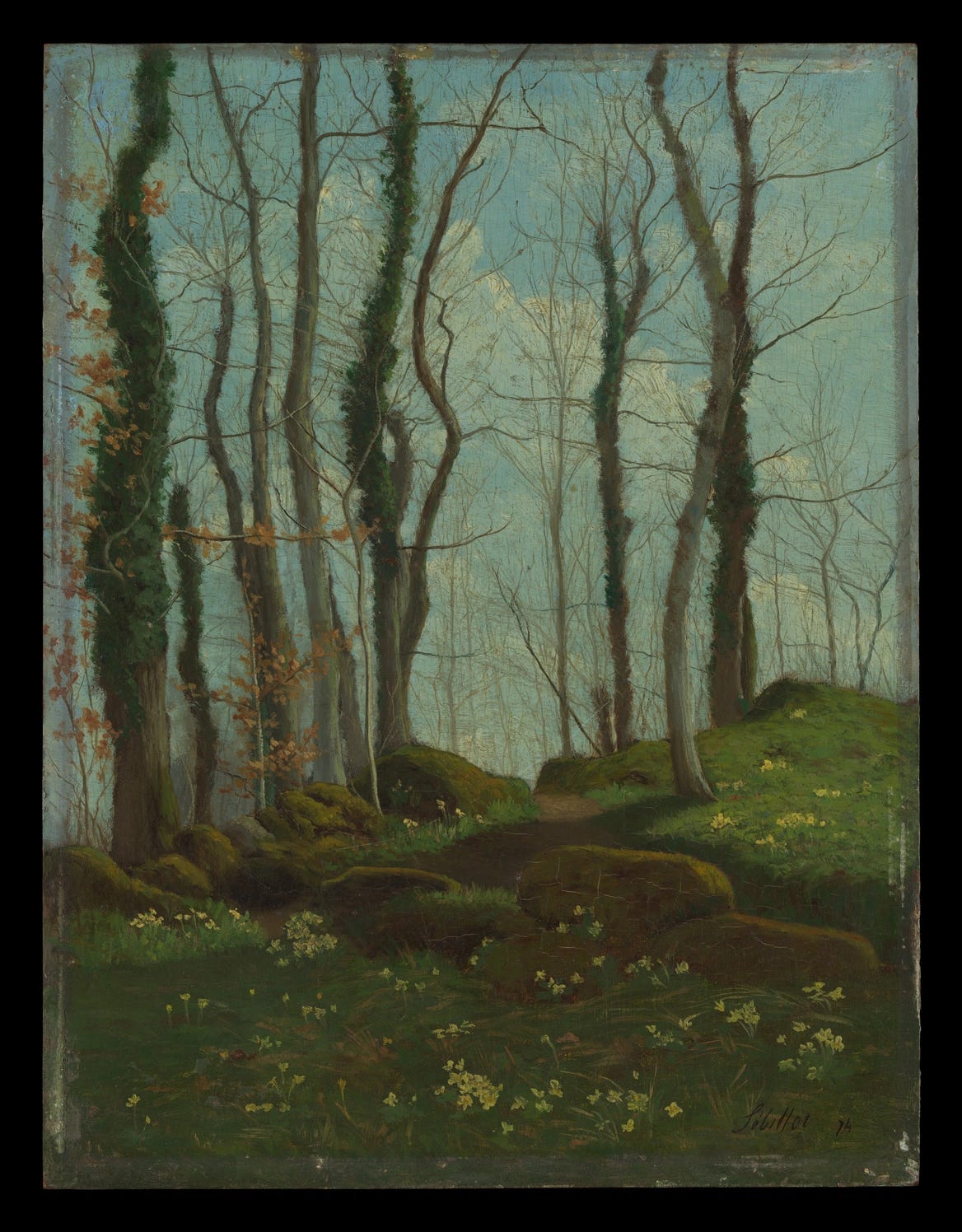
Solitude is where I clear space and time (where I make a clearing in the forest) so that these voices can emerge, speak into my world, and refuse to respond to me. Thinking, and then writing, is what happens in the space of solitude that I’ve cleared, where I crave a conversation that will never really emerge. What I do, in solitude, is my response to that very present absence.
This, not some opportunity to get to know oneself, is what’s being displaced in the emerging technological ecosystem that surrounds us.
WHY IS IT SO EASY to displace this sort of solitude right now? The technologies embedded in our phones inhabit the spacetime that solitude alone once opened up in social, cultural, mental, and emotional space. Our digital devices assume that people can, and will, clear out space and time so that they can engage with something not-quite-present in an almost sealed off micro-environment.
Using your phone facilitates something that can feel like solitude, but that also feels far more actively social. It gives you immediate rewards, and a form of response, that a difficult and opaque sort of solitude simply won’t.
What you’re doing when you’re on your phone can feel much like the sort of solitude I’ve described. The phone clears a space with its bright light, and holds open great swaths of time in which it arrests your attention. And you tap directly into a world of other voices. Indeed, these voices are much more lively than the ones that emerge from books, or your memory and imagination. They are, often, live action voices. Even if you wonder if they were created by an AI, they still feel rather lively and real.
And then there are all of the immediate responses: from actual other people on social media, or from the pseudo-human presence of an LLM chatbot. It’s a solitude that feels social (maybe this is just a more positive take on Sherry Turkle’s description of being “alone together”). Why wouldn’t people choose that over a darker, lonelier, and more difficult solitude?
I will be honest and admit that it’s become much easier for me to choose that bright, engaging, social solitude over a difficult and opaque solitude. There are fewer barriers to entry. And it at least appears to be less lonely. But I keep creating new disciplines and rituals to force me into a difficult and opaque solitude because I’ve also noticed that without it there’s a kind of vacuousness—a non-productive and non-generative emptiness—that opens up inside of me. A wasteland of sorts. Too much time in front of that bright light makes me feel like I’m filled with little bits of trash. I need that darker spacetime.
I am someone who was trained to develop an inner life in a context where difficult and opaque solitude was really the only sort available. So I both depend upon, and thrive pretty exclusively within, the inner ecosystem it creates.
THIS SORT OF INNER ecosystem isn’t universal, and it’s not irreducibly human. But it’s very old. And it does differ from the way that solitude has come to be understood, in the mainstream, over the course of modernity.
The sort of solitude that most people seem to imagine, when they set out to find it, more nearly resembles the kind of solitude that Montaigne imagines in 16th century essays like “Of Solitude”. Montaigne describes solitude as a clearing in space and time where it becomes possible to get away from the “contagion” of crowds and truly rest in oneself. Solitude is for being totally and completely alone, says Montaigne:
We must reserve a backstop, wholly our own and entirely free, wherein to settle our true liberty, our principal solitude and retreat. And in this we must for the most part entertain ourselves with ourselves, and so privately that no exotic knowledge or communication be admitted there; there to laugh and talk, as if without wife, children, goods, train, or attendance, to the end, that when it shall so fall out that we must lose any or all of these, it may be no new thing to be without them.
This sort of solitude sounds, in part, like a preparation for abandonment and death. It sounds, forgive me, like a rugged and aspirationally masculine sort of solitude. I remain unconvinced that the shattering grief of losing loved ones, or being abandoned, are things that spiritual disciplines like solitude can really prepare us for. I’m not sure I can agree with him that “the greatest thing in the world is for a man to know that he is his own.” I think it would be better if more men understood how much they belong to, and with, others.
To be fair, there are things Montaigne says about solitude that I agree with. He writes about forms of contagion in the social world (“the crowd” as he derogatorily refers to it) that are dangerous because they are fundamentally vicious. In a world like this, he says, “a man must either imitate the vicious or hate them.” This is an excellent summation of what social media does to people, I think. But Montaigne cautions that both options are equally dangerous, “either to resemble them because they are too many or to hate many because they are unresembling to ourselves.” I would agree that both of these are corrosive options, and that solitude can provide a refuge. But so can a nice little supper with a few friends.
MY OWN SENSE of what solitude is, how it works, or what it’s for is probably a little more antiquated. In the Confessions, Augustine of Hippo famously recounts that he finds, or knows, God in his “innermost self”. This inner reservoir that he refers to is, especially, the deep sea of memory. It’s somewhere in the deepest reaches of his memory, Augustine suggests, that there is some primal oceanic memory of the creation of all things lodged within his own bodily form.
I’ve heard people, both in my field (theology) and outside of it, argue that Augustine more or less “invented” the sort of interiority that people like me think of as somehow natural. I’ve never really bought that. I suppose that, if you think of Democritus or John Dalton as having “invented” the atom because they found language (and a structure of thought) for making it more present in time and space, then I might concede that Augustine is also a bit of an inventor.
But I’ve always just read Augustine as having articulated something about the nature of an inner ecosystem that can sense the presence of, and listen to the voices of, those who aren’t really there in an evidentiary sense. This might be God, or it might be the dead who speak through books and dreams. Either way, these not-quite-absent others are close enough in space and time to feel present, and yet far enough removed from our physical presence that it becomes hubris to expect a clear and direct response from them.
Solitude, for me, is inhabiting that sort of social space. It’s developing the fortitude and clarity to be able to glean something from the silence, not to demand a response, and to ritualize your reaction in some way. Like writing your own voice into it.
IT ALSO SEEMS important, to me, to note just how much this dynamic (even primal or deep) sense of interiority that Augustine describes is entangled with book culture, and reading. Someone like Montaigne would probably tell me that reading, when I’m supposed to be in solitude, is a little inappropriate. I’m not really learning to be with myself if I’m reading. Instead, I’m being sort of social. Maybe I’m even trying to keep up with the other literary strivers, who add to the social contagion around me, by reading one of the hot new novels of the year. Books are a bit antithetical to Montaigne’s hyperindividualist solitude. But I think they’re much more fundamental to a social solitude like Augustine’s. There are figures in Augustine’s solitude that manifest primarily in text.
In his Confessions Augustine isn’t simply addressing some random deity that he happened to stumble upon, in his solitude. Rather, he spends his difficult and opaque solitude speaking to a deity who he has encountered as a character in a very specific book: the Bible. Presumably he has, by the time he writes the Confessions, already spent an incredible number of hours in a difficult and opaque form of solitude cohabited by this somewhat inaccessible character (and a host of accomplices). This book—the Bible—was a spiritual technology that opened up, and filled, Augustine’s monastic solitude with a particular sort of absent presence.
Augustine is fully aware of the dramatic ends that many people have gone to, before him, to seek out a form of solitude that will bring them into relation with this same difficult and opaque presence that shows up in the biblical text. Desert fathers and mothers sought out physical spaces that were remote, in the sense that the human presence there was sparse. But it was, as many hagiographies tell us, often quite rich with more-than-human forms of presence, even and especially animals. It was thought that, in this sort of environment, one could turn down the volume on one form of sociality in order to turn up another: the sort that had been promised, or at least testified to, in a singular sort of narrative or text.
Augustine was also writing, and thinking, in a cultural moment when a dramatic shift in book culture was afoot. One of the most striking passages of the Confessions, for me, has always been his description of his own mentor—the Bishop Ambrose—reading silently. “When he read his eyes would travel across the pages and his mind would explore the sense,” Augustine wrote, “but his voice and tongue were silent.” Augustine couldn’t, entirely, understand why Ambrose did this. Perhaps, Augustine suggested, it was a method for preserving his voice which was often “prone to hoarseness.”
But what was impressed upon me, as a grad student reading this text, was how rare it would have been at this time to see a person reading silently. Even for Augustine, who wrote books that billions of others would silently consume, reading would have been something he did out loud. I imagine him, and the other monastics around him, in some corner of their shared residence, reading aloud and infringing on one another’s private spaces with their voices, asserting themselves in time and space. Reading would have been social, embodied, tactile and a little messy. You would have heard someone reading, maybe you would have seen them spit a bit with a hard consonant.
Someone like Ambrose, reading silently, must have looked as if he were in another dimension. He must have looked as if he were spiriting himself away, removing himself from the shared social world, keeping secrets. Perhaps there were some around him who even found his silent reading a bit rude, or antisocial, the way that it can feel aggressively dismissive when someone suddenly pulls out their phone at a dinner table. Perhaps they longed to hear a bit of what Ambrose’s eyes saw.
But Ambrose would have known, intimately, what a shared social experience reading was. That wouldn’t have been buried knowledge for him, like it is today. He would have known that the practice of reading is hearing voices. I wonder if he knew that he was helping to carve out the architecture for a new sort of inner experience (one that would be quieter, less vocal, less explicitly embodied) and laying the foundation for an inner castle that would easily be filled with bright synthetic lights.
Watching someone read a book, today, isn’t all that different from watching someone consume information on their phone. From an external perspective it looks as if both of these people have willfully removed themselves from a shared social space and have plugged themselves into a portable solitude. But the effect of these actions on inner ecologies is not the same.
IT IS ANACHRONISTIC TO think about reading, or books, or solitude this way. It’s not how people engage with books anymore. It’s not how they think about their solitude. But maybe that’s why I like it. Because I know it wasn’t really all that long ago that people really did read this way, and inhabit their solitude as a darker and more difficult space. In the scheme of things, these changes happened rather fast.
So I don’t want to forget about what gets lost when these habits and disciplines and ancient spiritual technologies become even more anachronistic and incomprehensible.
For me, it’s not that we lose an opportunity to know or learn something about ourselves. Rather, what’s lost is an opportunity to know something about the world of others, and an opportunity to come into contact with a set of voices (and absent presences) who we might not otherwise meet. We lose an opportunity to see something about interior landscapes that we allegedly have access to, in the right conditions.
This means, for me, that the capacity for thinking is also eroded. I believe that thinking needs a spacetime in which to happen, or occur. It needs the bounded conditions of an interior. And it needs a lively environment in that interior: not simply the flow of one’s own feelings and impulses but the absent presence of others, their words, their challenge to your own sense of presence.
The voices, and figures, that we meet in a book emerge from something very concrete and particular: an object, a string of words created by a real living person at a particular moment in time. Those words get into our heads, quite literally, when we read. They become present to us, they live within us. But they are still unavailable to us: they often inhabit different dimensions (mythical, fictional, divine, beyond life as we know it). They don’t respond if we attempt to engage them. They don’t answer us when we call to them, even though they speak to us directly. They are like shades without voices.
In that strange solitude where we encounter them, we learn to live with spirits and ghosts in a very particular way. And we live in a culture that’s been built around the present absence of many of these spirits and ghosts. These are forms of presence that won’t adapt to us, who demand that we attend to them and give us little in return. This is how people become shaped, from the inside out, by powers and forces that are bigger than themselves. And the conditions for that sort of formation are being dismantled.
Thanks for reading Galactic Underworlds! This post is public so feel free to share it.
No posts
Comments
Nothing yet. Say the first thing.
Sign in to join the conversation.