

AMERICANS MIGHT BE deeply loving people. It might be the case that, if it were possible to objectively measure the depths of emotion in an individual person and then average it across the population, the per-capita love levels in the American polis would be quite high. But it certainly doesn’t feel that way, in America right now. The United States as a broad public space—as a national idea—often feels like an engine of aggression that’s sapped of care, concern, and other affects that tilt toward love.
This is, perhaps, simply what happens when the public sphere becomes dominated by the fear of state murder and military occupation. Or when looming state violence and basic economic survival feel like the most pressing collective concerns.
Despite that, there are people who seem to recognize the deep felt need—in a political atmosphere of violence and fear—to love and be loved. “The grief you are feeling for your country and your neighbors is love,” wrote on Substack, the day before Alex Pretti was killed, and just over two weeks after Renee Good’s murder. She posted the sentiment with a photo of a melancholy sunset, and last I checked, the post had been shared almost 900 times (one of those was me) and liked by more than 7,000 people. It was a little translator, reminding people of what it might look like to think about love as a civic force. People seemed to like seeing that. What better figure than love to lift people up above the horrors of politics?
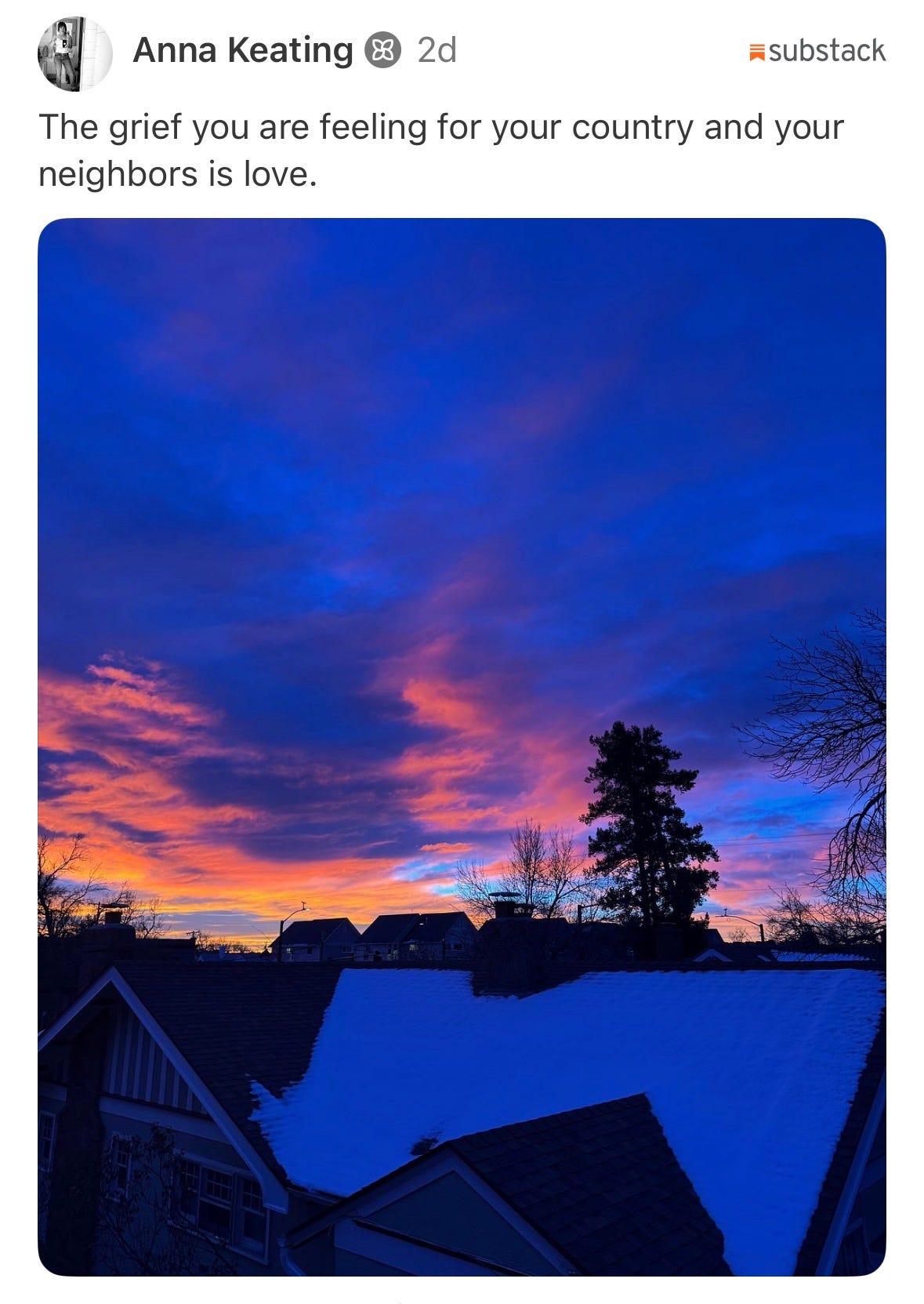
I find this image, and the sentiment, incredibly poignant and moving. And yet, it’s also left me thinking about love and what sort of power it is now, in America 2026. Whatever else it could be love, in American pop culture and social media, tends to be a romantic thing more than a civic or communal thing. People have wondered, in fact, if love might be the undoing of civic bonds rather than their fortification. Perhaps too many Americans have been taught to want—more than anything—the most insular, restricted, and commodifiable form of love. Or is this just a reductive story about love that fails to illuminate its complex power?
THE AMERICAN LOVE STORY I grew up with, and the one that I still (despite an alleged lag in American romance) see everywhere around me is a story about romance. Love, as I was taught by the American pop culture I consumed growing up, always finds its apex in the romantic love that’s shared between a couple.
My childhood imaginary of love was shaped by the era of the great, and unavoidable, romantic comedies. I learned, from Pretty Woman, that romantic love can—and perhaps should—save you from destitution. And I learned, from You’ve Got Mail, that the purpose of the Internet was the sort of connectivity that might ultimately lead to romantic love. I was thirteen when that single glorious season of My So Called Life defined, for me, the structural shape of desire as the painful and unfulfilled longing for the crush who will always sort of ignore you.
Even when I thought I was learning about some other form of love—the love for family, or friends—I was usually actually being fed a romance. Shows like Friends, Sex in the City, or Girls all appear to be about friend groups. But the purpose of these friend groups seems to, essentially, be to help you navigate the rocky waters of romantic love.
I’ve seen whispers, in think piece after think piece, that this whole foundation might be shifting. It appears to be the case that for younger Americans, today, this sort of romantic relationship is less and less of a priority. Romance might apparently be on the verge of going extinct, and boyfriends are now cringe. But these sorts of takes seem to ignore the fact that Gen Z remain devotees of romantasy genres, and other viral phenomena.
It might be impossible to dethrone romantic love, in American pop culture. And perhaps this is a cause for collective concern. There are obvious ways in which even romantic love can be civic. One can, for instance, affirm one’s belief that all people should be permitted to love whomsoever they choose to. But this still frames love as a matter related to romance, and sexuality. Can love still bend itself in more Platonic directions in America today, or have the intimate particularities of romantic love too deeply eroded the power of love as a civic virtue?
SOCIOLOGIST OF LOVE, Eva Illouz, is deeply skeptical of the civic power of love. “Love cannot, in any way, be a candidate to form the basis of civil bonds,” she writes in her 2023 book The Emotional Life of Populism. Love, Illouz says, “always contains some form of narcissistic component: I love the other who loves me in return.” Love, for Illouz, has no real universal potential.
She’s thinking, to a great extent, about the sort of love that’s born out of populist nationalism. The Emotional Life of Populism is a study of the rise of this sentiment in Israel, where Illouz lives and teaches. Love, as a nationalist bond, can be deeply religious. For instance, religious people submit to God, and in so doing, they “intermix the love of God and the love of nation. They shroud the land and the nation in the same metaphysical grandeur and fiercely guarded sacredness as God.”
But nationalist love, the sort that feeds the populism Illouz critiques, doesn’t need to be religious. One can simply love the land that forms one’s nation. With this “alchemy of metaphors” the land that one loves is understood to give love back. This loving land “has quasi-agentic power and forms a bond of mutuality with the people who live on it.” This land, “rewards grief and death through flourishing enterprises: the land binds citizens to their history and true identity as well as to their economic success.” This sort of love has civic power, we could say, but it’s not the sort of civic power that leaves much room for liberal democracy.
What democracy needs, Illouz argues, is something more genuinely universal. It has to tap into a claim about who we are, as humans, that pushes us beyond the particularities of religion or nation. Love, even the love of land, is still too particular.
It’s not only the use of love in the politics of populist nationalism that’s led Illouz to be skeptical about the civic powers of love. She’s spent her career studying love. Her 1997 book Consuming the Romantic Utopia is an incisive critique of the way that modern media and advertising have turned love into a consumer product. In that book she ties her own critique of love to Friedrich Engels’ 1884 book The Origin of the Family, Private Property and the State. This, she suggests, was the beginning of a long argument (made by many others) that love and capitalism are codependent in troubling ways.
Illouz’s critical take on the way that romantic love has come to serve as the cornerstone of capitalism has led her to observe the way that love—in western culture—has become deeply (perhaps inextricably) bound up with sexuality and marriage. In this sense, perhaps, love can neither be liberated from nor offer liberation from these kinds of paticularities, or the capitalist dream that encourages us to believe that this is where we find our ultimate purpose or meaning. In this moment of late capitalism, love seems to have become entirely disconnected from Diotima’s ladder, which (according to Plato) connected the particularities of romantic love with a more universal, impersonal, and non-sexual love of the good.
Illouz’s work is also deeply informed by Hannah Arendt’s critique of love, which finds love to be too limited and particular to serve as a genuine civic bond. In Arendt’s view of love, which was developed initially in a critical study of the theology of Augustine of Hippo, love is a bond that ultimately strives for intimacy. And it’s this drive towards intimacy that makes love particular, and politically corrosive. Politics needs the kind of distance that builds a big shared world, and can create the relative remove of pluralism. Love, for Arendt, is a force that collapses this necessary distance into intimate sameness.
I find Illouz’s critiques of love convincing, on many levels. And I, like her, have lately found myself longing for a universalism that seems to have gone missing. Not what Illouz calls the imperial universalist drive to “make all countries and cultures enter in a common time, space, and culture.” But instead what she calls a more anthropological universalism, the idea that there is some sort of deeply desirable “oneness of humankind” that can be seen in any particular place where you find people. But perhaps I am still a little too drunk on the possibilities of love to believe that it can never have anything to do with this.
IT MAY BE THE CASE THAT Diotima’s ladder has been broken. It may be the case that, in late capitalist modernity (and in the rising tide of populist nationalism that we can blame, at least in part, upon this capitalist context) love can’t really live beyond the erotic particularities we tend to associate it with. This may be one reason, even in activist politics today, we’re likely to see public forms of benevolence expressed in the language of care rather than the language of love.
But thinkers like bell hooks—whose intellectual life was cultivated in the wake of a Black radical tradition, and a feminist tradition, that both drew on love for political force—have argued that something goes missing when love falls out of our political language. We lose, hooks wrote in her 1999 book All About Love, the sort of language in which “we can let our hearts speak.” More than that, she argued, Americans might need love. “All the great movements for social justice in our society have strongly emphasized a love ethic,” she wrote. Love has been a call towards action.
In 1999 hooks was concerned by what she described as the feeling that America was “turning away from love.” It felt, she wrote, as if the people around her were “moving into a wilderness of spirit so intense we may never find our way home again.” In this environment, hooks noted that love only seemed to show up in the pop culture products that celebrated romantic love. She even observed that talking about love and politics with her own audiences (many who were already disposed to agree with her, I can imagine) seemed only to generate antipathy and agitation.
Hooks refused to let the figure of love collapse into romance. But she also didn’t separate the figure of love from romance, either. She wrote about love in families, love in larger communal contexts, love between friends, and love between lovers. She preserved the term love for all of these forms of relation and found, in each of them, the signs or seeds of something that bought them all together. She didn’t seem to hold them in a hierarchical relation, as a ladder might. But they were all bound together in some sort of web, structured by a more ideal form of love.
What hooks acknowledged, however, was the fact that if we are going to use love in this way—if we are going to presume that it has the capacity surface above the particularities of one form of love (like romance)—we have to understand it as religious, or at least spiritual. She defined love, in fact, as “the will to nurture our own and another’s spiritual growth.”
She was keenly aware of who might object to such an understanding of love, and why. And she was quick to defend this view as spiritual rather than religious. “An individual does not need to be a believer in a religion to embrace the idea that there is an animating principle in the self—a life force (some of us call it soul) that when nurtured enhances our capacity to be more fully self-actualized and able to engage in communion with the world around us.”
And yet, much as she worked to create distance between love and religion, it was to religious ideas from her own heritage that she turned in order to articulate what love is, and how it works. “Living life in touch with divine spirit lets us see the light of love in all living beings,” she wrote, in a self-aware reflection on the way that her own Christian childhood shaped her view of love. “That light is a resurrecting life force. A culture that is dead in love can only be resurrected by spiritual awakening.” She even acknowledged that, for those children who are not lucky enough to know love in their own families of origin, their religious communities are often the first school of love that they encounter. If they are lucky.
I think that hooks is right, that the loss of love in America is ultimately a political loss. Americans lose something real, politically speaking, if they lose love. Perhaps they lose a certain kind of work for justice. But I also think hooks is right that love is essentially not secularizable. It’s a figure, or form, from which secularism has not managed to strip the “taint” of religion or spirituality. And I think that’s precisely what gives it enduring allure, as a figure, when it refuses to be reduced to romance. It’s the way that love works, as a theological relic, that gives it the imaginative potency and power to function beyond the romantic.
IF HOOKS IS RIGHT, that love is not secularizable, and Illouz is right that democracy needs something universal to function as an anthropological bond, then I think the shape of our impasse becomes pretty clear. If democracy needs universalism, and love has to recognize its religious roots (which are particular), then these two things feel entirely incompatible. And perhaps this is why love feels like such a strange sort of presence, in whatever remains of the civic sphere, today. Love might only have civic power if it can tap into religious feeling. And if it taps into the particularism of religious feeling, does it mean that we are cutting it off from a more universal appreciation of humankind?
One thing I will say is that liberal democracy has, for as long as it’s existed, been a bit of an empty shell without content. When it’s compelling, it’s often because it’s reaching outside of itself to fill itself up. It has relied on a certain minimum distance from any one religion, in order to ensure a degree of pluralism. But it’s also, especially in places like the United States always creatively, sometimes parasitically, and often controversially, sustained itself by sourcing and restyling religious materials. Perhaps liberal democracy (as some would seem to have it) is finally dead. Or perhaps it’s poised to do something new with love, for sake of humankind.
Would such a thing even work? I’m not in the business of prospecting. But I do have thoughts, about how to resource the archive of theological materials, if anyone should go looking.
Perhaps, for too long, love (in public) has been treated as just a form of human emotion. For all their differences, this is what it seems to be for both Illouz and hooks. It’s something that we do, as particular individuals, to bond us with others. In this sort of view little particular beings (us) are the engines that power this love.
One of the brilliant and strange ideas that theological texts have preserved is that love is actually cosmic force: a benevolence right at the heart of all things. It’s a wild speculative claim with absolutely no real evidence in its favor. But it’s a potent (and enduring) idea. And it’s not particularistic, like nationalist devotions. It’s a claim about how reality is structured, for anyone (whoever they might be). And so, it’s an anthropological claim about what shapes humankind. It’s a claim that people come from, and return to, something loving that stays with them. And it’s a claim that this power or force can’t be taken out of them (though it can be dimmed, or dampened). It’s a claim that there’s something holding you, so that you can hold others. It might be a wild and speculative claim, but it is—I think—properly civic.
If you liked what you read, please help me share Galactic Underworlds with others!
Thanks for reading Galactic Underworlds! Subscribe for free to receive new posts and support my work.
Comments
Nothing yet. Say the first thing.
Sign in to join the conversation.