
IN THE CHICAGO O’HARE AIRPORT, in the midst of a 15-hour travel purgatory as we waited for our one-hour connecting flight back home to Louisville, my ten-year-old daughter told me that the toilets back home in America seemed angry and impatient. I’m sure you know the airport toilets she’s talking about: the ones that flush dramatically and aggressively while you’re still sitting on them. It was a bit of a culture shock, after two weeks in Japan where even the most public of restrooms are impeccably clean and the overwhelming majority of toilets all patiently sit there, offering up bidets. On our trip we’d encountered toilets whose lids rise up automatically when you open the door, and countless toilets with “privacy” buttons that play nature sounds or even music (including, at one, “Pomp and Circumstance”). “You can tell a lot about a country from its toilets,” my daughter sagely observed.
I laughed, of course, because talking about toilets is always a little disgusting and inappropriate and so requires a bit of laughter. But I’ve been thinking about her comment because the rather striking difference that these toilets highlight (toilets that are aggressive and demanding versus toilets that are at your service) also captures something I found myself thinking about, with some frequency, while we traveled in Japan.
Travel makes the familiar feel strange, including the thoughts that have been inhabiting the back of your own mind, rent-free. During my trip I inevitably found myself incredibly dependent upon technology (especially the flat rectangular map/translator/researcher/camera/wallet that I carried around in my purse). But I also found myself noticing what a prominent, yet unobtrusive, role technology seems to play in Japan. The experience left me feeling as if life back home in the United States has been fueling so much antipathy towards technology that I’ve come to think about it as something inherently antagonistic to human life and dignity. In essence I’ve come to think about technology as something that we’re increasingly forced to serve, rather than something that might be used in the service of life.1 I’m not saying that this is true, but it is a sentiment that I think I’ve been harboring even if half unconsciously. And I think America today really makes me feel this way.
NOT TO BELABOR the toilet example too much, but I’ve already used it so I think it’s worth expounding. I recognize that there’s something very simple and elemental about a toilet, and so it might be a bit counterintuitive to use in a discussion about technology. But things like sewage and sanitation infrastructure are often included in broad histories of technology. These are the kinds of things that have allowed massive groups of people to gather in condensed shapes and forms that we often refer to as civilizations. They’re the subterranean networks that almost invisibly facilitate a radical shift in the way that people live alongside one another. We take these things for granted, now, as forms of technology. But that’s what they are. So, toilets can give us a window into not only a culture, but their technology.
The automatically flushing toilet is a decidedly modern (and even cutting edge!) form of technology. It relies on things like infrared sensors to discern the user’s movement. It was presumably designed to solve something that threatens public and communal life: failure to flush. I am not an expert on this form of technology, so I really have no idea why so many auto-flush toilets in the US are so aggressive. But I’m going to venture a guess that it has something to do with cheap sensors that don’t work well (and seem to break easily) but are nevertheless ubiquitous. And it might even have something to do with programming. It might be assumed (for good reason) that Americans are particularly bad at taking responsibility for the collective care of communal spaces, and so are especially likely to succumb to the failure to flush. The result is a form of technology that is only somewhat effective, but also intimidating and hostile. It’s not really there to serve you, but to persecute and even punish you. You’re at its mercy. It’s a situation without much dignity for us.
I was recently speaking with a fellow American who confessed that she was disgusted by bidets. But when I pointed out that the water used for the bidet comes from outside the toilet bowl, while the water splashed about by an aggressive auto-flush toilet is water from the bowl itself, she had to admit that this was definitely more disgusting.
While they might exist, I have to say that during my entire trip to Japan I didn’t encounter a single aggressive auto-flush toilet. I suspect that they probably invest, in both public and private spaces, in better sensors. Many toilets even have sensors that close the lid before flushing. There are an overwhelming number of buttons on many of these toilets, such that foreigners have to do actual research to learn more about what these complex technologies are designed to do. Some have heated seats. Some glow in the dark. Many toilets are self-cleaning models that use detergents. Many of them have an automatic deodorizer. These are toilets that are designed not only to serve individual people, but to be an asset to a culture that values cleanliness. These aren’t toilets that are aggressive and suspicious of people. They exist to serve a broader communal value, and to ensure that this value is present in communal spaces. They serve life, and the living. This supports not only the dignity of individuals, but of the collective they create together.
BUT LET’S TALK ABOUT other things, because this was only one hyperbolic example. The example that most people will talk about, when they talk about technology in Japan, is the transportation system. I was prepared to be impressed by it, but I have to admit that I often had to force myself to observe it. It’s so well-designed and smoothly operated that it feels almost seamlessly integrated, and it fades into the background of consciousness.
We rode on the celebrated bullet trains, and reached speeds that more than doubled my fastest speed in a car on the American interstate. The ride felt calm and peaceful. The trains were shockingly punctual. I can’t even imagine what sort of complex technological apparatus exists to facilitate that sort of coordination.
I was anxious about using the rail system, in Tokyo, given that it’s such a massive city. It took me a long time to feel confident navigating the NYC subway system, when I lived there. But I was able to download a pass for the Japanese rail system on my phone before I even walked into the first station. All of the digital information that I could access through Apple Maps about my route was incredibly precise, and accurate. And I never had an issue getting cell service in the stations, or on the trains (or anywhere I went in Japan, really).
You might think that this efficient transportation system is just that: a form of advanced technology that helps people get around. What sort of discernible difference would that really make, on the rest of life in a city like that? An incredible amount, as it turns out.
The rest of life shifts in response to this advanced technology. The streets of Tokyo (again, a massive city) are calm and peaceful. When you walk around, you feel as if you’re in a city built for people, not for cars. In Louisville, where I live (and where I have actually seen a car hit a child, and send her flying in the air, on the street I live on) I feel the imminent threat of cars and traffic when I walk out the door. I didn’t feel that in Japan. The bikes in Kyoto did feel a little wild, but that was more of a point of confusion or mild annoyance.
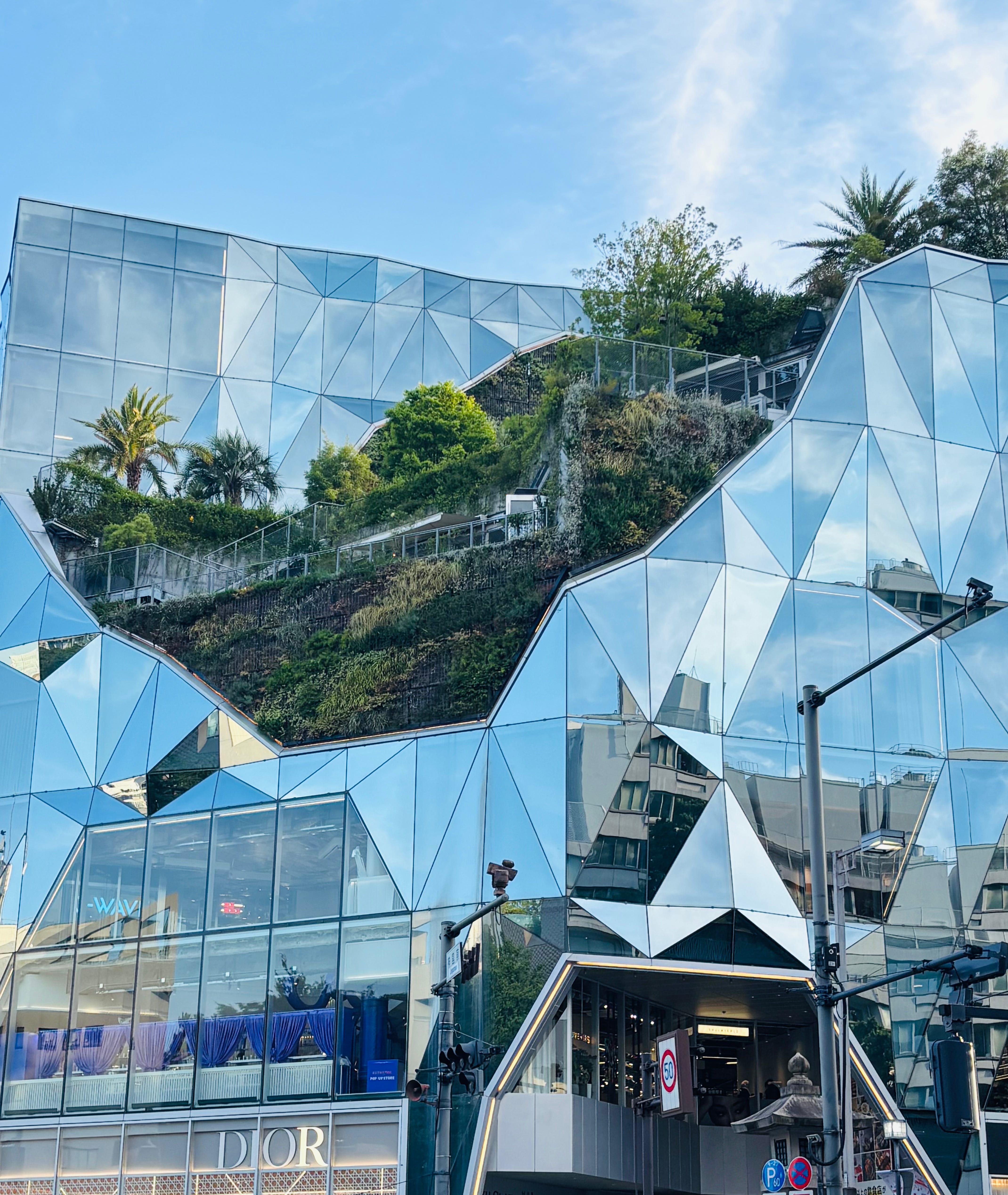
When we were outside, in these cities, feeling as if we were in spaces built for people, I couldn’t help but notice the abundant green, and all the park space. Part of this is more deeply rooted. The shrines and temples throughout places like Tokyo and Kyoto are already, themselves, like little parks. They are lined with gardens both inside and outside their own walls. So it makes sense that something like a park or a garden would be a non-negotiable element in these urban landscapes. I can’t help but assume, however, that because the air is cleaner, and the environment feels sort of humane, that things like trees, and flowers, and well placed rocks just belong in a place like that. They are simple marks of an environment worth living in, in an environment that’s still loosely organized around the living (instead of their machines).
I’m not claiming that Japan is a utopia. I understand that people, especially workers, in Japan have their own concrete struggles, like incredibly long work days and work weeks. I’m not ignoring that, even it if’s not the point I’m trying to make. And I also understand that many of my American eccentricities are out of place in Japan. I’m an American, and I love and accept my Americanness. So please don’t misunderstand me. But my travels in Japan have left me lamenting the role that technology seems to be playing in our culture right now, and I want better for us.
TECHNOLOGY MAKES US, as Americans, more capitalist. That’s what it does. Technological advancement allows us the opportunity to purchase new consumer products, and to make the producers of those products more rich. We value the accumulation of capital, and we use technology to advance our capitalist economy. That’s how it serves “us”.
And what this means for people, as individuals, is that they have to serve the economy that’s developed around these technological advancements, even when these advancements are actively destroying things (like social institutions) that were set up to serve us as living people, such as education. We are being told that we just have to accept what’s happening to our communal life because this is how technological advancement works in our culture. And it seems to be the case that we have to sit back and watch the other things we value being eroded and destroyed, because we’ve been told that these newest and most advanced technologies are basically the only thing that’s propping up our communal value system (the accumulation of capital).
We deserve better. We deserve better lives, and better communities. We deserve technology that facilitates the enrichment of collective life and communal spaces. We deserve technologies like high speed trains that make the air cleaner and better smelling, that make our parks and streets more beautiful, and ensure that fewer people are slaughtered on our streets by rouge machines. We deserve high tech toilets that don’t attack us, and that help to keep our collective spaces clean enough that we might even be inspired to contribute to, or carry on, that cleanliness.
People will tell you that this is impossible. But that’s not true. We do have to want something different, however. We have to, en masse, value things that most people here don’t value right now. Not just abstractly but deeply and concretely, in the way that touches on our deepest desires and our nervous systems. We have to talk about these things, publicly, collectively, incessantly. We have to empower the people who will fight and struggle to try and secure these things in our public spaces for us. It’s not impossible, but it’s a reach. I sometimes feel as if people are starting to reach.
The difference between technology that’s cutting edge and technology that slaughters people is that the former is oriented around life and the living, it’s there to serve life and the living, not to persecute or punish it. I think that American culture has lost whatever connections we might have had to technologies that serve life. We aren’t living, right now, in a culture where technology works in the service of life. We are living in the machine that capitalism has built to grow more technology, and our lives are being managed accordingly.
Go ahead and come at me with arguments about infeasibility, or about the need to be realistic and accept reality. I know how many people there are who believe that we just have to accept the cards we are dealt, and deal with them. And I also know how many people there are who are caught up in escapist fantasies in which this whole corrupt world just ends and falls apart. I don’t care. This is me, dreaming about a better world in the wake of a journey to another dimension. Dreaming is a fundamental human activity that has been devalued and debased in favor of mass produced fantasies that we buy from someone else. Reality matters less to me right now than that dream state, where we imagine how it’s still possible for us to live lives of dignity, even in the midst of incredible technological change.
No posts
Comments
Nothing yet. Say the first thing.
Sign in to join the conversation.