
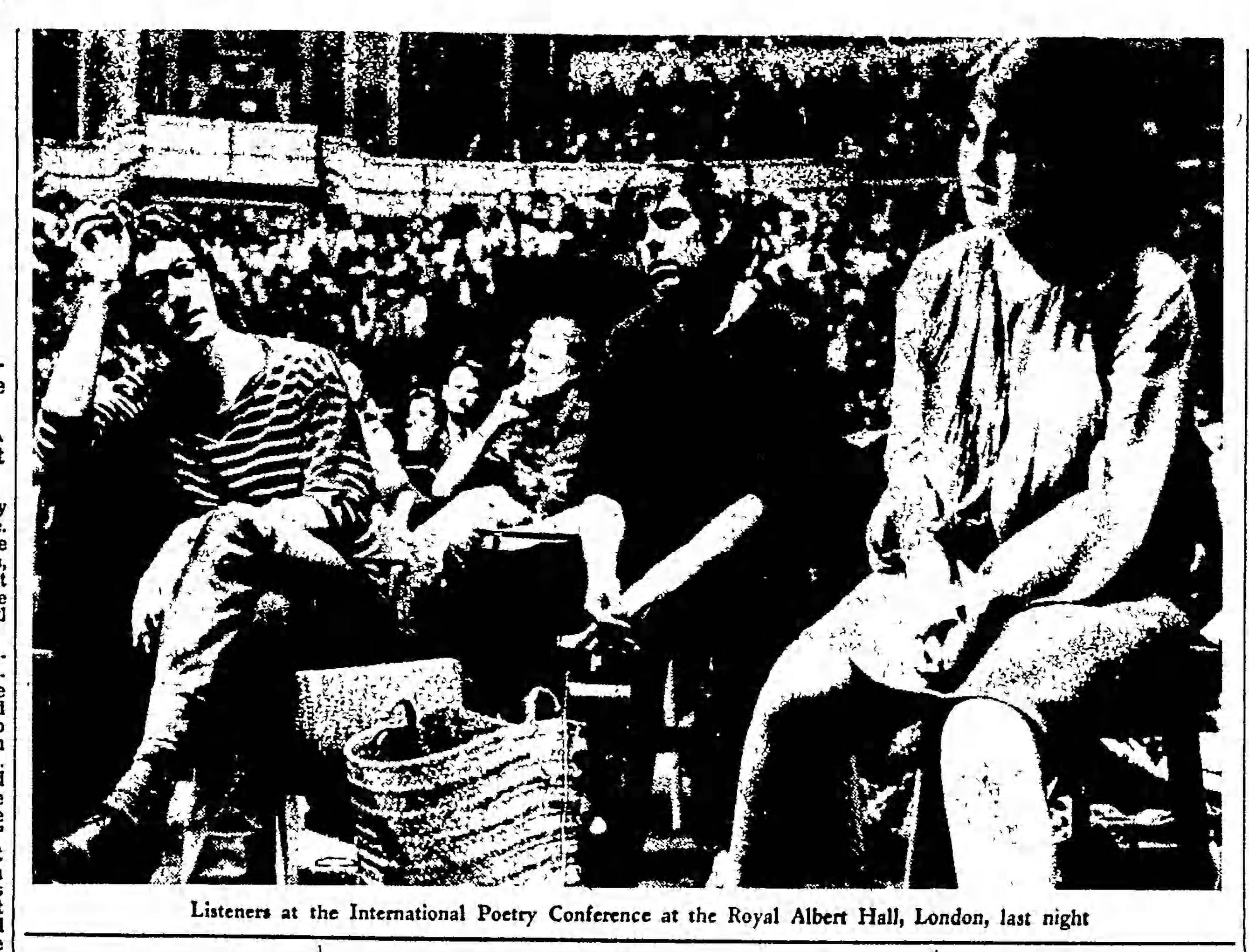
On June 11, 1965, a number of Beat poets, including Allen Ginsberg, Gregory Corso, and Lawrence Ferlinghetti, performed at the Royal Albert Hall in London. It was a landmark event, bringing some of the Beat spirit to the British counterculture. Typically but incorrectly referred to as “The International Poetry Incarnation,” it was filmed by Peter Whitehead and released as Wholly Communion.
The event has been discussed often, though not always with much accuracy. Last year, for the sixtieth anniversary, Simon Warner’s Substack ran a number of features aimed at straightening out certain details, including Leon Horton’s interview with Barry Miles and then a follow-up letter from Miles. Horton also did an interview with Dan Richter, which discussed the event. Last week, Beatdom 26 included a long essay by Horton about the weeks leading up to the reading, which clarified the timeline and explained how it came about. Considering this, I will keep my account short and add some information drawn from contemporary and overlooked documents.
The reading was pivotal for the British counterculture. Miles has said “for the youth of London it was a catalyst: the birth of the London underground,”[i] yet for the Beat poets it was something of an embarrassment. Ginsberg was furious and Corso and Ferlinghetti were similarly upset. The genesis of the reading was supposedly Ginsberg’s realisation that not only was he in England but other poets he admired were near enough that they could be brought together for their first joint reading in Europe. Thus, the concept was to have the Beats gather and read their work for an English audience. This soon got out of hand, with many English poets becoming involved and the final line-up comprising somewhere between 16 and 21 poets. It not only failed to be the event Ginsberg had intended, but the quality of readings was in his opinion very poor. He wrote an unpublished letter to the Times Literary Supplement:
A participant in the poetry reading, I woke up early next morning depressed, disgusted by almost all the other poets and disgusted most by myself. […]
There were too many bad poets at Albert Hall, too many goofs who didn’t trust their own poetry, too many superficial bards who read tinkley jazzy beatnick style poems, too many men of letters who read weak pompous or silly poems written in archaic meters, written years ago. […]
By the time I got up to read I was so confounded by (what seemed to me then) the whole scene turned to rubbish, so drunk with wine, and so short of time to present what I’d imagined possible, that I read quite poorly and hysterically.[ii]
Ferlinghetti was upset, too. He explained to an English porn magazine:
We had a 7,000-people audience and all they had to say were these limericks. I am talking about younger poets on the bill—George McBeth and Christopher Logue—were there and they were the perfect example of the well-modulated over-refined British voice which is so self-conscious, so weighed down with centuries of tradition, that it cannot really bust out and speak.[iii]
He said, “I was very surprised to find a full page editorial saying that it was an historic event.” The interviewer then went on to talk about Corso:
Penthouse: Gregory Corso told me he was completely against the poetry reading. In fact, when I spoke to him the following day, he was very angry about the whole affair.
Ferlinghetti: Yeah, he was. That’s why he sat down and read a minor love poem on stage. It was an intimate poem with low audience projection. It was his way of expressing his rebellion against the reading.
Penthouse: What do you think was bothering him?
Ferlinghetti: Well, he didn’t feel some of the poets should be on the programme, especially the English poets like Horowitz. Allen and I sort of feel the same way. If we just had three or four poets it would have been a gas of a reading. We could have taken our time, read more stuff, really gotten involved. That’s why Gregory was raving like that.[iv]
In Horton’s interview with Miles last year, they discuss the controversial question of who arranged the reading. Dan Richter had remembered that he and his wife Jill had booked the Royal Albert Hall but Miles said, “Dan and Jill were at the original meeting at Better Books when the idea was first mooted and Barbara did indeed pick up the phone and book the hall. Dan and Jill are conflating their memory with some other event.”
This may be true but newspapers from 1965 were very much under the impression that it was Jill Triebner who not only booked it but was the “impresario.” This may well have been a misunderstanding. When looking over the thousands of newspaper clippings I have of Beat-related events, the first thing I tend to notice is that accuracy was never much of a concern for reporters and editors. Sensationalism came first and the idea of a 25-year-old woman (or “girl” as she was sometimes described) wrangling more than a dozen poets—some of whom were internationally famous—made for a good story.
A June 9 report doesn’t help much:
The word was that Mr. Ginsberg, passing the Albert Hall one day last week, had impulsively decided to hire it out, and put the money down there and then. Mr. Ginsberg denied it. “It couldn’t be true,” he said. “I never have any money.”[v]
It is interesting that these news articles almost all focused on the financial details (admittedly coupled with some goofy quotes from Ginsberg that would feed the public’s thirst for weird countercultural titbits). Most of the reports said that Triebner had arranged it so that her boyfriend (or husband, depending on the source), Dan Richter, could read in a famous venue and that she could make a healthy profit from the 6,200 seats. The cost of the hall had been $1,736 and tickets were $1.40 (tickets were 10 shillings and 5 shillings depending on the seat, with the former being the equivalent of $1.40), so Triebner stood to make a quite substantial profit. (Later reports indicate that the money would be reinvested in future readings.)
Perhaps this is why the poets were supposedly pissed that they did not get much of a payday after the sell-out event. In any case, it should go without saying that Ginsberg at least had no thought of potential profits when he initially agreed to read. He’d been reading for free at various events around the UK in the weeks beforehand. You can read about that in Horton’s essay for Beatdom 26…
I don’t want to get too wrapped up in who organised it, for this is a somewhat contentious issue, but a quote from another newspaper hints at the fact that even then people weren’t entirely sure and it does seem to have been largely a group effort:
One of the organisers, Mr. John Esam, a New Zealander, said: “It is a completely spontaneous affair.
“So many poets turned up in London we said it would be a good idea to have an international poetry congress. ‘Let’s take the Albert Hall,’ said somebody, and somebody went out and hired it.
“We have not got a set programme and there is no fixed time. It depends on the audience and the poets as to what is created.” [vi]
The Observer repeatedly used the word “someone” to show their uncertainty,[vii] and Alexander Trocchi told the Eastern Daily Press that he was in charge.[viii] Miles said in In the Sixties that it was Michael Horovitz who was the chief organiser[ix] and in his interview with Horton he said Barbara Rubin phoned the Albert Hall. Richter disagreed in his interview, and certainly the contemporary media accounts seem to be on his side—but as I’ve said, they are not always to be trusted.
Even the name of the event has been reported incorrectly. In the Miles interview, he explained, “The reading was actually called ‘Poets of the World/Poets of Our Time’.” Indeed, in his book, In the Sixties, we can see that title at the top of a promotional document.[x] The name that most people use today is “International Poetry Incarnation,” which likely comes from the co-written poem by that title, which Ginsberg read on the steps of the Albert Hall on June 9. It was quoted extensively across the media without context. It would certainly seem from those reports that this was the name, and so that’s probably why the event became referred to as such (and why the Wikipedia article has it as its heading even now). However, we can see from the adverts below that “Poets of the World/Poets of Our Time” was the correct version, and at least one newspaper, The Evening Standard, reported it as being called “Poets of Our Time.”[xi]
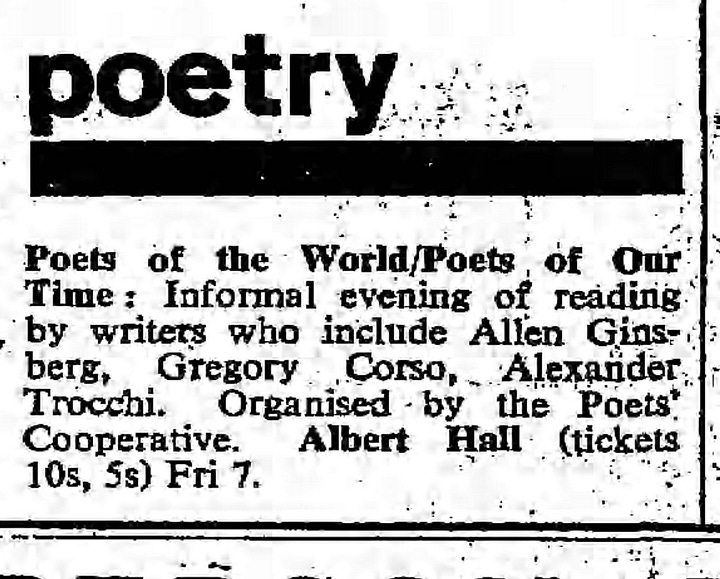
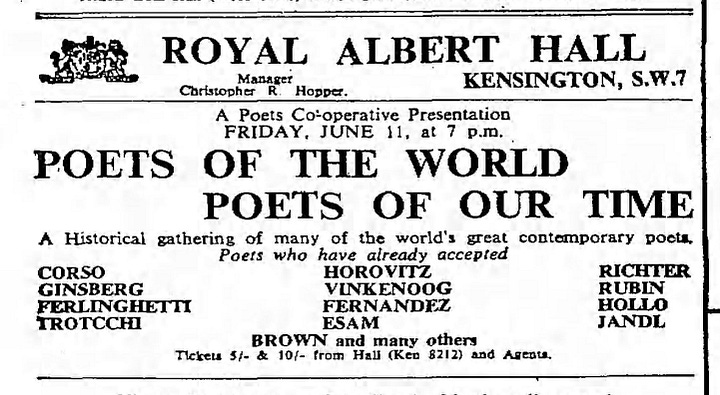
Another unclear point is the number of participants. One of these adverts lists thirteen poets plus “many more” unnamed. A reporter the day after the reading said there had been sixteen. Others say seventeen, nineteen, or even twenty-one. Given that the event was filmed, it should be easy to uncover this fact, but there was only thirty minutes of tape for a three-and-a-half-hour event and so it was filmed selectively. One consideration is that Burroughs was not in attendance but his voice was broadcast over the speaker system, perhaps influencing how people counted the participants. At least one poet (Pablo Neruda) was slated to read but had to drop out and Andrei Voznesensky chose not to read, allowing Ginsberg instead to read a translation. The Guardian provided the fullest account but only named six poets.
The audience size is debated, too. Every account says it was full to capacity, but what was the capacity—5,000? 7,000? 8,000? All these numbers have been quoted. Today, it is 5,272 but that’s because of modern-day safety restrictions. It has held as many as 12,000. One newspaper that seemed to have more accurate sources than others stated that the capacity was 6,200 in 1965.
Well, this short essay has cleared nothing up... If anyone has any further insights, please feel free to add them as comments below.
I recommend reading the linked documents from Simon Warner’s excellent Substack and also Barry Miles’ book, In the Sixties. Jonathon Green’s oral history, Days in the Life: Voices from the English Underground 1961-1971, also brings together various people who were present and creates a narrative by combining their memories. Pages 66-67 mostly concern the issue of whose idea it was and who contributed to organising the event. You can also watch Wholly Communion on YouTube:
[i] London Calling: A Countercultural History of London Since 1945, p.151
[ii] In the Sixties, p.81
[iii] Penthouse, Vol 1, No 4, p.26
[iv] Penthouse, Vol 1, No 4, p.71; 73
[v] Evening Standard, June 9, 1965, p.6
[vi] The Daily Telegraph, June 10, 1965, p.21
[vii] The Observer, June 6, 1965, p.36
[viii] Eastern Daily Press, June 6, 1965, p.4
[ix] In the Sixties, p.76
[x] In the Sixties, p.76
[xi] Evening Standard, June 12, 1965, p.6
Comments
Nothing yet. Say the first thing.
Sign in to join the conversation.