
In May 1959, a little over two years before his death, Ernest Hemingway was visited by a young journalist who had been given an assignment to write a story that involved travelling somewhere far away. At this point in his life, Hemingway was not in the habit of giving interviews, but after twenty-two-year-old Harvey Meyerson showed up in Ketchum, Idaho, Hemingway took a liking to him and spent two days discussing a wide range of topics, and then continued to correspond with him via mail, making small changes to his interview. It was one of the last interviews the old writer ever gave.[1]
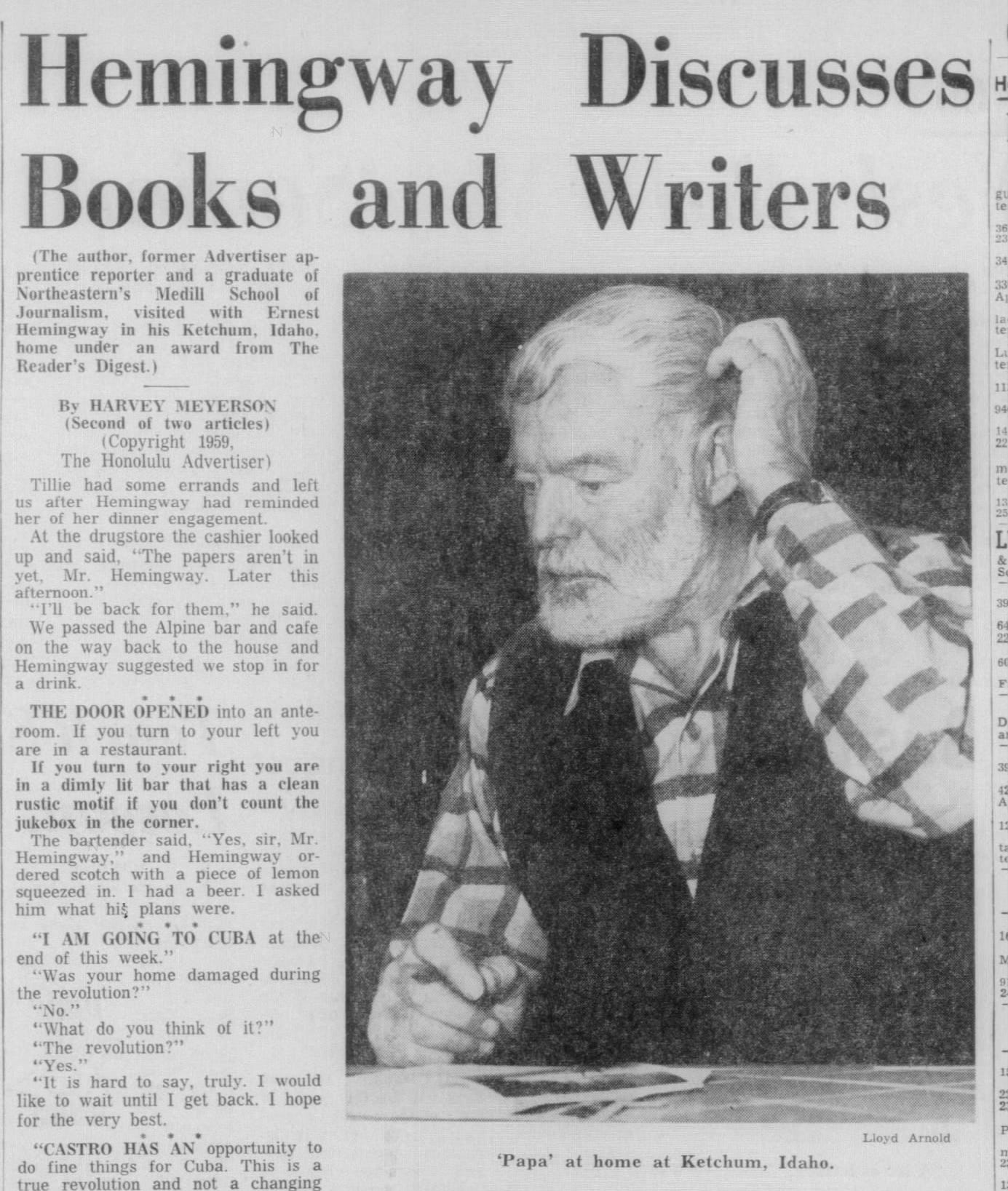
I found part of this interview (it was serialised over several issues) a few years ago when looking through newspapers from 1959. I was surprised to see a brief mention of the Beat Generation. To the best of my knowledge, it is the only time Hemingway talked about them and I don’t think it has ever been shared online before. Meyerson asks about several contemporary authors and then adds, “And the beat generation?” Hemingway responds:
I wish them all good luck. They seem to be doing okay. They have their own publicity organization already.[i]
It is hard to tell from this short answer whether Hemingway had ever actually read anything by the Beat writers but it struck me as interesting that he was aware of them. Just two months shy of his 60th birthday, he was not exactly their typical reader. In the early days of the Beat Generation, their work spoke more to the youth of America and among older writers, critics, journalists, and professors they were still largely dismissed as semi-literate juvenile delinquents. The term “beatnik” had been coined a year earlier and the media continued to depict them cartoonishly.
If one searches “Hemingway” and “the Beat Generation” online or in a library, one tends to find references to two separate but vital literary movements separated by several decades—post-war socio-literary groups that responded through art to a chaotic, violent world and left lasting legacies. They are widely studied but the connections between the Lost and Beat Generations are not immediately obvious. The Beats were quite open about having taken influence from their literary forebearers but Hemingway did not rank obviously among them and in works like On the Road, “Howl,” and Naked Lunch it is hard to see any links.
However, one does not have to look terribly far to find those them, and in fact when one digs into the journals and letters and interviews given by the Beat writers, one finds Hemingway’s name more than one might expect…
To receive new posts and support our work, consider becoming a subscriber. All of our essays are 100% free but this is made possible by those who choose the paid tier, which helps us access research materials and devote the time necessary to write and edit these essays.
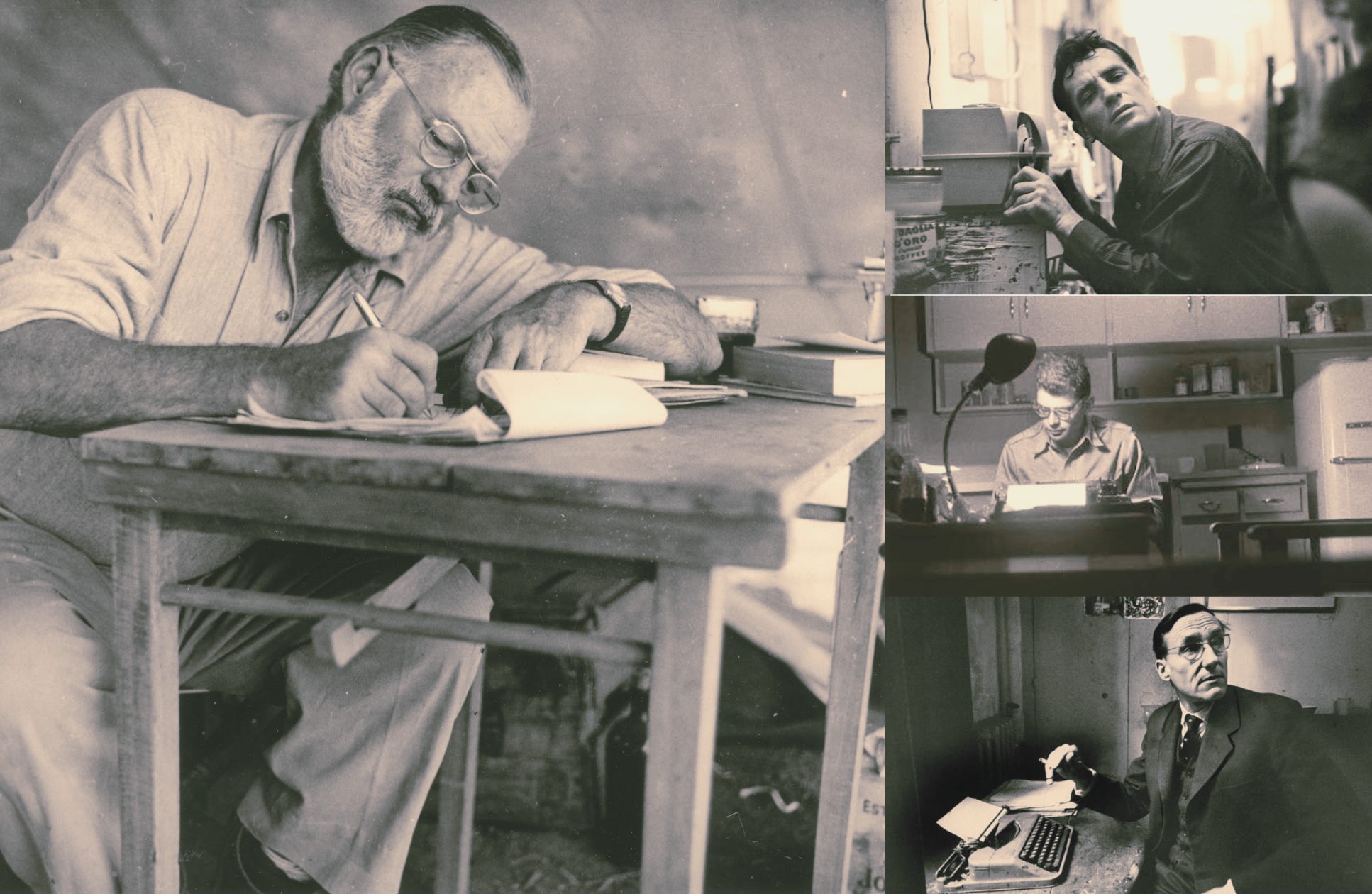
Hemingway and Kerouac
We shall start with Jack Kerouac because he mentioned Ernest Hemingway more often than the other Beat writers and seems to have been—for a while at least—the most influenced. This was not a lasting influence and by the time he was writing his major works he had very much moved on, but Hemingway was there in his formative years and he often mentioned him. They shared an editor (Malcolm Cowley) and a translator (Fernanda Pivano, who translated several other Beat writers), and when On the Road was published, the famous first review in the New York Times explicitly compared them.[2]
Kerouac was born in 1922, the year before Hemingway’s first book (Three Stories and Ten Poems) was published. When Kerouac began writing in his early teens, Hemingway was already a giant of contemporary literature, much imitated for his sparse prose, and Kerouac was initially impressed.
It was in the late 1930s that Kerouac began reading Hemingway. Somewhere around 1938, his friend Peter Gordon encouraged him,[ii] and soon after Kerouac wrote a parody of the elder writer for the Horace Mann Quarterly.[iii] By 1940, he was writing yet more Hemingway-inspired short stories and that spring he read perhaps the author’s greatest work, The Sun Also Rises.[iv] Kerouac of course had various literary influences but it was Hemingway, Joyce Johnson writes, who “had unclogged his sentences.”[v] He would later learn from Aram Saroyan and then Thomas Wolfe, which would draw him away from the sparseness of Hemingway’s style. Paul Maher Jr. writes:
Hemingway’s Farewell to Arms portrayed “War as it is—the price of love—the lost gene’rion” and The Sun Also Rises revealed a “sex-drive in life gone” with “bullfights for release.” Kerouac’s assessment of Hemingway was that he was a “supreme craftsman, investigation of American ideals on native grounds.[vi]
Indeed, in Hemingway Kerouac found an original American voice. He said, “I would much rather sit to a Hemingway, or a Thomas Wolfe [...] than to these Walpoles and Galsworthys and inane Gibbses.”[vii]
At some point in the mid-forties, Kerouac met Hemingway in New York. Gerald Nicosia says, “At one cocktail party in the Village Jack met Ernest Hemingway. After addressing him as ‘Papa,’ Jack proved too tongue-tied to make much of an impression on his former idol.”[viii] And “former” is certainly apt here, for by this point he had moved on to the array of writers one normally thinks of as influencing the Columbia Beat circle.
When thinking of Kerouac and Hemingway, most will recall On the Road and the character based on Allan Temko, whom Kerouac depicts as writing prose imitative of Papa. Throughout the late 1940s, Kerouac and Temko had Hemingwayesque dialogues, with Kerouac participating mostly to mock the unrealistic quality of speech. A number of people have recalled Kerouac doing this during these years.
By 1950, Kerouac was no longer impressed by Hemingway. That year, he wrote in a journal, “As I strolled in the pre-dawn darkness thinking that Hemingway & Fitzgerald had built their lives around lion-hunts and Yales, and were only really facetious.”[ix] During a trip to Mexico City, he decided that Hemingway was a fool for his love of bull-fighting and the whole macho persona. He called him a “fat ass”[x] and said that “a bull dies too big a death for the cowards in the seats.”[xi] Later, he said “Look, I don’t like him shootin those beautiful wild deer to prove his virility.”[xii] Kerouac was always a more gentle soul, appalled by the needless death of an animal—a lesson learned from his late brother, Gerard.
His opinion seems to have worsened over the years. In 1956, he wrote to Philip Whalen:
Stop wasting yr time with that idiot Gertrude Stein[3] and that special other idiot what’s his name, Miller, or Hemingway ... read the real writers, read Balzac, Han Shan, Shakespeare, Dostoevsky. No, read the great writers, stick to Rabelais, stick to Homer, stick to [Omar] Khayyam (a real poet, a grapey poet)—[xiii]
However, by the 1960s—perhaps as he moved into a more conservative point of view—he became a little more gentle in his commentary. In 1960, he said, “I only wish I could explain it thoroughly to someone like Faulkner and Hemingway, they’d understand (understand the absolute horror of what it is to be a ‘famous writer’ in America and not only that but a notorious writer).”[xiv]
In 1965, Kerouac said, “My agent should really treat me like Hemingway, make provisions that no one read the manuscript until it is copyrighted, and read only by select secretive editors,”[xv] showing again that even if he was no great fan of Hemingway, he at least saw himself in a similar position, and in 1968—a year before his death—he said, “Hemingway was fascinating, the pearls of words on a white page giving you an exact picture.”[xvi] That same year, Desolation Angels was published, and it contains quite a few references to Hemingway, including this one which is often quoted (without citation, of course!) on social media:
God how right Hemingway was when he said there was no remedy for life—and to think that negative little paper-shuffling prissies should write condescending obituaries about a man who told the truth, nay who drew breath in pain to tell a tale like that![xvii]
When we scour his books for references, we see numerous brief mentions. These include quotes and other details that show he was very familiar with Hemingway’s work and had not forgotten those books, even if he had only read them as a young man. Kerouac wrote a short essay called “Are Writers Made or Born,” and in it he delineated talent from originality, saying that Hemingway was one of the originals—someone who invented a new style, “a writer of genius [with] strokes of force never seen before and yet hauntingly familiar.”[xviii] Not all his comments were complimentary, of course. Nicosia cites various places where “Kerouac gibes at rationalistic Hemingway.”[xix] And there are also more obvious instances, such as “ABOUT ALL HEMINGWAY WRITES about (& Burroughs-Lee), is, these egotistic males who want to live forever.”[xx]
It is instructive that Kerouac connects Burroughs to Hemingway here, for he compared the two men and their writing on several other occasions…
William S. Burroughs
We have seen that Kerouac broadly moved from being influenced by Hemingway to criticising him and then perhaps regained some degree of respect. In that sense, his views were complex and evolving. Burroughs’ opinions are even more complex and arguably contradictory.
We should speak first of an essay entitled “Hemingway” that appears in his collection, The Adding Machine. Here, Burroughs is pretty damning in his assessment. He begins by noting—as he does elsewhere—the genius of “The Snows of Kilimanjaro.” However, he explains that this is the only great work Hemingway produced. He once said of this short story:
The Snows of Kilimanjaro was certainly the best if not the only writing Hemingway ever did. It is one of the best stories in the language about death, the stink of death. You know the writer has been there and brought it back. The end deserves a place among the great passages of English prose, with the end of Joyce’s The Dead and the end of The Great Gatsby.[xxi]
However, the rest of Hemingway’s work failed to impress him:
Hemingway has been admired and praised by critics for things that he did not do. The Sun Also Rises has been acclaimed as the definitive statement of the Lost Generation. It wasn’t. There’s more of the 1920’s in one page of Fitzgerald than in the whole of Hemingway.[xxii]
Like Kerouac, he felt the dialogue was all phony:
Hemingway has been described as a master of dialogue. He isn’t. No one talks like people talk in Hemingway’s novels except people in Hemingway’s novels.[xxiii]
Burroughs’ essay shows a great familiarity with Hemingway’s writing style, indicating that he had read much by the author and understood his “technology of writing.” He explained that “Hemingway talks about looking at what is in front of you,”[xxiv] which of course Burroughs considered a very positive thing, but felt that he failed to actually achieve this. He claimed that Hemingway ended up a victim of his own success:
Style can become a limitation and a burden. Hemingway was a prisoner of his style. No one can talk like the characters in Hemingway except the characters in Hemingway. His style in the wildest sense finally killed him.[xxv]
To his son, Billy Jr., Burroughs went even further. After recommending Carlos Baker’s biography of Hemingway, Burroughs said: “Hemingway quite literally wrote his own death from The Snows of Kilimanjaro.”[xxvi]
It wasn’t just Hemingway’s style of writing that Burroughs felt was a hindrance. Like Kerouac, Burroughs was decidedly unimpressed with the violence and macho posturing. He wrote that Hemingway “Sold his soul for a Safari. For a valorous wildebeest steak after a muscular martini.”[xxvii] He later told Victor Bockris that Hemingway was an idiot for shooting rhinos.[xxviii] In spite of Burroughs’ own love of guns and his occasional hunting of certain animals, he said—quite rightly—that there was no reason ever to shoot a rhinoceros. But it wasn’t just about violence and machismo. Burroughs told Bockris:
I also feel that for a writer to be a novelist, he doesn’t have, by nature of his profession, a clear-cut image of himself or a clear-cut image in general. If he cultivates his image too much his work will suffer. For example, a perfect case in point is Hemingway. His determination to act out what I might call the least interesting aspects of his own work. And to do everything that his characters could do and do it well limited and eventually crippled his work, down to shooting and fishing and all that. I feel that his work suffered from that. So, finally you get the image of Papa Hemingway which took over more and more. […] In his later years the image of Papa Hemingway took over—struggling with some noble marlin, dropping a wildebeest sweet and clean with a spine shot at three hundred yards, fucking the beautiful young Countess across the river and into the trees. Now off on another silly safari, his image led him to Kilimanjaro, the scene of his classic sellout. In a light plane crash near Kilimanjaro, Hemingway suffered brain damage as Papa butted his way out.
Involvement with his own image can be fatal to a writer. Was it Yeats who said every man must choose at some point between his life and his work? Artists usually choose the work, and compromises are usually unfortunate. Hemingway’s life posed a deadly threat to Hemingway as a writer, moving in a wildebeest at a time.[xxix]
Despite all these criticisms, Burroughs was sometimes far more positive. For example, he called Hemingway “a real writer” alongside other greats: Beckett, Genet, Joyce, Hemingway, Conrad, Fitzgerald, and Kafka.[xxx] In 1974, when asked, “What other writers have influenced you or what ones have you liked?” he replied, “Oh, lots of them: Fitzgerald, some of Hemingway.”[xxxi]
Indeed, if one scours Burroughs’ books for references, one certainly finds them. On several occasions, he reworked Hemingway’s phrase, “and a hole in back you could put your fist in, if it were a small fist and you wanted to put it there.” For example: “I could lean out the window and spit on his roof if I was a long range spitter and I wanted to spit there” (1955) and “He would have needed that like a hole in the head big enough to put a big fist in if he didn’t want to put it there” (1973).[xxxii]
Oliver Harris, in his recent book, One Shot, writes that “Sightings of Hemingway in Burroughs criticism are few and far between”[xxxiii] but that Burroughs in fact borrowed or stole from Hemingway more than a few times. He also provides a compelling argument that Burroughs even dressed up as a Hemingway character in a famous photo.
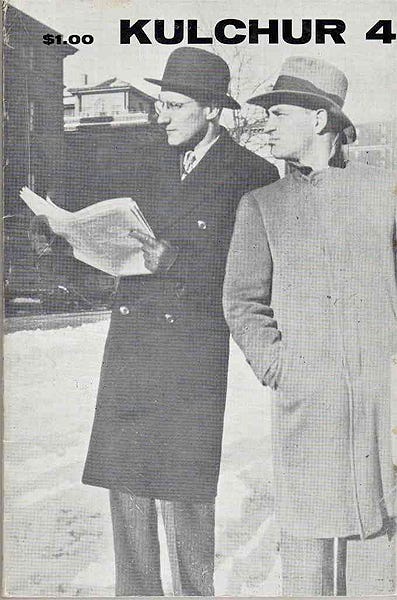
Harris suggests that Burroughs is dressed as one half of the pair of hitmen that appear in Hemingway’s 1927 short story, “The Killers” (with Kerouac as the other half but from the 1946 film noir adaptation). He goes on to say that in 1955 Burroughs further borrowed from and played with the story in “Hauser and O’Brien” and notes that in later years he quoted from the movie version accurately but either refused to name the film or pretended the lines came from different films. This is one of the tricky aspects of pinning down Burroughs’ literary references—he would quote from one work without attribution but then mention another. As we have seen, he mostly acknowledged the genius of “The Snows of Kilimanjaro” but he may have taken more direct influence from other works. Harris notes this use of “red herrings” and cites Burroughs’ deliberate attempts to compare his work to Chandler and Spillane when in fact those works owed more to Hemingway.
Interestingly, Kerouac saw similarities between Burroughs and Hemingway and he mentioned this in his interview with the Paris Review. He said of Junky, “It’s a classic. It’s better than Hemingway—it’s just like Hemingway but even a little better too.”[xxxiv] However, when he went on to quote from that novel, he in fact quoted from Burroughs’ part of their collaboration, And the Hippos Were Boiled in Their Tanks. To be fair, both books could be said to have a little of Hemingway in them.
In 1973, Burroughs made the strange remark: “Homosexuality is an illusion and so is heterosexuality. So maybe I fall in love with Papa Hemingway. Super male writer goes gay at 60?”[xxxv] Naturally, on the subject of Hemingway and homosexuality, it was Allen Ginsberg who went further…
Allen Ginsberg
Whilst it is not hugely surprising that Kerouac and Burroughs had some affinity for Hemingway, it is harder to see what Ginsberg saw in the man who was perhaps his exact opposite in temperament and style. However, he had reverence for most literary greats and read very widely, which meant that he got around to reading Hemingway and saw at least some value in his work.
It is unclear when Ginsberg first read Hemingway but he read Green Hills of Africa around 1947. In the 1950s, when he travelled to Paris, he thought often of Hemingway and the American expatriate Lost Generation writers of the 1920s. In fact, he even felt that it might be too egotistical to go to Paris and write because of Hemingway’s legacy.[xxxvi] He sometimes looked back in later years and connected Hemingway with Paris.
Ginsberg is quoted in Desolation Angels as telling Kerouac “Big Faulkners and Hemingways will grow thoughtful thinking of you,”[xxxvii] and around that time he wrote to his father to compare Kerouac and Hemingway, albeit for trying the opposite in prose:
Hemingway tried simplification & reduction (and was attacked for being too inhumanly stripped down)—Jack trying (as Proust & Celine) to include all the little private thoughts you normally wouldn’t mention—so he arrives at a complicated sentence structure.”[xxxviii]
Ginsberg continued to read Hemingway in the 1960s, sometimes dreaming about him, and when he was in Havana (in 1965) he visited Hemingway’s house, which was by then a tourist attraction. He later spoke with Ezra Pound about Hemingway. He connected Hemingway with William Carlos Williams in terms of presenting American speech in literary form:
In a rough way, this problem of natural-speech mind occupied everybody interesting in America in one way or another, once you begin thinking about it. Hemingway was also involved with the same problem.[xxxix]
He made this connection a number of times, but for the most part was unimpressed by “the Hemingway macho scene,” arguing in favour of “tenderness as the basis of genital or non-genital emotion” in a more Whitman-inspired approach to art and life.[xl]
In his poetry, he occasionally mentioned Hemingway and death, calling it “Hemingway’s preoccupation” in “I Have Increased Power” (1951) and saying that he “had to” kill himself in “Angkor Wat” (1963). He said that “Ernest Hemingway shotgunned his brain” in “Fighting Phantoms Fighting Phantoms” (1983).
It was in 1966 that Ginsberg seems to have given his most expansive commentary on Hemingway. He told William D. Knief of the Cottonwood Review:
Well, Hemingway was a nice guy, but he should have been sucking cocks for a while to get rid of the excessive necessity of being a man… because he had too formal an identity with being a masculine animal. And that’s not worthy of our species. […] Hemingway was a very, very great technician, and a good head and a real sharp mind, and basically a very sympathetic person. Especially toward his death. Especially in his prose of his last years he is much underestimated, I think. But Hemingway did have this problem of being too proud, with capitals PROUD—like too proud!—a desperate man. He had a nice beard.[xli]
That is certainly a classic response from Ginsberg. Now let’s look at a few other Beat and Beat-related writers…
Others
Lawrence Ferlinghetti read Hemingway in the late 1930s[xlii] and referred to him in a number of poems, although mostly as an example of the failed macho myth of America. He once connected Kerouac, Hemingway, Brautigan, and Lowry in an interview, saying they were all destroyed by success.[xliii]
Diane di Prima referred to him in an unpublished novel.[xliv]
Harold Norse once said, “I have always liked George Gershwin more than Ernest Hemingway.”[xlv]
Lew Welch, who loved guns and ultimately took his own life, was critical of Hemingway’s hunting, saying that he “never hunted as an Eskimo does, for the work of it, the providing, & naturally he never hunted with the same depth & skill.”[xlvi]
I have found no real connection with Gregory Corso but in 1961 Burroughs said to him, “I feel like I’m on a sinking ship and I want off,” and Corso replied, “Do you think Hemingway got off?” to which Burroughs said, “Probably not.”[xlvii]
Richard Brautigan was no Beat writer but is perhaps of interest to Beatdom’s readers, and he was obsessed with Hemingway as a young man. Hemingway is mentioned dozens of times in the excellent Jubilee Hitchhiker and in an essay that Michael McClure wrote about him, he noted the influence. In 1955, an important year in Beat history, Brautigan wrote a Hemingway-inspired short story and then had a Black woman character interrupt a typical Hemingwayesque dialogue with the line, “Don’t start talking like somebody from Hemingway Land.”[xlviii]
Hunter S. Thompson, who was also not a Beat writer (but a friend and admirer (at times) of the Beats), borrowed much from Hemingway. He even used The Sun Also Rises as a template for The Rum Diary, which you can read about here. You can read more about Thompson’s literary influences here, and there is an essay on HST and the Beats here and one specifically about him and Ginsberg here.
Feel free to add any other Hemingway-Beat connections in the comments.
Beatdom is a reader-supported publication. To receive new posts and support our work, consider becoming a free or paid subscriber.
Footnotes
[1] An amusing sidenote: Hemingway was extremely impressed by Meyerson’s interview and believed he would become an excellent journalist. However, Meyerson’s professor thought it was terrible and gave the student a poor grade. Still, Meyerson easily sold the piece and it became an important historical document.
[2] Gilbert Millstein wrote: “Just as, more than any other novel of the Twenties, “The Sun Also Rises” came to be regarded as the testament of the “Lost Generation,” so it seems certain that “On the Road” will come to be known as that of the “Beat Generation.” There is, otherwise, no similarity between the two technically and philosophically, Hemingway and Kerouac are, at the very least, a depression and a world war apart.”
[3] Stein—who was also a part of the Parisian Lost Generation scene—was a major influence on Philip Whalen and Lew Welch.
Endnotes
[i] Honolulu Star-Advertiser, May 04, 1959, p.C6
[ii] Nicosia, Gerald, Memory Babe: A Critical Biography of Jack Kerouac (University of California Press: 1994) p.62-63
[iii] Memory Babe, p.68
[iv] Maher, Paul, I Am The Revolutionary: Young Jack Kerouac (2017) p.74
[v] Johnson, Joyce, The Voice is All: The Lonely Victory of Jack Kerouac (Viking: 2012) p.83
[vi] I Am The Revolutionary, p.158
[vii] Charters, Ann (ed.), Selected Letters: 1940-1956 (Penguin, 1996) p.72
[viii] Memory Babe, p.112
[ix] Brinkley, Douglas (ed.) The journals of Jack Kerouac 1947-1954 (Viking, 2004) p.273 Note that Kerouac later added “I’ll never say anything like that again!” beside this sentence. I am not entirely sure what he means by this addition.
[x] I Am The Revolutionary, p.345
[xi] Memory Babe, p.327
[xii] Montgomery, John, Kerouac at the “Wild Boar” & Other Skirmishes (Fels & Firn Press, 1986), p.12
[xiii] Selected Letters, p.542
[xiv] Loewentheil, Jacob, Running Through Heaven: Visions of Jack Kerouac (Grolier Club, 2026) p.229
[xv] Running Through Heaven, p.148
[xvi] Plimpton, George (ed.), Beat Writers at Work: The Paris Review (The Modern Library: 1999) p.117
[xvii] Kerouac, Jack, Desolation Angels (Penguin, 2012) p.347
[xviii] Charters, Ann (ed.) The Portable Jack Kerouac (Viking, 1995) p.489
[xix] Memory Babe, p.407
[xx] Kerouac, Jack, Some of the Dharma (Penguin, 1999) p.397
[xxi] Burroughs, William S., The Adding Machine: Selected Essays (Seaver Books: 1986) p.40
[xxii] Adding Machine, p.67
[xxiii] Adding Machine, p.67
[xxiv] Adding Machine, p.69
[xxv] Adding Machine, p.39
[xxvi] Morgan, Bill (ed.) Rub Out the Words: The Letters of William S. Burroughs 1959-1975 (Ecco: 2012) p.343
[xxvii] Adding Machine, p.39
[xxviii] Bockris, Victor, The Burroughs-Warhol Connection (Beatdom Books, 2025) p.96
[xxix] Bockris, With William Burroughs: A Report From The Bunker (Seaver, 1981) p.193-194
[xxx] Adding Machine, p.49
[xxxi] Hibbard, Allen, Conversations with William Burroughs (University Press of Mississippi, 1999) p.83
[xxxii] Harris, Oliver (ed.) The letters of William S. Burroughs: 1945-1959 (Penguin, 1993) p.265
[xxxiii] Harris, Oliver, One Shot: A Beat Generation Mystery, (Moloko Print, 2024), p.178
[xxxiv] Beat Writers at Work, p.109
[xxxv] Rub Out the Words, p.401
[xxxvi] Morgan, Bill and Stanford, David (eds.) Jack Kerouac and Allen Ginsberg: The Letters (Viking, 2010) p.155
[xxxvii] Desolation Angels, p.260
[xxxviii] Schumacher, Michael, Family Business: Selected Letters Between a Father and Son: Allen and Louis Ginsberg (Bloomsbury, 2002) p.106 (There are other references in this book during Allen’s time in Paris.)
[xxxix] Carter, David, Spontaneous Mind: Selected Interviews 1958-1996 (HarperCollins, 2001) p.116
[xl] Leyland, Winston, Gay Sunshine Interviews (Gay Sunshine Press, 1978) p.106
[xli] Calonne, David Stephen, Conversations with Allen Ginsberg (University Press of Mississippi, 2019) p.19
[xlii] Smith, Larry R., Ferlinghetti: Poet-at-Large (Southern Illinois University Press, 1983) p.13
[xliii] The Cool Eye: Lawrence Ferlinghetti talks to Alexis Lykiard (Stride, 1993) p.30
[xliv] Calonne, David Stephen, Visionary Poetics and the Hidden Religions (Bloomsbury, 2019) p.206
[xlv] Ciuraru, Carmela (ed.), Beat Poets (Everyman’s Library, 2002) p.158
[xlvi] Philips, Rod, Lew Welch (Boise State University, 2006) p.31
[xlvii] Conversations with William S. Burroughs, p.2
[xlviii] Hjortsberg, William, Jubilee Hitchhiker: The Life and Times of Richard Brautigan (Counterpoint, 2012), p.62
Comments
Nothing yet. Say the first thing.
Sign in to join the conversation.