
When researching my book on the 6 Gallery reading of 1955, I kept coming across references to peyote. Of course, I knew that most of the Beat writers had tried it but I hadn’t realised until then just how much it affected them and influenced their writing, particularly during that pivotal period in their lives, the mid-fifties, when they were writing, performing, and publishing their most impactful work. Particularly in 1955, just before and then during the time they came to know one another and collaborate on poems and poetry readings, a great many of the key Beat writers tried or were reintroduced to this hallucinogenic substance, and for the most part they were extremely enthusiastic about its effects. I made a note to return to the subject and put together an essay on their experiences.
The following essay will be divided into sections arranged in a mostly chronological order but divided by Beat writers. It will not be totally chronological due to a desire for some clarity, as there is a degree of overlap between these various characters, particularly in 1952 and 1955, when they tried it in different locations.
Note: This essay was a little harder than usual to research, at least in terms of specific dates. Most popular biographies and histories are either vague or give contradictory dates, sometimes conflating multiple events. I went back into the letters and journals as much as possible but I could well have made some mistakes here, so please feel free to correct me in the comments if you see any errors.
Beatdom is a reader-supported publication. To receive new posts and support our work, consider becoming a free or paid subscriber.
“I was the first one” – Philip Lamantia’s “peyotl cult”
Unlike LSD, which was synthesised in a laboratory, peyote is a naturally occurring substance. Known as Lophophora williamsii, it comes from northern Mexico and has been used for thousands of years by the region’s indigenous population. The Spanish colonisers attempted to suppress its usage but it continued to some extent and underwent something of a revival in the late 19th century. It was around this time that Europeans began experimenting with it and documenting their experiences. Still, it remained a relatively unknown substance outside of Native American groups and botany circles until the 1950s.
Of the Beat and Beat-related writers, it was probably Philip Lamantia who first tried it, though that depends on what exactly we mean by “Beat-related.” Lamantia seems to have learned of peyote through Antonin Artaud’s Voyage to the Land of the Tarahumara, published in 1945.[1] He said this when asked in 2000, and he was also very confident in the dates he gave, though as always we should be cautious taking such details at face value. However, with Lamantia it can be hard to find more reliable sources of information, for he did not chronicle his life as extensively as his Beat peers and consequently archival documents and contemporary accounts are hard to come by. In any case, a half century after the fact, he said that he had read Artaud’s book “by 1949,”[i] and that is certainly probable.
There are various accounts—all speculative—about where and when Lamantia first tried peyote but in a 2000 interview with John Suiter he said it was in the autumn of 1950 at the Washoe Reservation, near Lake Tahoe. He took it during a ritual, which he described in great detail. He travelled to Mexico that year, leading to the idea that he tried it there but the Washoe land is in the United States, so if his memory is indeed correct, then he tried it north of the border. In any case, Lamantia told Suiter he “was the first one” to try peyote, adding that some of his “friends who weren’t into the literary scene” also did it.[ii]
By 1951, he was ordering dried peyote buttons in the mail whilst living in California, and he had a group of friends in the Bay Area with whom he regularly took peyote. Most accounts suggest that he turned these people on to it. He said in 2000, “there was a little group of people, we’d been taking peyote weekly for several months, and we had a sort of little Berkeley peyotl cult of our own.”[iii]
Lamantia was fascinated by indigenous cultures and lived at the Berkeley home of anthropologist Jaime de Angulo’s widow, Kathleen Freeman, where he read various books that had been owned by de Angulo. These included Carl Lumholtz’s Unknown Mexico (1902), which he found in the basement. It described the peyote rituals of several indigenous groups. In the coming years, Lamantia would travel to Mexico to take peyote there in what he felt was the appropriate setting. Unlike other bohemian psychonauts, he was more interested in the rituals and ceremonies than the substances themselves, and he would attempt (not always successfully) to participate in these events during his trips to Mexico.
“Old peotl cactus grooking in the desert to eat our hearts alive” – Kerouac, Cassady, and Burroughs
Kerouac was never hugely enamoured of hallucinogens but he was among the first of the Beat writers to try peyote. He tried it in February 1952,[2] at the Cassady home in San Jose. Caroyln later said:
One night two or three friends came over with a new kick. Neal was all excited and the atmosphere took on an expectant and awesome feel. They had brought peyote, which Neal and Jack had never had before. Explicit directions were given and followed; all theories and reported results reviewed. Neal watched, leaning on the table with eyes aglow, as the friend carefully chopped up the lobes of cactus as finely as its toughness would allow.[iv]
It is not clear who these people were, but they were quite possibly part of Lamantia’s “Berkeley peyotl cult.”[3] Carolyn, who declined to participate, continued:
Each participant ceremoniously chewed a tablespoon or two full of the gray-green mound and either sat on the couch to await results or ascended to the attic. I watched and waited. All was quiet. Extremely. I couldn’t tell when they ceased struggling with the rising nausea and became deep in their dreams. Since dim lighting appeared to be part of the ritual, I went to bed to read, still remaining alert to any signs of distress. No emergency arose, and no one cared to communicate their sensations that night, so I gave up and went to sleep.
Even the next day, my efforts at drawing out some descriptions of their wondrous experience were mostly futile. Neither Jack nor Neal could remember anything particularly startling or revelatory. It may just have been they couldn’t find words to match, unlikely in Jack’s case, but it seemed the deepest impression remaining with them was the nausea. Neal’s stomach was so sensitive anyway, he had lost his first dose and made himself repeat the ordeal. I doubt he was as enthusiastic on the second try. Nevertheless, they kept some peyote in the refrigerator and wrote to Allen in glowing terms, so he requested a sample for himself. The rest of the stash was finally dispersed when we awoke one morning to find ourselves criminals— possession of peyote had been declared a felony.[4] I think they were secretly pleased with the excuse to get rid of the stuff; after all, the illegality of marijuana had all never worried them.[v]
Kerouac indeed wrote to Ginsberg about having taken peyote, which caused some jealousy, for Ginsberg was eager to try it. However, these letters seem to have been lost. What does survive is a later letter to John Clellon Holmes, in which Kerouac says, “I been learning ever since the wild visions of musical pure truth I got on peotl (talk about your technicolor visions!).”[vi] Gerald Nicosia, in Memory Babe, says that Kerouac “had a powerful revelation of how it felt to die,”[vii] which might explain Carolyn’s impression that they were “secretly pleased” to not take it again, but in fact Kerouac did take it a second time just a few months later.
The second time Kerouac took peyote was with Lamantia at Freeman’s house, which he said was a “stone small castle overlooking Berkeley Calif.”[viii] He went with Neal and they found Lamantia reading the Tibetan Book of the Dead[5] and speaking in his typically mystical language. This was either the end of April or the beginning of May 1952. Kerouac wrote about a week later that there were a few people present who reminded him of old friends (Burroughs and Lucien Carr) and that he took peyote, but he says little about the experience. Instead, he mentions Cassady being upset about something (which seems to have been an opposition to Lamantia’s mystical language but could equally be related to the sensitive stomach Carolyn mentioned above) and the two friends had their first fight. Kerouac wanted to go back and take peyote with Lamantia a second time and Neal refused to drive him.
Lamantia later claimed that it was Kerouac’s first time trying peyote but he said this 50 years later, and his memory was not accurate. (He was also adamant that it was 1951, not 1952.) He says that Kerouac fell asleep, something Nicosia agrees with, saying that Kerouac was asleep for 12 hours.[ix]
Just a week or so later, Kerouac headed south and crossed into Mexico. On the bus from the border, he befriended some Mexican people, including a man called Enrique, with whom he drank mescal and smoked pot and discussed peyote.[6] Then, in Mexican City he took peyote two more times before swearing off it due to it being “definitely toxic on the eyes and stomach.”[x]
This brings us to Burroughs, who it is surprising to learn had not tried peyote before. Normally, Burroughs was in the position of experienced elder, telling his younger friends about mind-altering substances and helping them fix, but whilst he certainly knew a lot about peyote, he had not tried it until the middle of 1952. Ginsberg informed him earlier in the year of having taken it and Burroughs responded, “Get with those technicolor peyote kicks Daddy O and shoot me that solid address.”[xi] This refers to a place in Laredo, Texas, that sold exotic plants, including the peyote cactus. It is a bit ironic that Burroughs wrote from Mexico, where the cactus naturally grew, and Ginsberg was in New York and New Jersey, where it most certainly did not.
Ginsberg reported his experiences with the drug and his visions (an on-going obsession), to which Burroughs replied in June:
Madness is confusion of levels of fact. A peyote hallucination is a fact, but it is not on the same fact-level as an external material object. Madness is not seeing visions but confusing levels.[xii]
Later in that same letter, Burroughs reported having finally taken peyote:
By the way tried peyote. Interesting. Everything looks like a peyote when you are high on this God awful stuff. I have never been so painfully sick. That peyote came up solid out of my stomach like a ball of hair. I thought I would not get it out. I suffered excruciating spasms of the asposegus or whatever you call it, and it took me 10 minutes to get that peyote out of my stomach, and clogged my throat all the way up like I was a tube of tooth paste. I hope Yage doesn’t turn out to be one of these nausea kicks.[xiii]
Some phrases from this excerpt are used verbatim in Junky although Burroughs does not mention taking it with Kerouac in that novel, instead saying he (or rather his narrator) was with a group of visiting American hipsters. A few of these phrases are also repeated in Queer and are slightly altered and reused in “Letter from a Master Addict to Dangerous Drugs” (1956).
Although he does not mention him in the letter or his fictionalised account, Burroughs was with Kerouac and they took it together, as we can see from several of Kerouac’s letters. These show that this happened at some point between May 10 and June 3, but it’s hard to be more precise than that. It is also unclear how many other times Burroughs tried it. A Kerouac letter suggests they did it twice. Burroughs once claimed, “I have taken Peyote with Indians in Mexico”[xiv] and another statement (“Peyote made me terribly sick, so sick I couldn’t get any enjoyment out of it.”[xv]) implies having taken it once, though it’s impossible to say for sure. His remarks in The Yage Letters hint at more experience than just the one dose but again it is not clear.
In a letter to John Clellon Holmes, Kerouac gave more detail about Burroughs’ first peyote trip (and arguably a second, as there is a reference to “peotl highs again,” but possibly it was only Kerouac who took it this second time). It is given a title: “PEOTL EATERS OF THE HIP GENERATION.” (This pre-dates Holmes’ “This is the Beat Generation” article by five months.) He says they got the peyote from some young American hipsters. It was fresh and they mashed it in a dish. As they braced against the nausea, Bill said:
Ah, I feel awful, I feel worse than if I was suddenly a prisoner in the High Andes, a penalist in a town like Quito up on the High Andes all dark and windy and cloudy all day with incredibly dirty old Indian women sitting by a wall huddled in their robes against the cold wind […][xvi]
The quote goes on and on, with Burroughs apparently talking to stop himself from vomiting, and then they walk in a park, which Kerouac refers to as “grooking in the desert.”[xvii] Kerouac writes of “the houses all flashing, flashing in my eyeballs not in technicolor riot but in a great flapping of light that clapped over my eyes in intervals.”[xviii]
Interestingly, Burroughs was knowledgeable about peyote before having taken it. John Hoffman, Philip Lamantia’s closest friend, had died on January 20, 1952, and the rumour amongst hipsters was that he’d had a peyote overdose.[7] On March 20, Burroughs wrote Ginsberg to say, “By the way, Peyote poisoning presents symptoms similar to polio.”[xix] He is almost certainly correct, from what few details can be gathered. Burroughs had read about peyote some years earlier in an essay on yagé, which is where he first learned about the substance that would become an obsession for him. You can learn about that (and see scans of the essay) here:
Given that Lamantia and Hoffman were so close and that they often took drugs together, it is natural to assume that they did peyote. Garret Caples writes in Retrievals, “I don’t recall specifically whether [Lamantia and Hoffman] ate peyote together, though this seems probable as Philip began experimenting with it circa 1950.”[xx] It is indeed possible, though it is also possible to read into an account given by Karen Forrest, Hoffman’s girlfriend, a few pages later in that book and get the impression that Hoffman first tried peyote in Mexico not long before his death in early 1952. He was not with Lamantia at this point.
According to Forrest, she was informed of Hoffman’s death by Betty Keck, who we shall see in the next section helped turn Allen Ginsberg on to peyote back on the East Coast.
“Subterranean peyotelites” – Ginsberg and the Kecks
Whatever Kerouac’s impression of peyote, Carolyn Cassady was right about him writing enthusiastically to Ginsberg, who immediately began to pester his friend for a dose of this mystical succulent. For years, he had been eagerly experimenting with mind-altering substances and recording their effects. Through his hip friends, he presumably already knew of peyote but now that Kerouac had tried it, there was hope of finding some. However, it turns out he did not need Kerouac’s help. He got hold of some peyote buttons thanks to Bill and Betty Keck.
Like Lamantia, the Kecks were bicoastal bohemians who moved between San Francisco and New York. They appear in accounts of both the North Beach and Greenwich Village hipster scenes, and in 1952 they were part of the San Remo “subterranean” scene. It is not clear how well they knew Lamantia but the latter called Bill “the first hipster I ever met” and also “the original ‘link’.”[xxi] By “link,” Lamantia probably meant connection between East and West Coast hipster scenes. There is no evidence that Lamantia and the Kecks took peyote together or even discussed it (though it is highly likely), but it was Bill Keck who gave Allen Ginsberg his first dose.
In February, when Ginsberg was bugging Kerouac to send peyote across the country, he noted that Bill Keck was “the N.Y. peyotl connection.”[xxii] On April 17, he broke the key to his apartment and “went around looking for place to stay, wound up at Bill Keck’s.”[xxiii] The two men got into a discussion about peyote and marijuana, and then Bill gave him some:
He gave me, without my realizing it was sitting there beside us on the improvised table of a solid block of wood or box-three cones or buds of peyote: I was shocked and awed by their appearance-lifelike and large-cones or vortexes consisting of a seemingly alive vegetable.[xxiv]
Despite his eagerness to sample it, he kept it in his briefcase for two days before taking it at 8:30 one morning. The effects were not astounding because he took a relatively small dose, but they lasted for a whole day. He was at his father’s house in New Jersey and had a family dinner in the evening, during which he was still under the influence. He wrote the next day:
I took the peyote, but got no technicolor[8] visions. Will try larger dose, though had three plants. Got an all day kick like combo benny-tea. Painted picture and wrote thoughts.[xxv]
He wrote quite a lot about his sensations, including being repulsed by the smell of ink on his hands, but the experience was not nearly as intense as he had expected. He made notes about music but seemed oddly fixated on rocks. One interesting remark in a journal was: “We’re flowers to rocks.”[xxvi] He felt that he was not fully aware of the present but perhaps stuck five minutes behind himself, lost in thoughts, but decided “Peyote is certainly one of the world’s great drugs.”[xxvii]
After it had worn off, he felt relieved that he had avoided the potential horrors:
Also glad I sailed thru this Peyote test without any of the mental imaginables—the horrors of accidents, I didn’t cut my thumb or bite anyone or tip my mit.[xxviii]
However, when sampling it again about two months later, he did have a small injury. Walking around with Bill Keck, he bruised his foot.[xxix]
We can see that Keck not only turned Ginsberg on to peyote but continued taking it with him. Through Keck, Ginsberg also found a supplier that would allow him to purchase it via the mail: the Exotic Plant Company of Laredo, Texas.[9] A few people on the West Coast also seem to have been ordering it from this source.
He took it again between April and June (when he hurt his foot). In early May, he wrote in his journal:
How like Jekyll/ Hyde my notes on peyote are:
10:02—Drank potion
10:04—Feel faint
10:30—Hair is growing on my palms, etc.[xxx]
He took peyote a number of times throughout 1952, sometimes alone and sometimes in the company of other “subterranean peyotelites.”[xxxi] He mentioned it in journals and letters but it does not seem to have entered his poetry at this point. (He had, however, referenced it in “Paterson,” three years before actually trying it.)
Ginsberg switched coasts and began living in San Francisco in 1954, and here he tried peyote again. In early November, he did it with his girlfriend Sheila Williams, with the peyote this time being supplied by Jordan Belson (a filmmaker and friend of Harry Smith). Ginsberg, Williams, and Al Sublette “got hi”[xxxii] and walked around San Francisco. Back in his apartment, he wrote:
looked out my living room vast window down into the bldgs.—especially the Sir Francis Drake hotel—which has a Golgotha-robot—eternal— smoking machine crowned visage made up of the two great glass-brick eyes on either side (the toilets men and women of the Starlight Room)—upstarting out of the paved mist ground—I wrote on it.”[xxxiii]
This was the first of two peyote-fuelled observations he had of the Francis Drake Hotel. The second came about two weeks after he began writing “Howl,” in August 1955. It seems like an extraordinary coincidence that he bumped into Betty Keck, in whose house—some 3,000 miles east—he had first been given peyote:
We wandered on peyote all downtown, P&I [Peter and I], met Betty Keck and saw Moloch Molochsmoking building in red glare downtown St. Francis Hotel, with robot upstairs eyes and skullface, in smoke, again. And I saw in me and he a void under the knowledged, of each other.[xxxiv]
This second vision inspired him to go home and write Part II of “Howl,” the “Moloch” section. He later recalled:
I had an apartment on Nob Hill, got high on peyote, and saw an image of the robot skullface of Moloch in the upper stories of a big hotel glaring into my window; got high weeks later again, the visage was still there in red smoky downtown metropolis, I wandered down Powell street muttering, “Moloch Moloch” all night and wrote Howl II nearly intact in cafeteria at foot of Drake Hotel, deep in the hellish vale.[xxxv]
Ginsberg’s memory is a little off here. He lived at the Nob Hill apartment in late 1954 and wrote “Howl” almost a year later in another part of the city, so it was not “weeks later” but rather nine months. Also, he says that he “wrote “Howl II nearly intact” but the first draft was massively expanded and rewritten later. It changed hugely from the initial scribblings on the back of a draft of Part I, but it’s important to note that he was not only inspired by a peyote-induced vision but partly wrote it whilst high on peyote. He later recalled:
Part II of “Howl” was written under the influence of peyote, composed during peyote vision.[xxxvi]
He repeated this in a statement on drugs for the U.S. Senate, saying:
a central part of the poem called “Howl” was written while I was in a state of consciousness altered, or enlarged, if you will accept that, by peyote.[xxxvii]
Whilst Part II of “Howl” was written (or at least drafted) under the influence, it is Part I that actually refers to peyote. The 13th line is:
Peyote solidities of halls, backyard green tree cemetery dawns, wine drunkenness over the rooftops, storefront boroughs of teahead joyride neon blinking traffic light, sun and moon and tree vibrations in the roaring winter dusks of Brooklyn, ashcan rantings and kind king light of mind
Not only does this line explicitly refer to peyote but the phrase “tree vibrations” comes from his 1952 experience at his father’s house—the first dose of peyote he ever took. Peyote is mentioned again in “Footnote to Howl” and he explained later that the idea of angels appeared in American literature at this point “probably on account of peyote being circulated around then”[xxxviii] and cited his use of “indian angel.”[10]
In the coming years, Ginsberg took peyote again and talked about it often. He recommended it publicly, along with other substances that he felt helped expand consciousness and foster a peace-loving attitude. He complained about its illegality and recommended people look into traditional rituals. However, although he was one of the most outspoken public figures on the subject of peyote and other psychedelics, he did not take these substances nearly as often as people might think and in fact more or less abstained starting during their heyday in the mid-sixties. By 1962, he estimated that, including all the different types he had tried (peyote, yagé, LSD, mushrooms), he had only tripped around 30 times in 10 years.[xxxix] The following year, he expressed an interest in quitting altogether and by 1965 he said he was no longer doing such substances, although he continued to strongly recommend them to others and very occasionally partook. Even as of 1971, he still included it in a list of advice for young people: “Dropping acid or mushrooms or peyote or psylocibin in the company of wise men and of mother nature.”[xl]
Beatdom is a reader-supported publication. To receive new posts and support our work, consider becoming a free or paid subscriber.
“Peyote is pure magic”: Snyder, Whalen, and the 6 Gallery
Let’s go back to 1955 now, the year that the East Coast Beats mixed with West Coast poets to trigger the San Francisco Renaissance. Prior to the organising of the 6 Gallery reading, Gary Snyder and Philip Whalen had no connection to the Beat writers. They both came from the Pacific Northwest and had attended Reed College but were living partly in the Bay Area and spending their summers in the mountains.
On New Year’s Day, 1955, Snyder tried peyote for the first time. He was in San Francisco and wrote to Whalen to describe it:
An astonishing experience. Almost terrifying, one that takes you into an entire world which is left-handed, baroque, dripping with jewels, & where I for one, met Baudelaire, Rimbaud, Aleister Crowley... & a host of others, to whom the Peyote (almost a distinct personality) introduced me, as a sort of initiation. It is Jung’s Unconscious, with trimmings, history, etc. all scrambled in.[xli]
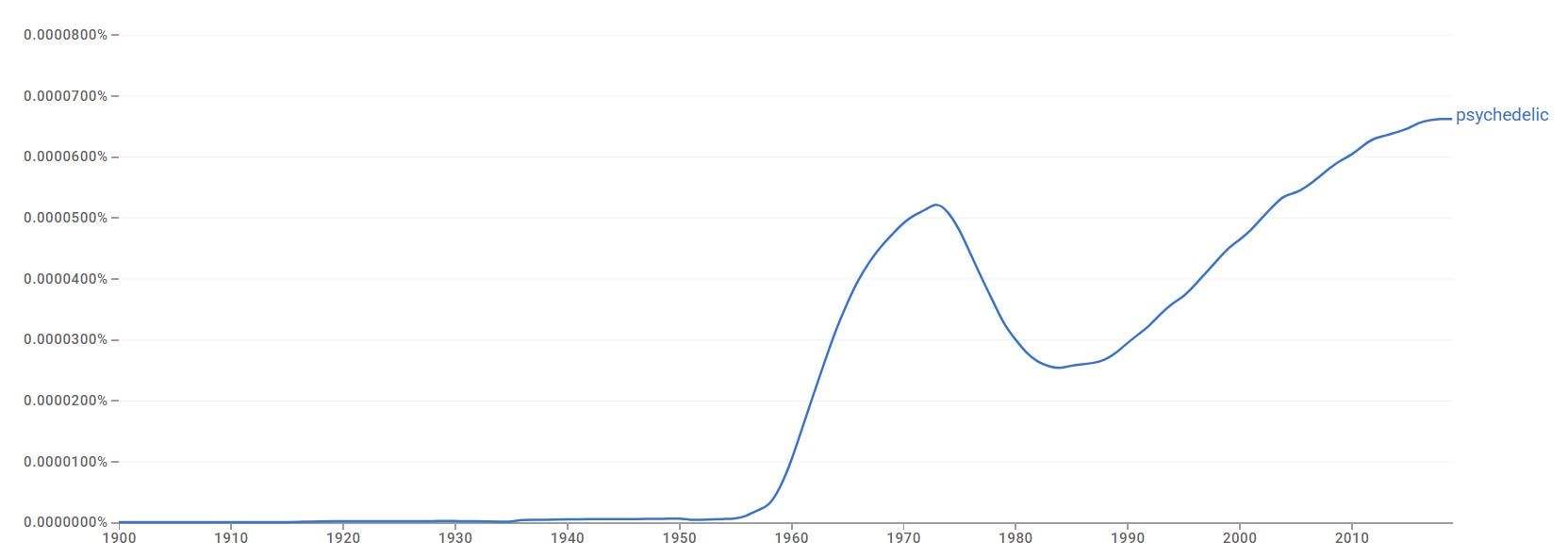
It is unclear where exactly he got it or who turned him on, though it seems to have been common on university campuses that year. (This was the year the word “psychedelic” was supposedly coined.) Snyder later noted that he had read the Oliver La Farge novel, Laughing Boy, which he believes is the first mainstream book to have depicted a peyote trip.[xlii]
He was quick to recommend it to his friend, Whalen, telling him: “Peyote is pure magic. But what it does for you, I’m convinced, depends, just like the Indians say, on how pure your heart is.”[xliii] Whalen tried it on April 22 with a group of friends. Nothing happened, so he went out for pizza and beer and then headed home, at which point the peyote hit him and he had a fantastic 12-hour trip. He wrote Snyder to say he felt “a lot better having tried it; discrimination sharpened, a few more insights.”[xliv] He had a second dose two months later which brought many effects, both positive and negative. He felt that the drug changed him not only when under its influence but in the months that followed:
When I am sober now I feel that I can sort out the realities and unrealities of this particular world more distinctly than I ever have before. I am more conscious of being conscious—that sounds literary, but take it literally—more aware that here I am with a lot to do. Best of all I find that I can work on things now & that I am working.[xlv]
David Schneider, in Crowded by Beauty: The Life and Zen of Poet Philip Whalen, writes that “In the spring of 1955, as they corresponded about peyote, Philip and Gary were absorbing what they could from these poetical lineages but at the same time trying to find ways to distinguish themselves from them.”[xlvi] Certainly, that seems to be what happened for Whalen, who later said “all my dopey theories and hangups and things about writing […] suddenly disappeared.”[xlvii] He told John Suiter many years later, “I felt I could write more lines, get more stuff into something instead of this imagist style of poetry that I’d been working at for some time.”[xlviii] He began writing different kinds of poems, and these were the ones he read at the 6 Gallery reading later that year. Snyder also took from his peyote visions images and ideas that would go into his poetry. A journal entry later in the year said that these found their way into Myths & Texts.
When Ginsberg first met Snyder on September 8, 1955, they talked about peyote. Snyder’s journals from this time show that he was still positive about the drug but noted that he was less enthusiastic than Aldous Huxley,[xlix] whose Doors of Perception had come out a year earlier and was very much in fashion among young bohemians. Ginsberg read it in April 1955 and was decidedly unimpressed.[l] Burroughs said to Ginsberg that the success of Huxley’s book might make possible their yagé project, which started to come together soon after that.[li]
Snyder felt that “Peyote has definite therapeutic value” but believed that it was not a magical solution that provided true wisdom. After moving to Japan in 1956, he said:
Take a good look at Indian philosophy sometime and see what a range of practices and ideas they experimented with, and the hells and heavens their saints have gone to in search of not only enlightenment, but all the interior landscapes that peyote and junk and wine and tea are but chinks in the door to.[lii]
This was in a letter to Ginsberg, who seemed to agree, for years later he explained:
By 1958 we had all concluded that drugs, peyote, psychedelics were interesting and were useful aids, but they weren’t supreme reality. They were maybe catalysts.[liii]
Snyder was also glad that he did not get too lost in the visions:
I’ll just say that I am grateful that I came to meet with peyote, psilocybin, LSD, and other hallucinogens in a respectful and modest frame of mind. I was suitably impressed by their powers, I was scared a few times, I learned a whole lot, and I quit when I was ahead.”[liv]
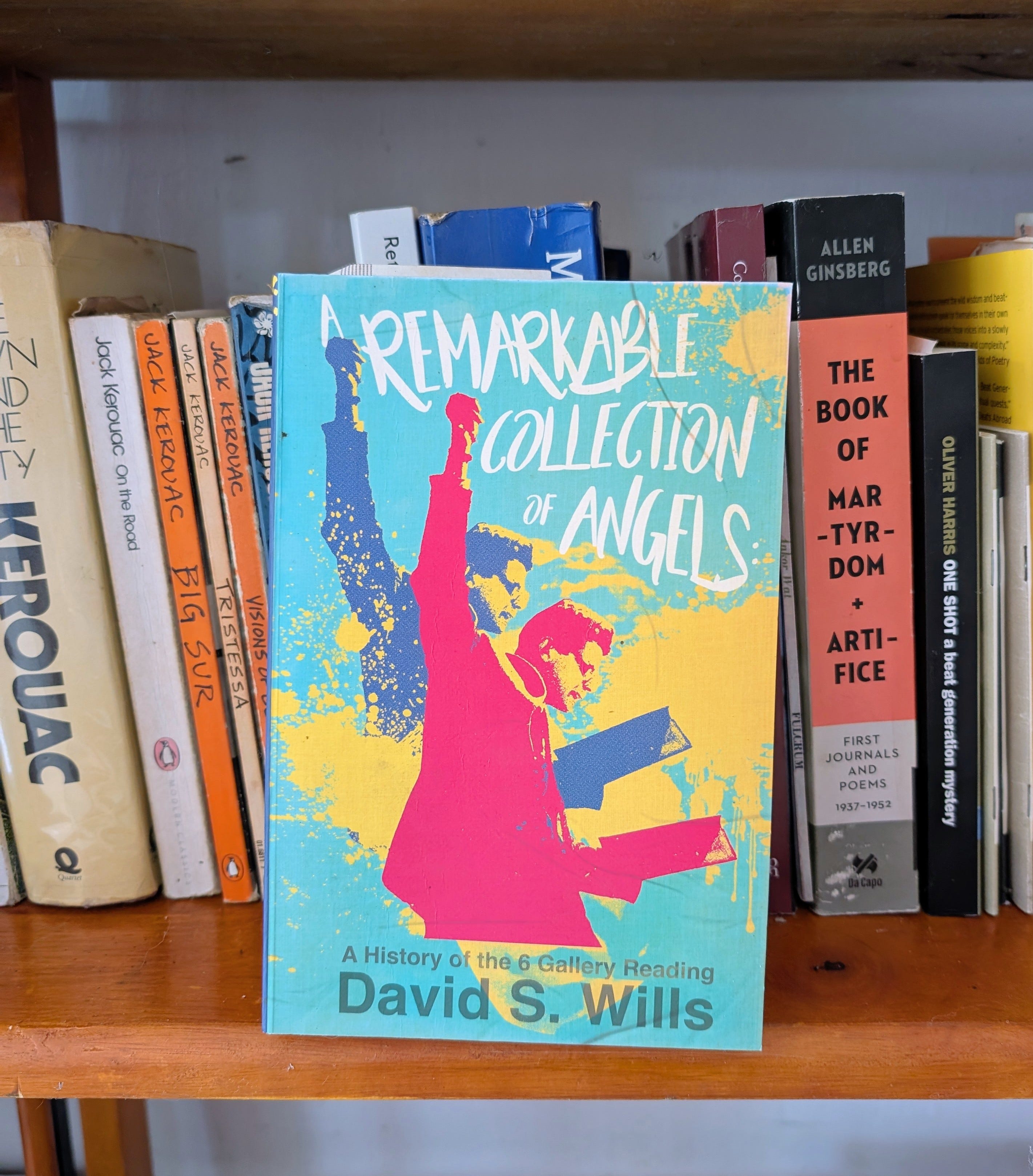
Given that Whalen’s 6 Gallery poems were all peyote-derived, and Snyder read from Myths & Texts, and Ginsberg performed “Howl” (including the peyote-infused Part II), then at least three of the five poets read from peyote-inspired work. Lamantia read from Hoffman’s unpublished poems, and both men were likewise inspired by peyote. A half-century later, Lamantia claimed that all the readers that night had a mutual interest in peyote, which is true… except that it was not true at the time. They had all taken it except for Michael McClure, the youngest of the five readers. Funnily enough, he could arguably be seen as the poet most associated with peyote but his introduction to it came a little later.
“Time ceases to exist” – McClure and the Post-6 Gallery Scene
In Lighting the Corners, McClure writes: “In 1957 artist Wallace Berman became my peyote father by giving me five buttons of peyote.”[lv] He is—as he so often was—probably wrong with the date,[11] but the essential fact is correct. It was most likely 1958 when Berman left the five peyote buttons at McClure’s home. Berman was a relatively recent arrival in San Francisco, having come up from Los Angeles, where he’d been involved in the arts scene.[12] Like Lamantia and others, he had been inspired by Artaud and possibly learned about peyote through his Tarahumaras book.
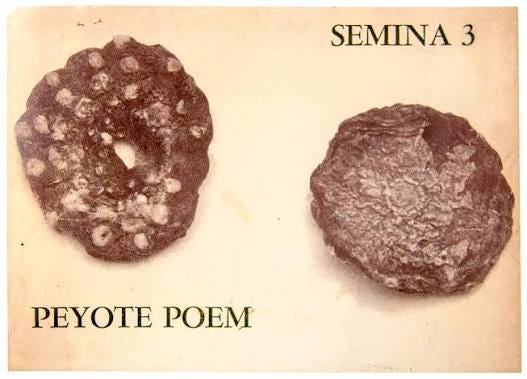
After taking peyote for the first time, McClure wrote “Peyote Poem.” He said later, “The day following my peyote high I was fortunate in having nearly perfect recall and wrote a long poem describing the vividness of the experience.”[lvi] Berman published it in Semina 3. In fact, it took up the whole of that issue of Semina. The front cover was a photo of peyote buttons shot by Berman and the interior was simply McClure’s poem. It contains the lines:
THIS IS THE POWERFUL KNOWLEDGE
We smile with it.
Interestingly, Francis Crick, who helped discover the structure of DNA, read this poem whilst in the Bay Area in 1959. He found a copy at City Lights[lvii] and quoted the above lines in a lecture. He was a fan of McClure’s poetry and felt that the poet did an excellent job of describing the experience clearly.
McClure was interested in both art and science and went on to write more about peyote, including at least one essay. This appeared in the City Lights volume, Meat Science Essays, in 1964. He read various scientific books in order to help him better understand what he experienced under the influence of peyote, which he felt took him “to lands of religiosity and physical matter”[lviii] and called it “a spirit experiment beyond conception.”[lix] He wrote in terms both (ostensibly) scientific and spiritual, saying that “Time ceases to exist.”[lx] However, McClure—perhaps wisely—understood that it was not something to do regularly. He noted that it was “non-addictive” but that the user was affected for days, weeks, or even months afterwards,[lxi] which is something Whalen had also recognised.
Like Whalen and others, McClure felt that it was not just a better sense of himself and of the universe that he gained from taking peyote, but also of poetry. Soon after taking it, he wrote to Charles Olson to say that he better understood the poet’s ideas:
I have taken Peyote now and your Human Universe is more true—which I would have thought to be impossible. I wish I hadn’t been so boxed in when you gave your lectures in San Francisco. With the peyote I came to realize—came to realize HAH, I KNEW, know, that we are absolute individual animals. […] Peyote puts you back within your own skin into the Human Universe. In your own personal, animal, individual universe. And you look out into the physical universe and see it as only the physical universe—all these emotional drags of unimportance are gone.[lxii]
By this time, San Francisco was undergoing something of a change, with harder drugs being used more. The playful, friendly artistic scene was becoming hardened, but peyote kept providing poets and painters with new insights and inspiration. The likes of Bruce Conner appeared and tried it, perhaps initiated by McClure.
Berman not only introduced McClure but also Bonnie and Ray Bremser. She mentions this briefly in For the Love of Ray.[lxiii] This could have been the same year that McClure took it (1958), which is also when Joanne Kyger tried peyote for the first time. She did so with Gary Snyder, who was briefly back from Japan. She wrote:
It was horrendous. It ripped the Christianity right off my back . . . this huge rush of animal energy, and I didn’t know how to relate myself to it. I finally saw this wild boar as my totem animal, and I followed it through India and into the Eleusinian mysteries.[lxiv]
She grew to appreciate it later, deciding that “Peyote has its own truth.”[lxv]
In 1959, Diane di Prima took it and “found other levels in my head. Later I wanted to get to the same places without the peyote.”[lxvi] Like many of the Beats previously mentioned, she said that it changed her writing, particularly that her work “broke open to long lines.”[lxvii]
Elise Cowen and Eileen Kaufman both tried peyote, and Lenore Kandel had a poem called “Peyote Walk.” See the collection Shaman Woman, Mainline Lady: Women’s Writings on the Drug Experience and Women of the Beat Generation for more details.
Lawrence Ferlinghetti mentions peyote in “Uxmal, Or the Flight to the Sun” (1969):
The sun itself rolls down on top of me, spinning. It is made of peyote and white hot sperm, jism of the universe. I am part of “Space Odyssey 2001” but I am also a bloodshot Indian prince seven feet tall. The white hot sperm falls in showers. The moon rises and drenches us in pulverized peyote....[lxviii]
Details about Bob Kaufman are hard to come by but he showed up in Mill Valley in mid-1956, when Kerouac was staying with Locke McCorkle, Robert Creeley, and Bob Donlin. He had peyote with him, which was prepared in milkshake form. The group drank their shakes and listened to an audio recording of a Native American peyote ritual.[lxix]
Harry Smith tried it and recorded a ritual, and later countercultural writers Ken Kesey and Hunter S. Thompson did it, with the latter even including a peyote button in his signature “Gonzo fist.”
Conclusion
As we have seen, peyote was widely used among the Beats, beatniks, hipsters, bohemians, and later hippies. It was not as frequently used as marijuana and was harder to come by than LSD, but it was something almost all of the countercultural figures of the era tried at least once. Although they primarily took it in their apartments or wandering in parks, they mostly acknowledged its religious and spiritual significance and had respect for the ancient traditions associated with it, and those who could made the effort to involve themselves in these rituals. Oddly, the experience tended to bring out the same observations and language. It was, for most, a social drug and something aimed at accessing new areas of consciousness, with most people coming to a greater understanding of the universe. Peyote even impacted their writing in some cases. Eventually, it became part of the idiotic mainstream stereotype of the unwashed know-nothing beatnik, as evidenced in this 1962 quote from Time:
They prefer to wear beards and blue jeans, avoid soap and water, live in dingy tenements or, weather permitting, take to the road as holy hoboes, pilgrims to nowhere. Most of them adore Negroes, junkies, jazzmen and Zen. The more extreme profess to smoke pot, eat peyote, sniff heroin, practice perversion.[lxx]
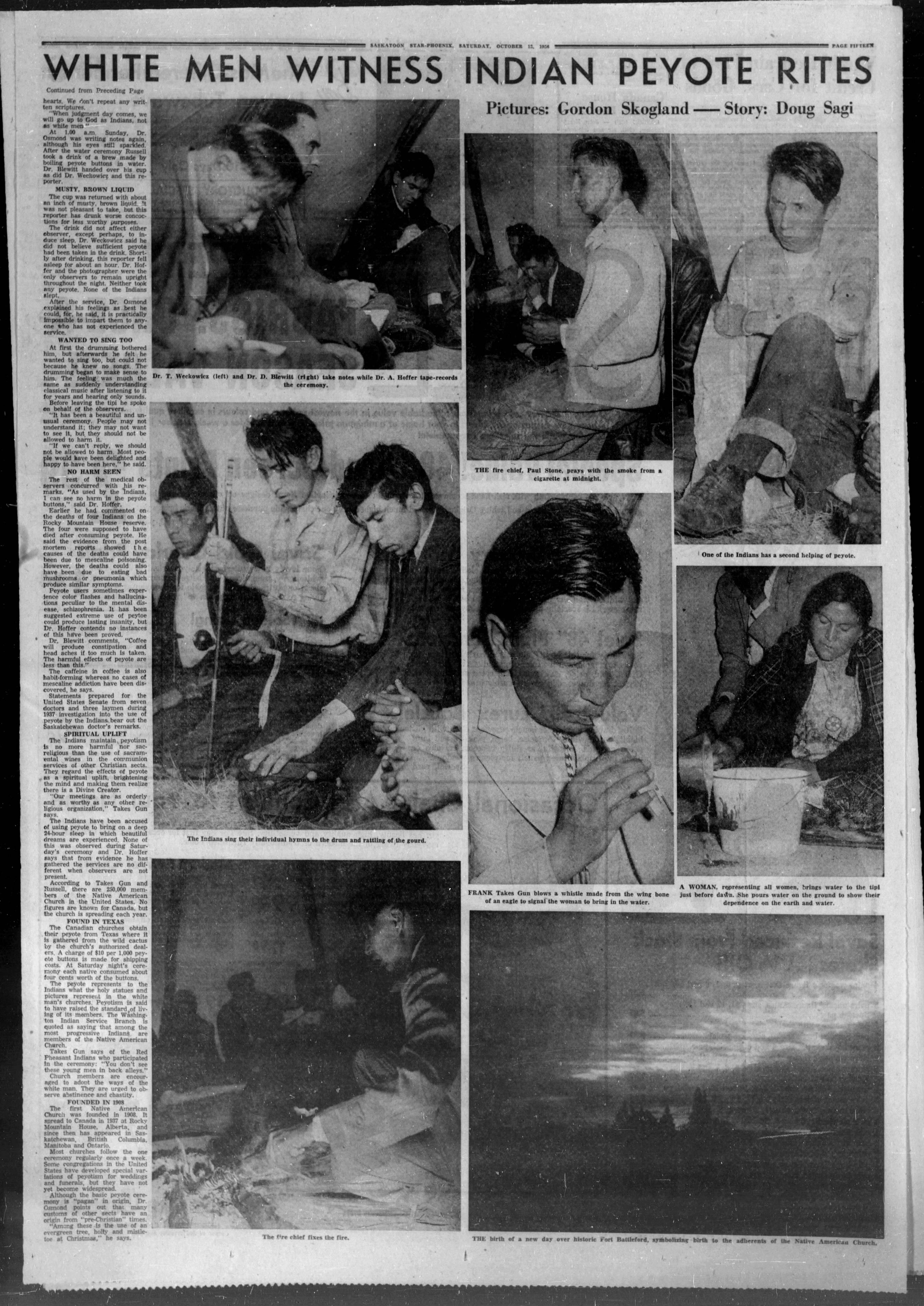
It is clear from this and other contemporary media coverage that popular perceptions of peyote were mired not only in regressive, conformist, close-minded sentiment but also racism. Peyote was not just a drug; it was used by indigenous peoples, who were viewed much the same as Black musicians and Asian monks by the sort of people writing for and reading Time magazine. At best, the mid-fifties media reported with patronising paternalism in headlines urging readers to save the poor Indians from what various newspapers called the “Devil’s Root.” Articles were absurdly inaccurate and grossly offensive. The headline here, for example, shows the extent to which “the white man” was a scientific observer of “the Indian’s” “primitive” rituals:
This one ties it to witchcraft, says it is a “root” rather than a cactus, and tenuously links it to a number of deaths:
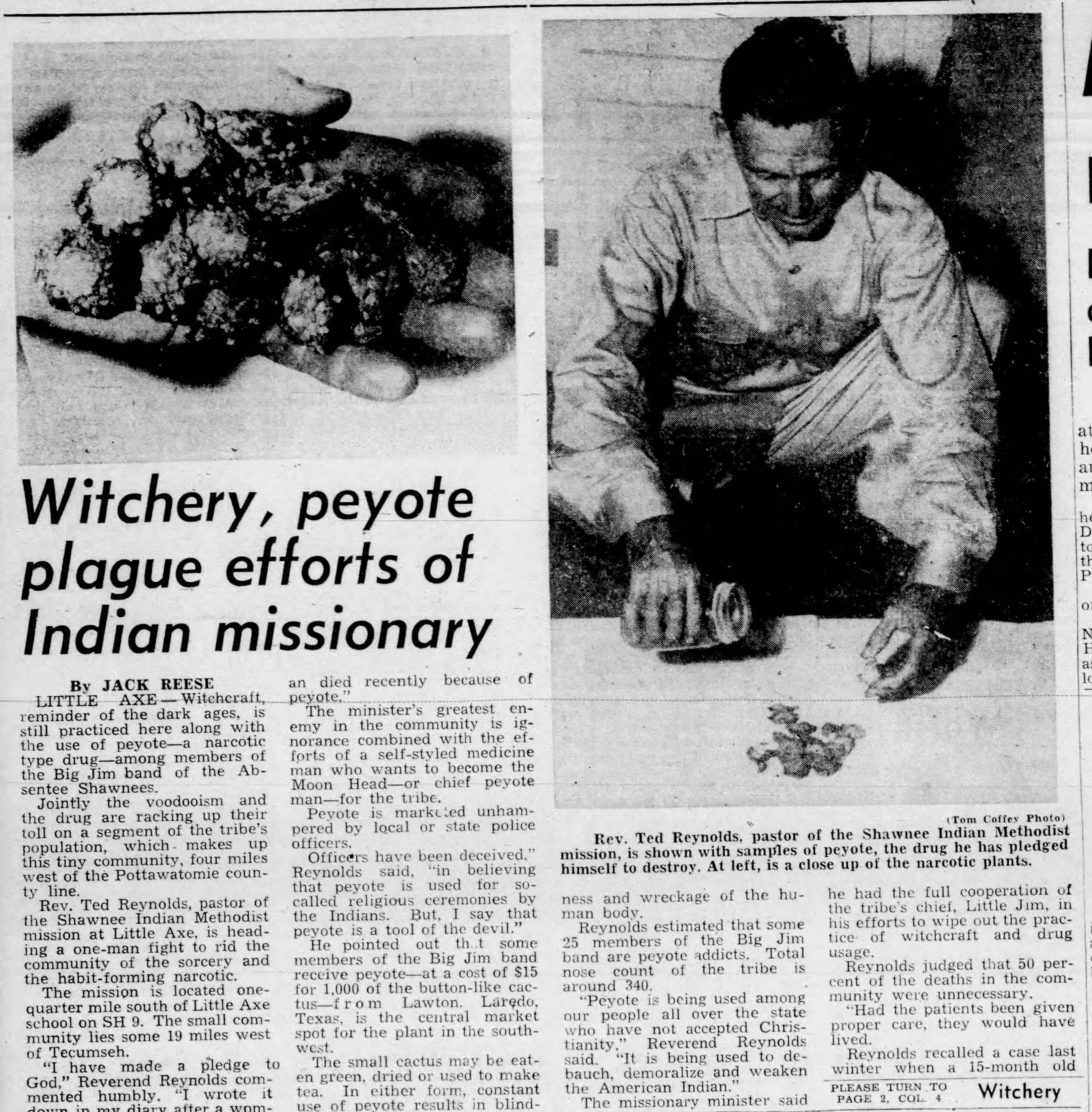
By the time the hipsters had become associated with peyote, though, it was seen as more of a threat to society. The authorities were no longer trying to “protect” Native Americans but viewed peyote as akin to heroin and other illegal substances. It became illegal at a federal level (aside from certain protected cultural use within indigenous communities) in 1970 and remains illegal across the USA today.
Beatdom is a reader-supported publication. To receive new posts and support our work, consider becoming a free or paid subscriber.
Footnotes and Endnotes
[1] Parts of this were reprinted in Wallace Berman’s Semina in 1959, increasing interest in peyote among the counterculture, but by this point the Beat writers had mostly tried it already. On a related note, Artaud’s The Peyote Dance was translated into English in 1975 by Helen Weaver, a former girlfriend of Jack Kerouac.
[2] There are few documents and they are mostly undated. Many later accounts are clearly incorrect, suggesting it happened in 1951. In any case, we can determine by responses to missing letters that February 1952 was his first time trying peyote.
[3] There is no indication that Lamantia was the one who visited and supplied the peyote, but it is far from impossible. In a letter Ginsberg sent Kerouac, he says, “I see you are digging Lamantia” and in the next paragraph he writes, “Send me some peyote.” It is possible that a missing letter from Kerouac talks about Lamantia giving him peyote but it’s equally possible he mentioned peyote and Lamantia separately.
[4] Carolyn Cassady is mistaken here. Peyote remained legal until 1970; however, in February 1952 there was a huge public discussion about whether or not to criminalise it, and there were some arrests made in the 1960s due to its being seen as a “narcotic.” It was banned at a state level in certain places as of 1952, but not California. The 1952 media discussion centred around whether Native Americans should have the right to do it or not. News reports of the time mostly viewed it as an uncommon practice that would not spread into the wider society.
[5] In Desolation Angels, this is the Egyptian Book of the Dead.
[6] There is more confusion here. Kerouac seems to have thought mescal came from the peyote plant, of which the psychoactive element is mescaline. Despite the names, these are not related. Kerouac merely drank mescal on the bus; he did not take any peyote or mescaline.
[7] Kerouac writes in Visions of Cody that Hoffman “committed suicide on peyotl, the new sleeping pill.” Some have suggested that Kerouac called peyote a “sleeping pill” because he once fell asleep on it, which may be true, but the context here suggests that he connected Hoffman’s apparent overdose with sleeping pills, more commonly used for suicide.
[8] Note that this is the fourth time his word has been used in these quotations. It seems the peyote experience brought this word to mind for many of the Beat writers who tried it. Note also that the others compared the experience to a mix of Benzedrine and marijuana as Ginsberg does here.
[9] A newspaper article I dug up from 1954 says that 1,000 peyote plants cost $15 (about $187 in 2026). It did not name this company but did say they could be ordered by mail from Laredo.
[10] Variants on “angel” appear nine times in “Howl” and many dozens of times in his other poems, but of course they appear prior to his peyote experiments and honestly the claim that “angel” came into American literature via peyote is rather absurd.
[11] See also his “For the Death of 100 Whales,” which he begins by referring to a October 4, 1954, article. It was actually published in April of that year. He’s also gotten the date of the 6 Gallery reading wrong a few times.
[12] He left Los Angeles after being accused of using pornography in his artwork. The pornographic image in question was Marjorie Cameron Parsons’ “Peyote Visions.”
[i] Interview with John Suiter, December 11, 2000
[ii] ibid
[iii] ibid
[iv] Cassady, Carolyn, Off the Road: My Years with Cassady, Kerouac, and Ginsberg (Penguin, 1990) p.170
[v] Off the Road, p.171
[vi] Charters, Ann, Jack Kerouac: Selected Letters 1940-1956 (Penguin, 1996) p.336
[vii] Nicosia, Gerald, Memory Babe: A Critical Biography of Jack Kerouac (University of California Press, 1994) p.366
[viii] Jack Kerouac: Selected Letters, p.349
[ix] Memory Babe, p.366
[x] Jack Kerouac: Selected Letters, p.362-363
[xi] Harris, Oliver, The Letters of William S. Burroughs: 1945-1959 (Picador, 1993) p.121
[xii] The letters of William S. Burroughs, p.128
[xiii] The letters of William S. Burroughs, p.130
[xiv] Harris, Oliver, William Burroughs and the Secret of Fascination (Southern Illinois University Press, 2003) p.165
[xv] Hibbard, Allen, Conversations with William Burroughs (University Press of Mississippi, 1999) p.63
[xvi] Jack Kerouac: Selected Letters, p.369
[xvii] Jack Kerouac: Selected Letters, p.369
[xviii] Jack Kerouac: Selected Letters, p.370
[xix] The Letters of William S. Burroughs
[xx] Caples, Garrett, Retrievals (Wave Books, 2014) p.125
[xxi] Meltzer, David, San Francisco Beat: Talking with the Poets (City Lights Books, 2001) p.139; p.140
[xxii] Morgan, Bill and Stanford, David, Jack Kerouac and Allen Ginsberg: The Letters (Viking, 2010) p.142
[xxiii] Ball, Gordon, Allen Ginsberg Journals: Early Fifties, Early Sixties (Grove Press, 1977)p.5
[xxiv] Allen Ginsberg Journals: Early Fifties, Early Sixties, p.5
[xxv] Gifford, Barry (ed.) As Ever: The Collected Correspondence of Allen Ginsberg and Neal Cassady (Creative Arts Book Company, 1977) p.126
[xxvi] Allen Ginsberg Journals: Early Fifties, Early Sixties, p.7
[xxvii] Allen Ginsberg Journals: Early Fifties, Early Sixties, p.10
[xxviii] Allen Ginsberg Journals: Early Fifties, Early Sixties, p.13
[xxix] Allen Ginsberg Journals: Early Fifties, Early Sixties, p.18
[xxx] Lieberman-Plimpton, Juanita and Morgan, Bill, The Book of Martyrdom and Artifice: Journals and Poems 1937-1952 (Da Capo, 2006) p.377
[xxxi] As Ever, p.131
[xxxii] Jack Kerouac and Allen Ginsberg: The Letters, p.249
[xxxiii] Jack Kerouac and Allen Ginsberg: The Letters, p.249
[xxxiv] Jack Kerouac and Allen Ginsberg: The Letters, p.319
[xxxv] Morgan, Bill, Deliberate Prose: Selected Essays 1952-1995 (Perennial, 2001) p.230
[xxxvi] Carter, David, Spontaneous Mind: Selected Interviews 1958-1996 (HarperCollins, 2001) p.46
[xxxvii] Deliberate Prose, p.70
[xxxviii] Morgan Bill (ed.), Best Minds of My Generation: A Literary History of the Beat Generation (Grove Press, 2017) p.397
[xxxix] Morgan, Bill, The Letters of Allen Ginsberg (Da Capo, 2008) p.276
[xl] Ball, Gordon, Allen Verbatim: Lectures on Poetry, Politics, Consciousness by Allen Ginsberg (McGraw-Hill Book Company, 1974) p.118
[xli] Suiter, John, Poets on the Peaks: Gary Snyder, Philip Whalen & Jack Kerouac in the Northern Cascades (Counterpoint, 2002) p.113
[xlii] Calonne, David Stephen, Conversations with Gary Snyder (University Press of Mississippi, 2017) p.158
[xliii] Schneider, David, Crowded by Beauty: The Life of Zen Poet Philip Whalen (University of California Press, 2015) p.89
[xliv] ibid
[xlv] ibid
[xlvi] Crowded by Beauty, p.90
[xlvii] Charters, Ann, Portable Beat Reader (Viking, 1992) p.307
[xlviii] Interview with John Suiter, October 28, 1997
[xlix] Oct 19 1955 journal entry
[l] Jack Kerouac and Allen Ginsberg: The Letters, p.283
[li] Harris, Oliver, The Yage Letters Redux (City Lights Books, 2006) p.xxxvii
[lii] Morgan, Bill, The Selected Letters of Allen Ginsberg and Gary Snyder (Counterpoint, 2009) p.9
[liii] Best Minds of My Generation: A Literary History of the Beat Generation, p.30
[liv] Plimpton, George (ed.), Beat Writers at Work: The Paris Review (The Modern Library: 1999) p.283
[lv] McClure, Michael, Lighting the Corners: On Art, Nature, and the Visionary (University of New Mexico College of Arts and Sciences, 1993) p.183
[lvi] McClure, Michael, Scratching the Beat Surface (North Point Press, 1982) p.6
[lvii] Scratching the Beat Surface, p.11
[lviii] Lighting the Corners, p.154
[lix] Lighting the Corners, p.143
[lx] Lighting the Corners, p.140
[lxi] Lighting the Corners, p.140
[lxii] Scratching the Beat Surface, p.97
[lxiii] Bremser, Bonnie, For the Love of Ray (Compton Press, 1971) p.124
[lxiv] Calonne, David Stephen, The Beats in Mexico (Rutgers University Press, 2022) p.197-198
[lxv] The Beats in Mexico, p.198
[lxvi] The Beats in Mexico, p.198
[lxvii] San Francisco Beat, p.15-16
[lxviii] Ferlinghetti, Lawrence, The Mexican Night (New Directions, 1970) p.42
[lxix] Memory Babe, p.525
[lxx] Baker, Deborah, A Blue Hand: The Beats in India (Penguin, 2008) p.122
Comments
Nothing yet. Say the first thing.
Sign in to join the conversation.