
When I search for the term “Flower Power,” Google confidently tells me that it was coined in 1965 by Beat poet Allen Ginsberg. This is not an AI hallucination; rather, it comes from Wikipedia, which in turn draws upon a number of sources.
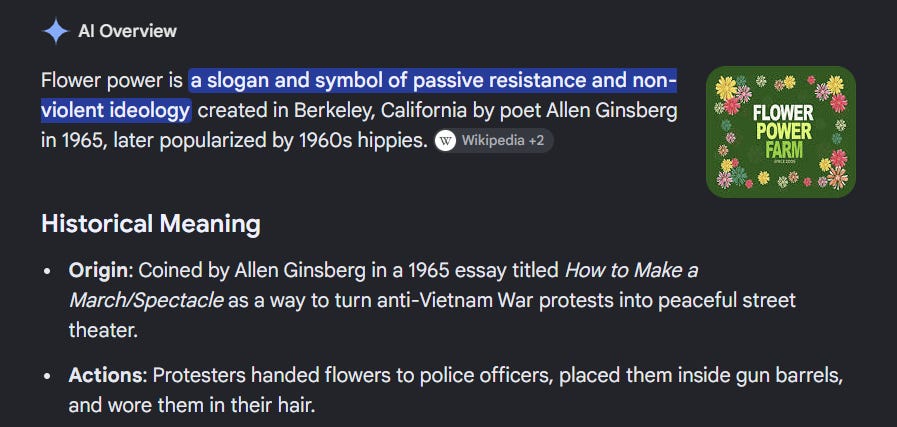
Of the three sources given on Wikipedia to prove the claim of Ginsberg coining “Flower Power,” one gets the poet’s name wrong, another is a dead link, and the third is an obituary that gives no sources for its various claims. In the etymology section, the primary source is Ginsberg’s 1965 essay, “Demonstration or Spectacle as Example, As Communication, or How to Make a March/Spectacle,” originally published in the Berkeley Barb and republished in The Portable Sixties Reader, edited “by Ann Charles” (sic—Charters). However, this essay does not use the term “Flower Power” and in fact it only appears once in the whole book: a short obituary for Jack Kerouac, written October 23, 1969. We can see already that even by Wikipedia standards, it is rather sloppy and should be scrutinised carefully.
Ginsberg did, however, write the aforementioned 1965 essay for the Berkeley Barb and it does recommend using flowers in protests, so one might be tempted to see him as the inventor of Flower Power. He gives 19 recommendations, of which flowers feature first:
1. Masses of flowers—a visual spectacle—especially concentrated in the front lines. Can be used to set up barricades, to present to Hell’s Angels, police, politicians, and press and spectators whenever needed or at parade’s end. Masses of marchers can be asked to bring their own flowers. Front lines should be organized and provided with flowers in advance.[i]
I will repeat the fact that even though he seems to outline the concept of Flower Power in this essay, he does not use the phrase itself, and in fact there is no record of him using it until well after it had been used in the mainstream media. (He often used the word “flower” in his letters but oddly it is absent between 1963 and 1968.)
But just because Ginsberg did not use the term in this essay does not mean that he didn’t coin it. In fact, a number of credible texts assert that he did. The best of the biographies, Dharma Lion, says he did but gives no details.[ii] Essays in the collections The Beats: A Teaching Companion[iii] and Allen Ginsberg in Context[iv] also make the claim, with only the latter providing evidence, but this is a dubious assertion in a hastily written obituary that gives no citation.
Barry Silesky’s biography of Lawrence Ferlinghetti is more specific. It explicitly states that Ginsberg coined the term at a rally in Berkeley on October 15,[v] but unfortunately no citation is given. The rally—which took place across two days (October 15 and 16) and saw protesters not only stopped by police but menaced by the Hell’s Angels—was documented by photographers and covered in the media but no one recorded Ginsberg actually using those words. Ginsberg never took credit, either. He might well have said “Flower Power” at that event, but it is strange that he did not use the catchy slogan in his essay and that there are no first-hand accounts of him using it. It seems people merely assumed that he did. It should also be noted that the essay was written later and published in November, before a second demonstration, with Ginsberg more keenly aware of the threat of violence and eager to calm any potential situation. Thus, his concept of Flower Power probably came about between October 15 and November 19 even though it was not yet named.
Given that there is no evidence for Ginsberg using the phrase in 1965, nor anyone else for that matter, then we must ask the obvious question: Who actually came up with the name “Flower Power”?
The two-word phrase “flower power” appears in newspaper records over a period of hundreds of years but mostly in a horticultural sense or to refer to floral patterns in articles on interior design and women’s fashion. Similarly, there are various books by this title, mostly horticultural in nature. At no point, however, was it used to refer to peaceful protest or hippiedom until 1967, which Ed Sanders later called “the great year of Flower Power.”[vi]
As one might expect, “Flower Power” was first used in its hippie/protest context in 1967, the year that “San Francisco (Be Sure to Wear Flowers in Your Hair)” was released and hippies descended upon the Bay Area. This has led some to speculate that the expression grew out of the song. However, it was used about two months prior to its release.
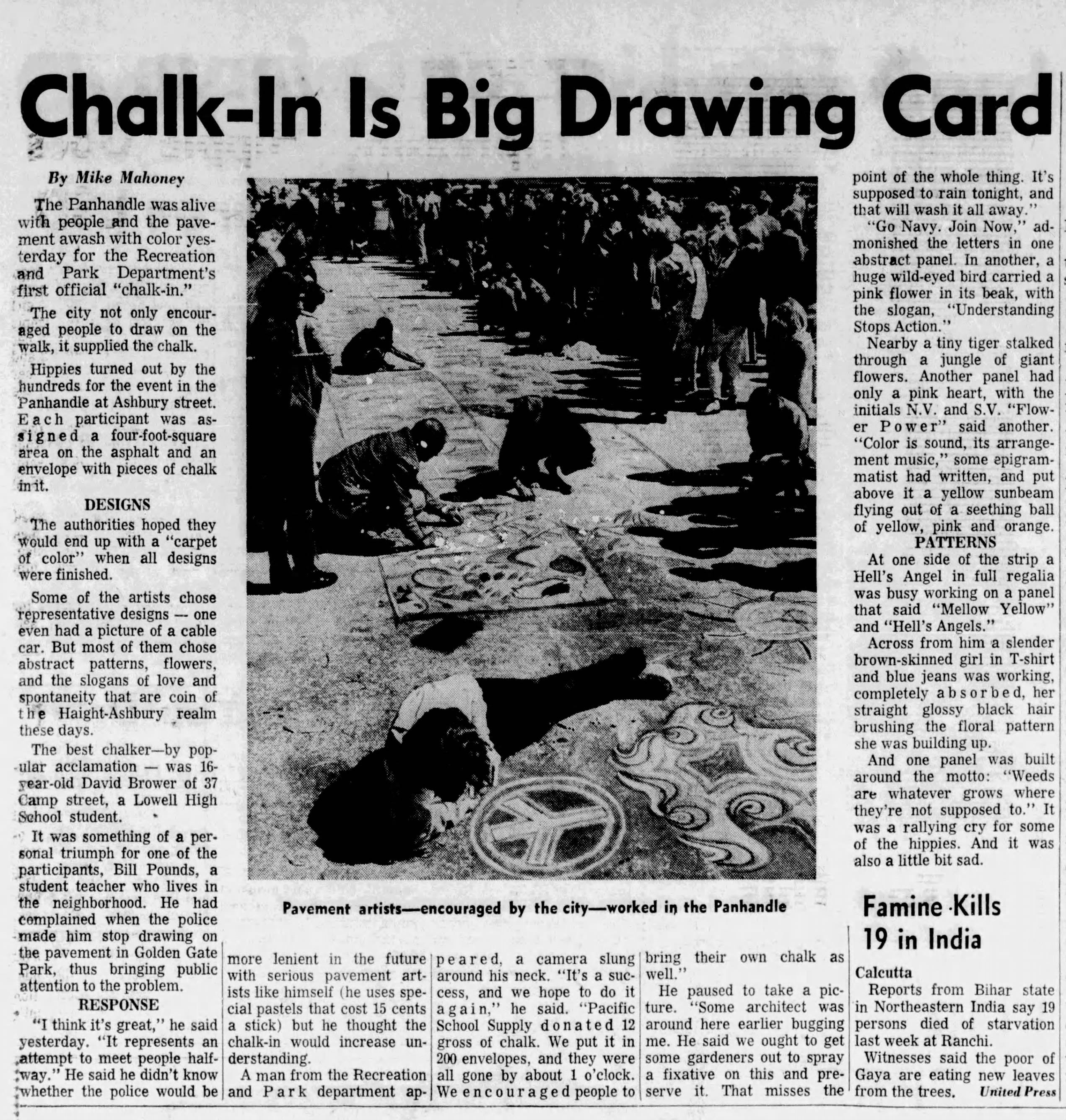
As best I can tell, “Flower Power” was coined by someone in attendance at the “Chalk-In” of March 19 (two months after the more famous Human Be-In of January 14). Held in San Francisco’s Panhandle, it was an officially sanctioned event at which participants were each allowed to decorate a 2-foot-by-2-foot area of asphalt using chalk. According to various reports, including an extensive one in the San Francisco Chronicle, the Chalk-In drew a large crowd, including both hippies and Hell’s Angels (the group Ginsberg wished to pacify with flowers in 1965), and one hippie wrote simply, “Flower Power.”[vii]
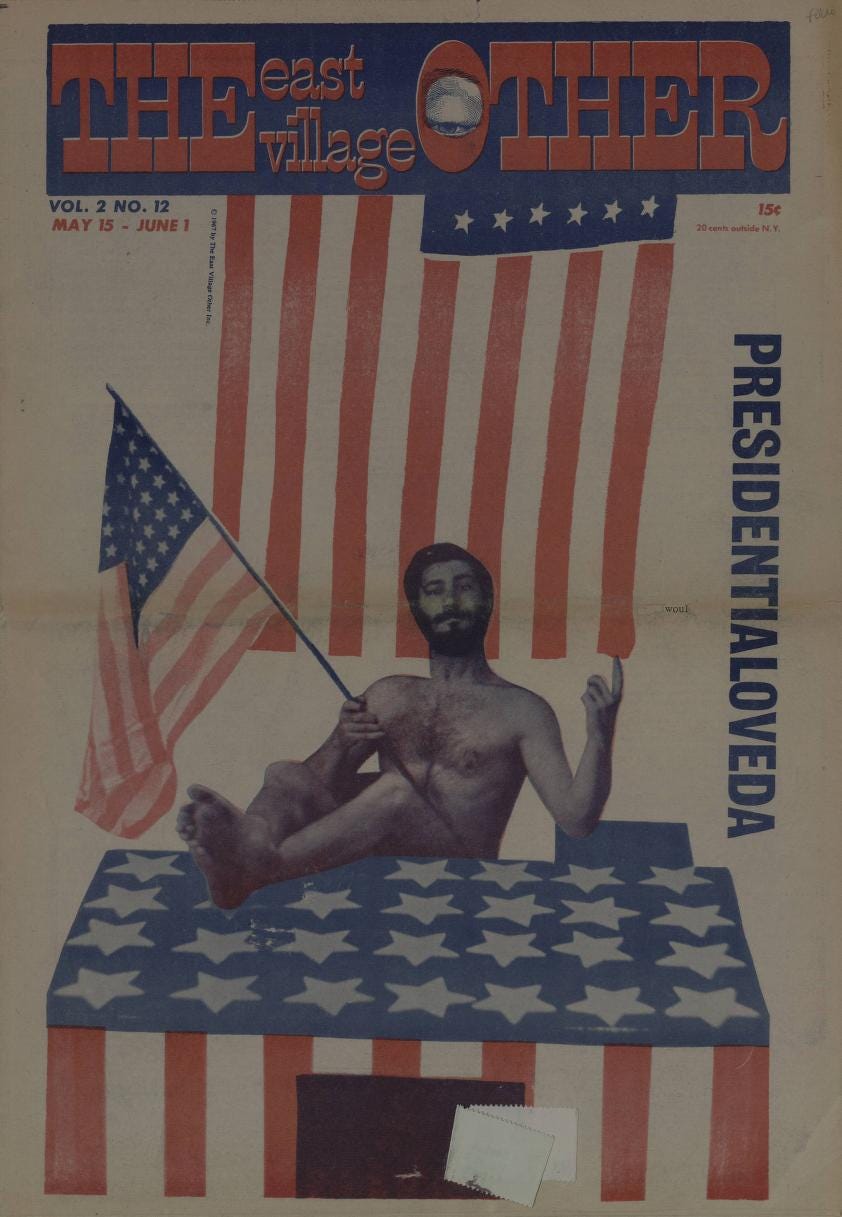
A few weeks later, in mid-April, 180,000 people participated in the biggest protest yet against the Vietnam War. Led by Dr. Martin Luther King, Dr. Benjamin Spock, and singer Harry Belafonte, parallel protests took place in New York and San Francisco. A group of protesters carrying daffodils in Central Park chanted, “flower power!” according to a report compiled from several wire services.[viii] Almost two hundred men (helped by “their chicks”) burned their draft cards and chanted this new slogan, which was reported a month later in an East Village Other article by Keith Lampe, titled “Flower Power,”[ix] and noted on the front page of Peace News.[x] Allen Ginsberg was in attendance for the San Francisco protest but there is no evidence that “Flower Power” was chanted there.
The following month, the New York Workshop in Non-Violence co-opted Armed Forces Day on May 20, redesignating it “Flower Power Day.” The Realist reported that the goal was to “‘Zap the military with love.... Blow their minds, not their bodies.”[xi] Despite threats of violence from right-wing groups, 300 protestors, including members of the armed forces, gathered in Central Park and lined the streets for three blocks. A reporter for Peace News wrote:
What is flower power? “Pacifism and non-violence taken for granted,” said one participant. Or in mathematical terms, “Resistance plus Flower Power equals Revolution.” Flower Power is also fun. “If we lose our sense of humour and our ability to love, if we become bitter, angry, and as up-tight as the hawks, we’ve nothing to offer society, no alternative way of living to present.[xii]
It was this month, May 1967, that “San Francisco (Be Sure to Wear Flowers in Your Hair)” was released and in the Bay Area the media began referring to it as “a new ‘flower power’ record.”[xiii] By the end of the month, the term “Flower Power” was widely used in the media to refer to the hippie ethos, and Tim Leary was recommending it as a replacement for all other forms of power as of June 11.[xiv] In early June, at Mount Tamalpais, a “Fantasy Festival” drew thousands of hippies, whom a local newspaper called the “flower power circle.”[xv] A week later, newspapers were referring to the migrating hippies as “flower children.”[xvi] Throughout June and July, “Flower Power” became a household term across the country, though not as widely known as “hippie,” coined a year earlier. Ginsberg had not used “Flower Power” by this point, but he was in the thick of the San Francisco scene and—along with Alan Watts—was worried about the hippie “invasion” and the resulting hysteria.[xvii]

“Flower Power” quickly crossed the Atlantic and was used in the United Kingdom, which is where it caught up with Allen Ginsberg. As Michael Schumacher notes in Dharma Lion, “Ironically, Allen was out of the country for most of the Summer of Love.”[xviii] Indeed, he had left the U.S. just as the movement he likely spawned began to gain momentum (just as he left San Francisco at the start of the San Francisco Renaissance he had kickstarted with the 6 Gallery Reading a decade earlier).
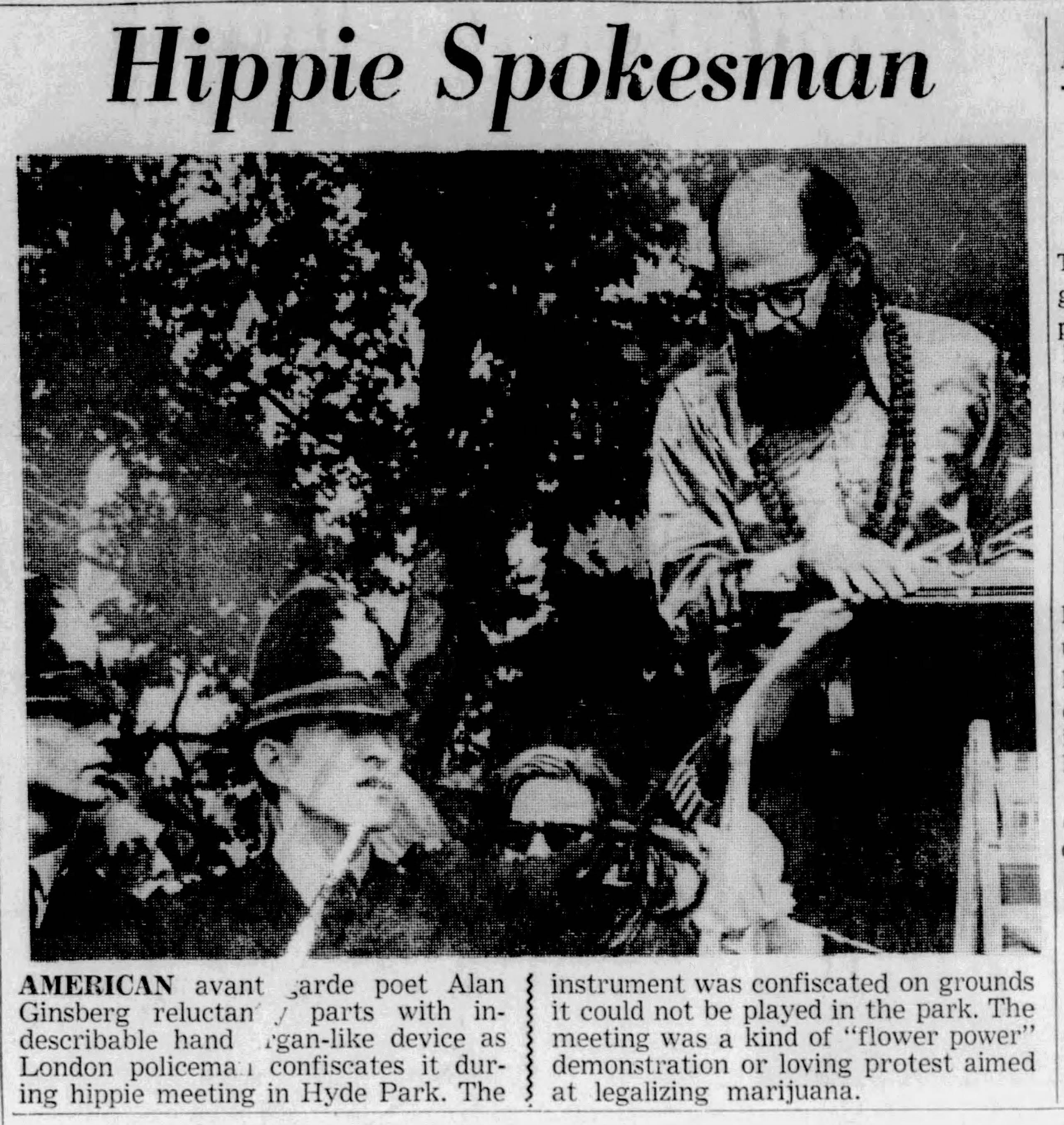
Just four months after it was first scrawled on a pavement in San Francisco, “Flower Power” was already a known term in England, where hippies protested in favour of marijuana legalisation. On July 16, in London’s Hyde Park, Ginsberg was amidst a group of seemingly stoned protestors and gave a poetry reading. Many of the hippies present were chanting “Flower Power!” and Ginsberg put this into practice when a police officer told him that he needed a licence if he wanted to accompany his reading with his harmonium (referred to in most reports as an accordion). Ginsberg told the officer, “Thank you,” and gave him a red rose.[xix] He continued his reading without musical accompaniment. The police also shut down speakers that were playing the Beatles’ recently released “All You Need Is Love,” which captured and continued the “Flower Power” ideal.
By this point, it is harder to track the use of the term as it spread around the world. Almost every major publication, including Sports Illustrated for some strange reason, had articles about it, usually attempting to explain the phenomenon for a square audience. As with the Beats Generation a decade earlier, most newspapers and TV shows were mocking in tone and some conservative publications were outright hostile. There was generally a belief that the new movement—termed the hippies, flower children, Flower Power, the Love Generation, or some combination thereof—had grown out of the Beat Movement, an idea furthered by John Lennon, who, when asked about Flower Power in October, quite randomly mentioned Ginsberg (though he did not say that Ginsberg had spawned the movement or coined the term).[xx] Soon after this, another publication said the Flower Power movement was merely “the Beats having a second wind.”[xxi]
This is perhaps not wholly surprising. Ginsberg and others from the earlier Beat scene were not only inspirations for the hippies but participated in anti-war demonstrations and other events populated by the hippies. Many of them had been present at the Human Be-In at the start of the year and some wore the sort of flowing, Indian-style clothes and long hair that the average person associated with this strange new movement. Even before Flower Power found its way into the newspapers, articles frequently referred to Ginsberg as “hippie poet laureate,” “hippie leader,” and “hippie high priest.”
The Summer of Love came and went and in the latter half of 1967 the countercultural movements all blurred into an incomprehensible but entertaining mix for mainstream America. Ginsberg leaned into it, no doubt happy that his method of peaceful protest and his penchant for free love were spreading so rapidly. And so it makes sense that by late-1967, he was being referred to as the “flower power protagonist”[xxii] and why a half-century later he is one of the faces of the movement and widely believed to be the one who named it.
Since people seem to like short-form summaries nowadays, I shall review and add a few final notes.
Allen Ginsberg could well have coined the term “Flower Power” in October 1965 but there is no hard evidence for it. By November of that year, he had certainly come up with the concept of using flowers at the forefront of peaceful demonstrations, but one should keep in mind that he was probably not the first to do this. He merely codified, publicised, and practised it.
“Flower Power” as a slogan and wider cultural movement came about in 1967. The first documented usage was in March and it was adopted by at least one anti-war organisation in April, which held a Flower Power Day event in May.
Ginsberg’s concept and the anonymous chalkster’s slogan emerged in the Bay Area but the term and a broader application took hold in New York before switching back to the West Coast as San Francisco became the home of the hippies, who migrated westward. Ginsberg probably encountered it during his time in England, though it’s not impossible he read about it in the underground press shortly before departing for Europe.
I can only see actual usage of the term by Ginsberg in later years, reflecting on the mid-sixties. The earliest is in a poem from 1970, and it’s perhaps of interest that Gary Snyder said in that same year, “For better or for worse, flower power is dead.”[xxiii] Certainly, the hippie movement had died but, by 1972, Ginsberg was advocating “flower power” in a broader sense, specifically an ecological one. He told Yves Le Pellec that it was
the power of greenery to regenerate the earth. Many people have not taken into account this aspect of flower power. They think it just means sticking a blossom into the muzzle of a rifle in front of the Pentagon, but also it is the preservation of the Amazon jungle as one of the great lungs of the planet.[xxiv]
He continued to advocate for peace and environmental protection, and in 1979 mentioned in a letter to Snyder the “evolution of our flowery power views.”[xxv]
This was just a quick essay digging into the origins of a phrase and a movement. There is much more to discuss related to the Beat writers’ pacifism and activism and their role in inspiring and guiding the hippie movement, but that’s all beyond the scope of what I wanted to explore here. Feel free to leave your thoughts in the comment section below. Likewise, if I’ve made any mistakes or omissions, let me know. For more on Ginsberg’s progressive politics, see Eliot Katz’s 2016 book.
[i] Morgan, Bill (ed.) Deliberate Prose: Selected Essays 1952-1995 (Perennial, 2001) p.10
[ii] Schumacher, Michael, Dharma Lion: A Biography of Allen Ginsberg (University of Minnesota Press, 2016) p.390
[iii] Grace, Nancy M. (ed.) The Beats: A Teaching Companion (Clemson University Press, 2021) p.58
[iv] Mortenson, Erik (ed.) Allen Ginsberg in Context (Cambridge University Press, 2026) p.367
[v] Silesky, Barry, Ferlinghetti: The Artist in his Time (Warner Books, 1990) p.145-146
[vi] Sanders, Edward, The Poetry and Life of Allen Ginsberg: A Narrative Poem (The Overlook Press, 2000) p.80
[vii] San Francisco Chronicle, March 20, 1967, p.3
[viii] Wisconsin State Journal, April 16, 1967, p.1-2
[ix] The East Village Other, May 15, 1967, p.4
[x] Peace News, April 21, 1967, p.1
[xi] The Realist, June 1967, p.17
[xii] Peace News, June 2, 1967, p.10
[xiii] The Fresno Bee, May 14, 1967, p.25
[xiv] Detroit Free Press, June 11, 1967, p.15
[xv] San Rafael Daily Independent Journal, June 10, 1967, p.1
[xvi] The Morning Star, June 18, 1967, p.B16
[xvii] Morgan, Bill (ed.) The Selected Letters of Allen Ginsberg and Gary Snyder (Counterpoint, 2009) p.90
[xviii] Dharma Lion, p.483
[xix] Daily Mirror, July 17, p.3 Note that other reports say he wore a pink carnation affixed to his red satin shirt. It’s possibly this same flower that he gave the police officer and that the journalist who claimed it was a red rose was making an assumption.
[xx] The Daily Sketch, October 9, 1967, p.13
[xxi] The Montreal Star, November 4, Entertainments, 1967, p.2
[xxii] Star-Gazette, November 11, 1967, p.30
[xxiii] Calonne, David Stephen, Conversations with Gary Snyder (University of Mississippi Press, 2017) p.46
[xxiv]Carter, David (ed.) Allen Ginsberg: Spontaneous Mind: Selected Interviews (HarperCollins, 2001) p.298-299
[xxv] The Selected Letters of Allen Ginsberg and Gary Snyder, p.210
Comments
Nothing yet. Say the first thing.
Sign in to join the conversation.