
“KLA wins no matter who wins. It doesn’t matter which hyperscaler wins, which semiconductor company wins, or which processor wins. AI doesn’t happen without process control.”
- KLA Corporation, 2026 Investor Day
ASML makes the machine that prints the pattern. Applied Materials deposits the materials. Lam Research etches the structures. And KLA? KLA determines whether any of it actually worked - at the molecular level, across thousands of steps, on wafers worth up to $20,000 each. Still don’t get it? Let me dumb it down: KLAC makes machines that inspect chips for tiny defects, helping factories improve yields and produce advanced chips reliably. In this day and age a mistake can cost billions , KLAC is there to make sure theres no mistakes.
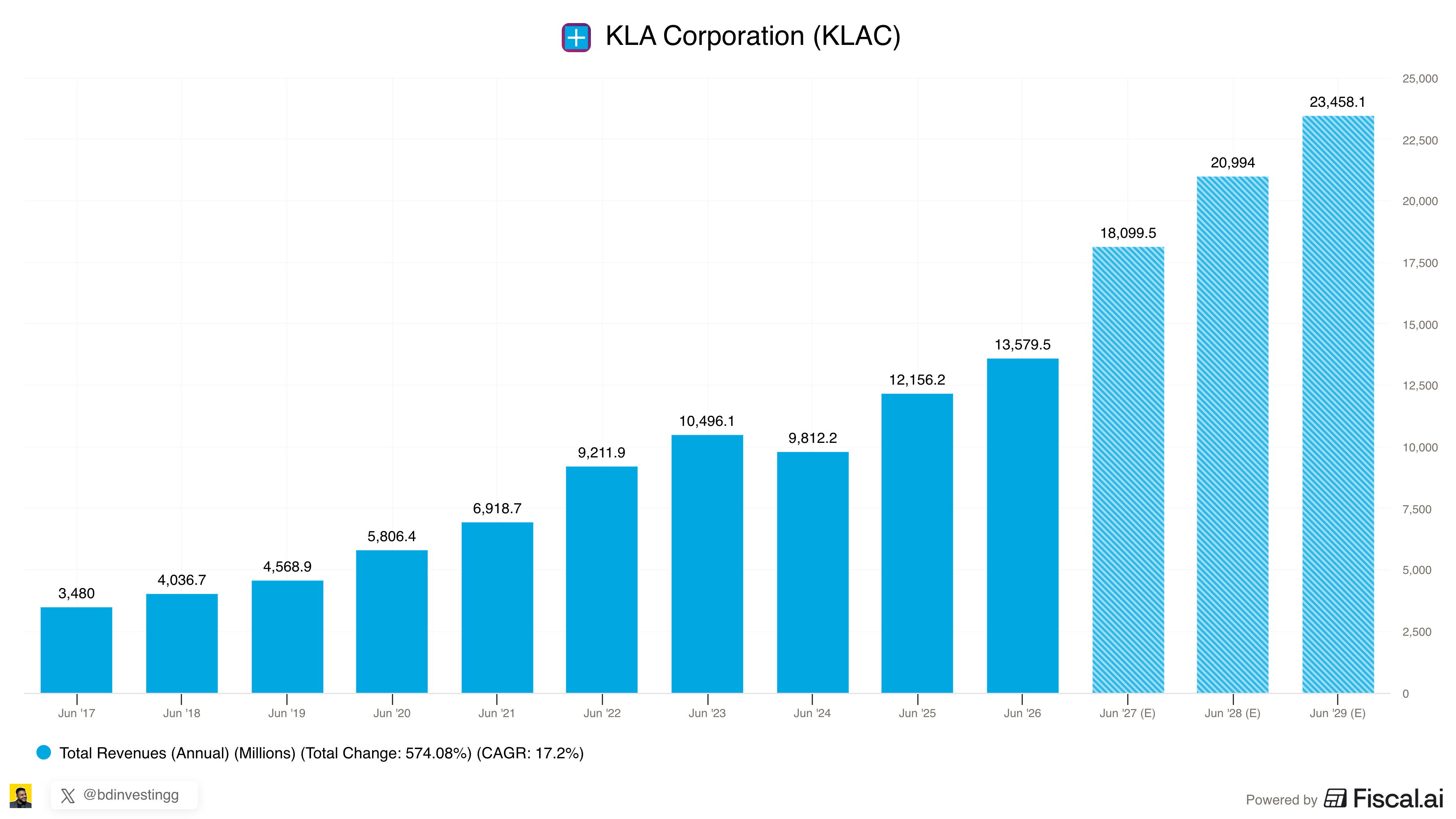
That is why this is the highest-margin business in semiconductor equipment, and why its competitive position has only strengthened as chips become more complex. Q4 FY2026 results just confirmed it again - record revenue of $3.66B, EPS beat of $0.03, and full-year revenue of $13.58B.
KLA does not make the chip. It determines whether the chip can be manufactured profitably. The more expensive the wafer, the more valuable KLA’s answer becomes.
Every modern chip requires hundreds to thousands of manufacturing steps. At each step, something can go wrong. A particle of dust. A misalignment of 0.001 microns. A chemical layer that’s 0.2nm too thin. Any of these defects - if undetected - will propagate through subsequent steps, eventually killing the chip entirely. And on an advanced AI accelerator wafer worth $15,000–$20,000, “kill rate” is everything.
The manufacturing chain - where KLA sits
AMAT - Deposit materials → LRCX - Etch structures → KLAC - Did it work? ✓ → Repeat 1,000× per wafer
KLA’s tools combine advanced optics, electron beams, sensors, AI-powered algorithms, and proprietary software. The hardware detects abnormalities. The software classifies them. The fab uses that information to fix the process before the defect spreads to thousands of subsequent wafers - saving tens of millions of dollars per correction.
Before the numbers: your research cited 60–80%, which requires clarification. The overall process control category is ~56.5%. But individual sub-segments are where the 60–80% (and higher) figures are real:
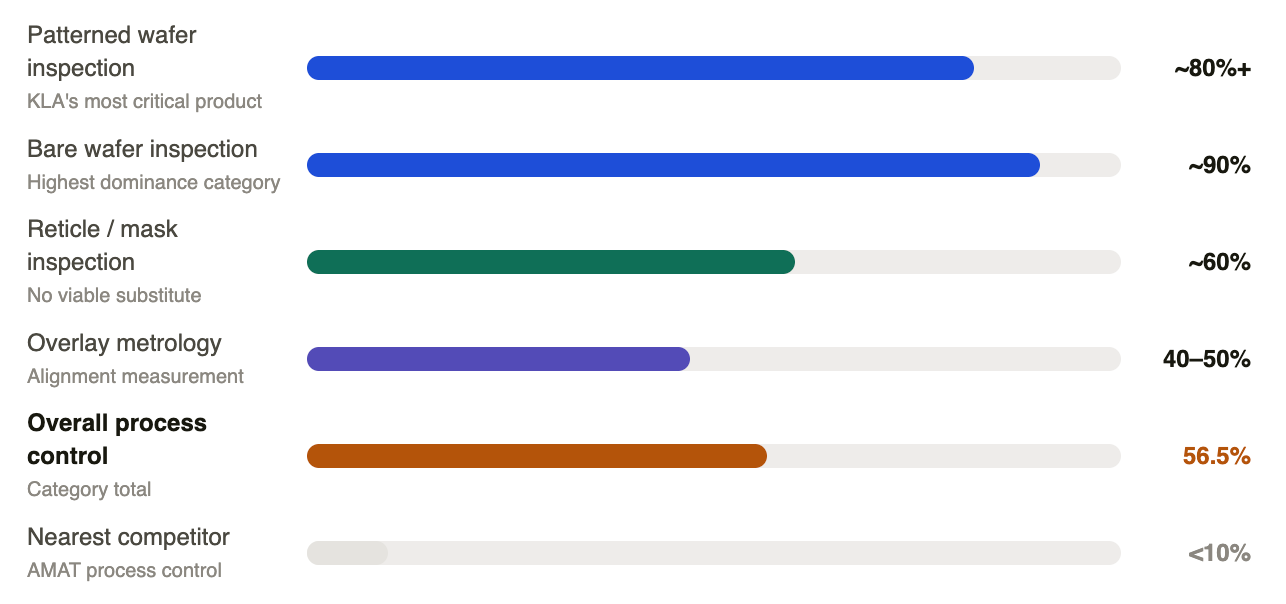
KLA is roughly 6.5× larger than its nearest competitor in process control. That is not a normal competitive gap. That is a structural monopoly in an essential manufacturing step.
- KLA Corporation, 2026 Investor Day disclosure
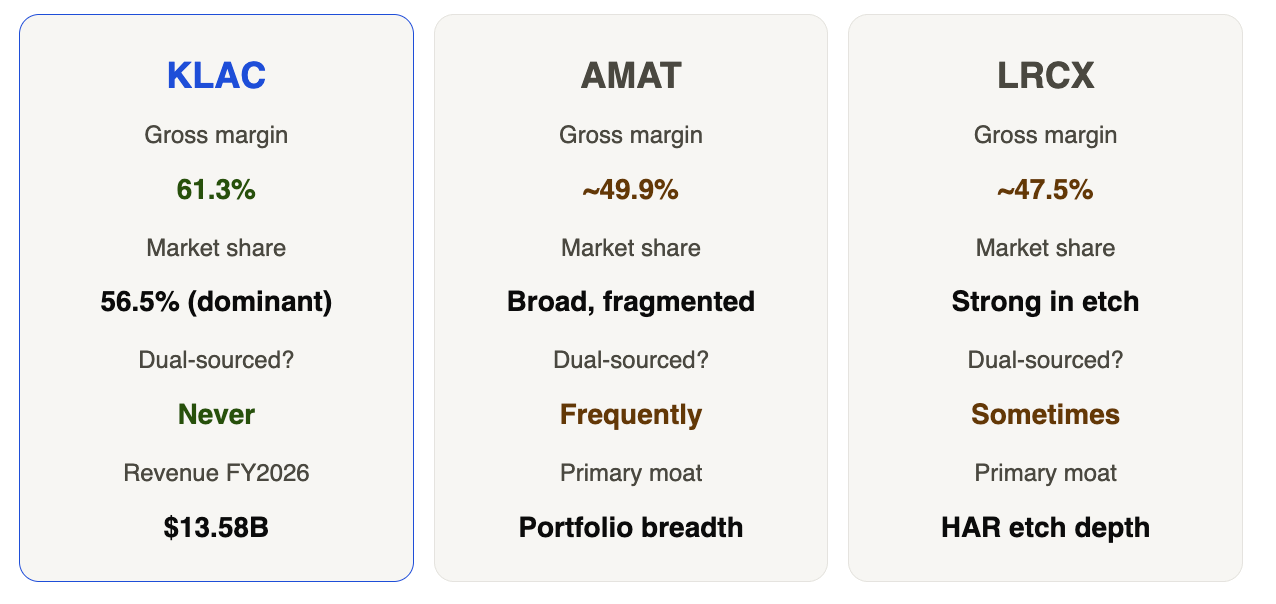
Applied Materials and Lam Research are excellent companies. This is not a dismissal of them. But the nature of their competitive position is structurally different from KLA’s - and that difference shows up in gross margins, market share stability, and customer behavior.
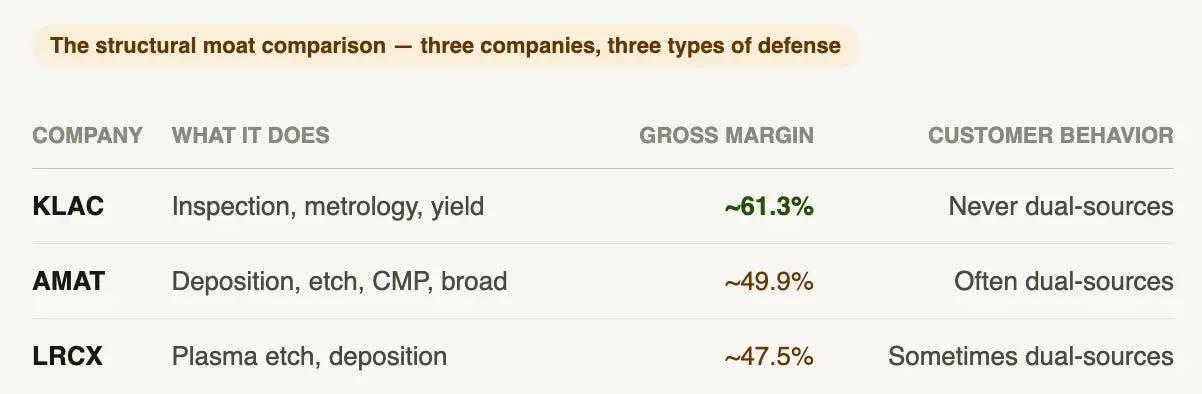
The key insight: AMAT and LRCX sell tools that physically alter silicon. Fabs intentionally dual-source deposition and etch equipment - if Lam’s price is too high, TSMC can buy from Applied or Tokyo Electron instead. KLA sells measurement and diagnosis. There is no second option that fabs trust with $20,000 wafers. Swapping out a proven KLA recipe mid-process risks catastrophic yield loss worth hundreds of millions. That is a different class of moat.
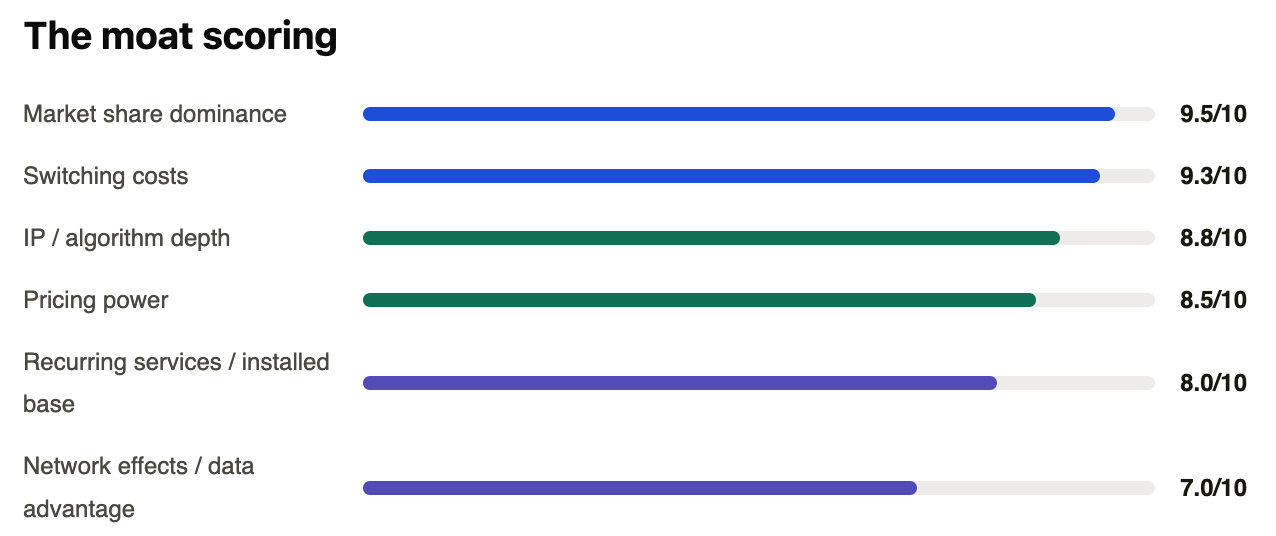
The market treats KLA as a secondary AI beneficiary. That framing is wrong in an important way.
The AI demand chain for KLA - 5 independent tailwinds
2nm and below logic: Smaller transistors = tighter tolerances = more inspection steps per wafer. Gate-all-around (GAA) transistors require defect detection at scales that didn’t exist 5 years ago.
EUV multi-patterning: Every additional EUV exposure step requires its own inspection cycle. More steps = more KLA revenue per wafer.
High-Bandwidth Memory (HBM): HBM for AI GPUs stacks multiple DRAM dies vertically. One bad die in the stack reduces the value of the entire package. Inspection at every layer is non-negotiable.
Advanced packaging (CoWoS, hybrid bonding): Chiplet architectures connecting GPUs, HBM, and networking dies introduce entirely new defect modes. KLA’s advanced packaging process control revenue is expected to hit $1.1B in calendar 2026 - more than 70% growth.
Wafer cost inflation: As wafer value rises, the economic incentive to catch defects earlier increases. KLA’s ROI for customers improves automatically as wafer costs rise.

The process control intensity trend - the most important long-term number
Process control as % of total wafer fab equipment spending:
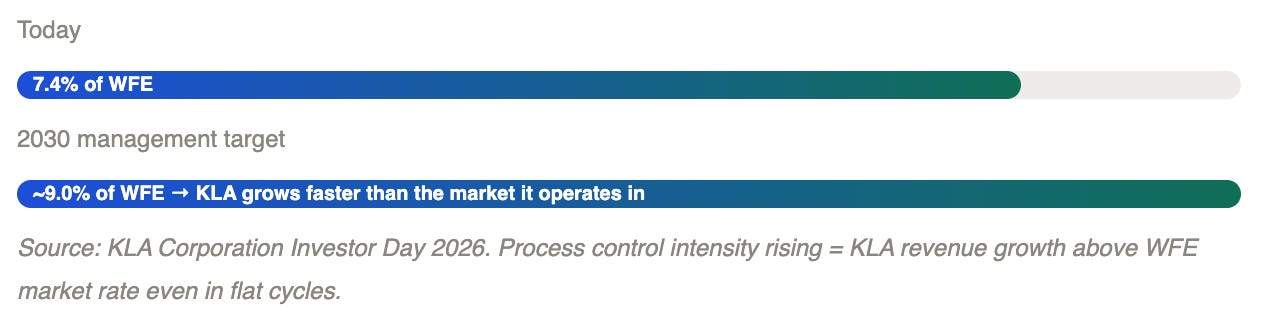
When the chip is worth $20,000 and the inspection tool costs $5 million, the economic value of not missing a defect is incalculable. KLA charges accordingly - and customers pay without negotiating.
Breaking: Q4 FY2026 results (July 28, 2026) - EPS beat of $0.03 ($1.05 vs. $1.02 estimate). Revenue of $3.66B, slight miss vs. $3.67B estimate. Stock dropped ~9% in after-hours - a reaction to FY guidance framing and broader chip sector selloff, not fundamental deterioration. Q1 FY2027 guidance: revenue $4.0B ±$200M, EPS $1.16 ±$0.10 - both above consensus.
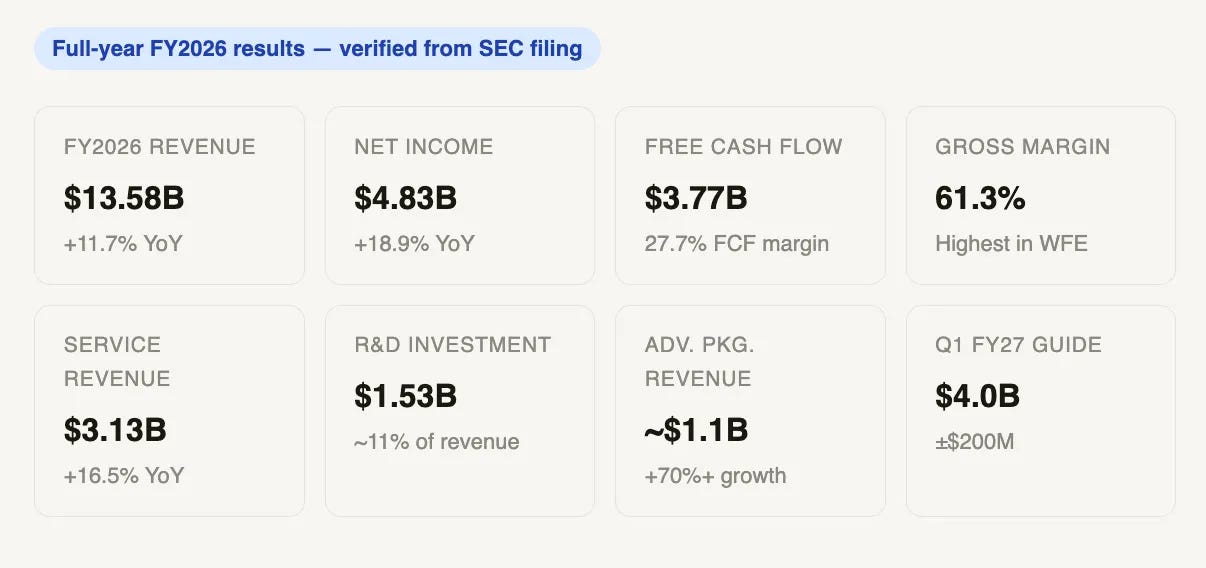
The 61.3% gross margin deserves its own moment of attention. Applied Materials is at ~49.9%. Lam Research is at ~47.5%. KLA runs 11–14 percentage points higher gross margin than its closest peers - not because it has lower costs, but because it charges more and customers don’t push back. That is the definition of pricing power.
Risk alert
⚠ Semiconductor equipment is still cyclical
Even the best company in the best niche feels WFE spending cycles. KLA’s service revenue provides significant resilience (~$3.13B annually), but tools revenue can slow sharply in memory downturns. The current upcycle is AI-driven and longer than average - but it is still a cycle.
⚠ China export controls - real but manageable
KLA’s China revenue has been pressured by export control restrictions on advanced process control tools. China exposure has declined as a percentage of mix, which actually reduces the risk going forward - but it also reduces the upside from any China spending acceleration.
⚠ The Q4 reaction - market sold 9% on a beat
KLA reported Q4 on July 28 - EPS beat, slight revenue miss, Q1 guidance above consensus. Stock fell ~9%. This happens in equipment stocks when guidance “beats by less than hoped.” The underlying business is unchanged. The reaction is a reminder that KLA at premium multiples requires perfect execution to avoid drawdowns.
⚠ Valuation - quality at a price
KLA does not trade cheap. The quality of the business is embedded in the multiple. A 20% drawdown on a fundamental miss is entirely possible even if the long-term thesis is intact. Always size according to your conviction in the cycle, not just the moat.
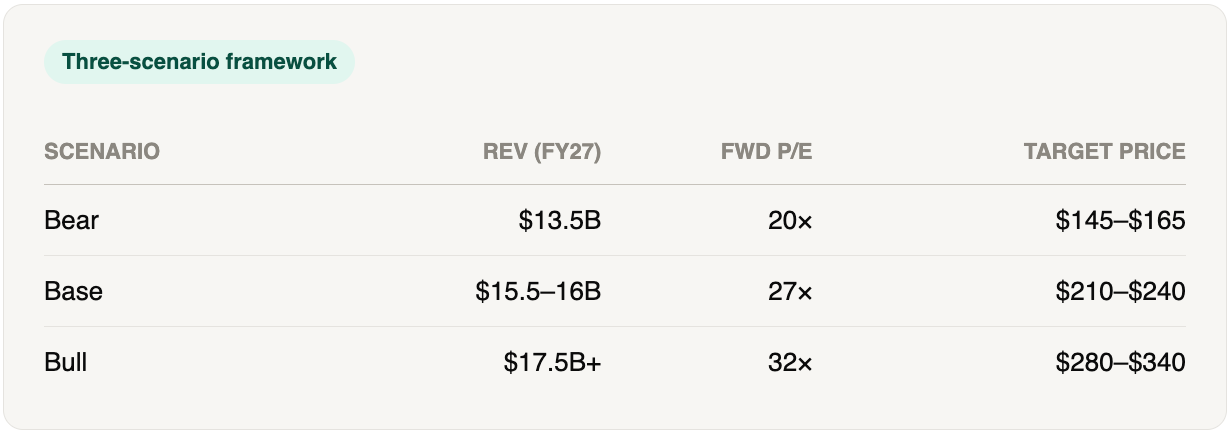
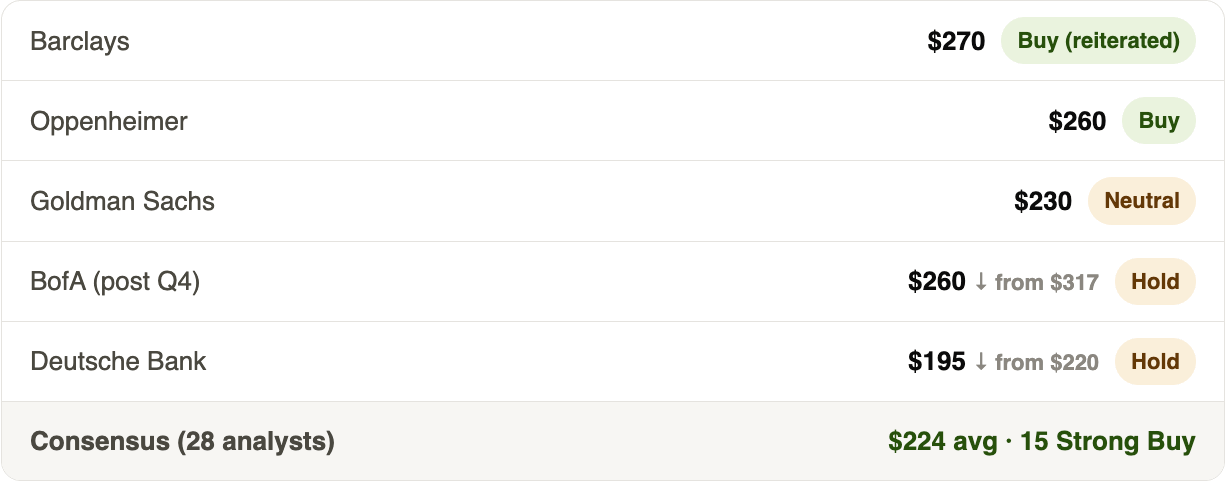
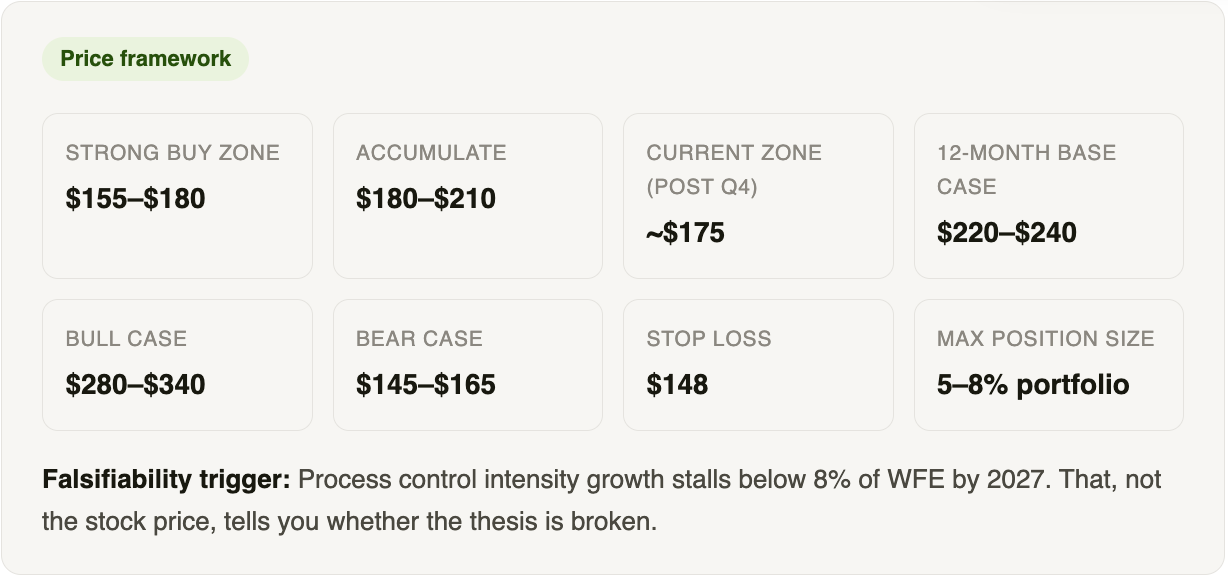
The 9% post-earnings drop is one of the oldest patterns in quality semiconductor equipment stocks. The business didn’t change. The narrative reset. That is almost always a buying opportunity in a wide-moat name.
⚠️ Disclaimer: For informational and educational purposes only. Not financial advice. KLAC is a cyclical semiconductor equipment company that can experience sharp drawdowns even with strong fundamentals. Market share data sourced from company presentations, Gartner, and TechInsights - subject to periodic revision. Always DYOR and consult a qualified financial advisor.
Comments
Nothing yet. Say the first thing.
Sign in to join the conversation.