
The Joseph Rowntree Foundation self-published a thought provoking think piece on AI in policymaking. Importantly, they acknowledged the “stark contrast” between some of the rhetoric – such as when Oliver Dowden described AI in the public sector as a “silver bullet” that “dangles before us the prospect of increased productivity, vast efficiency savings, and improved services” – with the dire use of data within government currently. The Foundation went on to argue that data collection and quality in the public sector is currently so poor that any AI working from these sets would be operating under a system of garbage in, garbage out.
Unfortunately, the piece concluded less auspiciously than it began. It claimed that “despite the sense that generative AI ought to boost productivity, the supporting evidence isn’t all there”. This seems unlikely given how corporates are falling over themselves to implement the technology. The article closed with the statement that although AI could help policymakers “possibly, sometimes, for some things … we need to get more granular about what AI we are talking about,” without explaining how that process might work.
The most interesting observation, I thought, was left unexplored. The piece correctly stated that “inserting technology into any system changes that system,” but used it to go down an unevidenced rabbit hole about how those changes might not be positive. But for me, the issue is whether the technology – or, indeed, whether change – will be embraced at all. Given how sclerotic many public institutions are and how they have already failed to embrace Big Data (or any level of effective data management at all), why would we expect them to adopt AI without a fight?
As long-term readers of this blog will have gathered, I’m no fan of degrowth economics. In my opinion, it’s a weird combination of socialism masquerading as environmentalism, overt primitivism, and Western privilege. I therefore gleefully accept any news that appears to confirm my priors.
Rutger Bregman, author of Humankind: A Hopeful History among other books, tweeted about a review of 561 degrowth studies which found that:
“Few studies use quantitative or qualitative data.”
Those that do “tend to include small samples or focus on non-representative cases.”
“Large majority (almost 90%) are opinions rather than analysis”.
Evisceration complete? Not according to degrowth academics and activists. Jason Hickel, author of Less is More, fired back: “The methodology really is extremely flawed … the authors look only at studies with "post-growth" or "degrowth" in the title … [but] not all degrowth research has "degrowth" in the title! … Huge swathes of research are ignored ... all the work on demand-side mitigation, sufficiency-oriented approaches, energy convergence, ecosocialism, decoupling, doughnut economics, etc — including work reviewed by the IPCC — all of it is ignored.” This was confirmed by ecological economist Julia Steinberger, who stated that out of 33 degrowth papers she commissioned, only one was included in the review.
Persuasive stuff. But I note that they didn’t engage with one critical graph in the review: the map of academics who write about degrowth.
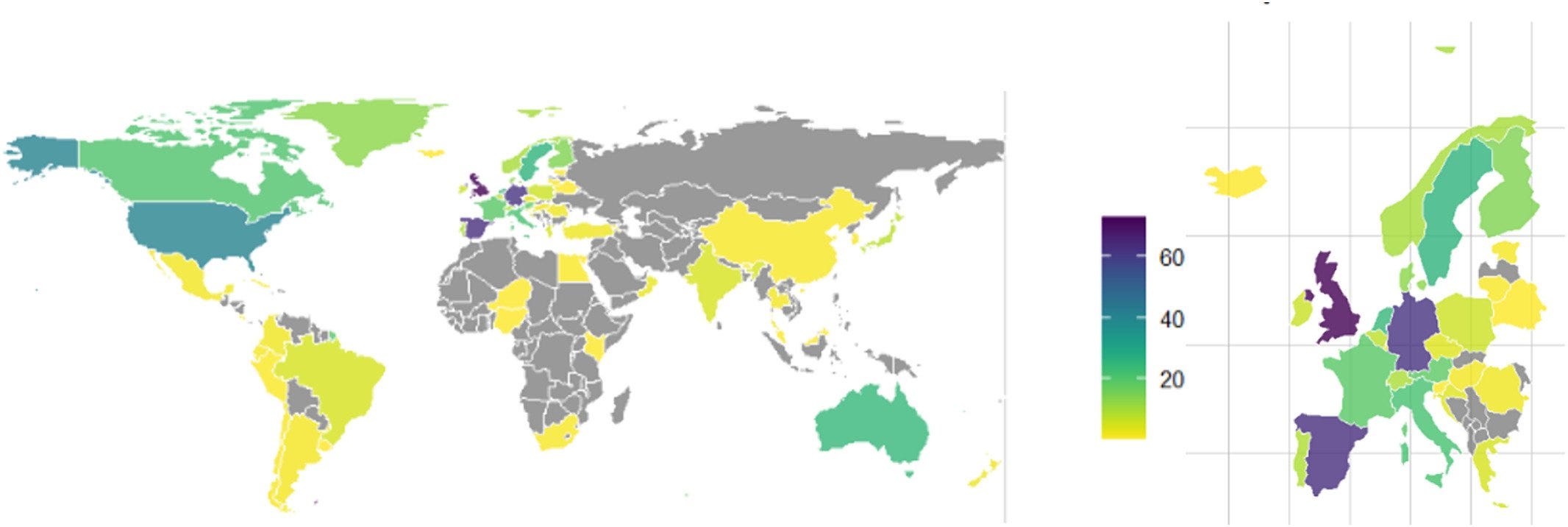
Degrowth is a Western ideology where privileged Western academics tell less-privileged non-Western people that wanting to be richer is evil. There’s no way around that.
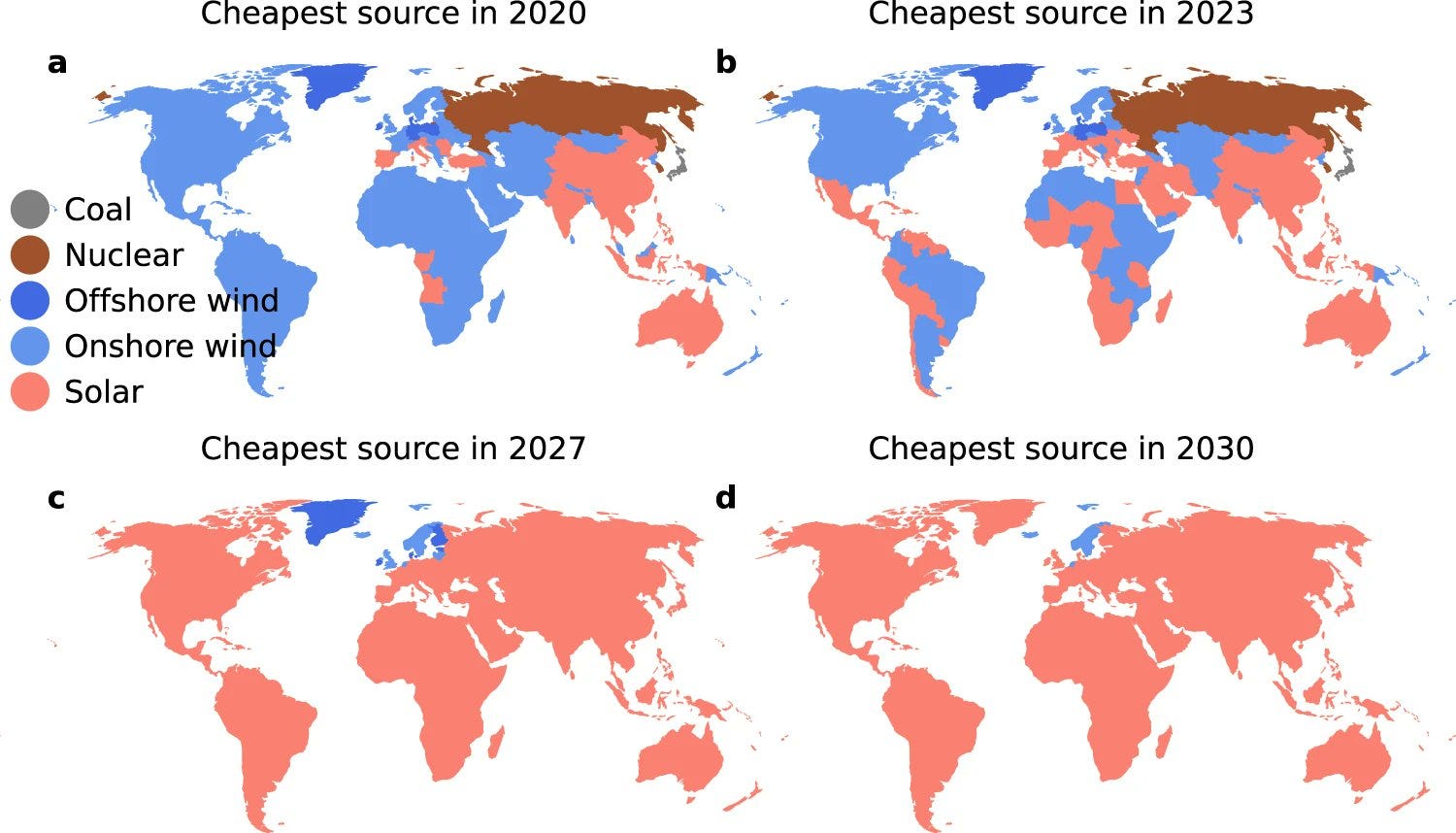
I came across a paper published by Nature late last year predicting that solar will become the cheapest energy source in almost all countries by 2030. Here’s the key graph:
At the end of September, the UK’s last remaining coal-fired power station, Ratcliffe-on-Soar Power Station in Nottinghamshire, will close for good. It’s been a long time coming. Coal’s share of UK electricity generation has fallen sharply over a short 10-year period.
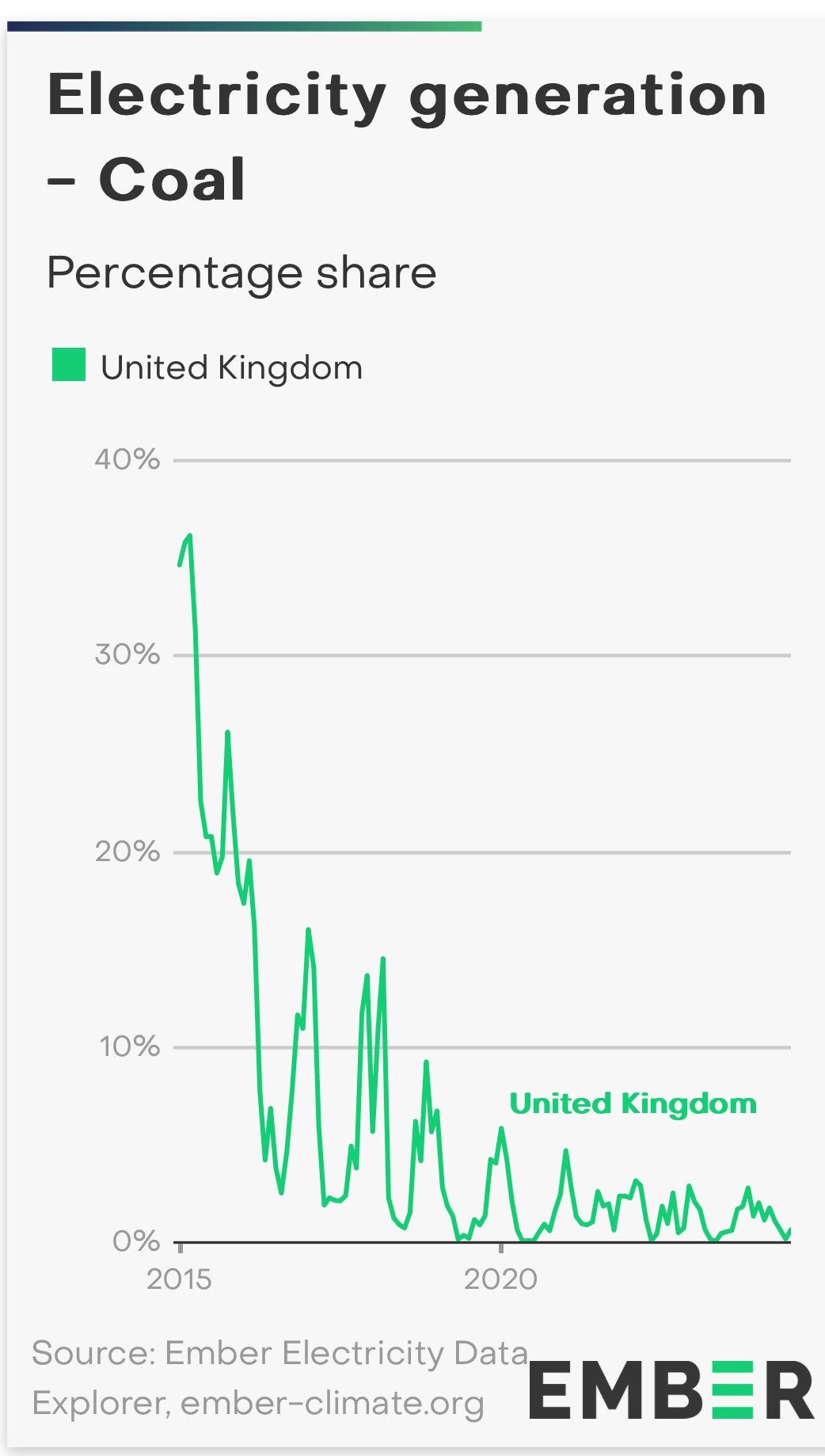
Given how instrumental coal was to the Industrial Revolution, first powering Britain to global prominence and eventually the world to greater prosperity, all while rapidly warming the planet, it’s a moment to reflect on our relationship with the ‘original black gold’, and also to think about where we might be going next.
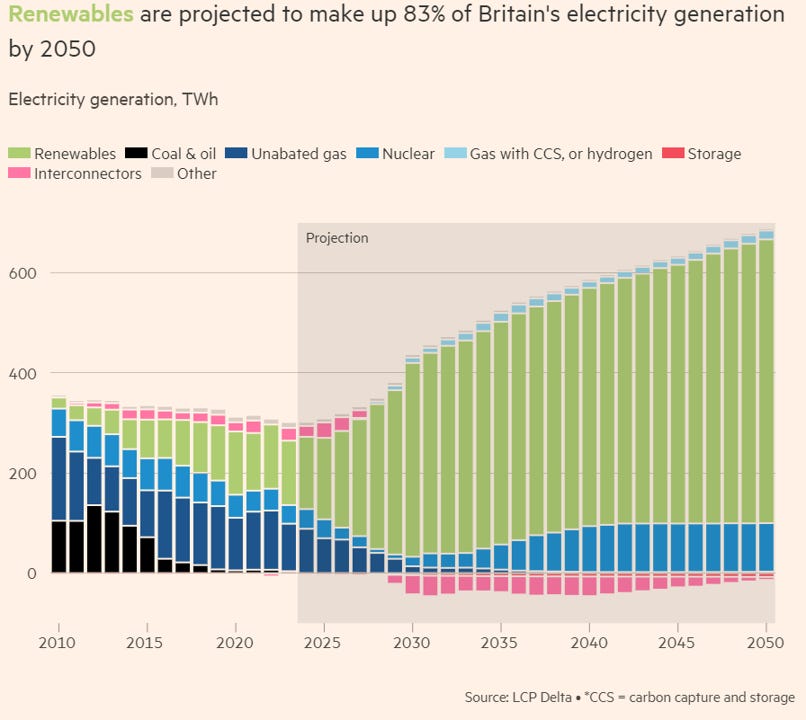
There’s something awe inspiring about exponential curves. Global GDP, computer processing power, and, during COVID-19 pandemic, the spread of the virus; all lines rocketing towards the heavens.
Nigeria’s population is no exception. I find myself strangely drawn to it, checking back every few months to marvel at a demographic explosion in action. In 1960, Nigeria’s population was 45 million. By 2000, it was 120 million. Today, most put it around 230 million. How high can it go? Estimates for 2100 range from 700 million to 1.1 billion.
But what if the graphs I’ve spent more time than I care to reflect on were just that – graphs – rather than representations of reality on the ground. This week, I learned that Nigeria’s last complete census was in 2006, when the country recorded a population of 140 million. The cone planned for 2016 was repeatedly delayed, and the 2023 census is yet to be collected.
Census-taking is controversial in Nigeria. It was a significant cause of the Civil War in the 1960s, where the Muslim north and Christian south vied for numerical supremacy. These power wranglings continue to this day, with districts, segmented by religion, are incentivised to inflate their population estimates to receive bigger budgets and more political representatives. As such, Nigeria’s official population count is almost certainly too high, with some suggesting it could be out by between 50-100 million.
A few weeks ago, I criticised JD Vance’s sexist approach to natalism, arguing that it would put people off the cause. Funnily enough, the Guardian’s Nesrine Malik has now written an excellent column about how she finds comments from Vance and others alienating. Malik states that men like Vance have an “inability to conceive of women outside mothering” and fail to understand the “material considerations to be taken into account upon entering a state from which there is no return” such as “the need for affordable childcare, support networks, flexible working arrangements and the risk of financial oblivion that motherhood frequently brings, therefore creating bondage to partners.”
Profoundly and beautifully, Malik concludes:
“Women have to navigate all that motherhood – or not – entails, all the deeply personal, bewildering, isolating and unacknowledged realities of both, while being subject to relentless suffocating, infantilising and violating public theories and notions that trespass on their private spaces. With that comes a sense of self-doubt and shame in making the wrong decision, or not being as content with those decisions as they are expected to be. It is a constant, prodding vivisection. That, more than anything clinical observers feel, is the truly disorienting and disturbing experience.”
The French Institute for Demographic Studies has a nice new tool allowing you to compare a variety of demographic indicators by country. Martin Kolk, a Swedish demographer, made this graphic.
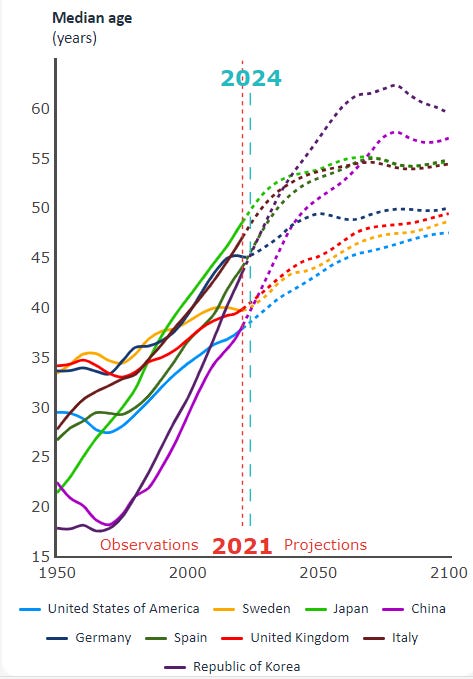
It shows that there is a wide range in median ages among Western countries, with the US and UK at around 40 years old, while Japan, Germany and Spain push 45. Also illustrated are the differing rates of change. China and South Korea have aged rapidly, moving from a median age of around 20 in 1970 to 39 and 44 today, respectively. By comparison, the UK’s ageing has been much more gradual, increasing from 35 to 40 over the same period.
Most frightening is where we might go next. South Korea is expected to reach a median age of 60 in the 2070s, meaning that there would be as many people aged 0-60 as 60+. It’s hard to see how a society could function in that situation – and it could be within our lifetimes.
No posts
Comments
Nothing yet. Say the first thing.
Sign in to join the conversation.