
According to an article in Fortune, “nearly half the OpenAI staff that once focused on the long-term risks of superpowerful AI have left the company in the past several months … as OpenAI continues to shift toward a product and commercial focus, with less emphasis on research designed to figure out how to ensure AGI can be developed safely.”
For those who take. AI risk seriously, this is bad news, and a development reflecting a broader trend within AI discourse this year, which a long read in the Atlantic recently explored. When ChatGPT launched, the article argues, AI doomers had their moment to influence the discussion, and, for a while, found sympathy among legislators and the public, who instinctively understood the risk of superintelligent machines.
But, somehow, they failed to meaningfully effect change. The purge of OpenAI’s board late last year, despite the company’s supposed in-built humanist philosophy, showed that talk (and corporate governance structures) is cheap for technologists hellbent on acceleration.
According to the Atlantic, the AI safetyist movement is currently gripped by despair, unable to stop the runaway train they think could drive humanity off a cliff. Although the article doesn’t reference Leopold Aschenbrenner, the idea of some form of AI Manhattan Project (which is exactly his idea) controlling the technology’s development, is supposedly garnering support.
The FT had a depressing Big Read titled ‘Learning to live with 50C temperatures’, which offered very few answers beyond: it’s going to get very hot in some places and there’s not that much they’ll be able to do about it.
The adaptations being (gradually) adopted by some Gulf States such as ‘don’t build as many massive glass skyscrapers which reflect the heat’, and ‘use more efficient communal air conditioning systems, rather than individual units for every office/flat’ were deemed to be grossly inadequate.
But perhaps 50 degrees Celsius is already old hat. A heat index (a measure which combines temperature and humidity and reflects a more accurate ‘feels like’ temperature) of 82.2°C was recorded at Qeshm Dayrestan International Airport in Iran yesterday. If confirmed, this would be the highest heat index ever recorded on Earth.
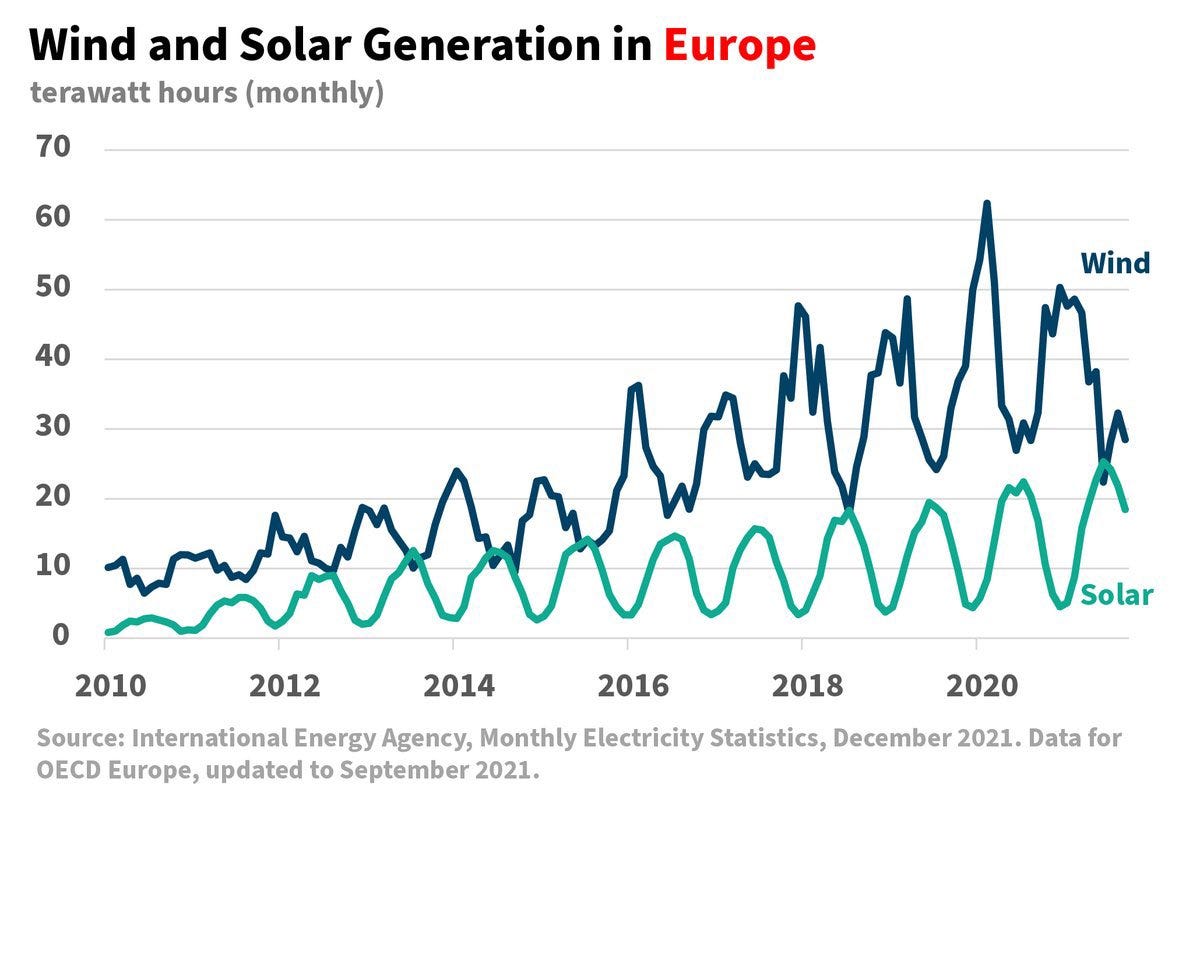
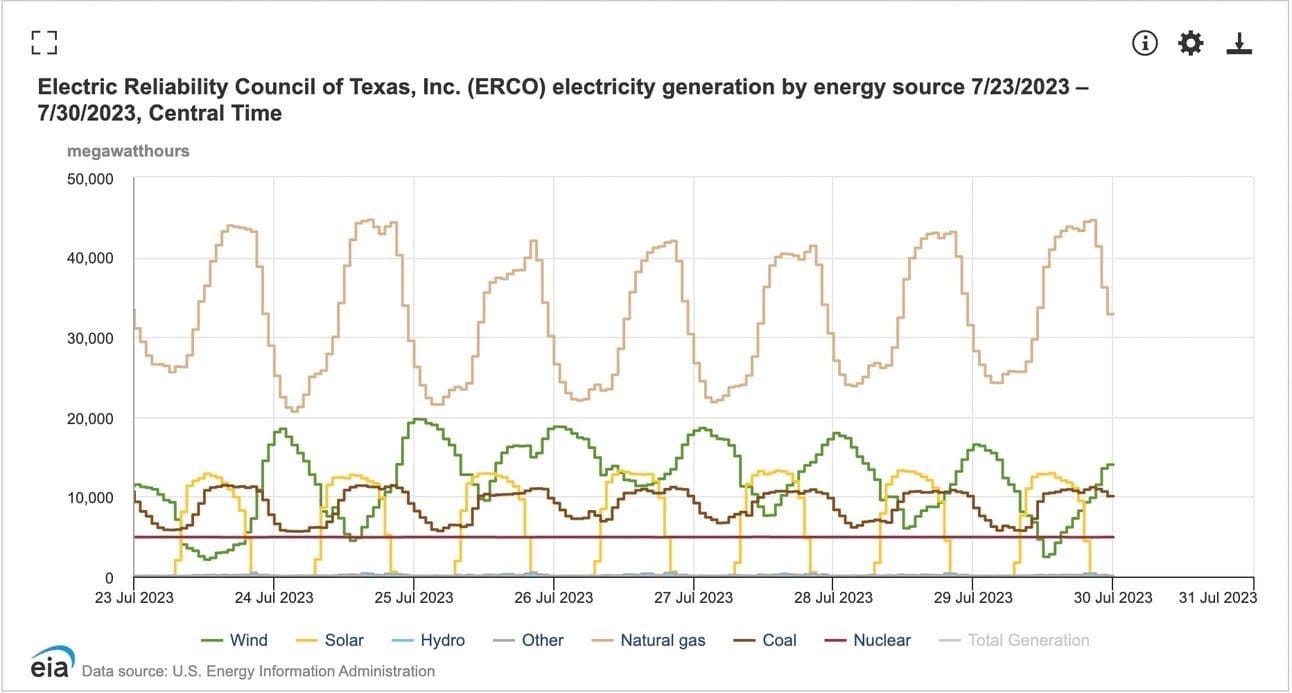
The Institute for Progress’ Alec Stapp shared the following tweet, which I want to amplify:
“Everyone knows about the intermittency challenge with renewable energy. But not as many people know that solar and wind are complementary both daily and seasonally. Solar peaks during the day and in summer. Wind peaks at night and in winter. They work better together.”
Nearly every week, I talk about the world’s fertility problem. For all the complexity, it comes down to this: the world isn’t having enough children and that has consequences. Understandably, natalist policies try to bump the numbers. But is the world’s fertility problem more complex than that, and therefore requires a more nuanced solution?
New US data shows that fertility is inversely correlated with education, meaning that the more educated people are, the fewer children they have. Only the least educated have a fertility rate above replacement, while those with bachelor’s level degrees or higher are skirting around 1.0, half what’s needed.
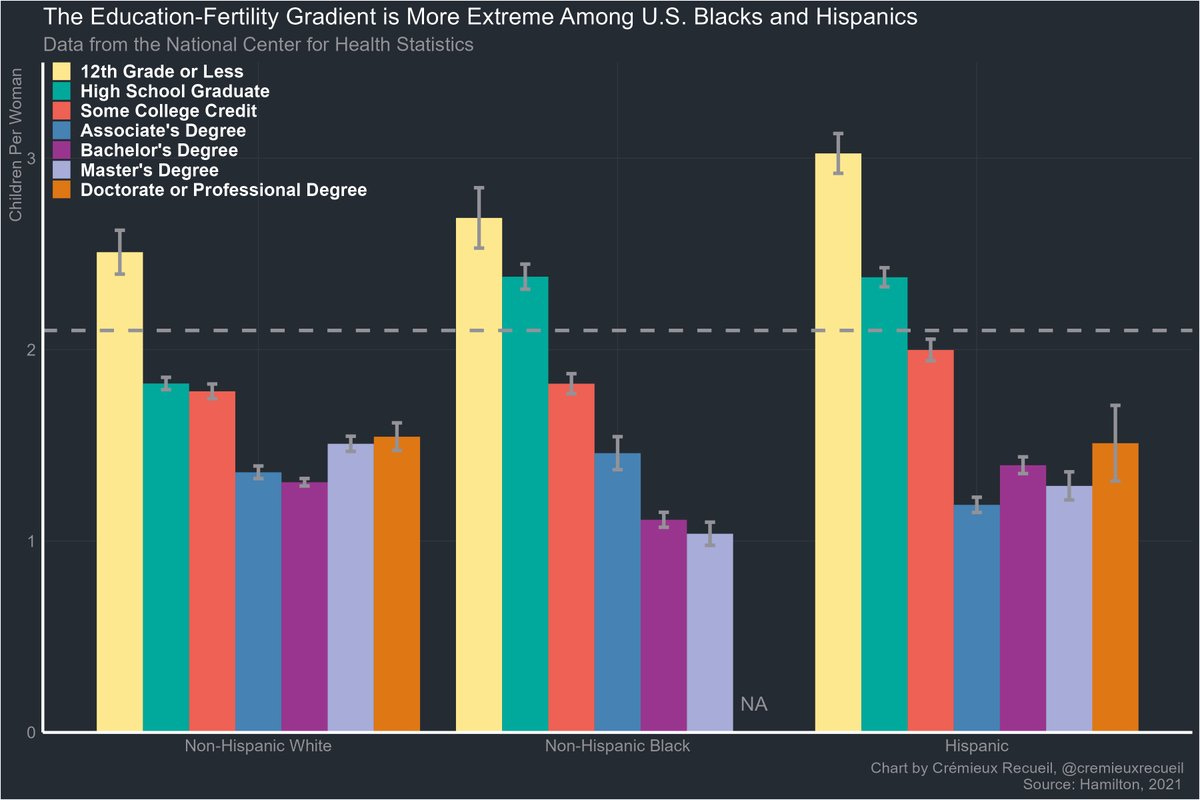
This poses a heretical question: rather than simply not having enough children, are we having enough of the right children?
I will immediately caveat this statement by saying that this is to say nothing of the individual worth of any single person. But given we know that intelligence is, to a high degree, hereditary, that intelligence is positively correlated with academic success, and that both academic success and intelligence are positively correlated with a whole host of societally desirable attributes such high income, high innovation and low crime, then it matters if most children are coming from people with less education.
Less subtly, as comedian Romesh Ranganathan said: “Morons are taking over, aren't they? And they're reproducing more quickly than us. For every intelligent person using a condom, there are two dipsticks using clingfilm.”
Rather than devising blanket policies to boost fertility, we need to consider tailored strategies to reach groups with the lowest fertility and where the impact of targeted efforts would be greatest: the highly educated.
A new report by the Entrepreneurs Network found that of UK’s 100 fastest-growing companies, 39 have a foreign-born founder or co-founder. These immigrant founders come from across the world, with America being the most common origin country, followed by Germany and India. This is a significant overperformance given fewer than 15% of the UK’s population is foreign-born.
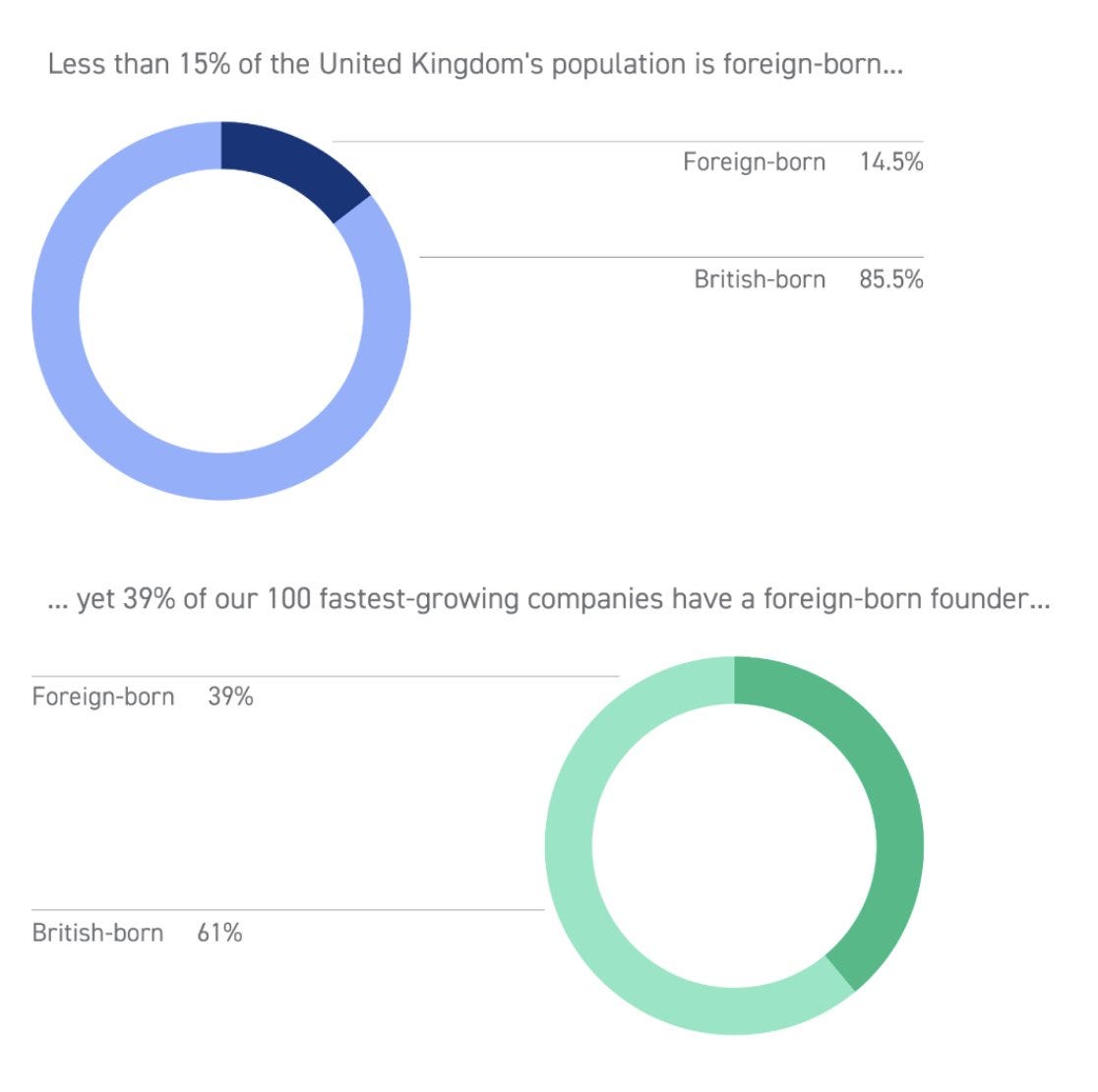
Given how valuable immigrants are to the UK’s startup ecosystem, the report made a series of recommendations, including:
Relaxing the new rules put in place last year which raised the minimum salary threshold for migrants to £38,700, and for certain industries, such as software engineering, even higher (£49,400).
Negotiate youth mobility schemes with the EU (and the US).
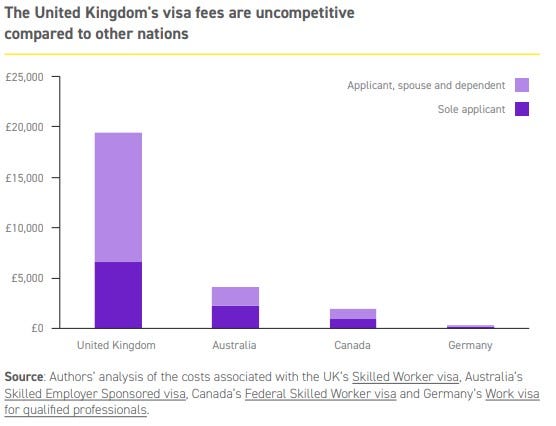
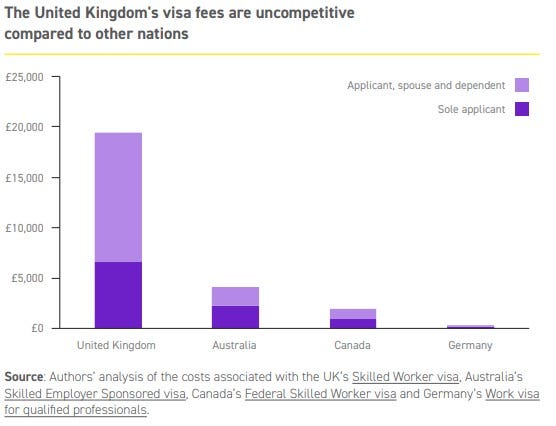
Lower uncompetitive visa fees.
Expand the High Potential Individual visa to more universities (a visa allowing graduates from the world’s top universities to come to the UK for two years before they have a job offer). Last year, only 42 universities in the world qualified.
Establish a specialised task force to recruit international talent, similar to America’s Operation Paperclip, which recruited 2,000 German engineers and scientists after WWII.
Grant advanced STEM students Indefinite Leave to Remain upon graduation.
Introduce the world’s first Global Talent Exam to actively recruit the world’s brightest individuals.
Building on the positive economic impact of skilled migration, the Migration Observatory from the University of Oxford has a new paper on the economic fortunes of the 1.2 million non-EU migrants who have arrived in the UK since 2015.
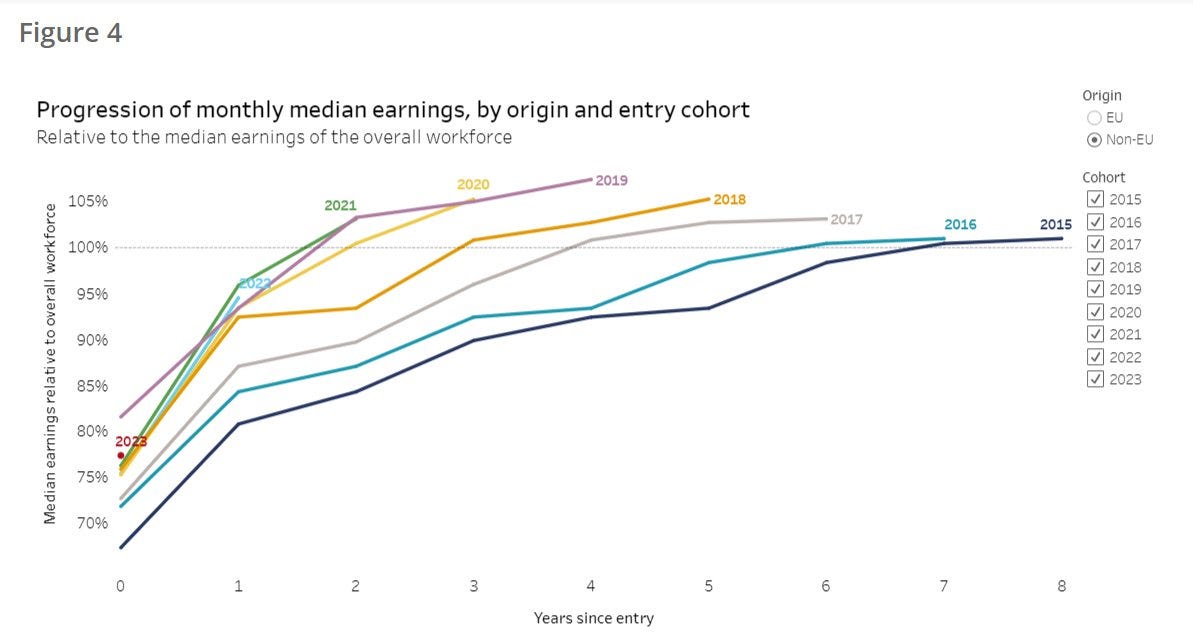
The analysis shows that the median income of every cohort eventually exceeds that of the general UK population. Furthermore, each cohort is reaching this level faster, reducing from 7 years for those that arrived in 2015, to only 18 months for those that came in 2021.
The only credible economic argument against migration in the UK is that the rate of change is too fast for supply of public services to keep up (which I disagree with). All other arguments are unfounded.
South Korea's fertility rate was 0.71 children per woman in Q2 in 2024, unchanged from Q2 in 2023. Is this the floor? (Narrator: It probably wasn’t).
No posts
Comments
Nothing yet. Say the first thing.
Sign in to join the conversation.