
Another week, another AI mega-essay. This one from Control AI, an AI safety think tank/pressure group, might be the closest we’ve come to a proper policy proposal. Here’s a quick AI-generated summary:
Introduction:
Humanity’s extinction is possible, and we can now create AI that rivals human intelligence.
Companies are investing to create artificial superintelligence that could surpass all human capabilities.
We don’t know how to control AI vastly more powerful than us, risking our extinction.
There is a narrow path to a future driven by human advancement and controlled AI.
The Problem:
The greatest threat is the concentrated effort to create artificial superintelligence.
We can’t predict or control an entity with greater intelligence than us.
The risks originate from AI’s intelligence enabling greater power over other actors.
We lack a sufficient theory or science for measuring intelligence.
The Solution — Three Phases:
Phase 0 Safety (next 20 years):
Prevent development of artificial superintelligence.
New institutions, laws and policies to control AI development.
Restrict compute, general intelligence, and dangerous capabilities.
Phase 1 Stability:
Build international system to maintain AI oversight long-term.
Create institutions for non-proliferation, verification, and cooperation.
Phase 2 Flourishing:
Develop foundations for safe, controllable transformative AI.
Build science of intelligence, specification methods, safe-by-design systems.
Key recommendations include:
Licensing regime for frontier AI development.
International treaty establishing compute thresholds and red lines.
New institutions like International AI Safety Commission and Global AI Research Lab.
Shift research focus to safety engineering and formal methods.
The goal is to harness beneficial AI capabilities while keeping humanity in control, unlocking prosperity and progress without extinction risks. Significant challenges remain in distributing benefits and using new powers wisely.
End of summary.
A lot of this seems sensible, but, to me, it has a touch of the Gordon Brown disease, namely, the belief that complex problems can be solved by simple, considered top-down policy, administered cooperatively by all relative stakeholders.
But that’s not how the real world works. People have competing incentives and don’t always act in humanity’s best interests, even when it’s spelled out for them. In this instance, it’s not in everyone’s interests to ‘pause AI’, the first stage of this policy.
Would OpenAI’s new investors, who have all supposedly put in at least $250m, be willing to have their investment stymied? Will Silicon Valley accelerationists, who have made a philosophy out of technological innovation, willingly down their tools, when they would think doing so is literally evil? And would every country abide by a temporary ceasefire, and not recognise that there’s a huge competitive advantage in moving forward while everyone else stands still?
You might argue that ‘they might not like it, but they won’t get a choice’, but in a globalised economy, that’s easier said than done. Overall, it's a nice plan, but I very much doubt it’s going to happen. Until AI safetyists get real about the market they’re trying to regulate, control will evade them, and Sam Altman will keep on winning.
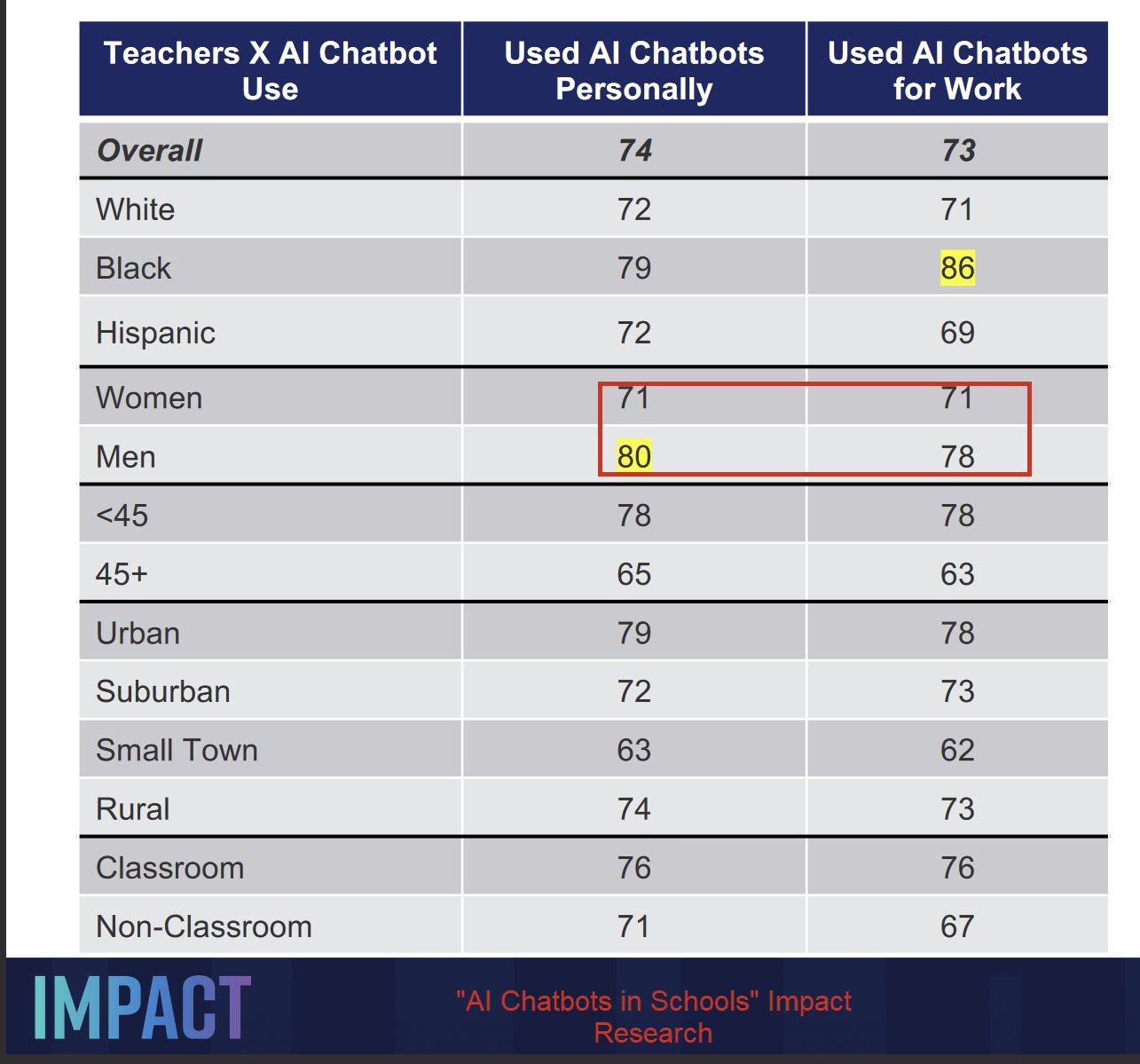
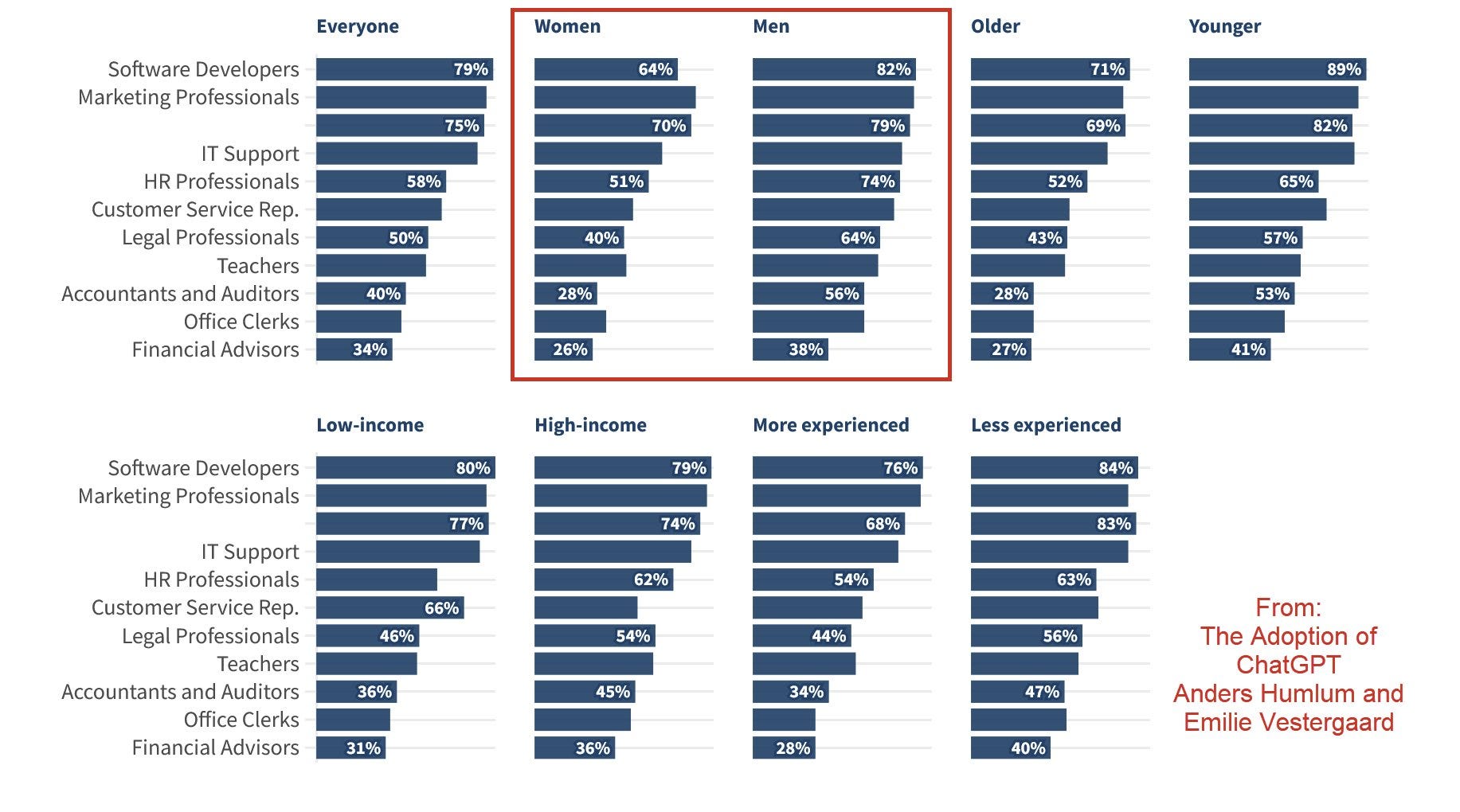
Research collated by Ethan Mollick, a leading AI professor at Wharton, showed that there is a consistent 10-20% gap across professions between the percentage of men and women using AI at work. Given AI is, for almost everyone, the future of work, and you only get good at using it through practice, this should be concerning for anyone worried about closing the gender pay gap.
An article in The Conversation made the perceptive point that elderly people in Africa are at acute risk from climate change. We all know that older people suffer in the heat. The BBC remind us every time it approaches 30 degrees, and Switzerland was even told by the European Court of Human Rights that it should to pay pensioners to compensate them as the climate warms.
In Africa, the situation will be much more serious. The continent is forecast to experience the worst effects of climate change, with temperatures set to soar from their already high levels. The mercury topped 50 degrees in Algeria this summer, for example. These dangerous temperatures will likely be inflicted on communities without access to air conditioning.
That will be coupled with a dramatic rise in Africa’s elderly population. We often think of Africa as a young continent (and it is), but falling fertility rates and ballooning populations mean that the number of over 60s is forecast to rise from around 70 million today to 235 million by 2050. It will be a big problem.
Last week, a friend queried the fertility rate of 1.5 I cited for Turkey. Search for it on Google and you get 1.89, and if you go into the UN or World Bank databases you get the same figure. Surely, I’d made a mistake?
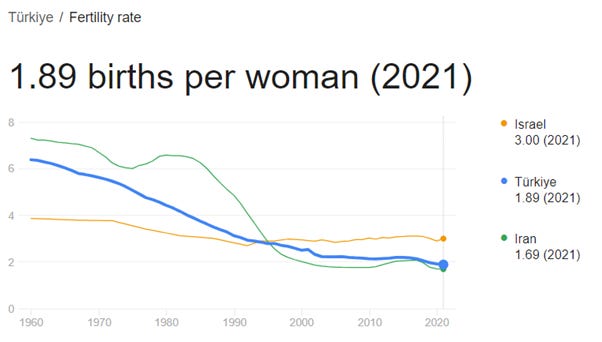
But take a look at the country’s official figures. In May, Turkey’s State Statistical Institute announced that the country’s birth rate had decreased for the eighth consecutive year in 2023, dropping to 1.51 children per woman. In response, Recep Tayyip Erdogan called the decline an “existential threat” while also taking a bizarre swipe at Eurovision for promoting “gender neutralisation” and threatening the traditional family with the “Trojan horses of social corruption.”
Given Turkey suffers from negative net migration, it can’t rely on immigrants bolstering the numbers. It’s heading for demographic decline. Even if we assume zero net migration and that fertility steadies at 1.5, Turkey’s 85 million population will fall to around 35 million in three generations. Can East and West ‘meet’ in a country smaller than modern day Morocco?
Falling births won’t only harm Turkey internationally, it could also cause internal strife. The much-maligned Kurdish population living in the South East of the country, who have been oppressed since the country was founded, a tradition continued under Erdogan, have a significantly higher fertility rate. The Centre for Eastern Studies estimates it to be between 2.5-3.5.
This difference in ethnic fertility rates will mean that Kurds become a growing force within Turkey. Internal migration within the country from East to West means that it’s difficult to extrapolate numerically, but we can be fairly sure that Turkey will struggle to control a growing Kurdish population, with the potential for unrest, or, at the very least, rising nationalism.
P.s. if you want to learn more about why the UN’s estimates are bogus, listen to Alice Evans’ recent podcast with economist Jesús Fernández-Villaverde. Here’s the key extract: “We send [the UN] an email [about their overestimation of fertility rates] and they told us they don’t want to be alarmist. That’s literally what they say in the email. They say, yes, maybe these projections do not make a lot of sense, but we want to be very cautious and we don’t want to be alarmist and we don’t want people to think there is a crisis looming.”
The trouble with the UN deciding what information the public knows is that it leads to people making decisions – both personally and politically – based on fake data. The result is polling like this.
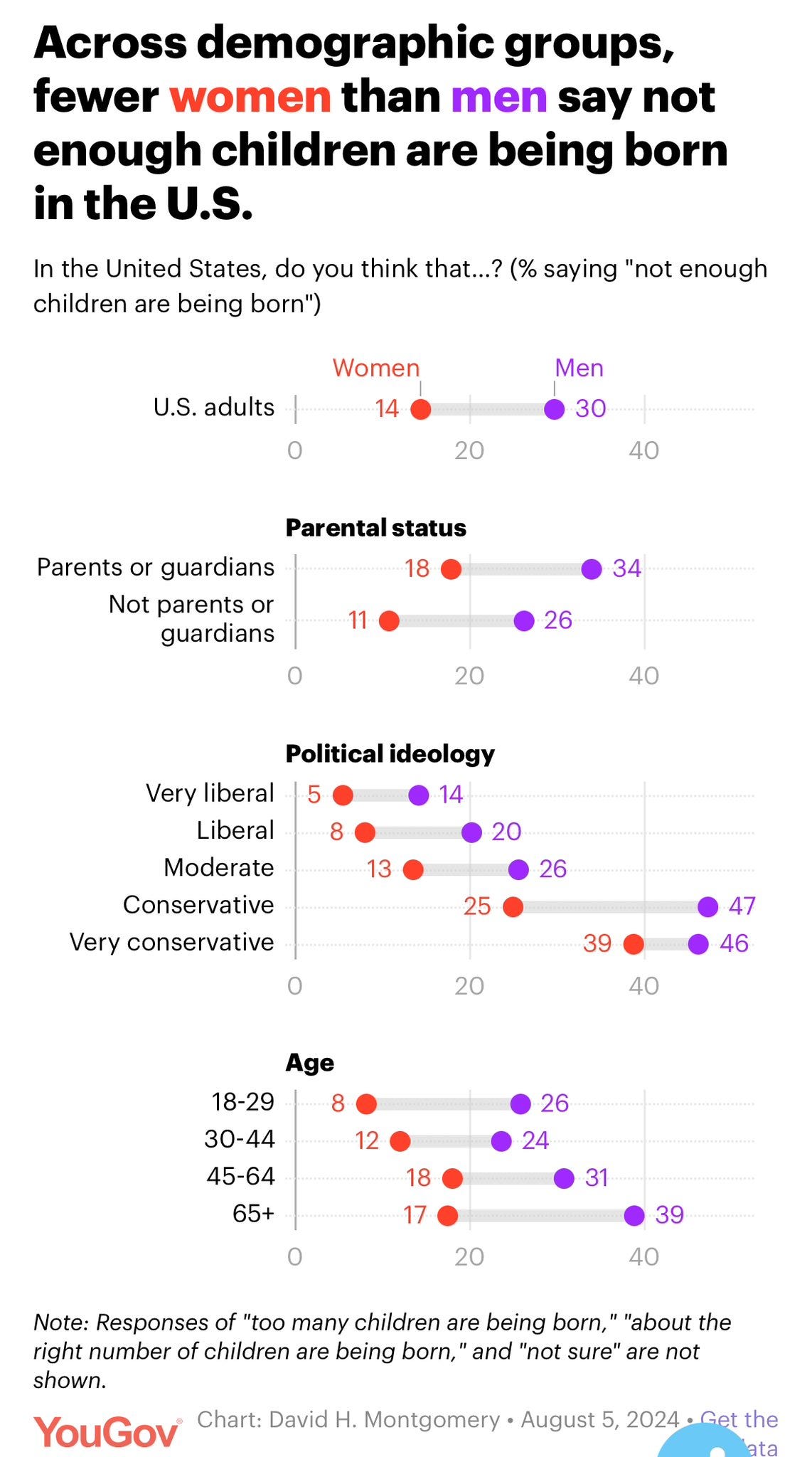
Sure, the gender gap is notable (funnily enough, if the burden of caring for children largely falls on women, then they respond to that opportunity cost by being less positive about it), but for me, the implications cut across the gender divide. It just makes me think ‘they have no idea because no one’s told them’.
No posts
Comments
Nothing yet. Say the first thing.
Sign in to join the conversation.