
Sam Altman seemed to have it all figured out. An unknown to most outside Silicon Valley until OpenAI launched ChatGPT, he immediately took to the global stage with ease, courting politicians to guide them towards sensible AI regulation. It was a masterclass in corporate leadership, communicating openness, accessibility and overall sensibleness in a scary industry that could easily face a regulatory crackdown.
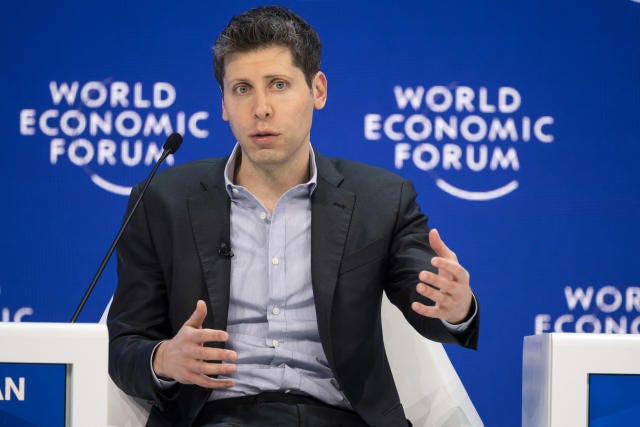



But that seems to have changed. Altman is barely seen in public anymore (in May, he even admitted to becoming a recluse), and OpenAI is striking a more defensive tone. This week, their Chief Strategy Officer, Jason Kwon, said California's draft AI bill “would threaten that growth, slow the pace of innovation.”
Now, there’s nothing wrong with a company not fully supporting incoming legislation. What is problematic, as Max Tegmark said, “it will be great if you can clarify *how* you want AI to be regulated rather than just explaining *how not*. Please list specific rules and standards that you want OpenAI to be legally bound by as long as your competitors are too.”
Since then, crickets.
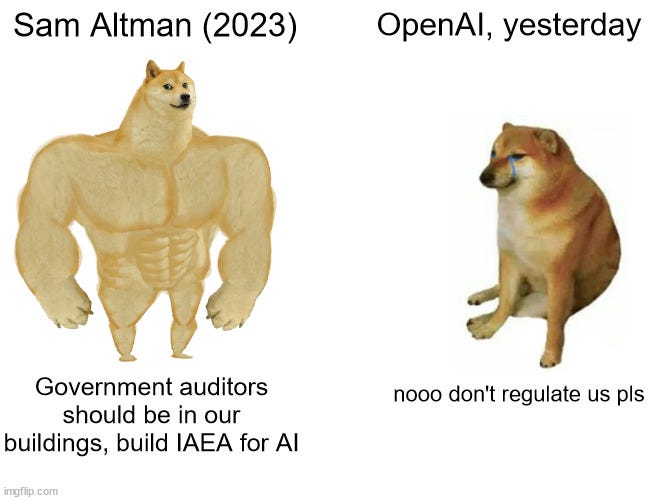
If Altman wants to change the conversation about AI regulation, he needs to find his voice again.
I enjoyed this column by Rupert Younger in the FT, which argues, as the headline suggests, that advances in AI technology, coupled with the need for businesses to become ever more streamlined and data-driven, means that we may not be far away from the first AI COO.
I won’t claim to understand enough about the intricacies of the COO role to know just how much of a stretch this is, but I do think it poses an interesting question about how AI could disrupt organisational structures.
At the moment, most businesses seem to be working under the presumption that trained Large Language Models (LLMs) can, in different ways, make individual workers more productive, acting a bit like a personal intern. At the same time, there is a lot of talk of LLMs fully automating more junior roles.
But logic would suggest that there are, in certain fields, mid-ranking or even senior roles that LLMs could already do a decent job at. Rather than everyone using their own LLM and the bottom rung of firms being automated away, should we expect more of a patchwork, with AI completely taking some tasks that were previously non-entry level, and organisations adapting their structures around them? It may be that companies need significantly fewer people in operations, but a similar number in advertising, say.
Claire Coutinho, the UK’s shadow Energy Secretary, reacted to an article in the Telegraph by scientist, Bjorn Lomborg, with the headline, ‘Innovation not global regulation will save the planet: Green goals have always been attained through human ingenuity. This time will be no different’, with the caption, ‘This is spot on from, Bjorn. As I said in my speech earlier this year, the big prize in climate change will be innovation e.g fusion, batteries, small modular nuclear reactors. The UK can play a major role in providing the solutions the world needs.”
This is partly true. We clearly need innovation in green energy, tech and infrastructure for a green transition. Just as important, though, is actually implementing it, both in the UK and around the world. We already have the technology to build all the green energy we need in the UK, for example, we just haven’t built it due to political choices. Likewise, the West can invent more efficient solar panels as much as it wants, but unless it works with the Global South to develop projects around the world, it won’t be a global transition.
Lastly, I would caution anyone from using Lomborg as their go to climate scientist. He’s probably not the most credible guy out there…

There’s been a lot of talk about the family policies of Taiwanese semiconductor manufacturer TCMS, after a tweet went viral proclaiming that:
“TSMC employees are 0.3% of Taiwan's population but 1.8% of annual fertility, Taiwan's Total Fertility Rate is 1.24 TSMC employees are above replacement rate though. To solve the fertility crisis all we have to do is make everyone work for TSMC.”
Although UK immigration academic, Jonathan Portes, added some helpful statistical context for why this isn’t quite as impressive as it makes out (essentially, as a tech company, TSMC almost exclusively employs people aged 20-40, so their employees are much more likely to become parents than the population average), TSMC still likely has a much higher fertility rate than one would expect. Why?
Phoebe Arslanagic-Little from the Boom Campaign (and also Onward) wrote a good article making the case for how TSMC’s generous family policies show how a ‘new deal for parents can shift the dial. At the Taiwanese company: childcare is offered to employees from 7am to 8pm; there are half-day science camps on the weekend; for the parents of infants, there are flexible shifts and lactation rooms for breastfeeding or pumping; and for expectant mothers, there is a sliding scale of maternity leave, with 12 weeks for the first child, 16 for the second and 20 for the third.
However, as Arslanagic-Little points out, the high salaries of TSMC’s employees may also be a factor, given, beyond a certain income, households have more children (with the distribution forming a U-shape, with middle income households having the fewest). The average salary drawn at TSMC is about £60,000 a year, despite the median Taiwanese income only being about £16,000.
I’m afraid that I’ve become cynical of supposed natalist policy success stories, and that this example hasn’t done anything to shake that.
Alec Stapp, Co-Founder of the Institute for Progress, tweeted a great thread on a paper titled ‘Top Talent, Elite Colleges, and Migration: Evidence from the Indian Institutes of Technology’. The paper found that, out of the students taking the entrance exam used for the prestigious Indian Institutes of Technology (IIT), 36% of the top 1000 have migrated abroad. This increased to 62% of top 100 scorers and 90% of top 10 scorers. Twice as many migrated to the US as any other country combined (65%). The UK came in second at 5%.
To conclude, here’s a depressing read: ‘If populations are declining — how can investors make the most of it?’. In times of war, buy defence stocks. When people stop having children, buy healthcare.
No posts
Comments
Nothing yet. Say the first thing.
Sign in to join the conversation.