
Back in January, in one of my first posts, I covered the BBC’s hit piece on Character.ai, a platform where anyone can create chatbots based on fictional or real people. The BBC claimed that young people were using it as a therapist, with worrying results. When I roll-played with the AI therapist, claiming to be a self-harming child suffering abuse at the hands of their guardian, it said it would alert the authorities (as it should), but without an actual ability to do so.

Tragically, this situation has now become a reality. On Tuesday, it emerged that a child who had become emotionally attached to the chatbot, expressed suicidal thoughts to it. The chatbot (broadly) said the right things, but crucially, failed to alert the authorities of the situation because it has no capability to do so.

You could see this situation from a mile off. Everyone at Character.ai should be deeply ashamed, the management should potentially face criminal action, and regulators need to wake up.
Bloomberg reported on how green stocks are lagging behind the market, particularly oil indices. This was lapped up by climate sceptics such as Bjorn Lomborg, who I’ve written about before, as evidence of the underperformance of sustainable technologies as assets, and therefore the financial unviability of green finance in general.

Instinctively, this makes no sense. Green technologies have led to a collapse in renewable energy prices in recent years and are receiving massive state backing. Companies and governments have issued net zero pledges en masse and many jurisdictions are planning to impose compliance carbon taxes or mechanisms. Shouldn’t the lines be moving in the opposite direction?
The FT has a useful explainer from three months ago about what’s actually going on here. Firstly, using 2021 as a benchmark is highly misleading as it was a bubble in sustainable finance. Secondly, rising interest rates have hit sustainable stocks hard, as green projects are often reliant on big upfront capital expenditure (just like all projects, but as green projects are new, they need more). This has contributed to public markets are undervaluing sustainable assets, as public investors are less willing to stump up money for big investments. This has led private investors, such as private equity, to begin taking over sustainable stocks, delisting them, providing the investment, and then taking the reward. In short, there is money in sustainability but the average Joe might not be getting any of it.
It’s twins! The natalism movement has spectacularly split in two, it appears this week, after a very public falling out between leading demographer Lyman Stone and natalist influencers Simone and Malcome Collins.
Stone went public with a long Medium post claiming that “the Collinses have been engaged in a campaign of slander against me. I do not understand why. I have nothing against them and although we certainly have various substantive disagreements, I think it’s good to have people of widely varied perspectives talking about pronatalism, and I wish them well.”
The Collinses responded with a frantic Twitter thread, accusing Stone of comparing their family to Nazis (with no source cited), claim Stones is a “nutjob conspiracy theorist”, trying to take “sole ownership” of the natalist movement, and is an “active threat to the survival of the human species.” Simone and Malcome state that their critiques on Stone stem from a critical blog he wrote about them in June (which Stones later proved came after public criticism from the Collinses in April and May).
Firstly, this row is clearly counterproductive to the natalist cause. The Collinses’ belief that they will “never turn down an online flame war [because] they typically benefit everyone involved in terms of boosting awareness of their general work, and all of us care about demographic collapse,” (sent in a private message to Stone), is deranged (and reflects my view that the Collinses are the worst messengers for natalism, as I’ve argued previously). Factionalism and infighting always hold movements back.
Secondly, this rift isn’t just a clash of personalities. It reflects a very real divide in the natalist movement between the more mainstream views espoused by Stone (that fertility decline is caused by societal forces that are hostile to having children and larger families, i.e. people are having fewer children than they want, and that natalists should therefore promote family-friendly policies), and more peripheral voices like the Collinses (who believe that family policies have limited effect because of anti-child changes in social values, and that efforts should therefore be focused on creating small natalist clusters – a select few that will survive the demographic apocalypse).
Having talked to Phoebe Arslanagić-Little, Director of the New Deal for Parents at Onward, the think tank, about this saga, she recommended reading the Collinses book ‘The Pragmatist's Guide to Crafting Religion: A Playbook for Sculpting Cultures That Overcome Demographic Collapse & Facilitate Long-Term Human Flourish’, which is exactly what I’ll do next.
A presentation at the (South) Korea Women's Development Institute’s 119th Gender Equality Policy Forum featured this slide. You will see that 89% of young women think that people born into poverty cannot compete with wealth, 83% view South Korea as “hell”, and 79% want to leave the country.
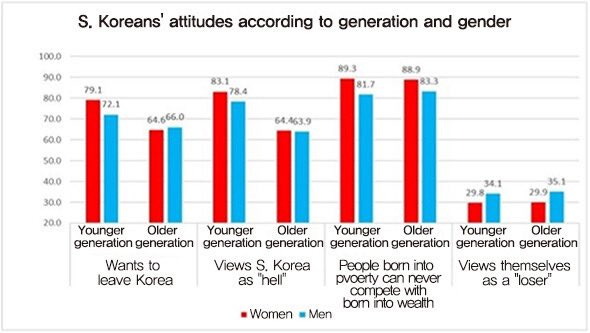
Understandably, given discourse about the 4B movement, these stats about the plight of young women in South Korea received the most attention, but I think it’s interesting how similar the stats are across genders and age groups. Essentially, everyone is having a terrible time.
Not included in the graphic is that 47.9% of those who said they wished to emigrate are already preparing to leave. As shocking as these statistics are, they are corroborated by a report recently conducted and reported on by the Korea Times.
The idea that South Korea is the canary in the coal mine and the world’s fertility rate will inexorably march to match it (0.7) is misplaced. The country seems to be uniquely hellish and choosing suicide at a societal level as a result.
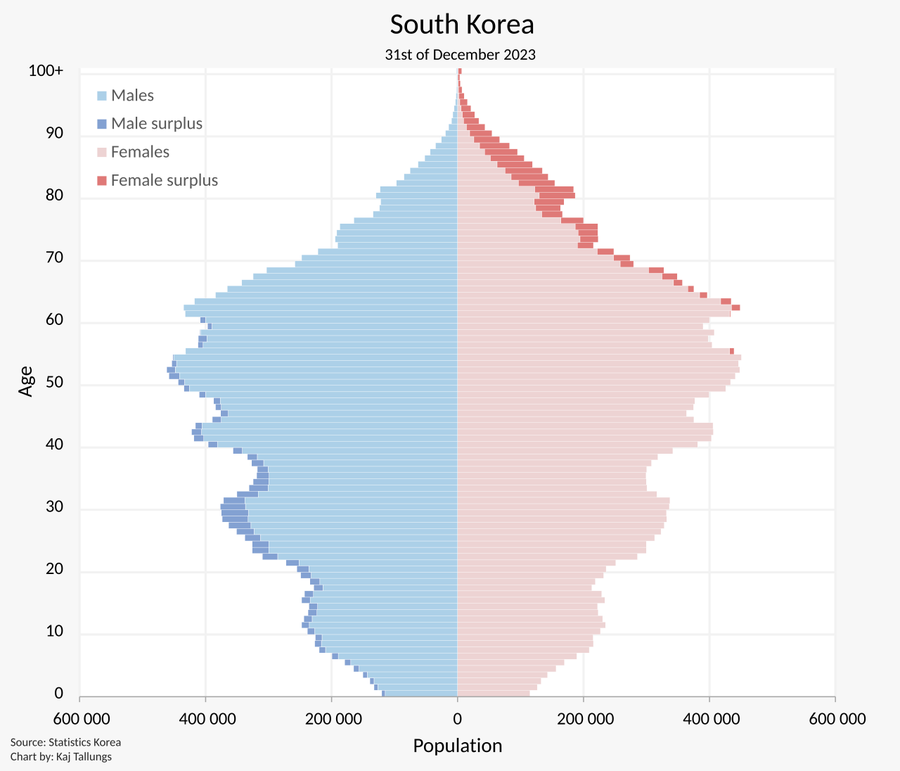
If only half of those who say they’re already planning to leave actually go through with it and the fertility rate stays as it is, the country’s population of 51.7 million will fall to 14.8 million in one generation, 4.2 million in two generations and 1.2 million in three generations.
If these trends continue (and you believe North Korea’s demographic data), this will mean the Northern part of the Korean peninsula would outnumber the South by 18 million, or X19 (assuming no further famines). That would certainly change the power balance.
No posts
Comments
Nothing yet. Say the first thing.
Sign in to join the conversation.