
Artificial intelligence
All I want for Christmas
OpenAI plans to release its next big AI model by December, around the second anniversary of the release of ChatGPT. Orion, the internal code name for what may be called ‘ChatGPT-5’ externally, could be up to 100 times more powerful than GPT-4, according to insiders. Can you feel the acceleration?
AI animation
I’m mesmerised by Runway, an AI video generator. Like a few AI video generators, users can create personal AI avatars simply by recording a short video of themselves talking. What makes Runway different is that the user can then create videos in a variety of styles. Take a look at some of these (real recording on the left and AI animations on the right)!
Thanks for reading Chronicles of the Future! Subscribe for free to receive new posts and support my work.

Climate change
Heat pumps and hot air
I was drawn to this graphic about the energy efficiency of heat pumps by Ember Energy. Slightly confusingly, energy flows from the centre outwards (i.e. from right to left for gas boilers and from left to right for heat pumps). It shows why heat pumps are so much better for the environment.
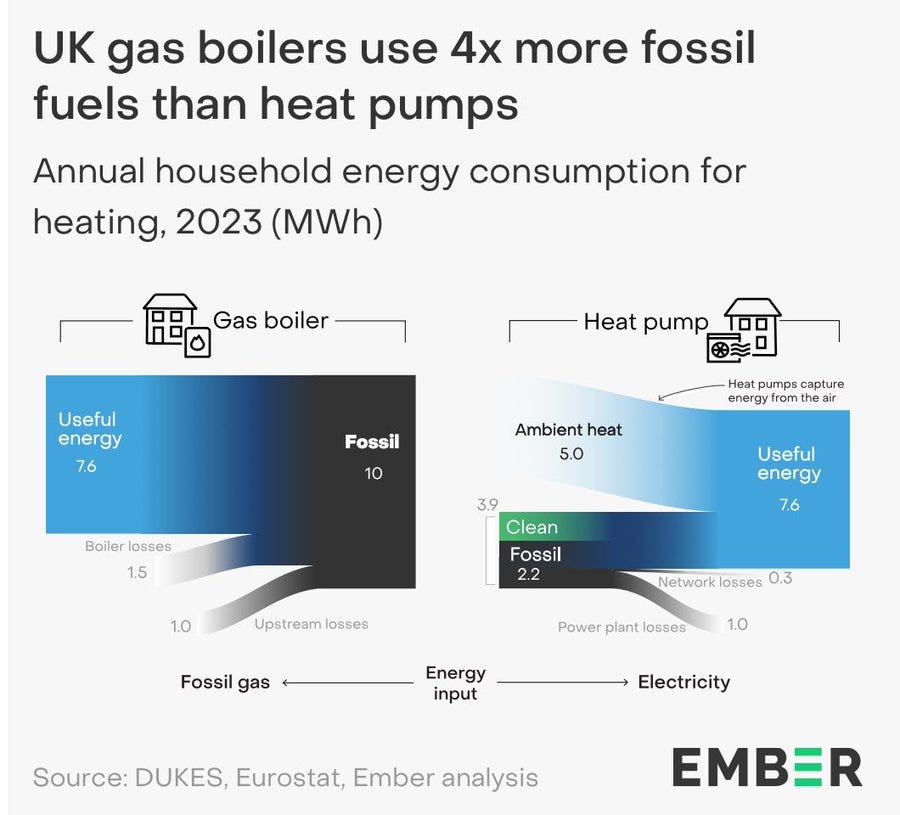
So, why isn’t everyone buying them? I dug into the National Audit Office’s (NAO) March report called ‘Decarbonising Home Heating’ to find out. Here are the key points:
18% of the UK’s greenhouse gas emissions come from home heating, showing the importance of moving away from gas boilers, which currently heat 88% of UK homes
The Department for Energy Security and Net Zero are targeting the installation of 600,000 heat pumps by 2028
However, in 2022, only 55,000 heat pumps were sold
The NAO blamed the low uptake on limited public awareness of the technology, the higher costs relative to gas boilers, and the lack of long-term financial support for households
On higher costs, the National Infrastructure Commission estimates that air source heat pumps (the most common type for households) costs £10,000 more than a gas boiler on average
£7,500 of this is now covered by government grants available
The Climate Change Committee estimates that £162bn of additional investment will be needed from 2020 to 2050 for installing low-carbon heating in existing UK homes
As heat pumps have similar life expectancies to gas boilers (10-15 years), their elevated cost isn’t a one-off (although maintenance of gas boilers is higher). Making them cheaper must be a priority, rather than subsidising them forever. The UK Government hopes that the cost of installing a heat pump will fall by between 25-50% by 2025 compared to 2021, and be equivalent to gas boilers by 2030 (excluding subsidies).
Industry experts are sceptical, however. In May, Mike Foster, CEO of the Energy and Utilities Alliance, told This is Money that there’s a natural limit to how cheap heat pumps can be. “The argument that prices will go down as volumes go up is a false argument. These products are already globally traded products.”
Bean Beanland, Director of Growth and External affairs at the Heat Pump Federation, added: “The devices themselves are already competitive … the heat pump sector is already mature.”
While claiming that the heat pump market is mature, when so few UK households have one, seems improbable, but when you look at the global picture, as Foster suggests, it’s thought that 190 million heat pumps are in operation. That’s a pretty big market, with room to grow by one order of magnitude but not two.
If we can’t get the price down, then heat pump adoption will be the type of environmentalism that I’m wary of – one that impacts living standards. In home heating, if we want to reach our climate pledges, our only choice may be the timeframe over which we take that hit.
Demographics
Decline and fall: Britain’s fertility rate
The UK’s fertility rate fell to 1.44 in 2023, according to the ONS.
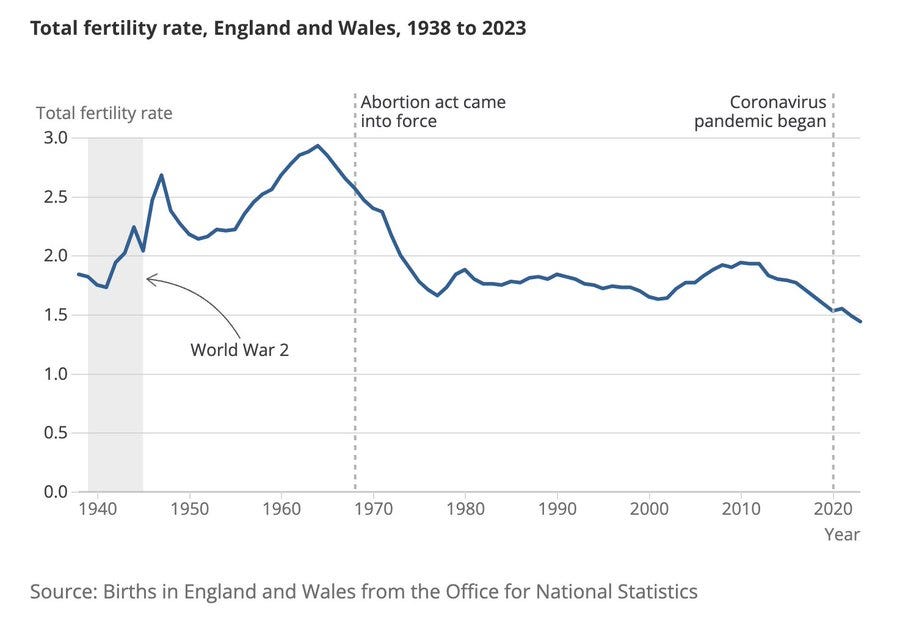
At this rate, a group of 100 adults of parenting age can expect to have just 52 grandchildren between them, a near 50% population collapse in two generations. Extinction event stuff.
Although I’m thankful that this made national news, it’s disappointing how much of the analysis suggested that the cause is a combination of high costs (housing, childcare, etc) and low wages that are putting people off parenthood.
Don’t get me wrong, these are definitely factors. Here are the maximum permitted ratios of two-year-olds per staff member, for example, a key reason why childcare in the UK is so expensive.
UK: 1 staff for every 4 kids
Netherlands: 1:6
France: 1:12
Ireland: 1:11
Denmark: No ratio
Germany: No ratio
Sweden: No ratio
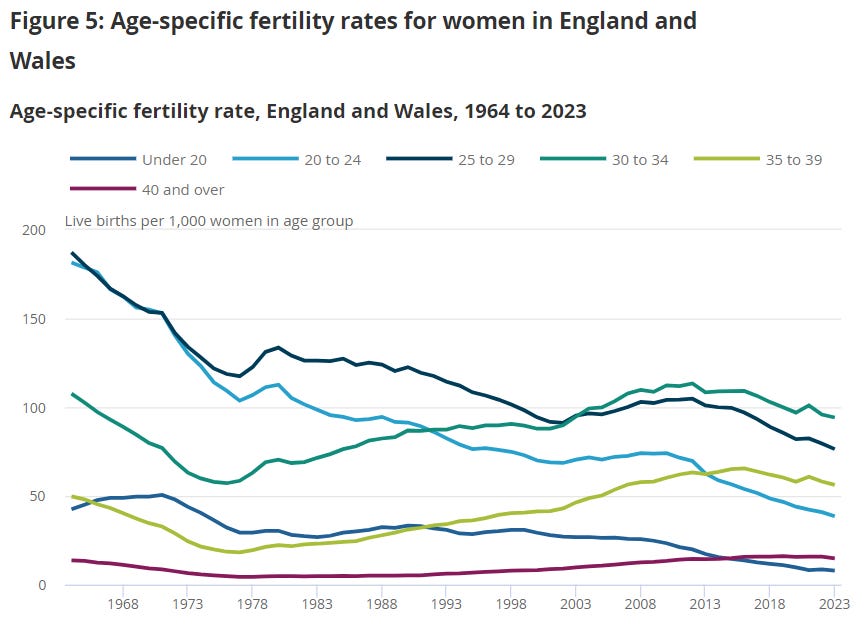
But an exclusive focus on the ‘supply side’ of the demographic collapse leads to silly conclusions. For example, The Economist claimed that British fertility will recover because the rising age of parenthood (now 30.9 for first-time mothers and 33.8 for fathers) means that the current generation of would-be parents are delaying children rather than forgoing them (i.e. the fertility rate will stabilise when the age of parenthood stops rising).
While there is some truth to this, there is still a clear absolute decline in all age groups, including 30-34s (the graphic below is just for women, but the trends are the same for men). That’s why this factor is thought to only be ‘worth’ an additional 0.2 points to the fertility rate.
The second reason The Economist is mistakenly cheerful is because of UK’s high net migration, which they argue has increased the need for primary school places in areas of high immigration. There are three problems with this. Firstly, the number of primary school places has fallen nationally in the last five years.
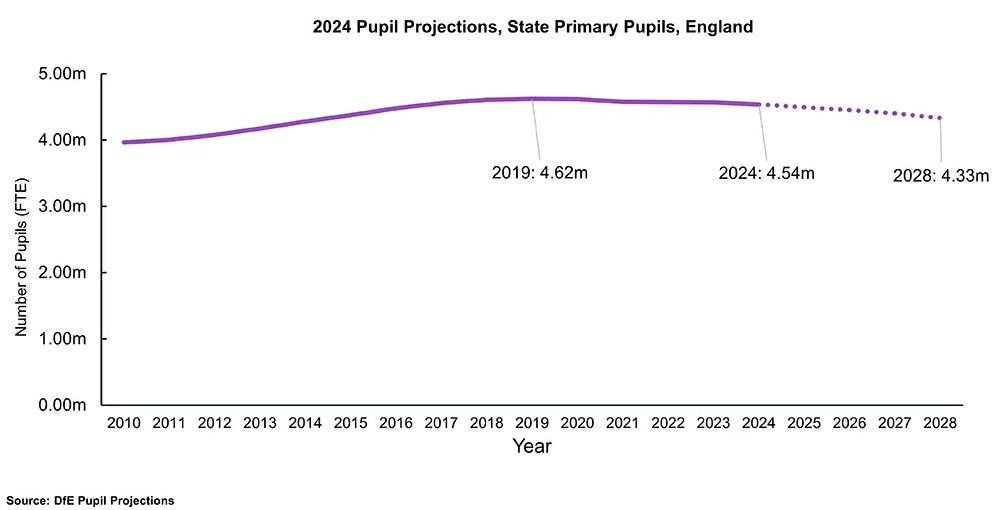
Next, second-generation immigrants have almost identical fertility rates as natives, meaning that you only get an immigration-induced baby boom once. And thirdly, to state the obvious, fertility has plummeted in an era of unprecedented immigration. If The Economist was correct, the opposite would have happened.
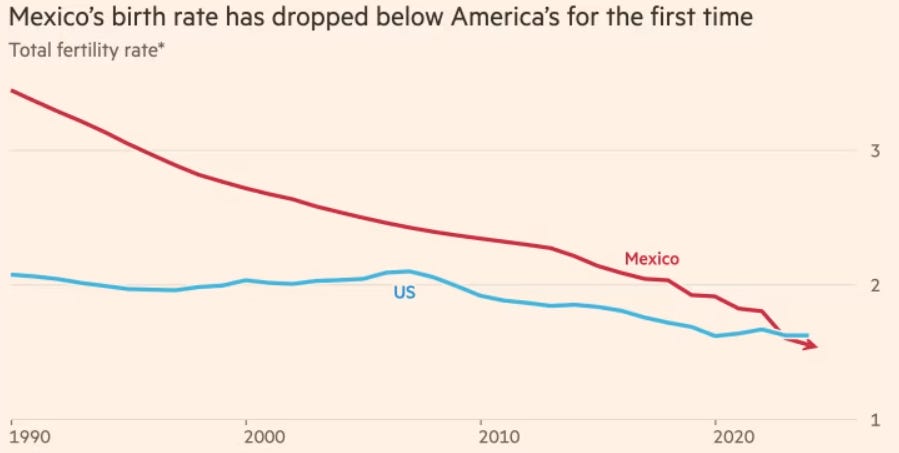
Overall, arguments centred on the exceptionalism of Britain as a land ill-suited to parenthood ignore the truth that fertility decline is a global phenomenon. As the FT’s John Burn-Murdoch showed in an excellent column last week, fertility is plummeting from Colombia to Tunisia. Mexico is now below the US. The EU’s average fertility is 1.46, with Germany’s at 1.35. Britain is simply moving with the pack.
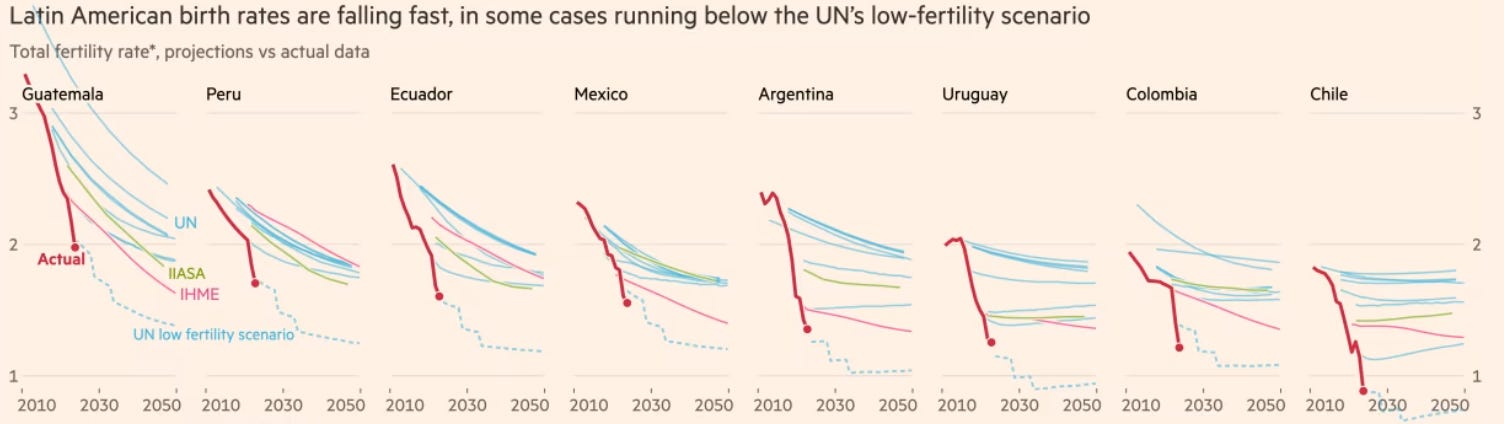
Fundamentally, we don’t know why fertility is collapsing worldwide – or how to stop it. Despite lots of careful analysis, Lyman Stone, who I frequently refer to here as the world’s pre-eminent pro-natalist demographer, nets out with this: more people need to get married, and earlier in their lives. Whether or not that’s true, it’s so apparently unimplementable (or even say in polite society), that it’s effectively useless.
The failure of natalists to have a solution to their biggest nightmare is a tragedy. We shouldn’t greet it with nonchalance. That’s why Janice Turner’s conclusion in her otherwise excellent long-read in The Times missed the point.
We worry who will care for a large, ageing boomer generation, but once they’ve died off we will be left with a far more sustainable population. Our self-centredness could save the world.
Fertility significantly below replacement will mean an inverted population pyramid *forever*. Globally, that will hit living standards and innovation. But even within the UK, if fertility were to stabilise now, the sharp decline we’ve experienced in the last ten years means we’ll have to wait for today’s children to reach retirement to ‘flatten the curve’, as it were.
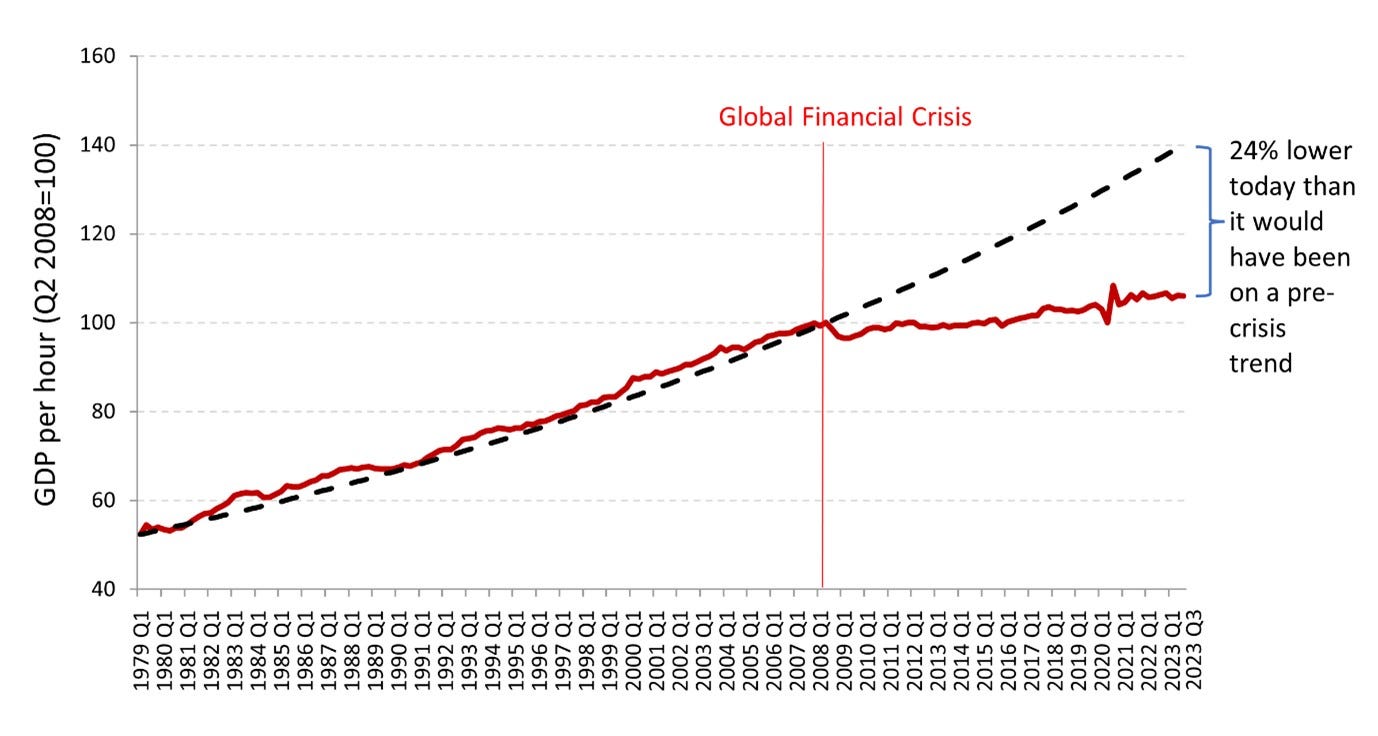
If we can’t solve it, there are only two other levers to pull. Mass migration, which is both unpopular and, on a global scale, zero-sum. And massive increases in productivity that outstrip demographic headwinds. But in the UK, at least, that looks unlikely.
Thanks for reading Chronicles of the Future! Subscribe for free to receive new posts and support my work.
Comments
Nothing yet. Say the first thing.
Sign in to join the conversation.