
Neither Kamala Harris nor Donald Trump made much of the technology in their campaigns, despite polling showing that the American public support government regulation of AI. But that doesn’t mean that the candidates are uninterested in the policy. During his first term, Trump passed an Executive Order on AI, stressing that “continued American leadership in Artificial Intelligence is of paramount importance to maintaining the economic and national security of the United States.” It laid the foundations for research investment, research institutes and regulatory guidance, including on the federal use of AI.
Joe Biden’s Executive Order on AI built on Trump’s, creating a framework for how all federal agencies use the technology. Harris was at the UK’s Global AI Safety Summit when the Order was announced. Trump has said he will repeal Biden’s Order “on day one,” but it’s not clear why he disagrees with it, or what he would do differently. In reality, both candidates have similar approaches to AI.
There will be competing forces in Trump’s administration. Some will push for ‘acceleration’, including many of his Silicon Valley backers. They may be joined by the Republicans of a libertarian persuasion who reject regulation. While others will likely opt for a more ‘safetyist’ approach – such as Elon Musk, who has criticised OpenAI for abandoning its philanthropic roots and recklessly pursuing technological driven-profit.
In recent months, the concerns of Musk’s camp have shifted from ‘safety’ to security’. I covered Leopold Oppenheimer’s essay in June which suggested that the US government should create a ‘Manhattan Project’ to develop AI quickly and safely, taking control away from accelerationists on the West Coast. Maybe that moment has come.
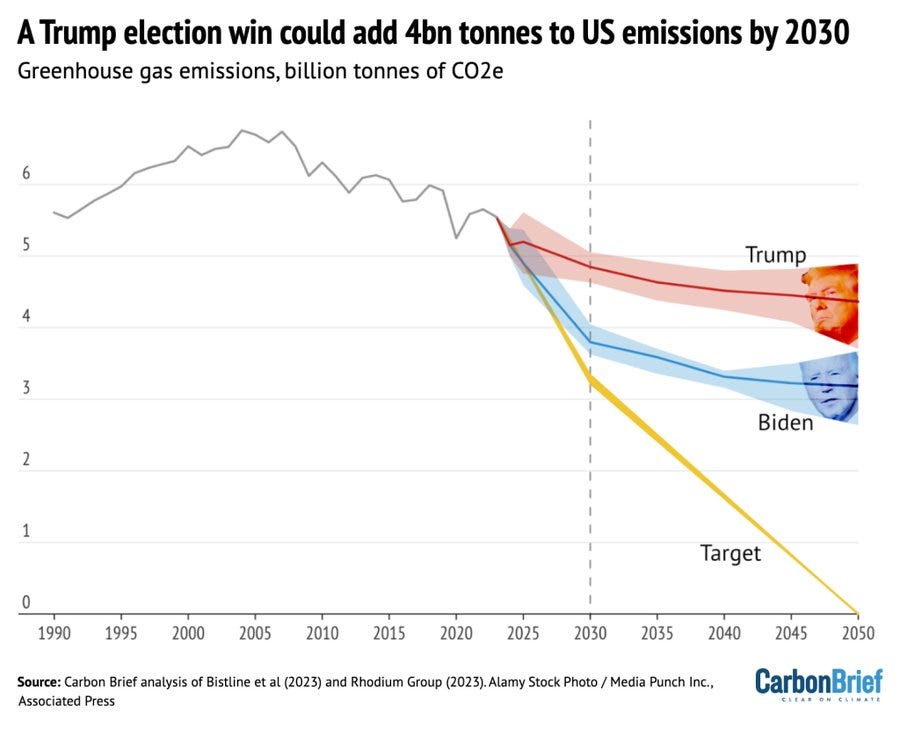
You can read Carbon Brief’s full analysis here.
The National Energy System Operator (NESO, previously the National Grid, which the government recently acquired and renamed) published a report detailing what needs to be done to achieve the “clean power by 2030” target, as requested by Ed Miliband as soon as he entered office. The short version: it’s “possible” but “at the limit of what is feasible” and would require a “Herculean effort.”
The cost of it? £40bn of investment annually (just under what we currently spend on defence), but that could apparently be achieved without raising prices for customers. Without additional explanation in the report, I assume that just means higher government spending. In the plans, by 2030 offshore wind would provide half of electricity, and onshore wind and solar another 29%, with a variety of other sources like biogas and hydrogen making up the rest.
Claire Coutinho, the Shadow Energy Secretary, provided a detailed rebuttal. She argued that getting everything built in time would require an “overhaul of planning” (i.e. forcing things through very quickly). That’s no bad thing, in my opinion. However, the rest of her critique is emphatic.
NESO say that bills won’t go up, but that means they won’t go down either and given Britain’s sky-high prices, that’s a travesty.
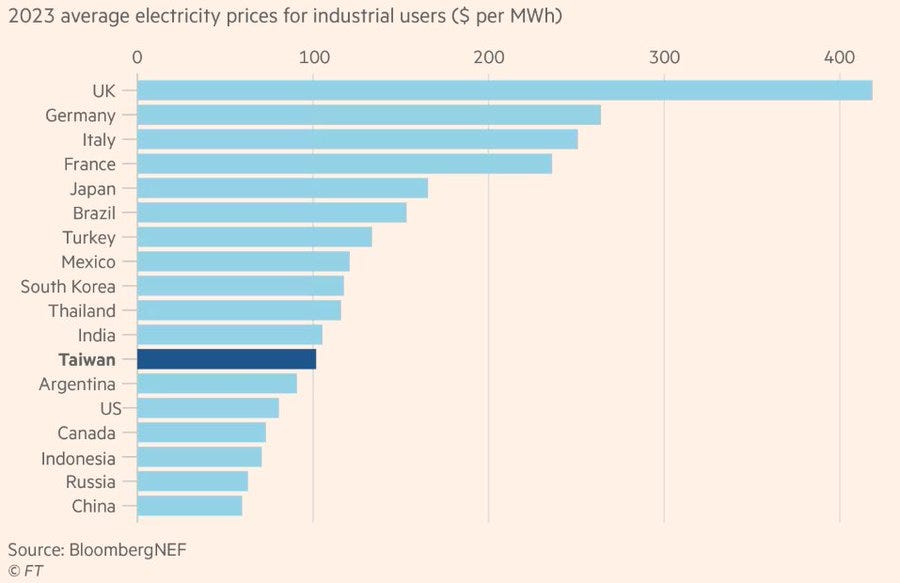
It also breaks Labour’s manifesto commitment that they “will save families hundreds of pounds on their bills, not just in the short term, but for good”. And given gas, currently our main energy source, is expected to get cheaper over the next few years, according to the International Energy Agency, we’ll be weaning ourselves off a potentially cheaper source.
Next, wind and solar, which NESO is counting on to produce 79% of our electricity, can be unreliable. As Sam Bowman, Editor of Works in Progress, pointed out, in the last week, gas has provided 47% of our power, with wind and solar down at 15%. On some (cloudy and windless) days, gas was as high as 62%, with wind and solar only contributing 6%. Unless you live in a perpetually windy or sunny climate, you need other sources to cover you in between times. The obvious renewable energy solution for Miliband would be nuclear, but he’s refused to commit to either Sizewell C or any small modular nuclear reactor projects.
There’s a real risk that we finish the decade with sporadic power shortages, and the government either having to compensate businesses and individuals to reduce their consumption at certain times (expensive), or South Africa-style ‘brownouts’ (the sign of a failing state).
Natalist J. D. Vance will become Vice-President in January. I’ve covered his approach in three separate Substacks over recent months. Firstly, I said his idea that we should grant voting rights to children of all ages, with their parents then voting on their behalf, is one we should take seriously. Secondly, I said that his communication plays into the worst natalist tropes, such as when he called Kamala Harris a “childless cat lady,” which was virally mocked by Taylor Swift. And lastly, I quoted an excellent column from The Guardian’s Nesrine Malik which argued that natalists like Vance have an “inability to conceive of women outside mothering”.
Over the next four years, I think all of these factors will come into play. We will likely see natalist policy pushed at a federal level – which is a good thing – but we will also see Vance continuing to use language that puts many off the cause, potentially meaning his policies have a short shelf-life.
Marriage rates are cratering in China. Yi Fuxian, the country’s pre-eminent demographer (not associated with the CCP), revealed that marriages in China fell by 16.6% year-on-year in Q1-Q3, with a 25.3% drop in Q3. He says this would indicate “an avalanche of births next year (less than 8 million).” For context, that’s more than one million less than 2023.
Alice Evans, academic and author of The Great Gender Divergence, reacted by saying: “Beijing has tried to maintain social stability, by preserving marriage & preventing exit.
1. 2011 Divorce law states that property belongs to the registered buyer.
2. Courts sometimes refuse divorces
3. Police may turn a blind eye to abuse
This may have reduced NEW marriages.”
Whether there’s a relationship between marriage and fertility is rising in prominence (the FT wrote a wide ranging article called ‘Does Gen Z have it tougher than previous generations?’ which included this graphic).
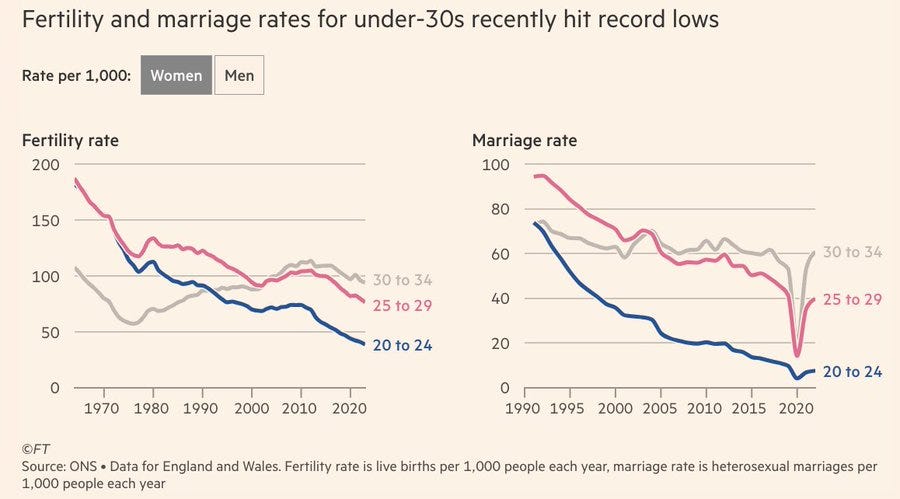
I dug into the data back in May, where I said: “I’m not convinced the disparity between married and unmarried fertility rates shows something exceptional about the ‘union’ itself. In these countries, could it just be that the people who still get married in the 21st century are much more likely to be Catholic [or otherwise religious], and therefore have more children for that reason? If that’s the case, then it shows, yet again, that religion is the only policy we know that really shifts the dial here. That might be ok [demographer Lyman] Stone – who openly brings his Christianity into his work – but it’s an unviable public platform.”
I then suggested that we need research on the relationship between divorce rates and fertility (noting anecdotal correlation). As far as I can tell, no work has been done on this. The closest you get are some old papers arguing that divorce liberalisation laws supressed fertility, with two academics in Spain claiming that it reduced fertility by 0.2 points.
Natalist influencers Simone and Malcolm Collins have been caught out by undercover journalism by Hope Not Hate, which was later written up by The Guardian. For context, the Collinses central view is that civilisation as we know it cannot be saved from demographic collapse, and that small clusters of new natalist cultures need to be formed to take humanity forward. They outline this theory in ‘The Pragmatist’s Guide to Crafting Religion: A playbook for sculpting cultures that overcome demographic collapse & facilitate long-term human flourishing’, which I’m currently reading.
It appears they are now proactively trying to create these cultures and give them a base. Posing as a potential investor, a representative of Hope Not Hate was handed a presentation about how the ideal place to start would be… the Isle of Man, because of its central location and “rapidly depopulating area”.
Their plans for the area, however, are (as I’ve said about the family before) so wild that they give natalism a bad name. They want “no-holds-barred medical research”, “AI citizenship”, with everything based on blockchain. Their governance structure of choice is: “dictator” voted every four years. But they don’t want “one person one vote,” because “existing governing systems assume that every citizen has equal value when they objectively do not.” Instead, they want to create a “tiered society” recognising that “competence is not evenly distributed among a population and rewards individuals with more control over governing decisions when they have demonstrated proven, measurable competence.”
You can see the full presentation in The Guardian’s article. I’m not sure this project is happening any time soon.
No posts
Comments
Nothing yet. Say the first thing.
Sign in to join the conversation.