
The SciSchmooze

Greetings again, friends of science,
Sempa xitlajpaloca, nohuampoyohua tlen ciencia,
Nearly 2 million people speak Nahuatl (Eastern Huasteca) in Mexico
Every year with the coming of the month of may, the catchy tune of the Lusty Month of May becomes an earworm. The song is from Lerner & Loewe’s Broadway musical “Camelot” starring Richard Burton, Julie Andrews, and Robert Goulet. (The above link, however, is for a slightly bowdlerized version of the song from the 1967 Warner Brothers movie of Camelot.)
On Saturdays, i join a group of folk at the Grocery Outlet in San Pablo at 11AM to protest actions of our current federal administration. The number of protesters keeps growing. The percentage of the drivers of passing cars that honk or wave keeps growing. The number of deplorable statements and actions of our federal administration keeps growing. Allow me to limit my following comments to actions regarding science.
All 22 Board Members of the National Science Foundation [NSF] were fired last week. They administered $9 billion of scientific research; that’s 1.3¢ of each tax dollar. The Administration is cutting the NSF budget to $4 billion; that’s 0.6¢ of each tax dollar and less than 15% of what we’ve spent on the war with Iran.
The Administration plans to reduce the NOAA [National Oceanic and Atmospheric Administration] budget by 36% and eliminate 35 projects and institutes. Among them:
> Climate and Weather Research
> Air Chemistry Research
> Ocean Acidification Studies
> Estuarine Research
> National Centers for Coastal Ocean Science
> Integrated Ocean Observing System
> Coral Reef Conservation Program
> Habitat Conservation and Restoration
> Community Project Funding
> Pacific Coast Salmon Recovery
> Species Recovery Programs
> Marine Sanctuary Creation
The Environmental Protection Agency’s budget was reduced by over half. The E.P.A. laid off over 1500 scientists. Only 124 scientists are left and some of those have been reassigned to clerical duties. The E.P.A. no longer researches climate change, the pollution of lakes and rivers, or health effects of air pollutants and toxic chemicals.
The National Center for Atmospheric Research (NCAR) created a superior computer climate model for weather forecasting that was adopted this year by the National Weather Service. The White House is shutting NCAR down for promoting “climate alarmism”.
SPACE
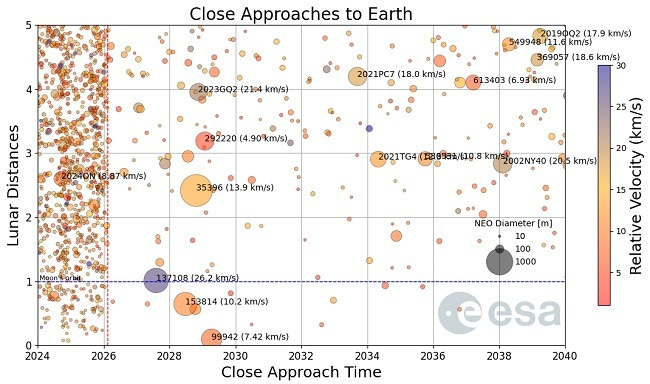
I wish there were room to show a much larger view of this graphic. It incorporates a lot of fascinating information. Each colored circle represents an asteroid that passed or will pass close to Earth from 2024 through 2040.
> Circle sizes indicate asteroid sizes on a logarithmic scale. See gray circles above 2038.
> Circle colors indicate the relative velocity the asteroids passed - or will pass - Earth.
> Vertical placement of each circle shows how close the pass was - or will be.
> The vertical scale is in multiples of the distance between the Earth and the Moon.
> There are many circles in the past since most of these were only detected as they whizzed by.
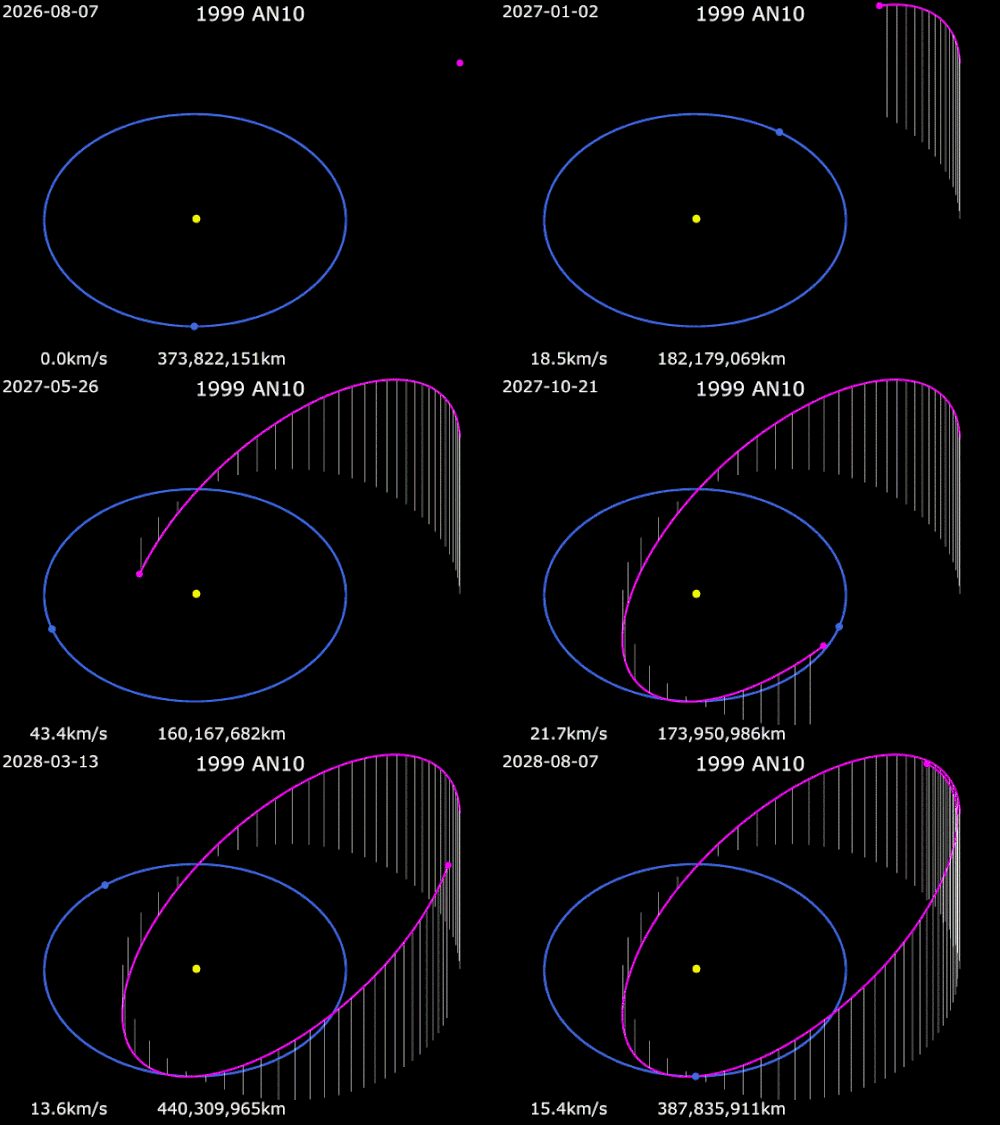
Example: The large purple asteroid #137108 sits almost exactly on the #1 horizontal line just to the left of 2028; therefore it is hundreds of meters in diameter and will pass close to the moon at high velocity next year. The asteroid is also known as 1999 AN10.
My EVENT PICKS
You do not have every time-slot of every day open for adventure, so peruse my list and set calendar reminders for the ones you can enjoy.
Black Box at the Center of the Electric Grid - Livestream Mon 4:30pm
Towards Responsible AI for Adolescent Mental Health - Livestream Tues Noon
Heat Pump Webinar: HVAC Systems & Water Heaters - Livestream Wed 6pm
After Dark: Bike Month - Ride On - Thurs 6 - 10pm, ExplOratorium, S.F., $
Wonderfest: Ask a Science Envoy: DreamFish & Wetlands - Sunday 7pm Novato
SkepTalk: A Field Guide to Getting Swindled - Livestream 14 May 7:30pm
CLIMATE
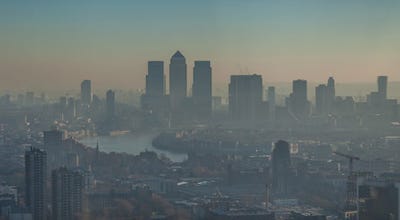
I just recently learned about the “Aerosol Dilemma.” Sulphate aerosols cause respiratory harm, are detrimental to ecosystems, and contribute to smoggy skies. Pollution regulations have decreased industrial sulphate emissions and the haze. Good. However, that haze increased the atmosphere’s reflectivity and helped keep the planet from overheating. Dilemma: the air is now better for us and for the biosphere but the decrease in aerosols is accelerating global warming! Oy vey!
Global warming of course includes warming of the oceans that cover 71% of our planet’s surface. About 90% of all of Earth’s warming is in the warming of the oceans. As the oceans warm and the atmospheric CO2 concentration increases, CO2 more easily dissolves into the water making seawater more acidic which hinders the ability of sea creatures to form their shells: nautiloids, clams, corals, sea urchins, barnacles, chitons, snails, shrimp, crabs, copepods, lobsters, turtles, tunicates, and many more.
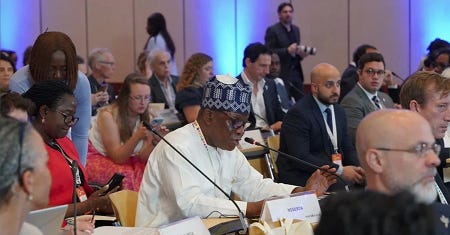
The “First Conference on Transitioning Away From Fossil Fuels” held in Colombia ended on Thursday. Diplomats from 57 countries attended along with NGOs, indigenous peoples, scientists, et al. The United States government was not invited for obvious reasons. Global investment in the transition away from fossil fuel energy hit a record $2.3 trillion in 2025, up 8% from 2024. The three largest amounts were for electrified transport ($893 billion), renewable energy ($690 billion), and grid investment ($483 billion).
PALEONTOLOGY
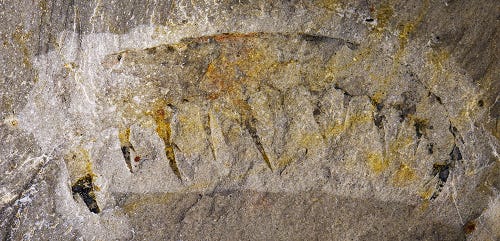
We have found only a few places on Earth that have fossils with soft tissue impressions of animals living during the Cambrian. One such fossil trove is the Huayuan biota in Hunan, China. To date, 153 marine animal species have been found there, all dating to 512 million years ago. Many species found there were already known from the Burgess Shales in Canada, meaning that a contiguous ocean covered both sites. However, 59% of the Huayuan biota are new to science. The fossil above is about 65 cm long (25 inches). That’s about as long as our cat - including her tail.
FUN NERDY VIDEOS
Analysis - Octopus Style - Emma Wildlife - 1 min
Chonkers: A Sea-lebrity - KTVU News - 3 mins
A Stellar San Francisco pinniped
What is Time - Sabine Hossenfelder - 6 mins (17 Dec 2025)
¿Is it time to eat yet?
Supermountains and Biological Evolution - PBS Eons - Gabriel Santos - 9.5 mins
¿Supplied iron, phosphorus, & calcium for life?
¿Why is there Matter in the Universe? - Star Talk - Neil deGrasse Tyson - 11 mins
This matters!
Small Modular Reactor Controversy - Just Have a Think - David Borlace - 14 mins
But with large issues
The Earth’s Inner Core - PBS SpaceTime - Matt O’Dowd - 17 mins
A new state of matter
Artemis II Crew public debrief - NASA - 17.5
Are we all part of the Earth’s crew?
AI Agents: The Best & the Worst Things Ever - Hannah Fry - 20 mins
You must watch this!
The Threat of Chemical Polymorphs - Veritaseum - Derek Muller - 33.5 mins
Some ‘chemicals’ are no longer possible - on Earth anyway
Sodium - Tales from the Periodic Table - Ron Hipschman - 48 mins
Face to Face with Orcas - Slice Wild - David Reichert - 51 mins
Orca, Elephant Seal, King Penguin, Black-Faced Sheathbill, Brown Skua, Albatross, Human
Largest Dinosaur Ever Discovered - TVO Docs - David Attenborough - 58 mins
Amazingly huge!
NERDY AUDIOS
Earth Day Special: Saving the Planet (again) - Scientific American - 20 mins
Every day is Earth Day
Knowing that experiences are just as real for others as they are for you; that’s empathy.
Dave Almandsmith, Bay Area Skeptics
“If you have no data I guess you can just assume things are safe.”
— L. Earl Gray Jr: Toxicologist and 30-year veteran at the Environmental Protection Agency commenting on the dismissal of his research unit.
Upcoming Events:
Click to see the next two weeks of events in your browser.
Monday, 05/04/2026
SynBioBeta 2026 - 05/04/2026 08:00 AM
San Jose McEnery Convention Center San Jose
SynBioBeta 2026 is a leading global synthetic biology conference bringing together founders, investors, and scientists. The event focuses on applications across food, climate, materials, and biomanufacturing. May 4 - 7, 2026 | San Jose, California.
See weblink for details
The Role of Autophagy in Aging and Age-Related Neurodegeneration - 05/04/2026 12:00 PM
Sonoma State University - Biology Colloquium Rohnert Park
From the Buck Institute website: “...Bijoya is from India where she got her bachelor’s and master’s degree in Biotechnology. Aging biology was introduced to her when she joined the lab of Gayatri Ramakrishna in Institute of Liver and Biliary Sciences, New Delhi. There she studied the role of senescence-associated pathways in the progression of liver cirrhosis to hepatocellular carcinoma and received her PhD degree in 2019. Then she joined the Brand lab at Buck as a Glenn postdoctoral fellow. Her area of research was to explore mechanisms by which mitochondrial reactive oxygen species (ROS) acts as a signaling molecule to abrogate various pathways using hypoxia/HIF as a model. She recently joined the Hansen lab where she plans to delve into the cellular recycling process named autophagy and how it affects aging using mammalian cell culture and C. elegans as a model system...”
Speaker: Bijoya Sen, The Buck Institute
Big animals & the maintenance of species diversity - 05/04/2026 04:00 PM
James H. Clark Center (Bldg 340) Stanford
Speaker: Robert Pringle, Princeton University
Room: Auditorium
The Black Box at the Center of the Grid: Rebuilding Trust and Accelerating Timelines in Energy Planning Through Open-Source Modeling - 05/04/2026 04:30 PM
Hewlett Teaching Center Stanford
Grid planning has never been harder - or more consequential. Variable renewables, distributed resources, vehicle electrification, data centers, and industrial decarbonization are compounding in real time, turning the grid into a dynamic, multi-sector nervous system for the entire economy. Yet the tools guiding these decisions remain proprietary black boxes: artifacts of a simpler era, too slow to innovate and too closed to build the stakeholder trust that decisions of this scale require. A century of regulatory layering and institutional fragmentation built this quagmire. Getting out of it demands a new approach - one where modernizing planning tools and restoring trust are pursued as a single mission, enabling the faster, more credible decisions the energy transition cannot afford to delay.
Speaker: Alice Jackson, Breakthrough Energy
Attend in person or watch online (see weblink)
Chasing cosmic acceleration with galaxies: From the Dark Energy Survey to the Rubin Observatory - 05/04/2026 04:30 PM
Stanford Linear Accelerator (SLAC) Colloquium Series Menlo Park
The origin of cosmic acceleration remains an open question: is it caused by a dark energy and if so, what are its properties? Or is our theory of gravity incomplete on the largest scales? These questions have driven an ambitious effort from the cosmology community to develop wide galaxy surveys. I will first explain how galaxies are indeed a powerful way to test cosmology, focusing on the weak lensing effect. I will then present the newest results on our understanding of the Universe and dark energy from the completed Dark Energy Survey (DES), which produced the largest weak lensing catalog to date. The methods and results the DES collaboration has developed over the past decade set the scene for the new generation of galaxy surveys such as the LSST by the Vera C. Rubin Observatory. I will update on the status of the Rubin Observatory and end with the challenges we will need to solve to test dark energy and gravity with its future weak lensing measurements.
Speaker: Agnes Ferte, SLAC
Attend in person or watch online (See weblink)
Science on Tap: Gossip girl (microbial edition): chemical communication in host-microbe systems - 05/04/2026 06:00 PM
Crepe Place Santa Cruz
Microbes communicate with each other using small molecules that can trigger biological processes such as bioluminescence, cell differentiation, or surface modification. Mass spectrometry is an important tool that allows scientists to intercept and detect chemical messages in different microbial systems. Together, we will explore unique chemistry produced by several different microbial and host-microbe systems, including our current research on bioluminescent Vibrio fischeri and the Hawaiian Bobtail Squid.
RSVP at weblink
The Social Life of Subatomic Particles - 05/04/2026 07:30 PM
Hewlett Teaching Center Stanford
The various materials that we experience in everyday life are built from molecules. In turn, molecules are built from atoms. Atoms are built from electrons and nuclei. Nuclei are built from protons and neutrons, which were once considered “elementary particles”. Bob Hofstadter won his Nobel Prize for dispelling this notion by showing that protons have an internal structure and measuring their size. I will describe how, building on his work, we learned that protons and neutrons are built from particles called quarks and gluons. As far as we know, this is where the “cosmic onion” ends. However, we have also discovered that quarks come in six different flavors and that they have a rich “social life”: they are never alone and always appear in clusters that correspond to protons, neutrons and their numerous cousins. In recent years experiments in giant particle accelerators have dramatically advanced our understanding of the “social preferences” of quarks, revealing many exotic clusters and determining which ones are stable enough to be observed experimentally and how quarks are arranged inside them.
Speaker: Marek Karliner, Tel Aviv University, emeritus
Tuesday, 05/05/2026
AI+Science: Accelerating Discovery Conference - 05/05/2026 08:30 AM
Traitel Building Stanford
AI+Science: Accelerating Discovery is an interdisciplinary conference bringing together researchers across physics, mathematics, chemistry, biology, neuroscience, and more to examine how AI is reshaping scientific discovery.
Experts will separate hype from reality, spotlighting where AI is already enabling genuine breakthroughs and where its limits and risks remain.
Centered on the essential role of scientists in this new era, the conference will explore both near-term advances and future possibilities, along with the unique challenges of applying AI in scientific work. Above all, it focuses on elevating human understanding: what people understand, not what AI understands.
This conference is ideal for scientists, engineers, and research leaders across academia, industry, and government who want a clear, interdisciplinary view of where AI is genuinely accelerating discovery, and what it means for scientific practice.
This year’s conference will feature keynotes, panel discussions, and opportunities to connect with peers. Watch this space for more details regarding agenda and speaker lineup as we approach the event date.
Please note: advance registration is required and space is limited for in person attendance. The event will also be livestreamed on our website.
Affine Virtual Arrays for Millimeter-Wave Imaging and Metrology - 05/05/2026 12:00 PM
Cory Hall Berkeley
Imaging systems are ubiquitous in the world, from complex mammalian eyes to infrared sensors in snakes, from selfie cameras on smartphones to the VLBI telescope system that took an image of a black hole, from MRIs and X-rays to microscopes and telescopes, they allow for the exploration of the universe and the revelation of the invisible. The most fascinating systems among these are the ones that allow observers to see beyond the limits of the naked eye. An imaging radar is one such technology-familiar to travelers who have stood in an airport scanner with their arms raised. Unlike other imaging methods, radar can penetrate materials, operate at long ranges, and does not use hazardous ionizing radiation, making it ideal for applications such as concealed weapons detection, autonomous navigation, non-destructive testing, and remote sensing.
Despite their potential, existing imaging radar systems experience a cost-speed trade-off that has limited their development and widespread adoption. High-resolution imaging radars traditionally require large, densely sampled arrays, expensive RF hardware, or slow mechanical scanning. In this talk, Aditya Varma Muppala will introduce affine virtual arrays, a technique that enables a single radar element to generate 10,000 virtual elements in real-time, breaking the cost-speed trade-off. Based on this idea, he will demonstrate several imaging radar systems and experiments. Muppala will then show how this same idea of affine virtual arrays can be extended to perform fast spherical near-field measurements for phased array calibration. Lastly, he will introduce new ideas related to real-time virtual array generation for both imaging and antenna measurements.
Speaker: Aditya Varma Muppala, UC Berkeley
Towards responsible AI for adolescent mental health and well-being - Livestream - 05/05/2026 12:00 PM
Stanford University
Adolescents worldwide turn to general-purpose generative artificial intelligence (AI) chatbots for mental health support, despite these tools not having been designed for youth well-being. Industry, policy and research trail far behind this rapid, largely unregulated adoption. Simultaneously, most responsible AI frameworks lack consensus, accountability, and meaningful implementation - particularly regarding adolescent health. Drawing on a policy and AI framework scan, multi-stakeholder workshops, and interviews with adolescents, we identify urgent, actionable priorities to prevent harm and ensure AI responsibly supports adolescent mental health.
Speaker: Caroline Astrid Figueroa, Stanford University
Macrostrat and the ‘digital crust’ - 05/05/2026 12:00 PM
Braun (Geology) Corner (Bldg 320), Rm 220 Stanford
Daven Quinn is a research scientist at the University of Wisconsin - Madison. A structural geologist by training, he has become a leader in the emerging field of geoinformatics, working to model the Earth’s crust as a complete, integrated system. He leads the development of geological software including Macrostrat, a digital model of Earth’s geologic framework; Rockd, a collaborative field guide; and Mapboard GIS, an iPad app for geologic mapping.
Over the past two decades, macrostratigraphy, a quantitative approach to the geological record, has led to new insights into the Earth-life system. It also motivated the development of Macrostrat, a unique database that links geologic maps and stratigraphic columns into a unified representation of Earth’s crustal framework. Macrostrat’s data structures provide a scaffold to contextualize other datasets (e.g., fossil occurrences and geochemical measurements) within the rocks they describe, and open data services support a variety of uses beyond research, most prominently including the community-oriented Rockd app. Macrostrat is now being adapted to capture geological relationships at multiple scales, to address research areas ranging from basin-scale stratigraphic correlation to mineral-systems modeling.
A central vision in geoinformatics is the development of multi-scale, multi-modal descriptive geological models structured to align with modern computational approaches. Such “whole-system” models could greatly accelerate geological research, much as global circulation models have in atmospheric science or in silico cell models in biology. Top-down efforts to build world-scale geologic models have had limited impact; long-term success will require purposeful collaboration across geoscience subfields, human-centered software design, fluid data sharing, and new architectures for encoding geologic insights. A Macrostrat-like framework for connecting geological knowledge is one of many elements needed to make this “digital crust” a reality.
Exotic Hadrons - 05/05/2026 03:30 PM
Hewlett Teaching Center Stanford
In recent years, experiments in high-energy accelerators have discovered a large number of unusual, heavy “cousins” of the proton - i.e., strongly interacting particles collectively known as hadrons. Ordinary hadrons are either baryons, which contain three quarks, or mesons, which contain one quark and one antiquark. The new, unusual hadrons contain either two quarks and two antiquarks (known as tetraquarks) or four quarks and an antiquark (known as pentaquarks). These particles are often referred to as multiquark or exotic hadrons. Given the large number of such exotic hadrons discovered thus far, it is becoming increasingly important to discuss which additional multiquark states are likely to be observed and how quarks are organized within these exotic hadrons. In my talk, I will address these questions and provide some guidelines about the essential differences between the two types of exotics. I will also discuss a very recent experimental result from the LHCb Collaboration at CERN that shows how potent Coulomb repulsion between quarks can significantly contribute to hadron mass, in a down-to-earth demonstration of E=mc2, flipping the expected mass hierarchy between isospin partners.
Speaker: Marek Karliner, Tel Aviv University, emeritus
Killing bacteria by leveraging phage-derived peptide antibiotics - 05/05/2026 04:00 PM
Latimer Hall Berkeley
Speaker: William Clemons, Jr, Caltech
Raising AI: Parenting the Future - 05/05/2026 06:30 PM
Event Space to Left of Mills Building Main Door San Francisco
Join pioneering AI scientist De Kai and KALW for a timely, human-centered look at the responsibility we share in guiding AI’s evolution.
What if AI isn’t just a tool, but something we’re actively raising together? Join pioneering AI scientist De Kai for a thoughtful, accessible conversation on how today’s systems learn from us, reflect our values, and shape the world we share. A timely, public-minded look at our collective responsibility in guiding AI’s future.
Reserve a spot at weblink
The Untimely - 05/05/2026 07:00 PM
Long Now Foundation San Francisco
Temporal droppings.
Autistic meanderings that stray from linearity.
Little sedimentations, little curls of temporality.
Dense knots clogging the otherwise smooth materiality of time in its totalizing productions.
Mischievous bebops lurking between the tick and the tock, upsetting the steady count.
The clock’s disability.
These are some of the many ways Bayo Akomolafe wrestles to articulate what he calls the “untimely.” But perhaps his most pressing meaning can be discerned from the scandalous question he asks: “What if time misbehaves?” What if time - far from being a simple line that carries on into steady futures through mediating nows and exhausted pasts - careens off the highway, swirls into circuitous paths, and produces monstrous bodies that the imperial tick-tock cannot metabolize?
Why This Talk Matters Now
In an Anthropocenic moment when the Doomsday Clock inches closer than ever to midnight; when climate scientists tell us we have less time than we think to get our act together; and, when the pillars of global coordination are being dismantled by the rise of authoritarianism, the bitter urge is to argue with the gods for more time, or to imagine ourselves returning to a safer place on the timeline. But Akomolafe argues our “fixes” often reproduce the problem, and offers alternatives to progress narratives as the default response.
The Long View
Akomolafe urges us to deepen the practice of long-term thinking by exploring other temporal dimensions. He asks us who gets to move through time seamlessly in the first place, and what gets buried or forgotten when a single framework is universalized.
Dr. Bayo Akomolafe is a philosopher, writer, activist, professor of psychology, and executive director of The Emergence Network.
Wednesday, 05/06/2026
What Do Observations of Exhumed Tectonic Plate Boundaries Tell Us About Subduction Zone Earthquakes? - 05/06/2026 12:00 PM
Earth and Marine Sciences Building Santa Cruz
Speaker: Donald Fisher, Pennsylvania State University
Advancing Aerospace Autonomy with Foundation Models - 05/06/2026 12:30 PM
Mitchell Earth Sciences Building (04-560) Stanford
Foundation models, trained on vast and diverse data that capture broad aspects of the human experience, are at the heart of the ongoing AI revolution, transforming how we create, problem-solve, and work. These models - and the insights gained from developing them - are increasingly relevant to the advancement of autonomous robotic systems. In this talk, I will highlight how recent efforts to apply foundation models to embodied systems can be leveraged to push the frontiers of aerospace autonomy. The discussion will focus on two main thrusts. First, I will discuss how techniques traditionally developed in the foundation model literature can be adapted to enable reliable decision making in space, with an emphasis on spacecraft rendezvous and proximity operations. Next, I will discuss the opportunities presented by foundation models within data-driven autonomy stacks, ranging from automated data curation to serving as high-level reasoning modules.
Speaker: Daniele Gammelli, Stanford University
Room: 350-372
Co-producing knowledge for sustainable fisheries and biodiversity governance - Livestream - 05/06/2026 03:00 PM
UC Davis Bodega Marine Laboratory
Speaker: Dr. Jaime Grimm, Assistant Professor, University of Victoria
Register for Zoom at weblink
Astronomy’s Newest Discovery Machine: The Vera Rubin Observatory - Livestream - 05/06/2026 05:00 PM
UC Berkeley
Join us as four Berkeley astronomers share how they are using the Vera Rubin Observatory in Chile - which contains the largest camera ever built and will create an ultra-high-definition time lapse of our Universe - to bring cosmic mysteries to light.
Register at: basicscience.berkeley.edu
Moderator: Steven Kahn, Dean, Division of Mathematical & Physical Sciences, UC Berkeley
Speaker: Josh Bloom, Professor of Astronomy, UC Berkeley
Speaker: Raffaella Margutti, Associate Professor of Astronomy and Physics, UC Berkeley
Speaker: Peter Ma, Graduate Student, Astronomy, UC Berkeley
Astronomy on Tap San Antonio: A Tour of the Solar System & Space Weathering on the Moon - Livestream - 05/06/2026 05:00 PM
Astronomy on Tap
We are excited to hear from the Lunar and Planetary Institute’s Allison McGraw: “Everything is Bigger Than Texas: A Tour of the Solar System ” and Univerity of Texas San Antonio’s Austin Patridge ” Space Weathering on the Moon”.
Heat Pump Webinar: HVAC Systems and Water Heaters - Livestream - 05/06/2026 06:00 PM
Acterra
A free webinar on the benefits of Heat Pump systems! Learn about HVAC and HPWH basics, advice, and all the available incentives.
Join us for an engaging Green@Home webinar where we’ll unpack heat pump technology, specifically with Heat Pump Water Heaters and HVAC Systems. Our home heat pump expert, Mike Salameh, will share his personal experience, answer your questions, and walk you through the benefits of upgrading. Plus, local contractor Emerald Eco will be available for all your cost and installation questions. Finally, we will learn about available rebates and incentives that can significantly lower your installation costs.
Register at weblink
Birdy Hour: Wild World of Frog Mating Systems - Livestream - 05/06/2026 06:00 PM
San Francisco Bay Bird Observatory
Like birds, frogs are a commonly studied species that rely on acoustic communication for survival and fitness. During the frog breeding season, males gather together in big groups and advertise themselves to females. Often times, parameters of male advertisement calls may signal something about the male’s quality, such as genetic quality or potential energy investment. Females make decisions about who to mate with based on the comparison of these calls, and their choice will determine the fitness of their offspring. In these cases, mate choice plays a key role in the evolution of the signals that males use. In this talk, Trina will share several stories of the ways in which we can use frog behavior to ask questions about signal evolution and decision-making to better understand how animals communicate with one another.
Register at weblink
Speaker: Trina Chou, University of Tennessee, Knoxville
Cosmology in Overdrive: Chasing Cosmic Acceleration with Galaxies - 05/06/2026 07:00 PM
Sapp Center for Science Teaching and Learning Stanford
Nearly 30 years after the discovery of cosmic acceleration, its origin remains the source of open questions: is it caused by dark energy, a mysterious energy causing the Universe’s expansion to go faster and faster with time? Or was Einstein’s theory of gravity wrong? Cosmology is now at a turning point: tensions between different measurements are appearing, and a deluge of data from new ambitious experiments will come over the coming decade. In this talk, I will discuss how imaging galaxies is key to addressing these questions and present where cosmology stands today: at the crossroads between the completion of current galaxy surveys, such as the Dark Energy Survey (DES), which imaged hundreds of millions of galaxies, and the next generation of observatories, such as the Vera C. Rubin Observatory, which will image billions. I will also highlight the final cosmological results from DES, particularly those related to the possible time dependence of dark energy, describe the promise of the Rubin Observatory, and discuss how this new era of data - along with the rise of artificial intelligence - will help us characterize the expansion history of the Universe and test gravity on the largest scales with unprecedented precision.
Speaker: Agnès Ferté, SLAC
Register at weblink to attend in person or online
Thursday, 05/07/2026
Development of decarbonization tools - 05/07/2026 01:30 PM
Environment and Energy Building (Y2E2) Stanford
The availability of low-cost but intermittent renewable electricity (e.g., derived from solar and wind) underscores the grand challenge to store and dispatch energy so that it is available when and where it is needed. Redox-active materials promise the efficient transformation between electrical, chemical, and thermal energy, and are at the heart of carbon-neutral energy cycles. Understanding design rules that govern materials chemistry and architecture holds the key towards rationally optimizing technologies such as batteries, fuel cells, electrolyzers, and novel thermodynamic cycles. Electrochemical and chemical reactions involved in these technologies span diverse length and time scales, ranging from Ångströms to meters and from picoseconds to years. As such, establishing a unified, predictive framework has been a major challenge. The central question unifying our research is: “can we understand and engineer redox reactions at the levels of electrons, ions, molecules, particles and devices using a bottom-up approach?” Our approach integrates novel synthesis, fabrication, characterization, modeling and analytics to understand molecular pathways and interfacial structure, and to bridge fundamentals to energy storage and conversion technologies by establishing new design rules.
Speaker: William Chueh, Stanford University
Attend in person or watch online (See weblink)
What We Talk to When We Talk to Language Models - 05/07/2026 04:00 PM
International House Berkeley
What exactly are we talking to when we talk to language models such as ChatGPT, Claude, and Gemini? Do these models have genuine minds with mental states? I will argue that the LLMs we interact with are at least quasi-agents with quasi-beliefs and quasi-desires, in a sense I will explain. I will also argue that the LLM quasi-agents that we interact with are best understood not as abstract models or even as hardware instances but as virtual entities bound to conversation-based memory threads. I will draw some parallels with the TV show Severance.
Speaker: David Chalmers, New York University
Register at weblink
After Dark: Ride On - 05/07/2026 06:00 PM
ExplOratorium San Francisco
Celebrate Bike Month with the Exploratorium and the San Francisco Bicycle Coalition! Hop on your two-wheeler, park it with our secure bike valet service from Bike East Bay, and head inside Pier 15 for the year’s most freewheeling party. Light up an LED tower with your pedaling prowess. Make sorbet and ice cream on our bike blender, and get hands-on with basic bike maintenance. Come meet other bike-minded people, and gear up for an evening of laughter and community.
Ages 18+
NightLife Carnival SF - 05/07/2026 06:00 PM
California Academy of Sciences San Francisco
Carnaval SF is back for year three at NightLife, now with a Fiesta y Fútbol twist! Join our colorful celebration of music, dance, and soccer pride from Latin American, Caribbean, and Afrodiasporic cultures. Experience the joy of Carnaval throughout the museum with hands-on activities, live performances, a pop-up mercado (marketplace), and more!
Astronomy on Tap Davis - 05/07/2026 06:00 PM
Sudwerk Brewing Company Davis
Matthew Citron will talk about “Searching for the dark side of our universe with particle accelerators”
and
Ted Swift will speak about “Chasing shadows: measuring asteroids using stellar occultations”
Friday, 05/08/2026
UC Santa Cruz IGPP Seminar - 05/08/2026 12:00 PM
Earth and Marine Sciences Building Santa Cruz
Speaker: Josef Dufek, University of Oregon
In Town Star Party - 05/08/2026 09:15 PM
San Jose Astronomical Association San Jose
Come join San Jose Astronomical Association (SJAA) for an evening of stargazing. Event details:
Events are held at the parking lot of our headquarters, Houge Park, San Jose. The event duration is 2 hours. SJAA volunteers will share night sky views from their telescopes.Please refrain from bringing your own telescopes (Binoculars are welcome). If you like to be a volunteer with or without a telescope, please email at “itsp@sjaa.net“.
Register at weblink to attend
Saturday, 05/09/2026
Hike at Windy Hill - 05/09/2026 09:00 AM
Windy Hill Open Space Preserve Portola Valley
Join POST on a guided hike on one of the first open spaces we protected as an organization! A POST Representative will share a few words about POST’s decades of conservation success before hiking groups leave to explore a strenuous but rewarding 7 mile hike with 1,500 feet of elevation gain.
Windy Hill was the first land protection project POST ever completed. Today, it’s an ideal spot for flying kites, walking dogs, mountain biking and horseback riding. The grassy ridge top of this popular 1,312-acre open space preserve is clearly visible from many spots along the Peninsula and is an ideal property to highlight POST’s work to expand the extensive recreational trail networks in our region.
Register at weblink
Family Nature Adventures: Mother’s Day Tea Party & Flowers Workshop - 05/09/2026 10:30 AM
Chabot Space and Science Center Oakland
This Months Theme: Mother’s Day Tea Party & Flower Workshop
Make Mother’s Day unforgettable with a perfect mix of creativity, nature, and cherished family moments!
Tea Party: Enjoy a charming tea party experience perfect for honoring the special moms and caregivers in your life.
Flower Workshop: Dive into the beauty of local flowers with a hands-on workshop where you’ll learn how to identify blooms and explore their unique characteristics.
Guided Flower Walk: Put your new skills to the test as Chabot educators lead you to discover the most vibrant blooms in the redwood forest.
Additional activities include flower dissections and making seed bombs to take home, extending the joy of nature to your garden. Don’t miss this celebration of moms, love, and the wonders of nature!
Virology and immunology of emergent arboviruses: learning from the patients - Livestream - 05/09/2026 10:30 AM
California Section, American Chemical Society
Emergent viruses are primarily zoonotic viruses, meaning that they infect both human and non-human animals. They can be transmitted predominantly by aerosols, direct contact or through vectors. This talk will focus on the latter group of emergent viruses, which are transmitted by arthropod vectors (arboviruses). The main arboviruses are transmitted by mosquitoes. We will describe their molecular and genetic characterization during outbreaks and surveillance from febrile patients. We will also explore the immune response in these patients, and what can be learned from survivors and seropositive healthy individuals to create new treatments and define correlates of protection for future vaccine studies. Finally, we will discuss how these patient-based observations can inform more basic in-vitro studies.
Speaker: Sandra Lopez Verges, Gorgas memorial Institute for health Studies, Panama
Register at weblink
Electrify Your Life Fair: EV Ride and Drive Activity - 05/09/2026 11:00 AM
Sunnyvale Community Center Sunnyvale
Learn how to lower expenses and reduce pollution with electric homes and cars.
The Electrify Your Life Fair is for anyone who wants to save money and cut down on pollution at home and in the community. Join to learn how to switch from gas cars and home appliances to clean, electric options.
Activities include:
EV Ride and Drive: Take live test drives in electric vehicles (EVs). To test drive, register here to reserve a time slot for YOUR test drive or ride! Reserving ONE time slot allows you to test drive and test ride more than one car during that time slot. Availability of vehicles is dependent on the number of attendees. Read below for more details.EV Display Area: See different EV models and ask owners about their experiences.Electric Home Experts: Learn about heat pumps, induction stoves and other electric appliances.Rebate Information: Find out about programs rebates that can help you save.
Please note: If you are not participating in the EV Ride and Drive activity, you do not need to register for the event. You can walk in!
Starry Nights Star Party - 05/09/2026 09:15 PM
Rancho Canada Del Oro Open Space Preserve Morgan Hill
Join the San Jose Astronomical Association (SJAA) and Santa Clara County Open Space Authority (OSA) for an unforgettable night of exploring the night sky. Our knowledgeable docents, members of SJAA, will be your guides to providing valuable insights into the wonders of our universe. The viewing site features darker skies than viewing from the city. It’s dark enough to see the band of our Milky Way galaxy during the summer months.
Gather with fellow space fans for an evening under the stars as we set up telescopes for an up-close experience viewing interesting objects in the nighttime sky. Connect with amateur astronomers and space enthusiasts to share in the excitement of observing the night sky in all its splendor. You may even see a meteor or satellite passing overhead. Whether you’re a beginner looking to learn more about the heavens above or a seasoned stargazer seeking to deepen your knowledge, this event promises to spark curiosity and awe for the wonders of our cosmic backyard. Come join us for a star party that will leave you inspired by the beauty and science of astronomy.
Sunday, 05/10/2026
Marine Science Sundays: Saving Species - 05/10/2026 10:30 AM
Marine Mammal Center Sausalito
Join us in celebrating Endangered Species Day this month by learning more about marine mammals that have returned from the brink of extinction. You’ll hear about the endangered species we care for and more about the Center’s efforts to keep the rarest seal in the United States, the Hawaiian monk seal, from extinction.
Talks at 10:30 AM, 12:00 PM, and 2:00 PM, each lasting 30 minutes.
Wonderfest: Ask a Science Envoy: DreamFish & Wetlands - 05/10/2026 07:00 PM
Hopmonk Tavern Novato
Wonderfest Science Envoys are early-career researchers with enhanced communication skills and aspirations. Following short talks on provocative modern science topics, these two Science Envoys will answer questions with insight and enthusiasm:
Stanford biologist Marina Luccioni on Fish that Make Dreams - Hawaiian traditional knowledge from the 1400s references “nightmare fish.” Indeed, eating the heads of certain fish species does induce dizziness, severe hallucinations, and nightmares. How do these fish come to contain and accumulate neurotoxins, and how do those molecules cause hallucinations? Of equal importance, how do we do such science that is respectful of indigenous knowledge and fair to local communities and ecosystems?Stanford ecologist Ryan Rogers on What’s Up with Wetlands? - Tidal wetlands are environments of constant change: tides rise and fall, salinity shifts, and waters stay perpetually in motion. In these challenging conditions, seagrasses flourish, creating underwater meadows that support rich and diverse communities. Studying these ecosystems reveals how biodiversity sustains them, and why protecting wetlands and estuaries is critical for resilient coastlines.
Monday, 05/11/2026
The Rise of Industrial AI in America: Microfoundations of the Productivity J-curve(s) - Livestream - 05/11/2026 12:00 PM
Stanford University
We examine the prevalence and productivity dynamics of artificial intelligence (AI) in American manufacturing. Working with the Census Bureau to collect detailed large-scale data for 2017 and 2021, we focus on AI-related technologies with industrial applications.
We find causal evidence of J-curve-shaped returns, where short-term performance losses precede longer-term gains. Consistent with costly adjustment taking place within core production processes, industrial AI use increases work-in-progress inventory, investment in industrial robots, and labor shedding, while harming productivity and profitability in the short run. These losses are unevenly distributed, concentrating among older businesses while being mitigated by growth-oriented business strategies and within-firm spillovers.
Dynamics, however, matter: earlier (pre-2017) adopters exhibit stronger growth over time, conditional on survival. Notably, among older establishments, abandonment of structured production-management practices accounts for roughly one-third of these losses, revealing a specific channel through which intangible factors shape AI’s impact.
Taken together, these results provide novel evidence on the microfoundations of technology J-curves, identifying mechanisms and illuminating how and why they differ across firm types. These findings extend our understanding of modern General Purpose Technologies, explaining why their economic impact - exemplified here by AI - may initially disappoint, particularly in contexts dominated by older, established firms.
Speaker: Kristina McElheran, University of Toronto
Register at weblink to attend
Genes and Culture: Theory and Misuse - 05/11/2026 04:00 PM
James H. Clark Center (Bldg 340) Stanford
Speaker: Marcus Feldman, Stanford University
Room: Auditorium
Powershift: Supporting Tribal Energy Sovereignty at the California Energy Commission - 05/11/2026 04:30 PM
Hewlett Teaching Center Stanford
Tribal Nations across California and the U.S. are increasingly asserting leadership in clean energy development-pursuing projects that advance energy resiliency, economic opportunity, and tribal sovereignty. Since many Tribes face unduly high energy costs, long outages and have long borne the brunt of fossil fuel extraction, such projects can have an outsized impact. In a dual role at the California Energy Commission (CEC) and Stanford’s Precourt Institute for Energy, Kelsey Freeman has been helping launch a landmark state policymaking effort to ensure that California Native American Tribes can benefit from the clean energy transition. Freeman will discuss how Tribes are leading the way to harness clean energy for the benefit of their people amidst legal, policy and practical challenges - and how the CEC is working to support.
Speaker: Kelsey Freeman, California Energy Commission
Attend in person or watch online (see weblink)
Microelectronics: When the Enabler Becomes the Bottleneck - 05/11/2026 04:30 PM
Stanford Linear Accelerator (SLAC) Colloquium Series Menlo Park
Microelectronics spans a broad stack from materials and devices to circuits, architectures, and integrated systems, all of which are essential to modern scientific instrumentation. Across fields such as photon science and high-energy physics, advances in microelectronics have enabled new experimental capabilities, from highly segmented detectors to ultrafast, low-noise readout systems. However, as these systems scale, microelectronics increasingly defines the limits of what is possible. As next-generation facilities push toward extreme data rates, challenges in bandwidth, latency, and energy consumption shift attention toward how efficiently information is extracted from measured signals. This colloquium examines the role of microelectronics across these layers, with particular emphasis on circuits and architectures that govern data movement and system-level performance. Through representative examples, it illustrates how architectural choices in data reduction, processing, and control are being rethought to address emerging system-level constraints. The talk concludes by outlining opportunities for cross-layer co-design and key research challenges for future data-intensive scientific instruments.
Speaker: Angelo Dragone, Stanford and SLAC
Attend in person or watch online (see weblink)
The Hidden Health Costs of the Digital Age - 05/11/2026 06:00 PM
Commonwealth Club San Francisco
Screens - all the time, everywhere, it seems. We sit at our desks facing screens, hold meetings over screens, answer email after email on them. You’ve heard about the mental health harms of screens, but what about the physical ones? Headaches, back pain, restless sleep, and rising rates of preventable disease. Manoush Zomorodi, host of the TED Radio Hour, says technology is breaking us down, and she comes to Commonwealth Club World Affairs to share her investigation into how our digital lives are changing the way we think, learn and feel.
It’s a topic she explores in her new book Body Electric. From breath and eyesight to blood pressure, posture, and productivity, she says science has shown how small shifts - not “digital detoxes” - can make us healthier, and all we need is five minutes.
Melissa Painter, founder and CEO of Breakthru, will be joining Manoush Zomorodi. Painter is a pioneer in human-embodied intelligence, spatial computing, and kinetic literacy, working to redefine how we interact with technology to protect human health and cognitive performance. Her work bridges the gap between emergent technology and the physical self, creating practical avenues for embodied practices in an increasingly sedentary, screen-saturated world.
Attend in person or online. Tickets at weblink
Skeptics in a Real Pub - 05/11/2026 07:00 PM
Fiddler’s Green Millbrae
Enjoy an evening of socializing and feasting with fellow Bay Area science-forward folk in an Irish Pub on the Peninsula with great food. < Menu >
Join us! This is a free event brought to you by Bay Area Skeptics. All are welcome.
The Paradox of Specialization: How Work Has Become More Demanding - 05/11/2026 07:00 PM
Hawthorn SF Nightclub and Lounge San Francisco
For over a century, thinkers like Adam Smith and Karl Marx believed that as jobs became more specialized, workers would focus on fewer, simpler tasks. And for a time, that seemed true. But today, many specialized roles - from teachers to doctors to police officers - require people to juggle more responsibilities than ever before.
In this lecture, Michelle Jackson, Associate Professor of Sociology at Stanford University, explores this surprising shift in the modern workforce. Drawing on historical and statistical research, she shows how advances in science and data have expanded - not reduced - the scope of what workers are expected to do.
From predicting crime to preventing illness to improving educational outcomes, workers are now tasked with managing increasingly complex systems. This talk reveals how specialization has paradoxically led to more demanding jobs - and what that means for work, inequality, and everyday life today.
Tuesday, 05/12/2026
Black Spot, Black Death, Black Pearl: Tales of Bacterial Pathogens - 05/12/2026 11:00 AM
Weill Hall Berkeley
Belonging in a Digital Age: Teens, Tech, & Third Places - Livestream - 05/12/2026 11:40 AM
Stanford University
From Random Walks to Phase Transitions: Information and Trading - 05/12/2026 03:30 PM
Hewlett Teaching Center Stanford
Wonderfest: How a Shark Thinks - 05/12/2026 06:00 PM
San Francisco Public Library San Francisco
Black Oystercatcher Monitoring - 05/12/2026 06:00 PM
Hopkins Marine Station Pacific Grove
May LASER Event - Stanford - 05/12/2026 07:00 PM
Li Ka Shing Center for Learning and Knowledge Stanford
Wednesday, 05/13/2026
Marine parasites at island-like, disturbed hydrothermal vents - 05/13/2026 11:00 AM
Monterey Bay Aquarium Research Institute Moss Landing
UC Santa Cruz Whole Earth Seminar - 05/13/2026 12:00 PM
Earth and Marine Sciences Building Santa Cruz
UC Davis Bodega Marine Laboratory Seminar Series - Livestream - 05/13/2026 03:00 PM
UC Davis Bodega Marine Laboratory
Ignite SF #19 - 05/13/2026 06:00 PM
Brava Theater San Francisco
People Pleasing Is Ruining Your Sex Life - 05/13/2026 07:00 PM
Planted SF San Francisco
Thursday, 05/14/2026
Coastal Walk at Cowell-Purisima Trail - 05/14/2026 10:00 AM
Cowell Purisima Coastal Trailhead Half Moon Bay
UC Berkeley Energy and Resources Group Colloquium - 05/14/2026 04:00 PM
Giannini Hall Berkeley
Drake Awards 2026 - 05/14/2026 05:30 PM
Computer History Museum Mountain View
After Dark: Unplug and Play - 05/14/2026 06:00 PM
ExplOratorium San Francisco
NightLife - 05/14/2026 06:00 PM
California Academy of Sciences San Francisco
The Aquatic World of Penguins - Biology of Fish-Birds - Livestream - 05/14/2026 07:00 PM
Marin Audubon Society
Breathing Your Way Out of Fight-or-Flight: The Power of Nervous System Regulation - SOLD OUT - 05/14/2026 07:00 PM
Decentered Arts Studio San Francisco
A Field Guide to Getting Swindled: Why Your Brain Is a Charlatan’s Best Friend - Livestream - 05/14/2026 07:30 PM
Bay Area Skeptics
Friday, 05/15/2026
Metabolic Drivers of Sleep Disruption in Alzheimer’s Disease - 05/15/2026 12:00 PM
Li Ka Shing Center for Learning and Knowledge Stanford
The Importance of Fault Network Geometry for Understanding Earthquakes - 05/15/2026 12:00 PM
Earth and Marine Sciences Building Santa Cruz
The Exceptional Botanical Diversity of the Siskiyou Crest - 05/15/2026 03:00 PM
UC Botanical Garden Berkeley
Saturday, 05/16/2026
An Easy Intro to Feynman’s QED, Part 2: Adding Alternative Histories - Livestream - 05/16/2026 09:00 AM
Washington DC Quantum Computing Meetup
National River Cleanup Day at the EEC - 05/16/2026 09:00 AM
Don Edwards Refuge Environmental Education Center Alviso
Stanford Medicine: Health Matters Showcase - 05/16/2026 09:00 AM
Li Ka Shing Center for Learning and Knowledge Stanford
Astronaut General, Dr. Yvonne Cagle - 05/16/2026 11:00 AM
Hiller Aviation Museum San Carlos
Family Bird Walk - 05/16/2026 12:00 PM
Don Edwards Refuge Headquarters & Visitors Center Fremont
Sunday, 05/17/2026
Junior Rangers at the Refuge: Slough Sleuths - 05/17/2026 10:30 AM
Don Edwards Refuge Environmental Education Center Alviso
Monday, 05/18/2026
Understanding the development of reward learning through the lens of meta-learning - 05/18/2026 12:30 PM
Computing and Data Science Building (CoDA) Stanford
Stanford Energy Seminar - CANCELED - 05/18/2026 04:30 PM
Hewlett Teaching Center Stanford
The Apollo Moon Missions: How We Solved the Impossible - 05/18/2026 07:00 PM
Swedish American Hall San Francisco
Comments
Nothing yet. Say the first thing.
Sign in to join the conversation.