
Greetings science fans!
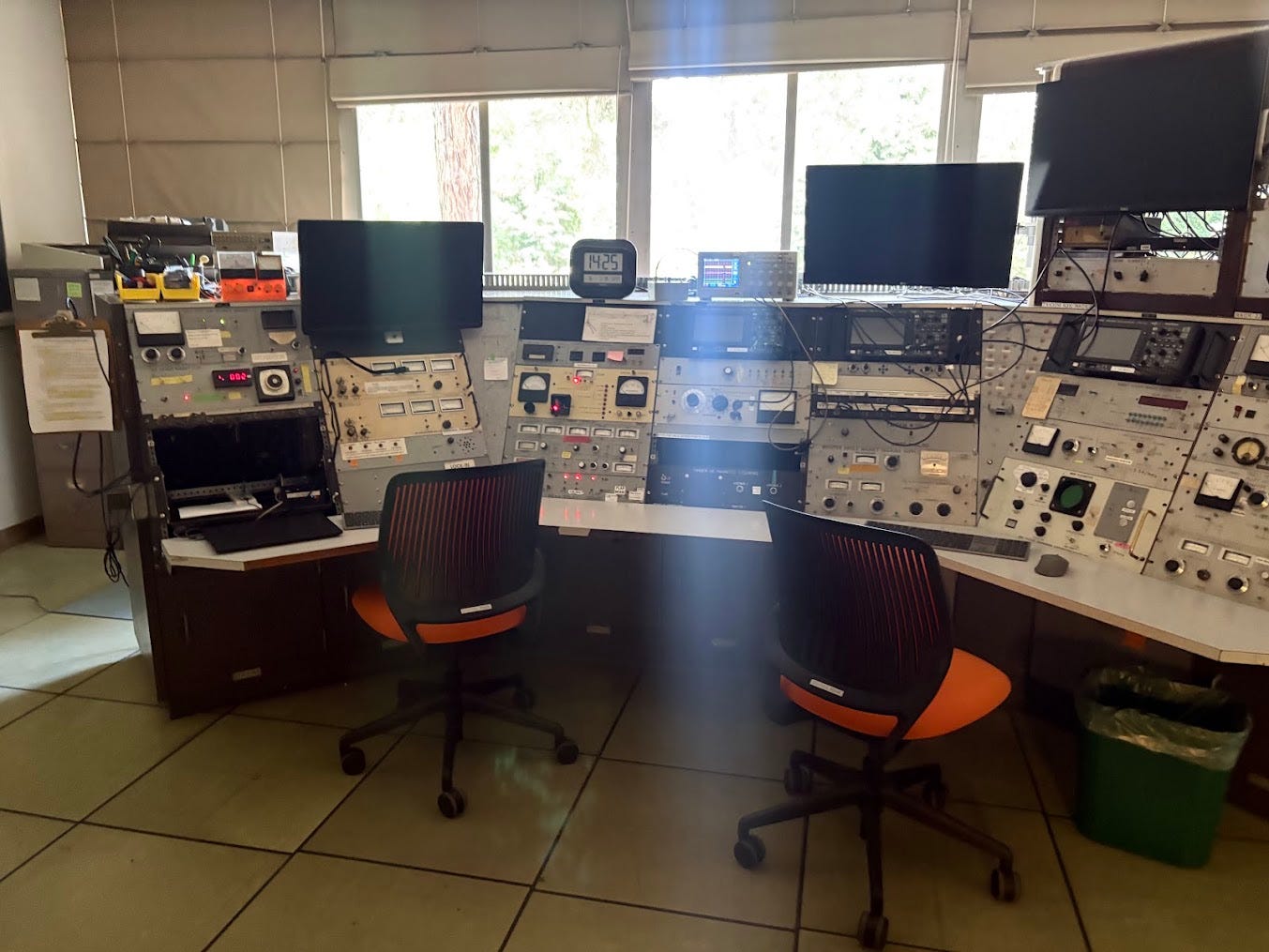
I was visiting friends in Seattle over the weekend and had the good fortune to get an impromptu tour of the Nuclear Physics Laboratory at the University of Washington, home to two of the most ambitious experiments to study dark matter.
The first is ADMX, the Axion Dark Matter Experiment. The QCD axion, originally proposed in the late 1970s to solve a problem in particle physics, was quickly identified as a promising dark matter candidate. ADMX searches for axions the way you might search for a radio station: using a strong magnetic field and a cold, precisely tuned microwave cavity, it scans across frequency bands that correspond to the possible masses of the particle, waiting for axions to convert into detectable photons. It is patient, methodical work, looking for a whisper from a particle that makes up most of the mass of the universe, but has never been directly detected.
The second is the LEGEND project, which is hunting for something equally profound: neutrinoless double-beta decay, a process that would occur only if neutrinos are their own antiparticles. If observed, this would demonstrate that the neutrino is its own antiparticle and could be the key to understanding how our universe formed, transforming how scientists understand matter, mass, and the evolution of everything we can see around us. LEGEND-200 is currently taking data at the Gran Sasso National Laboratory in Italy, while the next stage, LEGEND-1000, with a total detector mass of one ton of enriched germanium, is under preparation. The scale of these collaborations is genuinely humbling - hundreds of researchers across dozens of institutions, all chasing a signal that may take decades to find, if it exists at all. Seeing it up close is a reminder of what big team science looks like when the question is big enough.
And July 20, is itself a good day to think about humanity’s long patience with the cosmos. Fifty years ago, NASA’s Viking 1 touched down safely on Mars at 7:53 a.m. EDT, giving humanity our first ground-level view of the Red Planet. The twin robotic spacecraft conducted experiments to detect life and, although they didn’t provide conclusive answers, sparked a revolution in space study. This week is a great opportunity to learn about some amazing spacefaring exploits that are only possible through persistent exploration. Wednesday’s Astronomy on Tap, Thursday’s After Dark at the Exploratorium, and Saturday’s gravitational wave talk at the San Jose Astronomical Society each offer a different window into that same spirit of slow, cumulative discovery.
Science at its best is an act of extraordinary patience.
— Kishore
My picks for the week:
Astronomy on Tap San Francisco Wednesday, July 22, Standard Deviant Brewing, San Francisco
After Dark: Out of This World - Thursday, July 23, Exploratorium, San Francisco
Hunt for Gravitational Waves: A Story Spanning the Frequencies of Space-Time Saturday, July 25, San Jose Astronomical Association, San Jose
Upcoming Events:
Click to see the next two weeks of events in your browser.
Monday, 07/20/2026
How Do We Actually Make Meat Taste Like Meat? The Future of Food Science - 07/20/2026 07:00 PM
Hawthorn SF Nightclub and Lounge San Francisco
The flavor of food comes from thousands of chemical compounds interacting with our senses in ways most of us never think about. As scientists work to create more sustainable alternatives to traditional animal products, understanding those flavors has become one of the biggest challenges in building the foods of the future.
In this lecture, Jeremy Nowak, a physical chemist and food scientist who has worked at both Impossible Foods and The EVERY Company, explores the science behind flavor, protein innovation, and sustainable food technology. Drawing on his work developing alternative proteins, he explains how scientists identify the molecules responsible for taste and use them to create entirely new foods.
From plant-based burgers to proteins made through fermentation, this talk examines how chemistry, culture, and sustainability are shaping the future of what we eat and the global food system that feeds us.
Tuesday, 07/21/2026
Learning Submesoscale Processes at the Sea Surface - 07/21/2026 11:00 AM
Monterey Bay Aquarium Research Institute Moss Landing
I will describe several of our team’s previous and ongoing projects to examine dynamics and submesoscale processes through deep learning analysis of remote sensing datasets and ocean general circulation model (OGCM) outputs. By learning the fundamental patterns of sea surface temperature (SST) at scales of ~1 to 100km, we have surveyed the incidence and geographic distribution of features (e.g. fronts) and processes (e.g. upwelling) that manifest in SST data. The resultant model contains the salient dynamical features traced by SST. I will then discuss an algorithm trained on the ECCO LLC4320 OGCM to accurately predict and infill partially masked (i.e. cloudy) scenes of SST. This technique qualitatively outperforms standard, linear approaches and demonstrates the OGCM successfully captures submesoscale processes imprinted on SST. Lastly, I will detail our current program to identify and characterize density fronts, first in OGCM outputs and then by combining multi-platform remote-sensing datasets (SST, sea surface height, winds, and salinity). In turn, we aim to infer vertical transport through the mixed layer and to estimate the upper ocean heat content.
Speaker: Xavier Prochaska
Popping the Science Bubble: How neurons spark - 07/21/2026 05:30 PM
Berkeley Public Library Berkeley
Learn about cutting-edge research happening at UC Berkeley, directly from the scientists themselves. Join Popping the Science Bubble in the second floor Mystery Room or join us virtually on Zoom: http://bit.ly/PtSBBerkeley (register at the link).
This month’s presentations will be:
How neurons spark: The story of nerve signals - Sirui Ning, Chemical EngineeringSecond speaker to be determined
Wednesday, 07/22/2026
Connecting Researchers, Educators, and Students Through Accessible Science - 07/22/2026 11:00 AM
Monterey Bay Aquarium Research Institute Moss Landing
Science Journal for Kids and Teens aims to make scientific research discoveries more accessible to a general audience and particularly to children. Students can have a hard time conceptualizing what scientific researchers do and how they communicate their findings. And many teachers, especially K-12, do not have adequate research backgrounds to make it feasible for them to teach about scientific processes. Science Journal for Kids digitally publishes free, kid-friendly adaptations of peer-reviewed scientific papers. In this talk, I’ll discuss the resources we provide and how they have been shown to improve STEM literacy in classrooms. I’ll give examples of how teachers have used our materials and the beneficial collaborations we’ve had with university and community partners. Finally, I’ll discuss the role that researchers have in actively participating in and supporting outreach endeavors that improve scientific understanding.
Speaker: Miranda Wilson, Science Journal for Kids
Exploring Strange New Worlds: Rocky Exoplanet Atmospheres with JWST - 07/22/2026 07:00 PM
Sapp Center for Science Teaching and Learning Stanford
Can we learn about the history and geology of a rocky planet like Earth by measuring its atmosphere? In just a few decades, astronomers have gone from wondering whether planets exist around other stars to discovering thousands of them. Now the James Webb Space Telescope (JWST) is taking the next step: not just finding these worlds, but beginning to study what they’re like - including whether they have atmospheres at all, which are critical for planetary habitability. In this talk, we’ll meet the small, rocky exoplanets that are most like the inner planets of our own Solar System, and see how JWST looks for the faint chemical fingerprints of gases around distant worlds. We’ll also tour what JWST has discovered so far, what has surprised us, and why some planets seem to lose their atmospheres while others manage to hold on. Along the way, we’ll connect these observations to bigger questions about how planets evolve - and what it might take for a world to be truly Earth-like.
Speaker: Laura Schaefer, Stanford University
Virtual Skeptics on the Pub - 07/22/2026 07:00 PM
Bay Area Skeptics
This is a casual night of socializing with fellow science-forward skeptics and with others inhabiting our oblate spheroidal planet.
Please join us! This is a free event brought to you by Bay Area Skeptics. All are welcome.
Finding “The One”: Compatibility & Relationship Science - 07/22/2026 07:00 PM
The Faight Collective San Francisco
From dating apps and reality TV to advice from friends and family, we’re constantly told what makes two people compatible. But relationship scientists have spent decades studying a surprisingly simple question: what actually predicts whether a relationship will last?
In this lecture, Dr. Annika From, a relationship researcher at the University of Nebraska - Lincoln, explores what psychology research can tell us about romantic compatibility. Drawing on decades of studies, she examines some of the most common beliefs about relationships, including whether opposites attract, how much similarity matters, and whether attraction can grow over time.
This talk separates popular dating myths from scientific evidence and explores what researchers have learned about the factors that truly contribute to happy, healthy, and long-lasting relationships.
Astronomy on Tap San Francisco ??’ July 2026 - 07/22/2026 07:00 PM
Standard Deviant Brewing San Francisco
Speakers:
Jessica Snyder (Blue Marble Space Institute of Science) - Lessons for Deep Space Survival
and
Luca Boccioli (UC Berkeley) - A Tale of Neutrinos and Supernovae
Snyder is a Senior Research Investigator at the Blue Marble Space Institute of Science, having previously worked as a scientist at NASA. Boccioli is a Postdoctoral Research at UC Berkeley.
Thursday, 07/23/2026
SETI Live: Mars Rovers at 50: From Viking to the Future of Exploration - 07/23/2026 02:30 PM
SETI Institute
Fifty years ago, on July 20, 1976, Viking 1 became the first spacecraft to successfully land and operate on Mars, transforming our understanding of the Red Planet and launching a new era of planetary exploration. Today, sophisticated robotic explorers like Curiosity and Perseverance continue that legacy, searching for signs of ancient habitability and preparing the way for future human missions.
Join host Dr. Simon Steel and planetary scientist Dr. Pascal Lee as they explore the remarkable history of Mars rovers and landers-from Viking, Sojourner, Spirit, Opportunity, Curiosity, and Perseverance to the next generation of robotic explorers being developed for Mars, the Moon, and beyond. They’ll discuss what we’ve learned from five decades of exploration, the technologies that made it possible, and where robotic exploration may take us next. Recent concepts even include adapting Mars rover technology for future lunar missions.
What have Mars rovers taught us about our neighboring world? What mysteries remain unsolved? And what might the next 50 years of planetary exploration look like?
Join us live and bring your questions!
After Dark: Out of This World - 07/23/2026 06:00 PM
ExplOratorium San Francisco
Life beyond Earth - is it possible? Find out what it takes to survive in space, and hear from SETI scientists about the search for life off-planet.
Ages 18+
NightLife - 07/23/2026 06:00 PM
California Academy of Sciences San Francisco
Thursdays hit different at NightLife. The museum comes alive after hours - wilder, more curious, and full of exciting creatures. Grab your friends, grab a hand-crafted drink, and let yourself wander into whatever weird or wonderful corner calls you.
Plus, you can:
Step inside our four-story Osher Rainforest, where you can explore the Amazon’s treetops surrounded by free-flying birds and butterflies.Wander our newest exhibit, Vivid: Immerse Your Senses, for an unforgettable, embodied experience that awakens the senses and unlocks hidden worlds and unexpected perspectives.Venture into our aquarium exhibit Venom, to encounter live venomous animals and learn the power of venom to both harm and heal.Bask in the glow of one of the largest living indoor coral reef displays in the world: our 212,000-gallon Philippine Coral Reef habitat.Take in the interstellar views from the Living Roof, then grab a bite from the Academy Café and head to the West Garden to drink and dine under the stars.
The Science Behind Cat Color, Personality Traits and Intelligence - 07/23/2026 06:00 PM
San Francisco Main Public Library San Francisco
Learn about the science behind cat behavior, including the relationship among cat color, personality traits and intelligence, from Karol Maybury, Ph.D., a professor of psychology at the University of Maine at Farmington and co-founder of the Maine Cat Lab.
Presented by San Francisco Public Library
Friday, 07/24/2026
Lick Observatory After Hours - SOLD OUT - 07/24/2026 06:30 PM
Lick Observatory Mt. Hamilton
Take a walk through the Eastside of the Lick Observatory, culminating in a visit to the iconic Shane Telescope. After a journey through time with a history lecture, we’ll transition to a night of star gazing. Experience the cosmos firsthand through our expert-led portable telescope stations.
Our behind-the-scenes After Hours Tour showcases the Shane instruments, technology, and the scientific discoveries we have been making for almost 150 years - including an up-close look at the 3-meter Shane Telescope, the largest telescope on the mountain. During twilight, staff will give a history lecture about the founding and construction of the observatory. Once the sky is dark (and weather permitting), guests will view celestial objects through our portable telescopes. This event will be approximately 4 to 6 hours long. Visitors should be prepared to walk about one mile during the evening, including taking stairs.
Sunset Nature Walk - 07/24/2026 07:30 PM
Pond SF2 Menlo Park
Discover the San Francisco Bay’s evening wildlife on a guided walk at Ravenswood Pond SF2! We’ll explore the shorebirds that gather here at dusk, learn about the vital role of the South Bay Salt Pond Restoration Project, and share simple ways you can support the health of this important ecosystem.
This free, 1.4 mile roundtrip walk takes place on a flat, accessible trail (one overlook includes a 4inch step). Onsite parking and a toilet are available. Bring your binoculars or borrow a pair of ours. Warm layers are recommended as temperatures drop quickly after sunset.
Register at weblink
Saturday, 07/25/2026
Hunt for Gravitational Waves: A story spanning the frequencies of space-time - 07/25/2026 07:30 AM
San Jose Astronomical Association San Jose
Gravitational Waves are the ripples in the fabric of space-time created by some of the most violent dances in the universe between heavy, dense and extreme objects called compact binaries. Compact objects include star remnants such as white dwarfs, neutron stars and black holes. When two of such compact objects get trapped into each other they spiral with increasing speed towards their shared center and eventually collide, forming strong ripples in space-time that we detect from earth.
There have been many efforts in GW detection since the 1900s, the most recent and famous of which is LIGO. But there are also upcoming missions such as the LISA mission spearheaded by the ESA and the NANOGrav collaboration’s work on pulsar timing arrays. In this talk, we will see an overview of the targets, data analysis pipelines and upcoming research in each of these three quests.
Speaker: Shan Parmar, Cornell University
Lick Observatory After Hours - SOLD OUT - 07/25/2026 06:30 PM
Lick Observatory Mt. Hamilton
Take a walk through the Eastside of the Lick Observatory, culminating in a visit to the iconic Shane Telescope. After a journey through time with a history lecture, we’ll transition to a night of star gazing. Experience the cosmos firsthand through our expert-led portable telescope stations.
Our behind-the-scenes After Hours Tour showcases the Shane instruments, technology, and the scientific discoveries we have been making for almost 150 years - including an up-close look at the 3-meter Shane Telescope, the largest telescope on the mountain. During twilight, staff will give a history lecture about the founding and construction of the observatory. Once the sky is dark (and weather permitting), guests will view celestial objects through our portable telescopes. This event will be approximately 4 to 6 hours long. Visitors should be prepared to walk about one mile during the evening, including taking stairs.
Sunday, 07/26/2026
Top Predators - 07/26/2026 10:30 AM
Marine Mammal Center Sausalito
Some of the world’s best predators are in the ocean! Come learn about orcas, sharks, and even polar bears! You’ll hear about hunting habits to what we think makes them succeed, as we dive into some incredible top predators!
30 minute presentations at 10:30 am, 12:00 pm, and 2:00 pm
Raptor Encounter in Morgan Hill - 07/26/2026 05:30 PM
Morgan Hill Community & Cultural Center Amphitheat Morgan Hill
Join Peninsula Open Space Trust (POST), Santa Clara Valley Open Space Authority (OSA), and master falconer and educator Antonio Balestreri for Raptor Encounter in Morgan Hill! Guests will experience a presentation featuring several species of native owls, falcons, and hawks.
This educational presentation will focus on the roles raptors play in our environment, raptor biology, and conservation. Sign up for this unique opportunity to see these rescued and captive-bred raptors up close.
Seating will be outdoors and on the ground, and the program may include a free-flying bird of prey. Please come prepared with a picnic blanket to help you be comfortable sitting in the open field. Low-profile chairs will be allowed, but we will ask that you set up behind guests seated on blankets.
Please note that children are welcome and encouraged to attend! However, this event is a 2-hour sit/listen educational program and may be better suited to kids aged 10 or older.
Monday, 07/27/2026
What Breaks First at Scale: Lessons from Real-World Distributed Systems - 07/27/2026 07:00 PM
Valley Research Park Mountain View
As modern AI-powered and real-time applications grow, they increasingly rely on complex event-driven infrastructure. This session explores practical lessons learned from operating large-scale messaging and distributed systems in production. We will dive into the critical trade-offs regarding reliability, scalability, and observability in asynchronous environments, and discuss how architectural decisions compound when systems reach global scale.
Speaker: Ajinkya Kehr, Meta
Tuesday, 07/28/2026
All About International Observe the Moon Night 2026 - Livestream - 07/28/2026 06:00 PM
Astronomical Society of the Pacific
Finding Shackleton’s ‘Endurance’ - 07/28/2026 06:00 PM
Hopkins Marine Station Pacific Grove
Wednesday, 07/29/2026
Space Week: Astro Academy Day 1 - 07/29/2026 10:00 AM
Chabot Space and Science Center Oakland
Thursday, 07/30/2026
Space Week: Astro Academy Day 2 - 07/30/2026 10:00 AM
Chabot Space and Science Center Oakland
Tremendous Telescopes: The Future of American Space Observation - 07/30/2026 05:30 PM
Commonwealth Club San Francisco
After Dark: Splashdown - 07/30/2026 06:00 PM
ExplOratorium San Francisco
Emo NightLife - 07/30/2026 06:00 PM
California Academy of Sciences San Francisco
A Neurologist on the Strangeness and Wonders of Our Brain - 07/30/2026 06:00 PM
Commonwealth Club San Francisco
Mapping the Invisible: The Future of Geospatial Intelligence - 07/30/2026 07:00 PM
Donkey & Goat Winery Berkeley
The Sixth Sense: How Your Brain Knows Where Your Body Is - SOLD OUT - 07/30/2026 07:00 PM
Nirvana Soul Coffee San Jose
Friday, 07/31/2026
Space Week: Astro Academy Day 3 - 07/31/2026 10:00 AM
Chabot Space and Science Center Oakland
Lick Observatory After Hours - SOLD OUT - 07/31/2026 06:30 PM
Lick Observatory Mt. Hamilton
Saturday, 08/01/2026
Community-access Hiking Day at Martin Griffin Preserve - 08/01/2026 09:30 AM
Martin Griffin Preserve Stinson Beach
Space Week Festival Day 1 - 08/01/2026 10:00 AM
Chabot Space and Science Center Oakland
Vintage Computer Festival - 08/01/2026 10:00 AM
Computer History Museum Mountain View
First Saturday Tour at the Santa Cruz Arboretum - 08/01/2026 11:00 AM
UC Santa Cruz Arboretum Santa Cruz
Bay Day - 08/01/2026 11:00 AM
ExplOratorium San Francisco
Are There Gray Foxes in Your Backyard? - 08/01/2026 01:00 PM
Don Edwards Refuge Headquarters & Visitors Center Fremont
Lick Observatory After Hours - SOLD OUT - 08/01/2026 06:30 PM
Lick Observatory Mt. Hamilton
Sunday, 08/02/2026
Space Week Festival Day 2 - 08/02/2026 10:00 AM
Chabot Space and Science Center Oakland
Vintage Computer Festival - 08/02/2026 10:00 AM
Computer History Museum Mountain View
Solar Observing - 08/02/2026 02:00 PM
San Jose Astronomical Association San Jose
Comments
Nothing yet. Say the first thing.
Sign in to join the conversation.