
Greetings, fellow observers of the physical world!
As we cross the halfway mark of July 2026, the global temperature isn’t the only thing hitting a fever pitch. With the 2026 World Cup barreling through its high-stakes knockout rounds, the high-intensity drama on our screens is matched only by the invisible, brutal engineering tournament happening directly beneath the players’ cleats.
This week, we are pulling our focus out of the clouds to examine two very different kinds of competitive arenas: a physical tournament of highly engineered grass, and Big Tech’s brand-new multi-agent “idea tournaments” designed to automate hard science. Grab a cold drink—it’s time to break down the mechanics of the game.
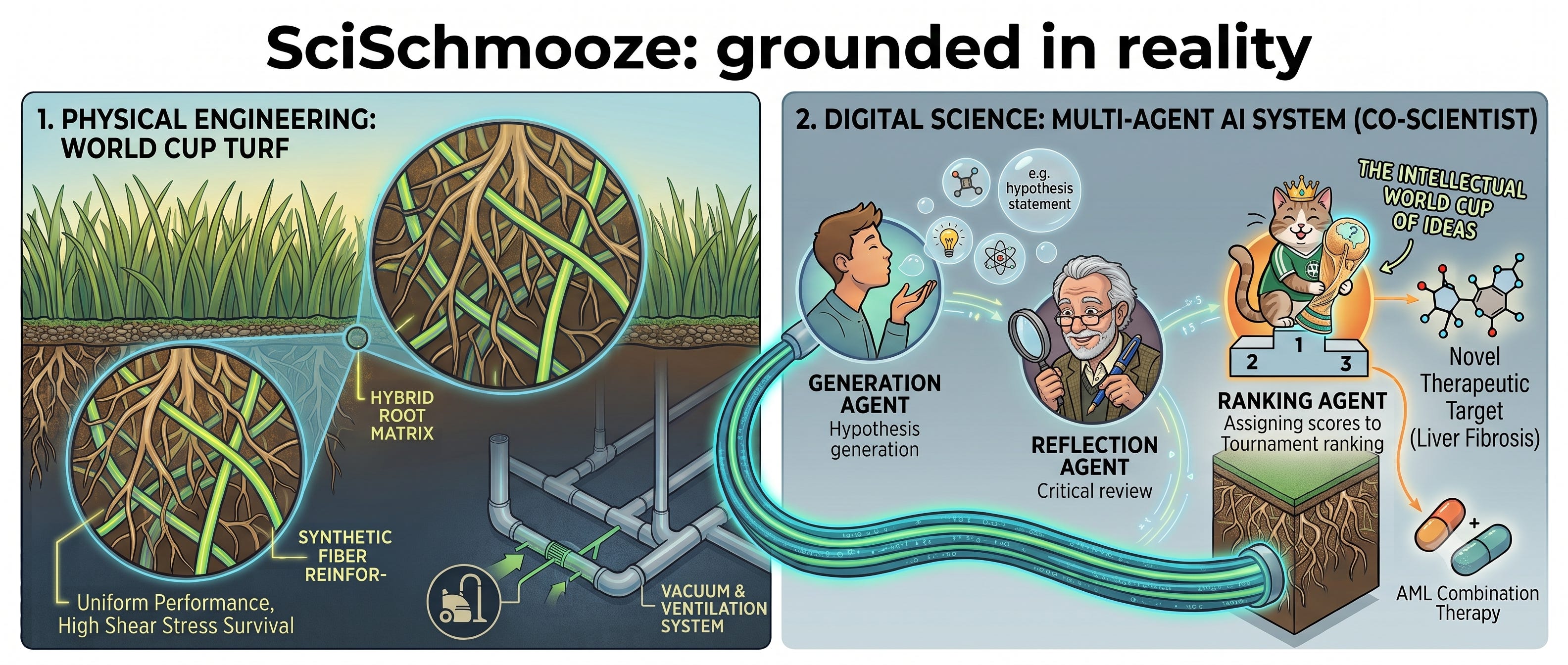
If you’ve been watching the World Cup matches over the last few weeks, you aren’t just looking at elite athleticism—you’re looking at a masterclass in composite materials science.
The logistical nightmare of a 48-team tournament spread across sixteen stadiums means playing in radically different environments. How do you make a pitch in the high altitude of Mexico City perform identically to one in the heavy humidity of Miami? You stop treating grass like a plant, and start treating it like a reinforced industrial composite.
To survive the intense shear stress of world-class athletes sliding, pivoting, and carving into the earth, turfgrass scientists had to completely re-engineer the field. First, uniform sod is grown on giant sheets of plastic so the root structures remain entirely intact during rapid transit and immediate stadium installation. Once laid down over a 14-inch bed of sand and modular plastic drainage cells, the natural grass is literally stitched together with 2.5 inches of synthetic fibers.
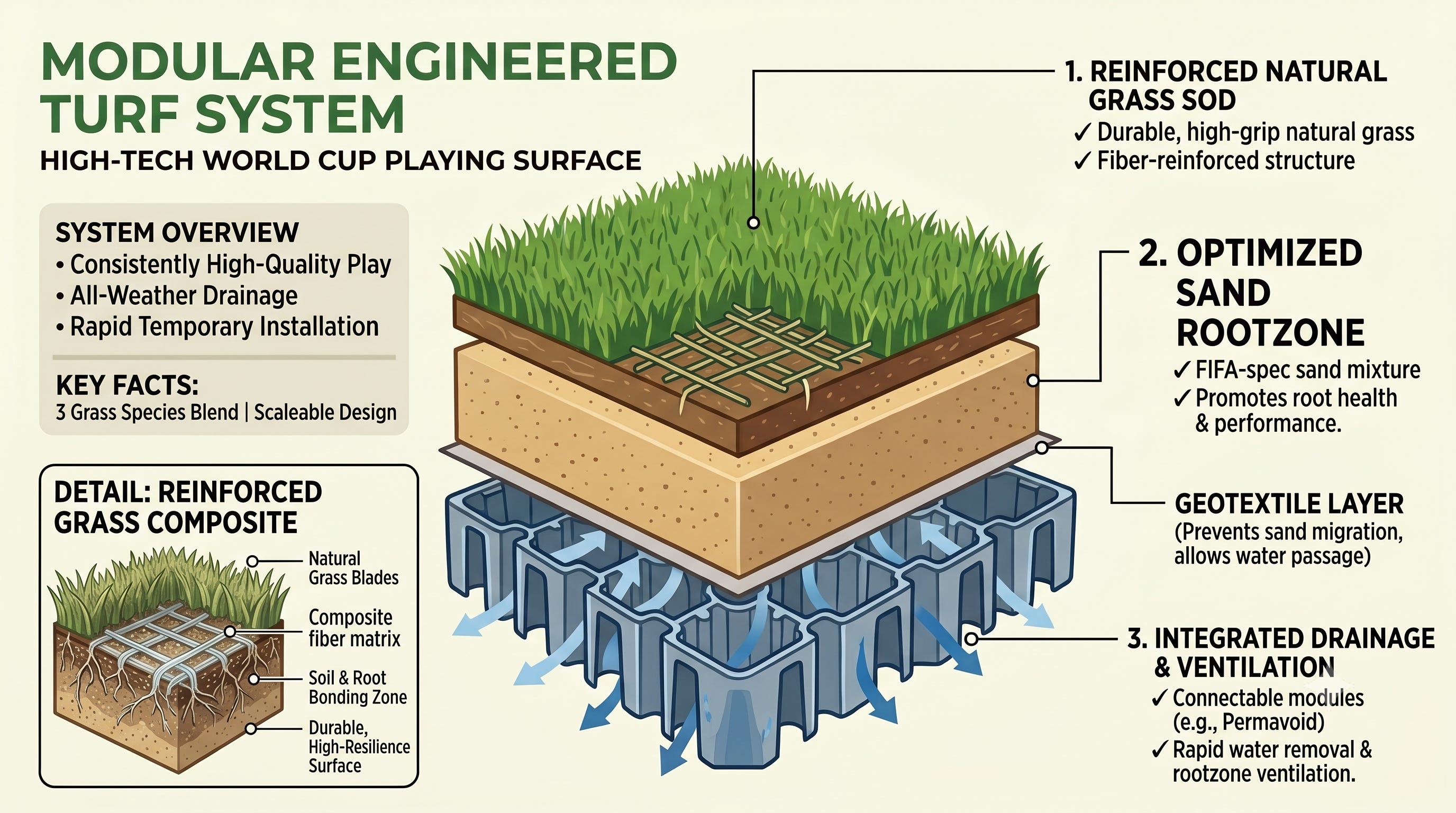
Cross-section of 2026 World cup engineered turf grass
(Adapted from https://www.utk.edu/turfgrass/)
This hybrid root matrix acts exactly like rebar in concrete. Under normal circumstances, an elite athlete making a sharp, sudden turn would rip up a massive divot of earth. In this composite matrix, the synthetic threads catch and anchor the natural roots, preventing the pitch from tearing apart and ensuring uniform ball-bounce physics regardless of the local weather. It is a literal physical tournament of tensile strength and root-binding kinetics.
Meanwhile, in the digital realm, Google DeepMind has brought a very different kind of tournament structure out of the lab. Formally graduating from a research project to a full peer-reviewed Nature paper, DeepMind officially introduced Co-Scientist.
Instead of relying on a human to feed a single prompt to a chatbot, the framework operates like a hyper-accelerated academic department populated by a collaborative coalition of specialized AI agents:
The Generation Agent: Pitches literature-grounded hypotheses and research focus areas.
The Reflection Agent: Acts as a piece-by-piece peer-reviewer, tearing ideas apart for correctness and novelty.
The Ranking Agent: Runs an automated “idea tournament,” scoring surviving theories Elo-style using AlphaGo-inspired logic.
The system is already showing real-world promise; in lab-validated trials published in its Nature debut, Co-Scientist successfully identified novel therapeutic targets for liver fibrosis and discovered unprompted combination therapies to combat acute myeloid leukemia.
This all sounds incredibly revolutionary—until you look at the compute budget. DeepMind acknowledges that Co-Scientist’s energy is spent largely on verification, ruthlessly cross-checking its own agents against structured databases like ChEMBL and UniProt to prevent confident hallucinations. As a recent Labcritics analysis points out, candidate generation is getting cheap, but verifying physical reality remains expensive.
The tech industry is running into a sharp architectural wall: Large Language Models (LLMs) excel at processing scientific text, but face steep structural limitations when acting as the primary calculator for physical or chemical properties.
A prominent viewpoint of Yann LeCun (a Turing Award-winning AI pioneer and Executive Chairman of AMI Labs) is that text is too thin a signal for true intelligence. Because LLMs merely predict the next word, they possess no causal world model; they excel at mapping statistical correlations in language, but lack an internal physics engine to understand the underlying mechanics of cause and effect. As LeCun bluntly puts it, “they do not understand the physical world.” Their linguistic fluency simply masks an inability to compute first-principles math or balance chemical reactions.
This absence of physical grounding is also central to a critique by UCL physical chemistry professor Peter Coveney and Science Museum Group director Roger Highfield in Frontiers in Physics. In their paper, “AI needs physics more than physics needs AI,” they warn that modern frontier architectures rely on trillions of parameters but lack uncertainty quantification, provide no mechanistic insights, and fail to capture basic scientific laws.
This reality check explains the industry’s rapid pivot from pure chatbots toward Large Quantitative Models (LQMs), highlighted by Google Cloud’s recent rollout of scientific tools from SandboxAQ—an independent Alphabet spinout that claims to operate at the intersection of AI, quantum mechanics, and physical science.
Unlike text-trained LLMs, LQMs are explicitly engineered directly on physical equations and laboratory data. The new enterprise paradigm splits the labor: a frontier LLM handles the natural language interface and literature synthesis, but it completely offloads the rigorous physics—such as calculating exact molecular adsorption energies on a metal catalyst surface—to a rigid, deterministic engine like Sandbox’s AQCat.
Here lies our healthy dose of SciSchmooze skepticism: When an AI tournament crowns a top-ranked hypothesis, does it expand human insight—or just scale up an automated checklist? Just like the high-stakes engineering playing out on the grass, the ultimate test for this quantitative league is simple. Can it deliver a truly paradigm-shifting material in the physical world, or will it just churn out faster, automated spreadsheets?
Structurally yours,
Lili
Upcoming Events:
Click to see the next two weeks of events in your browser.
Monday, 07/13/2026
Evolution through gene duplications - 07/13/2026 06:00 PM
Crepe Place Santa Cruz
For two decades, the “complete” human genome wasn’t actually complete. Roughly 8% stayed unknown because it was located in the most repetitive, copy-pasted stretches of our DNA, which happen to be the exact regions that I am interested in studying! Now, truly complete assemblies have finally filled in those gaps. We even have pangenomes: genome reference structures built from the DNA of many individuals instead of just one, designed to capture the diversity of a whole population.
In this talk we’ll look at the current state of comparative genomics and pangenomics, then turn to vertebrate evolution through one of its most creative forces: gene duplication. When a gene gets accidentally copied, the spare is free to take on new jobs - and sometimes it succeeds, producing a gene with a new and important function. We’ll meet some duplicated genes that expanded recently in primate evolution and appear to have helped build several distinctly human traits. Hidden for years in genomic “dark matter,” they can now be examined in detail for the first time. Come find out how complete genomes are changing the field!
Speaker: Prajna Hebbar, UC Santa Cruz
UFOs and Life Out There: Some Skepticism, Some Optimism - Livestream - 07/13/2026 07:30 PM
Bay Area Skeptics
With the release of the Spielberg blockbuster “Disclosure Day,” there has been great public interest in UFO claims and cases. In this illustrated, non-technical talk, astronomer Andrew Fraknoi will discuss the scientific, skeptical understanding of UFO (or UAP) claims. He will show what really happened in several famous cases, including the events in Roswell, New Mexico, which now drive the town’s tourist industry. Then he will explain our modern scientific understanding of the possibilities of intelligent life among the stars, and the serious and extensive experiments now under way to detect “techno-signatures” - remote evidence of advanced technological lifeforms.
Speaker: Andrew Fraknoi, Foothill College (emeritus)
Tuesday, 07/14/2026
Encrypting to a Mathematical Fact - Theoretically Speaking - 07/14/2026 05:30 PM
Calvin Laboratory Berkeley
When people think of encryption, they typically imagine a plaintext being encrypted so that only someone with the correct cryptographic key can decrypt it. In this talk, Sanjam Garg (UC Berkeley) will discuss a different kind of encryption scheme, where a plaintext can be encrypted to a puzzle or, more generally, to any mathematical fact. Anyone who can solve the puzzle or prove the fact can recover the plaintext. This talk traces the evolution of this idea and highlights recent developments that are making such techniques increasingly practical and relevant to real-world deployments.
Register at weblink
Restoring the Carmel River: The Rancho Cañada Floodplain Restoration Project - 07/14/2026 06:00 PM
Hopkins Marine Station Pacific Grove
Join Jake Smith, Planning & Conservation Program Manager for the Monterey Peninsula Regional Park District, for an overview of the Rancho Cañada Floodplain Restoration Project at Palo Corona Regional Park. This ambitious effort is transforming a former golf course into restored floodplain and upland habitat along the Carmel River, reconnecting the river to its historic floodplain and creating critical habitat for threatened steelhead trout and other wildlife. Learn about the project’s vision, construction progress, ecological benefits, and how this large-scale restoration will enhance climate resilience and create new opportunities for nature-based recreation and education in the Carmel Valley.
Wonderfest: Neural Synchrony - 07/14/2026 07:00 PM
Hopmonk Tavern Novato
When minds “connect,” the underlying brains synchronize their activity. The stimuli that most potently evoke this neural synchrony includes, perhaps surprisingly, the sharing of stories. Neuroscience now recognizes that narrative constitutes not only the basis of conscious experience, but also the principal mechanism that shapes human selves and societies - for good or for ill. Our Wonderfest speaker, Dr. Thomas Lewis, M.D., is Adjunct Professor at the University of San Francisco and Assistant Clinical Professor of Psychiatry at UC San Francisco. Dr. Lewis is co-author of A General Theory of Love.
Skeptics in a Real Pub - 07/14/2026 07:00 PM
Fiddler’s Green Millbrae
Enjoy an evening of socializing and feasting with fellow Bay Area science-forward folk in an Irish Pub on the Peninsula with great food. < Menu >
Join us! This is a free event brought to you by Bay Area Skeptics. All are welcome.
Astronomy on Tap East Bay - 07/14/2026 07:30 PM
Two Pitchers Oakland Oakland
This month, we have two awesome speakers lined up! Anna Coerver (UCB) will be talking about the infancy of the Universe and the measurements we make to learn about its very early stages. Then, we’ll hear from Dr. Macy Huston (UCB) on discovering the invisible with gravitational microlensing.
Our FREE Astronomy on Tap events feature accessible, engaging science presentations on topics ranging from planets to black holes to the beginning of the Universe. There is always lots of time to ask questions and interact with the presenters and other scientists who inevitably stick around for the beer.
Wednesday, 07/15/2026
Special LASER celebrating Stanford Research Park’s 75th Anniversary - What is Special about Silicon Valley? - 07/15/2026 05:30 PM
The Hub at Stanford Research Park Palo Alto Piero Scaruffi on “A History of Silicon Valley” Ge Wang on “What Do We (Really) Want From AI” Elise DeMarzo (Code: ART Festival) on “Digital Art, Real Community” Mihai Codreanu (Stanford) on “The Impact of University Research Parks”
Multi-Agent Systems at Scale as a Shared Platform for the enterprises - 07/15/2026 07:00 PM
Valley Research Park Mountain View
An agent is simple: Prompt + Tools + Model + Boilerplate. The first three are where product teams create value. The last one - state management, history compression, streaming, cancellation, tracing, memory, persistence - is 80% of the code but 0% of the differentiation. At ThoughtSpot, we built an Agent Platform that draws a hard line between agent logic and agent infrastructure, letting product teams ship customer-facing agents faster by owning only what matters: their prompts and their tools. This talk covers the infrastructure patterns behind that separation: State management across tool calls. Stateless tools (state on the agent, passed as arguments) give you testability and let the LLM reason about state. Stateful tools (state in the tool service) avoid serialization overhead. I’ll walk through flow diagrams, show how we propagate state via tool response metadata, and discuss when each pattern fits. Configuration-driven agent definitions. Agents defined entirely through config - templated prompts, tool endpoints, sub-agent rules, compression strategies. Teams ship agents without writing orchestration code. Inter-agent communication. Two patterns: agents-as-tools (sub-agent called like any tool, returns structured output) and agent handoff (full conversation transfer). The platform handles routing and context - teams just declare delegation rules. Shared memory across agents. Memory in the platform, not individual agents, means knowledge accumulates across agent boundaries. Tiered scoping (tenant, org, user) with retrieval that surfaces relevant context regardless of which agent captured it. Tool protocol design. MCP as the base, with patterns layered on top: cancellation semantics, progress streaming, context variable propagation, and adapters for existing services. Building for customer-facing scale adds constraints - high concurrency, encryption, tenant isolation, auditability - that shaped our API design throughout.
Speaker: Ashish Shubham, ThoughtSpot
Attend in person or online. See weblink
Decoding the Magnetic Interstellar Medium - 07/15/2026 07:00 PM
San Francisco Amateur Astronomers San Francisco
The interstellar medium is the “stuff between the stars” in galaxies: the turbulent broth of gas and dust out of which new stars are born, and into which some old stars explode. Magnetic fields thread this interstellar environment, helping to sculpt galaxies through their influence on a diverse range of physics, from the propagation of high-energy charged particles to star formation. Despite its importance across scientific realms, the interstellar magnetic field and its influence on Galactic processes are not well understood. I will discuss recent new directions for deciphering the magnetic interstellar medium
Speaker: Dr. Susan Clark is an assistant professor of physics at Stanford.
Nerd Nite SF #162: “Curing” Hysteria, The Sharks of San Francisco Bay, and Who Speaks for Earth? - 07/15/2026 08:00 PM
Rickshaw Stop San Francisco
Is it really that time again? Another Nerd Nite so soon? Yes, dear nerds, I’m pleased to say it’s true: Nerd Nite SF returns to Rickshaw Stop on July 15th at 7pm! Have you ever wondered who on Earth is (officially) trying to talk to aliens? Have you ever wondered what “hysteria” actually was as a “medical condition” or how it was “cured?” Did you know that there’s some really heckin’ old sharks living in the Bay and if you want you can join a research team to study them? (it’s true! you literally just sign up!) We’ve all got a lot of questions these days; the world is a confusing place. Luckily, we’ve got some answers. Come on down!
Messaging ET: Who Speaks for Earth?
By: Julia DeMarines, Astrobiologist
Did you know that humans have sent over a dozen high powered messages to space to intentionally get a response from potential ET onlookers? While most people aren’t aware of these activities, these messages speak on behalf of humanity and all beings on our planet who have no say in the matter! This raises ethical questions: Should we be messaging at all? What should these messages say? And most importantly, who speaks for Earth? In this talk I will discuss the Dear ET project - an international effort that bridges active philosophy and STEAM education to raise awareness of these messaging efforts, support legitimate global representation, and hopefully enact messaging policy in the future.
“Curing” Hysteria: Strange Remedies and Women’s Resistance in the 19th-Century U.S.
By: Vivian Wolf, Dominican University
In the nineteenth-century United States, women diagnosed with hysteria and other nervous disorders were prescribed treatments including prolonged bed rest, all-milk diets, hydrotherapy, and electrical stimulation. This talk examines the cultural and economic forces behind these so-called cures while exploring how writers challenged prevailing ideas about health.
Sharks of San Francisco Bay: What We Know, What We are Learning, and How You can Take Part
By: Meghan Holst, UC Davis
San Francisco Bay is home to a diverse and historically significant population of sharks, but much remains unknown about their long-term conservation needs. In this talk, Dr. Meghan Holst of Ocean Science Expedition Academy (OSEA) will share what we currently know about Bay sharks, the critical research questions OSEA is working to answer, and how the organization is creating equitable, hands-on opportunities for community members to take part in real marine science. Whether you’re a curious local or an aspiring researcher, you’ll leave with a new appreciation for the sharks in your backyard and how you can help protect them.
Thursday, 07/16/2026
SETI Live: A New Way to Search for Alien Civilizations - Livestream - 07/16/2026 02:30 PM
SETI Institute
For decades, SETI researchers have focused on finding narrow-band radio signals that might stand out from the natural universe. But what if an advanced civilization that wanted to communicate would choose a very different strategy?
Join host Dr. Lauren Sgro and UCLA astronomer Dr. Ben Zuckerman as they discuss his new paper, Broadband Searches for Extraterrestrial Technological Intelligence: A New Strategy to Find Nearby Alien Civilizations. The research proposes a new approach to SETI that focuses on broadband signals and existing astronomical surveys, potentially changing how we search for evidence of technological civilizations beyond Earth.
Could signs of extraterrestrial technology already be hidden in data we’ve collected for entirely different purposes? What can current observations tell us about the likelihood of nearby communicative civilizations? And what does the apparent silence of the cosmos really mean?
After Dark: Unplug and Play - 07/16/2026 06:00 PM
ExplOratorium San Francisco
Your monthly invitation to hang out and try something new - play science trivia, find your community, and connect deeply.
Ages 18+
NightLife: Analog - 07/16/2026 06:00 PM
California Academy of Sciences San Francisco
Trade screen time for real time. Wander, make, and connect during a night dedicated to the non-digital world.
Choosing the Next Generation: An Introduction to Embryo Screening - 07/16/2026 07:00 PM
Hawthorn SF Nightclub and Lounge San Francisco
For many people, IVF is imagined as a medical procedure. In reality, it often becomes a series of difficult decisions: what information to learn, which tests to run, how to interpret genetic results, and what to do when science can offer probabilities but not certainty.
In this lecture, Christina Ren, a board-certified reproductive genetic counselor building the next generation of embryo screening technology, explores how genetics is transforming the IVF process. She explains what today’s embryo screening can and cannot tell us, and why the field is moving beyond simple categories of “normal” and “abnormal.”
As screening expands to include risks for conditions like cancer, heart disease, and diabetes, this talk examines how families navigate one of the most complex questions in modern medicine: how should we use genetic information when making decisions about future generations?
Cats, Wildlife, and Solutions - Livestream - 07/16/2026 07:00 PM
Golden Gate Bird Alliance
Join our panel of experts to learn about how outdoor cats are impacting our urban ecology, with a focus on solutions that work for public lands, your neighborhood, and your home!
This panel discussion will be moderated by Golden Gate Bird Alliance’s Conservation Director Whitney Grover and will include the following panelists; UC Berkeley PhD and wildlife ecologist Tyus D. Williams, East Bay Regional Park District Wildlife Biologist Natalie Reeder, Full Circle Cats (Nonprofit Cat Rescue) Founder Kate Wilson, and Cat Topia Director of Marketing and Communications Matthew Hildebrandt.
Friday, 07/17/2026
Family Author Event: Amelia Otter’s Mischief in the Water - 07/17/2026 03:00 PM
Pacific Grove Museum of Natural History Pacific Grove
Author Luke McLelan will read his delightful book about Amelia Otter, a real live otter who made some mischief in Monterey Bay and befriended surfers. Families with elementary age children are invited to join us for this free event. We will have books available for sale and the author will be on hand to sign them.
Lick Observatory After Hours - SOLD OUT - 07/17/2026 06:30 PM
Lick Observatory Mt. Hamilton
Bair Island Sunset Walk - 07/17/2026 07:30 PM
Bair Island Wildlife Refuge & Trail Redwood City
Flock together for a lovely walk along the marshes of Bair Island while viewing the flamboyant colors of a California sunset! The walk will be an easy 0.8 mile stroll along the marsh at Bair Island.
Come view the sunset on our walking tour around the charming marshlands of Bair Island. Many birds and other wildlife species make an appearance at dusk. While strolling along the trail, you will learn about the fascinating history of the area, local wildlife species, and what you can do to contribute to the health of this important ecosystem. Bring your binoculars or borrow a pair of ours.
A drinking fountain is available in the Bair Island parking lot. Parking is free.
This easy walk will be on a dirt path with no elevation gain. We will gather at the seal dedication statue and walk to the observation deck, 0.4 miles away. The entrance to the trail is accessible via ramps. Please bring warm clothes as it quickly gets cold after the sun sets.
Please note:
Public restrooms are NOT open at this time.The observation deck is NOT open at this time.Pets are not allowed at Bair Island.All minors must be accompanied by an adult for the entirety of the walk.
Register at weblink
Saturday, 07/18/2026
Nature Journals and Sensory Walk - 07/18/2026 10:00 AM
Don Edwards Refuge Headquarters & Visitors Center Fremont
Join us to learn to make and decorate your own nature journal! Afterwards, use your journal to engage all your senses as you explore the habitats of the Refuge on a self-guided sensory walk! We will have signs set up to help guide your experience!
We will provide all the materials needed for nature journaling. This family-friendly event is open to all ages - just bring water, sun protection, and your sense of curiosity!
We will have a table set up to greet you, direct you to the Pavilion for nature journal creation, and answer any questions you might have! Drop in anytime between 10:00 a.m. and 12:00 p.m. at your convenience. Please allow up to one hour to complete the self-guided sensory walk and nature journaling activity. After completing the self-guided walk, come back to the Pavilion to get a prize!
Sign up for your free tickets here:
https://NatureJournalsJuly2026.eventbrite.com
Family Bird Walk - 07/18/2026 12:00 PM
Don Edwards Refuge Headquarters & Visitors Center Fremont
Join us on a fun, family, feathered Family Bird Walk! This program is especially recommended for families with children ages 5-10.
Let family walks become a shared time of nature learning! We’ll begin by helping kids create their personal bird watching field guides, and then head out onto the trails to find those birds.
A limited number of binoculars are available to borrow. Recommended for families with children ages 5-10, but all are welcome! This program is led by Ken Roux.
Register at weblink
The Tech Topple: The Largest Live Domino Build in California at The Tech Interactive - 07/18/2026 12:15 PM
The Tech Interactive San Jose
Get ready for the ultimate chain reaction! Tech Topple: The Great Adventure brings its massive, 40,000-domino spectacle back to The Tech Interactive for its 11th year. This year’s jaw-dropping build features an intricate “one-ball path” where a single, determined ball will travel all the way from start to finish, triggering approximately 300 incredible chain reactions across land, sea, and sky-high surprises! Watch as the ball crosses an ocean on a ship, scales a mountain, and falls in an avalanche.
The entire layout is engineered by Reactica, a team of seasoned domino and chain-reaction artists who have built for brands like Disney World and the Golden State Warriors, with several members having starred on FOX’s Domino Masters.
Want a sneak peek before the big drop? Come watch the builders in action and meet the team during standard museum hours on Sunday, July 12, and from Wednesday, July 15 to Friday, July 17!
Beyond the big crash, the entire museum is open for exploration. Visitors can become domino masters themselves by heading into the Tech Studio for interactive domino building challenges. It is a full day of physics, patience, and hands-on experimentation perfect for curious minds.
The Great Topple Drop: 1:00 p.m. sharp
Lick Observatory After Hours - SOLD OUT - 07/18/2026 06:30 PM
Lick Observatory Mt. Hamilton
Starry Nights Star Party - 07/18/2026 09:30 PM
Rancho Canada Del Oro Open Space Preserve Morgan Hill
Join the San Jose Astronomical Association (SJAA) and Santa Clara County Open Space Authority (OSA) for an unforgettable night of exploring the night sky. Our knowledgeable docents, members of SJAA, will be your guides to providing valuable insights into the wonders of our universe. The viewing site, Rancho Canada del Oro Open Space Preserve, is just 30 minutes south of downtown San Jose, and features darker skies than viewing from the city. It’s dark enough to see the band of our Milky Way galaxy during the Summer months.
Gather with fellow space fans for an evening under the stars as we set up telescopes for an up-close experience viewing interesting objects in the nighttime sky. Connect with amateur astronomers and space enthusiasts to share in the excitement of observing the night sky in all its splendor. You may even see a meteor or satellite passing overhead. Whether you’re a beginner looking to learn more about the heavens above or a seasoned stargazer seeking to deepen your knowledge, this event promises to spark curiosity and awe for the wonders of our cosmic backyard. Come join us for a star party that will leave you inspired by the beauty and science of astronomy.
Registration required (at weblink). See weblink for additional information.
Monday, 07/20/2026
How Do We Actually Make Meat Taste Like Meat? The Future of Food Science - 07/20/2026 07:00 PM
Hawthorn SF Nightclub and Lounge San Francisco
Tuesday, 07/21/2026
Learning Submesoscale Processes at the Sea Surface - 07/21/2026 11:00 AM
Monterey Bay Aquarium Research Institute Moss Landing
Popping the Science Bubble: How neurons spark - 07/21/2026 05:30 PM
Berkeley Public Library Berkeley
Wonderfest: Modern Alchemy: Building New Elements - 07/21/2026 07:00 PM
Hopmonk Tavern Novato
Wednesday, 07/22/2026
Connecting Researchers, Educators, and Students Through Accessible Science - 07/22/2026 11:00 AM
Monterey Bay Aquarium Research Institute Moss Landing
Exploring Strange New Worlds: Rocky Exoplanet Atmospheres with JWST - 07/22/2026 07:00 PM
Sapp Center for Science Teaching and Learning Stanford
Virtual Skeptics on the Pub - 07/22/2026 07:00 PM
Bay Area Skeptics
Finding “The One”: Compatibility & Relationship Science - 07/22/2026 07:00 PM
The Faight Collective San Francisco
Thursday, 07/23/2026
After Dark: Out of This World - 07/23/2026 06:00 PM
ExplOratorium San Francisco
NightLife - 07/23/2026 06:00 PM
California Academy of Sciences San Francisco
The Science Behind Cat Color, Personality Traits and Intelligence - 07/23/2026 06:00 PM
San Francisco Main Public Library San Francisco
Friday, 07/24/2026
Lick Observatory After Hours - SOLD OUT - 07/24/2026 06:30 PM
Lick Observatory Mt. Hamilton
Sunset Nature Walk - 07/24/2026 07:30 PM
Pond SF2 Menlo Park
Saturday, 07/25/2026
Lick Observatory After Hours - SOLD OUT - 07/25/2026 06:30 PM
Lick Observatory Mt. Hamilton
Sunday, 07/26/2026
Top Predators - 07/26/2026 10:30 AM
Marine Mammal Center Sausalito
Monday, 07/27/2026
What Breaks First at Scale: Lessons from Real-World Distributed Systems - 07/27/2026 07:00 PM
Valley Research Park Mountain View
Comments
Nothing yet. Say the first thing.
Sign in to join the conversation.