
Programming note: today’s post is a book review of sorts along with some investment journal thoughts on cable. I have some updates on existing investments as well as a few new situations to write about in the next few posts. As I’ve mentioned in the BHI chat, there are a lot of interesting ideas currently. Speaking of the chat, I’m really enjoying that function and it’s a great place to share brief ideas and quick thoughts. If you’re a BHI reader, check it out. It’s a great place to ask questions as well in any of the Q&A threads.
One of the stocks I’ve received the most questions on recently is Charter (CHTR). I’ve never owned it and I don’t believe I’ve ever written about it, but I have followed it closely, along with its cable cousin, Comcast. I have sold a few puts on CMCSA at times as part of Saber’s (creatively) named “buy/write” tactic that I use to collect premium income on certain large cap stocks, designed to add modest additional returns to the portfolio’s results. More on that some other time…
Charter is a pure play broadband and cable internet provider. Comcast is more of a media conglomerate with a broadband internet business, a broadcast network (NBC), a movie studio and a theme park business (Universal).
The cable industry is one that has confounded value investors perhaps more than any other over the past decade or so, tempting us with the allure of recurring revenue (present and past tense at least), high free cash flow yields and a capital allocation legend directing much of those cash flows.
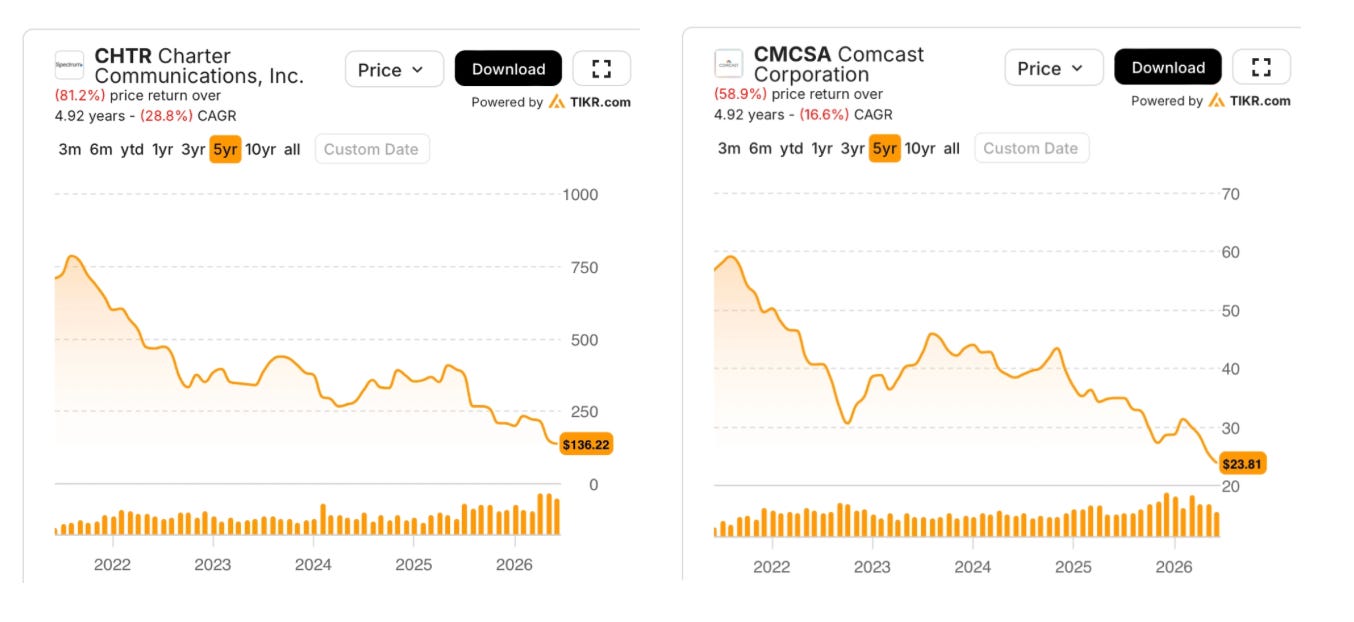
But the results over the past decade have been disastrous for stockholders, with CHTR down 42% and CMCSA down 30% (the latter cushioned by dividends).
The pain in the last 5 years has been particularly acute:
There are many titans in the media world, but few stand taller than John Malone. One of my favorite business books is Cable Cowboy, which covers the dawn of the cable industry and Malone’s early deal making that helped build it into a juggernaut.
I recently read Malone’s new book “Born to Be Wired”. Relative to the triumphant tone of Cable Cowboy (a biography written in 2002), the tone of this book (written by Malone) is very different, with discussions of the industry’s challenges. After reading the book, I watched a few of his old interviews to see how his views on the media industry and cable specifically have evolved over time.
Most recently, he suggested the possibility that these companies’ competitive positions might be akin to discount airlines: a small number of players, but all very competitively fighting with each other to fill their last few empty seats. This marginal pricing pressure makes it difficult to retain customers and even more difficult to raise prices. And though the business has “fixed” costs, they do seem to rise over time with inflation, another concern when your top line is stagnant.
Charter is planning to decrease their capex spend from around $11b to $8b, but their network still largely consists of copper lines that are being reworked to provide “symmetrical” upload and download speed (right now, you might be paying for 500 Mbps, which is your download speed, but your upload speed might only be 20-30 Mbps). Charter is in a heavy upgrade cycle right now which will soon provide equal speeds across their entire footprint (i.e. 500 Mbps download and upload). For 99% or more of customers, this will essentially be the same experience as true fiber optic internet. However, data consumption continues to skyrocket and a few years from now, the demand for bandwidth will likely be much greater than it is today. I’m not an expert in this area, but my understanding is that it’s easier (less costly) for true fiber lines to increase the bandwidth than it is for the hybrid mixture of fiber and coaxial copper lines that Charter offers (which they call “fiber powered”). Copper lines transmit data using electrical signals and fiber lines use light pulses. Since light travels much faster than electricity, my thinking is that true “fiber to the home” (FTTH) offerings will be better positioned in the long run as data consumption keeps rapidly growing.
All this to say, while CHTR capex is set to decline in 2028, I’m not sure it can be sustained at that lower level without falling behind competition in say 2029 or 2030. The faster technology advances, the more bandwidth we seem to require, and I can only imagine the amount of data we’ll be consuming 3 or 4 years from now in this brave new AI world we live in. The next upgrade cycle is always right around the corner in cable.
Cable Monopolies
The competitive position of cable companies in the early decades of the industry was far different than today. They were local monopolies. There were thousands of cable companies that worked like franchises. You entered a town, hung wire, and got the license to serve the customers that your wires passed. You were literally the only game in town for people who wanted to watch the channels you distributed. The cable industry was a consistent growth engine that produced high recurring free cash flow that was used to hang more wires in new locations. Companies often got over their skis by taking on too much debt to grow too fast, but the underlying economics of each local franchise were excellent: high variable margin revenue that was recurring and growing.
Eventually, the industry matured, competition became more intense, regulatory changes (Telecommunications Act of 1992 among others) began to slowly erode the returns in this industry, but even still, these companies acted like duopolies and continued to extract their rents for many years.
But, about 10 years ago, the cord cutting wave began and the television industry was completely disrupted. Cable bundle subscribers have dropped from around 100 million at the peak in 2014 to around half that level today (and continuing to fall). Fortunately, cable operators were well positioned early on for the change from cable TV to streaming because the wire coming into your house transmits data and could be used to provide high speed internet. So cable operators adapted, and today they are basically internet providers that happen to have a TV business on the side if you want it. They prioritize their broadband offerings, and this is the main money maker. Charter has 29 million internet subscribers and only 12 million cable TV subscribers (this ratio used to be flipped).
Competition and the Trend of ROIC
Today, those cable monopoly days are long gone. Competition is intense and only seems to be rising. My best investments have tended to come from companies where returns on capital were improving. A great stock doesn’t need to have high ROIC to begin with if those returns are gradually improving. Over the intermediate term (say 5-7 years), I’ve noticed the direction of ROIC is much more important to a stock’s return than the absolute level of ROIC. Take two hypothetical companies over a decade period:
The first started the decade with 40% ROIC and ended at 20%
The other started at 8% ROIC and ended at 15%
In almost every case, the second company will be the far better stock, even though the first still earns better ROIC. Part of this is because the starting valuation of the first company (which reflects its outstanding 40% ROIC) is almost always too high, and the starting valuation of the 8% ROIC is almost always too low (if returns rise).
Bank of America was a far better stock than Wells Fargo in the last 10 years, even though WFC had a higher ROE than BAC throughout the entire decade:

Wells Fargo started and ended the decade with a higher ROE than Bank of America, but BAC was the far better stock.
Notice the slope of the ROE in each graph below:
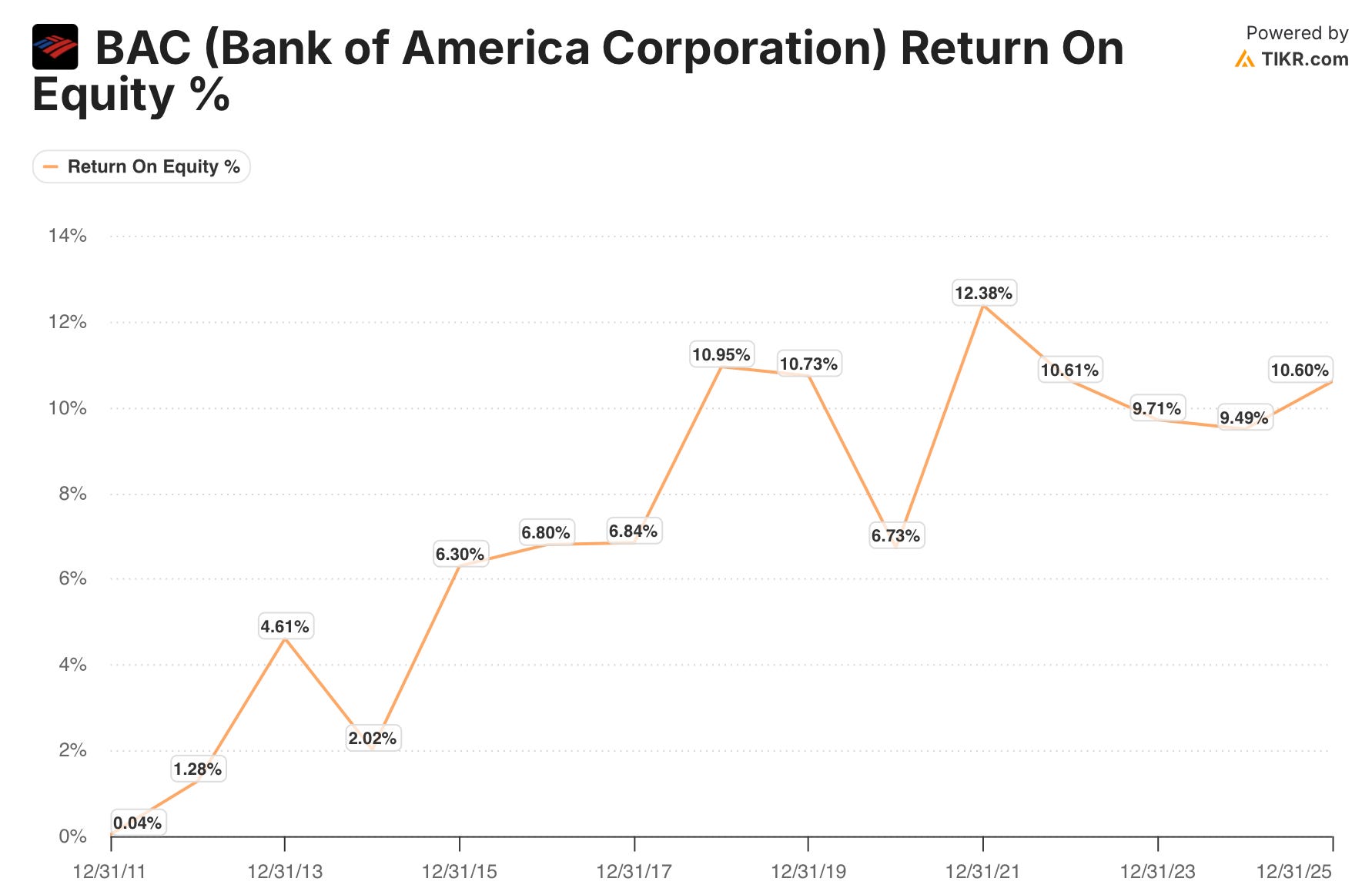
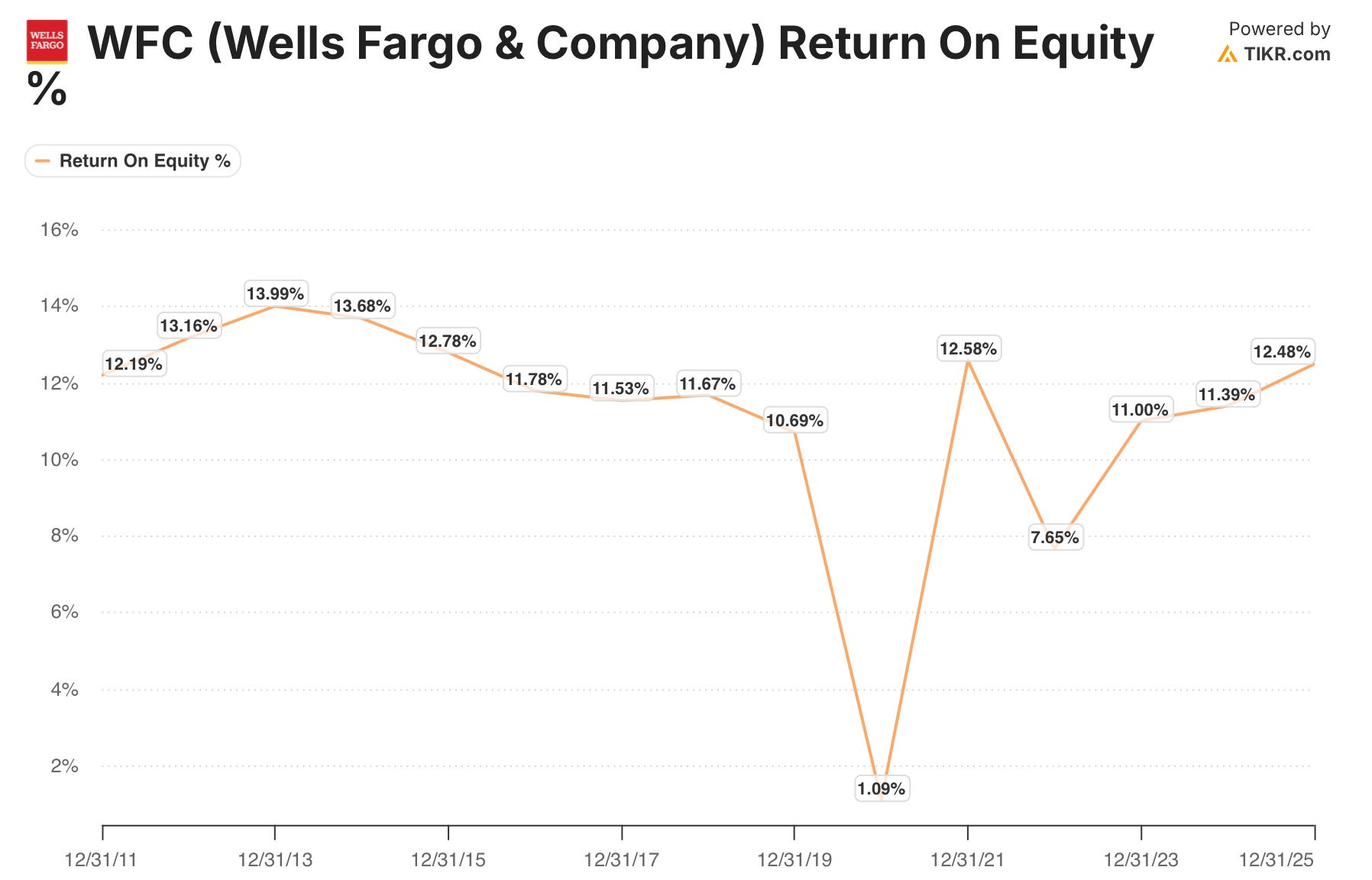
The incremental ROE (i.e. the direction of ROE) is what really matters during the time you own a stock.
The WFC vs BAC example has more to do with company specific circumstances, but the slope of an ROE curve is usually correlated with competition. If competition is rising, returns on capital tend to fall, and stock returns tend to suffer.
“Be scared of the guy with money to burn” - John Malone
Cable companies and phone companies have entered each others arenas and are ramping up competition.
If you get your internet with Charter (Spectrum), you can get a mobile line from them for $30 per month. In a bit of a paradox, Charter competes with Verizon using Verizon’s own network, offering a mobile plan that is generally cheaper than Verizon’s retail plans (though there are some quality differences). But, if you’re a Verizon customer, you can now get fiber internet in certain markets at a bundled cost that is much lower than what Charter offers.
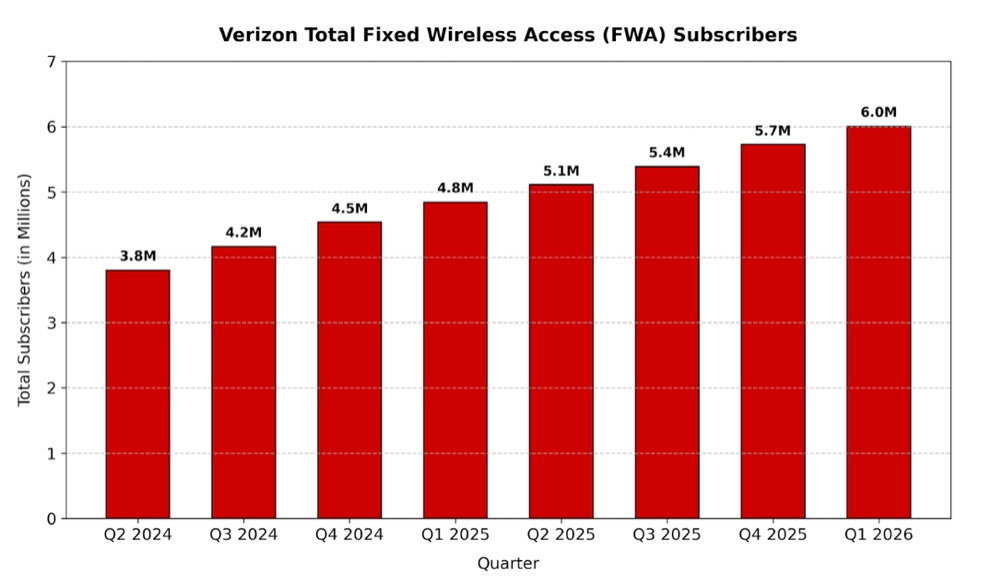
In addition to fiber competition, a big problem for the cable broadband industry has been a technology called “fixed wireless” (or FWA), which delivers high speed internet to your home using mobile cell towers to send the signal: similar to how you get 5G internet on your phone. For years, FWA was dismissed as inferior quality, but FWA is rapidly growing, suggesting the quality might be good enough.
FWA uses excess spectrum capacity that Verizon and the other large carriers have on their networks. Imagine you own an office building that your business occupies that has excess space you aren’t currently using. You can rent out this space to others for extra income, which is nice since you’re paying for the entire building. The thought was that this excess spectrum currently used for FWA internet would reach capacity at some point (the office building would fill up), and then the growth of FWA would slow. This has actually happened in some cases at certain times, with reports of data “throttling”. However, with Verizon buying Frontier, they may be able to offload data onto their fiber network, freeing up more capacity on their towers to serve more FWA customers. This is how Charter operates their mobile business: they use Verizon’s network but a whopping 89% of the data runs across Charter’s own wires, meaning only a very small portion of their data is using Verizon’s capacity.
Perhaps FWA has a longer growth runway than the industry initially predicted:
And speaking of Malone’s quote about being scared of a guy with money to burn, we can’t have a cable discussion without mentioning Starlink, which is part of SpaceX, which just raised $80 billion of fresh cash.
SpaceX is capturing investor hearts and minds with visions of datacenters in space, Mars colonization and asteroid mining. SpaceX’s IPO prospectus reads like the script of the next Avatar or Dune movie, leaving us with a cliff hanger (what will the company do next?!); but one thing we do know is that in terms of current revenue, SpaceX is today much more of an internet service provider, and one that likely can grow much larger over time.
If I’m in the cable business, there is nothing scarier than Elon’s boundless ambition combined with his army of equity investors ready, willing and able to pony up more cash whenever it is needed.
I think Starlink could end up being very big, which would be a very big problem for broadband cable companies.
Amazon also has their own satellite offering, called Amazon Leo, which already offers up to 1 Gbps speed, more than the vast majority of internet users currently need. Starlink offers 400 Mbps and is testing speeds up to 1 Gbps. Satellite doesn’t offer the same speeds as broadband today, but I view satellite’s quality improvement as a technological inevitability.
Discount Airlines and Pricing Power (or Lack Thereof)
With competition for broadband customers heating up, I think it will be difficult for the industry to raise prices and even retaining customers and keeping pricing flat is getting much harder. It’s still somewhat of a headache to switch, but most of it can be done online now and it is much easier to switch providers than it used to be. I recently threatened to do so, and in less than 15 minutes my overall cable+internet bill dropped $80/month (including TV).
This is where John Malone’s discount airline analogy is fitting. The airline industry has only a few players, but they’re fighting hard to fill their last empty seats. A big part of an airline’s cost structure is fixed, which means that each additional seat sold above their costs is very high margin. The incentive to fill those seats at any price is strong because some profit is better than none, and the empty seat, once the plane takes off, is profit that is lost forever. This is why the airline business is so competitive, despite having only a relatively small number of competitors. Cable internet has a similar high fixed / low variable cost structure: the cost of the network is mostly fixed and thus each new subscriber gained or lost carries a very low variable cost. This is operating leverage: and even a small decline in subscribers leads to a big decline in profits. So the incentive is to offer discounts, cut costs to keep customers, and fill those last remaining seats at almost any cost. A wise friend of mine reminds me that a declining business is such a tough slog.1
Cable Valuations
I’ve spent a lot of time over the years thinking about Charter, Comcast and even Verizon. I think Verizon tends to have the best position of these three (I ignore AT&T which never can get out of its own way, and T-Mobile doesn’t seem cheap to me). Verizon trades at 9x FCF, is growing modestly, and I think offers the better customer value proposition: if you live in a market where fiber is offered, I think you’re going to be able to get a cheaper bundled phone+internet price through Verizon than you will with Charter/Cox or Comcast. I also think the quality (fiber) is better, and the customer experience is better: Verizon offers multi-year rate locks, vs Charter (Spectrum) where I have to call each year to get another “intro” rate.
That doesn’t mean Verizon is a buy, though it doesn’t look bad with an 11% FCF yield, a 6% dividend and a new $25 billion buyback authorization.
I think the cable companies (CHTR and CMCSA) are in a worse competitive position: they’re losing broadband customers to Verizon (and other FWA and other fiber companies). The main attraction is that their stocks look cheap: Charter earned $31 of FCF/share last year and the stock is at $126, or just 4x FCF. Management expects capex to fall from $11.5 billion to $8 billion, which would increase FCF further still. As mentioned above, I’m skeptical that capex can be sustainably lower given the ongoing nature of cable upgrade cycles.
Charter is buying Cox Communications (another cable provider). Here’s my napkin math on the combined company earnings power, should they hit their objectives:
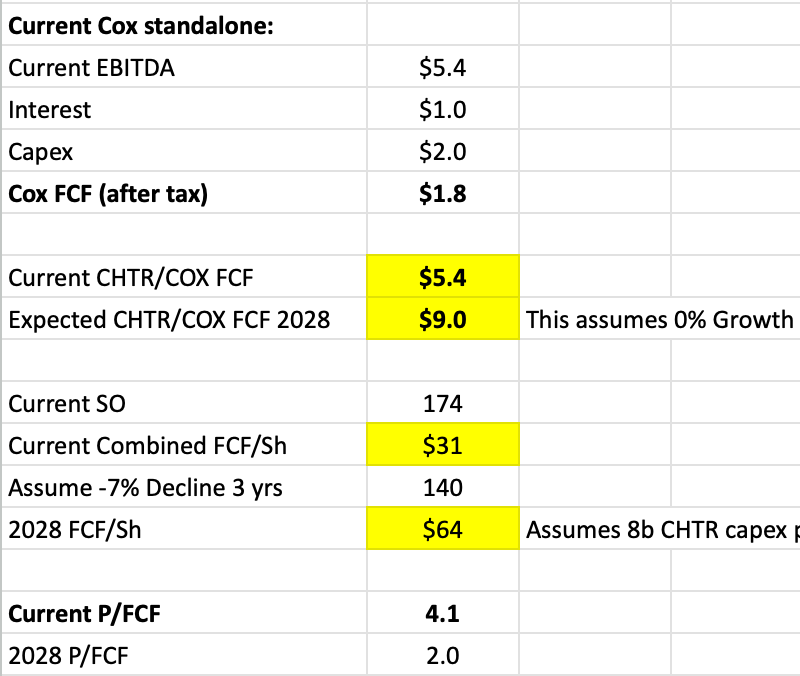
$64 of FCF/share is 50% of the market cap, so clearly the market isn’t buying the EBITDA durability. We all know what Charlie Munger calls EBITDA, and in the cable business, he’s got a point. The problem with EBITDA is that it excludes some very real fixed costs: the capex, but also the massive interest payments that are due on $100 billion of debt.
A small decline in revenue could lead to a big decline in profits, and so CHTR is trading like a call option on the company’s ability to keep revenue stable.
CHTR is going to be a big winner if broadband subscribers stabilize, but for now, I sit on the sidelines and will watch this game unfold.
I know it’s somewhat anticlimactic to read a long post without any positive actionable takeaway, but hopefully these thoughts from my own investment journal are somewhat useful for you. Reality is most of my investment work doesn’t result in an investment, but does result in some type of learning, and this is a long game of compounding those learnings.
If you’re interested at all in cable, I highly recommend reading Cable Cowboy. I also enjoyed his new book Born to Be Wired. Malone is an outstanding thinker and investor with one of the greatest track records in business. He has a sharp eye toward value creation, and I think if he were starting again with a fresh slate today, I wonder if he would be invested in cable. I got to thinking about various industries he might be interested in (another topic for a future post), but I think he’d likely be looking for businesses that pass the 10-year test (those with strengthening competitive positions that will be more profitable in a decade).
He once called Facebook “the greatest business model ever created”. I wrote about that here. He bought Netflix personally in 2011 when it was down and out, and I think this was his basic logic: a company that would be much larger and more profitable in the future, on the right side of long-term technology trends.
It’s generally a good practice to think about long-term investments this way, being mindful of the capital cycles and the trends in ROIC’s. I think there are opportunities in all kinds of stocks, and I invest in both compounders and bargains, but I always try to keep the 10-year test in mind.
Thanks for reading.
John Huber is the founder of Saber Capital Management, LLC. Saber manages an investment fund modeled after the original Buffett partnerships.
John can be reached at john@sabercapitalmgt.com.
Disclaimer:
John Huber and clients of Saber Capital own NFLX. Our fund has sold puts on CMCSA and VZ, and may again transact in any of the stocks mentioned at any time. Our investments may change at anytime without further notice. This article is for educational purposes only. I enjoy writing about investments and exchanging ideas with readers, but nothing here should be considered a recommendation. I make mistakes and cannot make any warranties or guarantees about the performance or accuracy of anything on this site. We are long-term investors who are not concerned with near term results. Please conduct your own due diligence, take your time doing your research and only act when you have developed conviction based on your own understanding and your own work.
Please see full disclaimer here.
My friend Charlie Frischer is an occasional sounding board for me when I’m thinking about certain investments. He recently gave me a simple but very insightful observation it is very hard for companies with declining revenue because cutting costs usually means cutting people, which means a team with 10 people has to become a team of 9 the next year, and 8 the year after that, etc… The choice is to make these cuts and deal with an increasingly pessimistic workplace culture, or don’t make the cuts and see your profits shrink even faster than revenue due to the operating deleverage. Layoffs and cost cuts are often productive and even healthy at some companies that have good underlying businesses, but it’s a major headwind for companies whose pie is shrinking. Another friend, Nat Stewart, had a similar point on valuations, pointing out that to invest in a declining business, the discount has to be so much larger than you realize (I think this is true especially in the cases where high fixed costs are involved… department store retailers come to mind, and so does cable internet providers
Comments
Nothing yet. Say the first thing.
Sign in to join the conversation.