
It’s easy to remember that the goal of investing is to earn a good profit (return) on the money you invest. It’s sometimes forgotten that the goal of a business is (or should be) to do the very same thing. A high return on capital is what creates value over time, but for some reason, Wall Street (and as a result, many management teams) tend to prioritize revenue growth, earnings growth and profit margins more than ROIC. Part of the reasoning could be simply due to the fact that margins and growth are stated numbers that don’t need to be calculated.
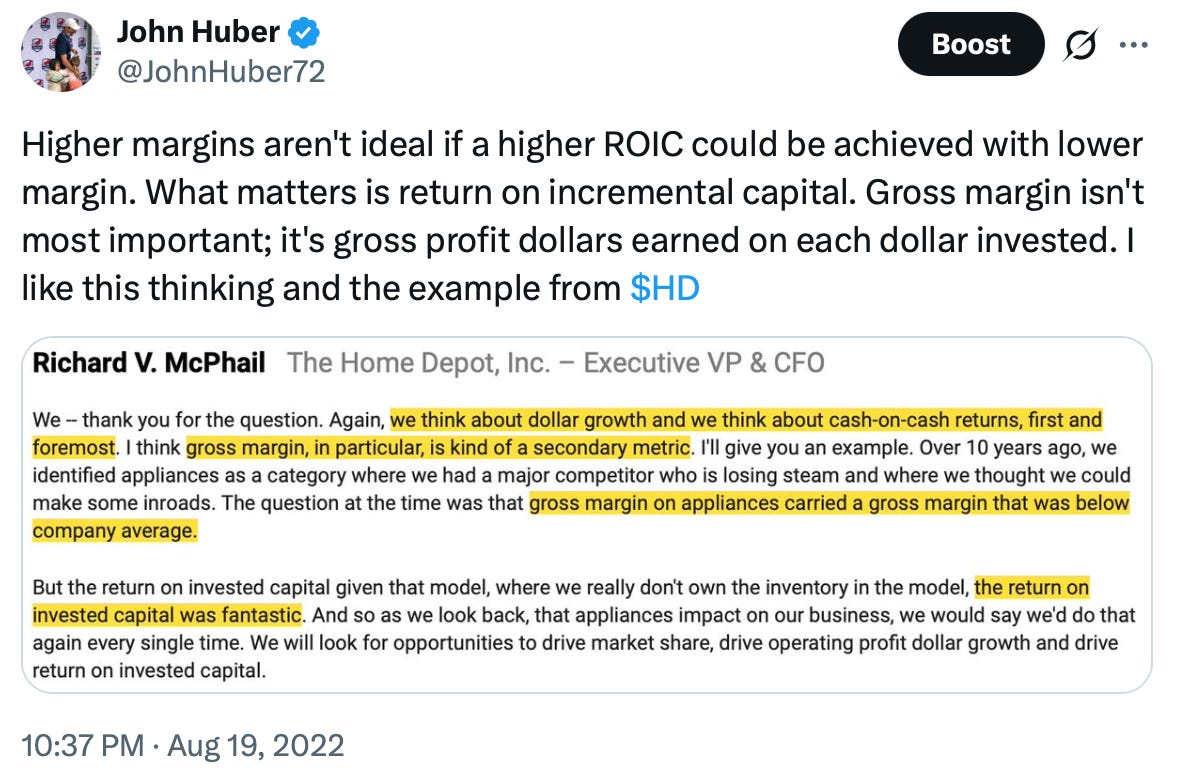
A common question I see analysts ask is why a company would sell a product or enter a business line that has a lower profit margin than the company average. On the surface, it might seem like a logical question, but it is a misunderstanding on what creates value. The goal is not to earn a high profit margin; the goal is to earn the most profit dollars per unit of capital (the latter creates value). You can obviously have a great business with a high profit margin, but you can also be great with the opposite: some of the best businesses in the world (Costco, Walmart, Amazon) are low margin, high turnover businesses. (The same principle applies to turnover in the context of an investment portfolio by the way; I wrote a post on this 11 years ago: Portfolio Turnover: A Vastly Misunderstood Concept).
It is as refreshing as it is rare when you see a corporate leader pointing this out. Here is HD with a nice example of why selling lower margin appliances benefits the company’s overall profits:
One of my favorite pieces of advice from Charlie Munger is to not forget what our true objective is in any task1. Our goal as investors isn’t to buy high quality companies, it’s not to buy low P/E stocks, it’s not to buy companies that are growing, it’s simply to grow our capital over time. This goal can be achieved using any of the above strategies, but sometimes the strategy itself becomes the goal, which then morphs into dogma more than quality investment management.
I see the same problem in corporate America. Even if we throw aside the obvious issues like mismatched incentives between CEO’s and investors, I’ve noticed that even management teams who genuinely want what’s best for shareholders often get off track by being told what matters is profit margins, growth, “returning capital to shareholders”, getting more sell-side “coverage”, or the worst of all: “beating expectations”. None of these things are inherently bad (most are indifferent to very good things), but management teams talk much more about these factors than they do about what really matters, which is return on capital, and more specifically, compounding shareholder value.
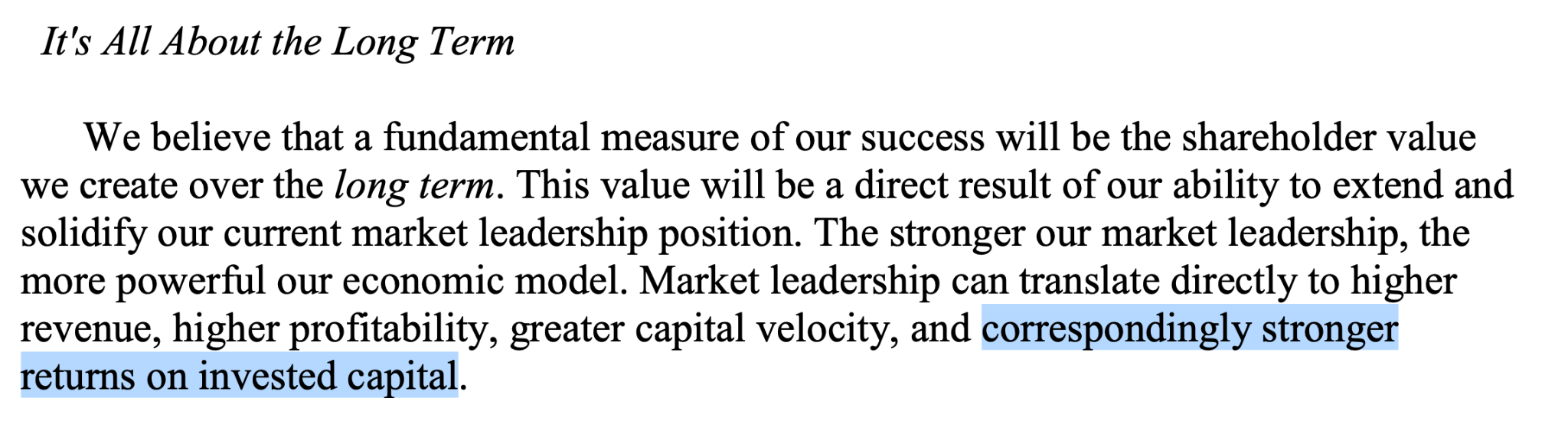
Jeff Bezos’s 1997 shareholder letter still stands to me on both simplicity and logic:
Here is an outstanding interview of Bezos from the .com era where he dismisses being labeled an “internet company”, despite being perhaps the most famous internet company during that era:
Along with Buffett’s Berkshire letters, those early Amazon letters are the gold standard for corporate strategy, capital allocation, and long-term thinking.
Current Mispricings
There are a number of interesting things happening in markets currently, where capital seems to be abandoning certain parts of the market and flowing into the AI suppliers, with ever increasing concentration. I believe this is creating opportunities in certain high-quality companies with strong returns on capital and future prospects, as well as stocks on my “Category 2” compounder list (stocks of durable, mature companies at a big discount to my estimate of fair value).
More on this in a few planned upcoming posts…
Today, I’ll share some notes on NRP, which in my view has a healthy amount of these three ingredients (ROIC, value, and thoughtful management).
Mailbox Money, Royalties and Growth without Capital
Comments
Nothing yet. Say the first thing.
Sign in to join the conversation.