
You are a soldier standing on a hill defending your base in a Gulf State; there is a fighter aircraft heading right at you. It is about to fire a missile.
No problem – you have a shoulder-launch missile capable of taking out the enemy.
This is just like a video-game except that the weapon is real and its pressing into your shoulder; it weighs as much as a large bag of dog food or a new-born elk calf. (if you picked the calf as a reference, I want to know more about your life choices).
You press “FIRE”, and there is a sharp physical kick from your rocket. You hear a high-pitched audio tone signaling an infrared lock on a target’s heat signature. There is a sudden rush of hot exhaust as the rocket ejects clear of your shooter before igniting its main motor. If it had fired its rocket before getting a distance away, it would have torched you.
In a perfect world, your missile hits the incoming jet and you are safe.
But this is not a perfect world.
Your missile misses…
…and your buddy beside you has also fired a missile and by good chance it hits the jet. You are both safe.
Unless you are in the American army.
And you have no buddy.
The American FIM-92 Stinger missile costs about $480,000. When it was first introduced in 1980, it cost one-quarter of that amount, but upgrades and so on have raised the price.
You are on your own and you have only one missile.
Now imagine that you are an Iranian soldier and you are facing an incoming American jet. You fire your Chinese-made QW-12 missile – and it misses!
Fortunately, your buddy fires his missile, and it scores! You are safe.
The Chinese missiles cost about $200,000 each – less than half the price of the American weapon.
The American FIM-92 Stinger and the Chinese QW-12 are approximately equal in capability.
Yet the American weapon – despite being older and thus paid down – is much more expensive. Its cost gives the enemy a two-to-one advantage.
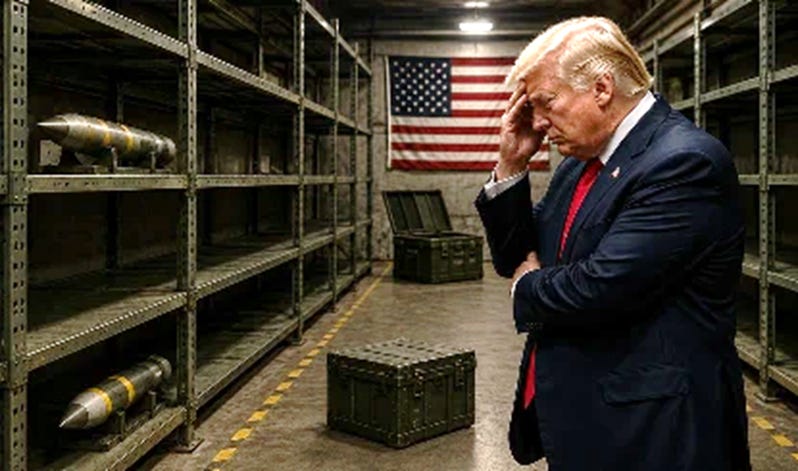
You have heard the heated quarrels about the shortage of American missiles.
Some American generals are openly calling for an end to the war, but Trump denies the shortage (“we have plenty of missiles”) and has no strategy to force an end to the war anyway.
But the real issue is not whether America has a shortage – it is WHY America has a shortage.
And about the obscene cost to Americans of replacing those weapons.
China, you will have read, is expected to supply Iran with 300 to 400 Chinese-made shoulder-launched QW-12 and FN-16 missiles. The purchase, valued at $60-70 million, is one of Tehran’s largest-known efforts to strengthen its short-range air defences since the outbreak of its war.
A Chinese defence ministry spokesperson said he was “not familiar with the relevant situation”, so you know it’s true.
Deliveries will initially be by air from Urumqi in western China, then transiting through Pakistan to Iran, probably on the new rail line.
(While America has been burning its money in clouds of rocket smoke, China has been building railways around the world).
Extend our gaze beyond shoulder-launched missiles to the larger American defensive systems like Patriot rockets. The Patriots, in the view of the Israelis, are obsolete, and are being phased out in Israel.
It takes at least 3-4 Patriots to take down an incoming missile, and the cost of a full domestic Patriot battery runs about $1.09 billion (roughly $400 million for the station/radar equipment and $690 million for the initial missile allotment). Statistics offered by combat situations have concluded that the Patriot success rate is probably around 3 to 6% successful.
The conflict with Iran has severely depleted U.S. and allied Patriot missile inventories, consuming roughly 65% of the U.S. pre-war PAC-3 stockpile. Stock levels have dropped from around 2,330 down to fewer than 850 interceptors, driven by intense waves of Iranian drone and missile volleys.
China has more hypersonic missiles, more ballistic missiles, huge drone production…the Chinese are working at digital speed and the US is trying to get car makers to covert their plants to turn out more of their obsolete weapons.
In tackling the problem of “why US missiles are of less quality and quantity”, we can turn first to a business publication.
Forbes ran an article more than a decade ago that still rings true:
“The main customer for weapons is a political system that is focused first and foremost on securing its own re-election. That’s the way political systems are -- they are preoccupied with preserving power rather than pursuing efficiency. So while legislators talk incessantly about fixing the Pentagon’s broken acquisition system, in practice they are constantly imposing constraints on how weapons can be developed, produced and sustained with the aim of rewarding key constituencies. These claimants on federal resources typically get their cut of the action by adding costs, and new mechanisms added to the system to restrain cost growth like auditors and testers over time themselves become hungry mouths that must be fed.”
On top of the politics, which are not overly concerned with the best weapons at the best price, we are faced with the rapidity with which threats change in the current era.
A few years ago the term “asymmetric warfare” was rarely heard; now it is the accepted military jargon. Ukraine can fight Russia on nearly equal terms by using cheap drones to travel thousands of miles and blow up supply centres, oil depots and military bases on the other side of Russia.
The essence of the asymmetrical practice is to use cheap weapons to destroy or use up expensive weapons. The side that is on the receiving end of the cheap weapon has to ask: what is the price of letting the cheap weapon land? Would it blow up an aircraft carrier, or a fuel depot, or a civilian centre? Invariably, expensive defence weapons have to be used.
Putin did not see this coming.
Russia has a navy that is taking a deep sleep on the bottom of the Black Sea because cheap Ukrainian drone boats hunted them down in their harbours.
I wrote a short time ago about a very innovative Ukrainian system to ensure that its front-line soldiers were getting exactly what they need. Any soldier in a Ukrainian army unit who needs an improved kind of weapon to fight the Russians in front of them, can now go to an online catalogue, place their order and receive the specific weapon(s) within a week.
All the latest, newest gear is there. Need an interceptor drones, an unmanned ground vehicle or some electronic warfare equipment? Just check your catalogue and press ‘order’. A wounded Ukrainian soldier behind Russian lines even ordered an electric bike, which was delivered to him by drone, and he sped to safety.
This is defence procurement on steroids.
The army units generate their own demand, manufacturers compete on field performance, and delivery data pinpoints any places where the delivery system slows down. Each army unit gets what it needs, right away. This is the world of ‘fight-flex’, Ukrainian style.
They have crushed a procurement system that used to take years if not decades, into a work week.
It’s called Brave1 Market, a government institution that acts as a hub for defence innovations. New firms compete with new ideas against established solutions.
By contrast, the US system favors established suppliers who have a fixed interest in maintaining the flow of their current lines of weapons. American manufacturers did not want to see the cheap drone wave coming – and now Iran is a master of the art of making cheap drones.
Iran’s assembly lines are intentionally modular, mobile, and hidden across dispersed facilities and underground depots (such as caves and reinforced bunkers), making it difficult for foreign strikes to completely halt production. Recent intelligence indicates that Iran’s industrial base can reconstitute and restart assembly lines faster than traditional military manufacturing sectors.
Iran was the drone supplier to Russia at the start of its war with Ukraine.
And just to illustrate how Iran is doing it, Iran produces a higher proportion of graduates in STEM (science, technology, engineering, and mathematics) than the United States, the United Kingdom, Japan, and many European countries.
One-third of Iranian university graduates receive degrees in science/engineering (the fourth highest globally, behind China, Russia, and Germany)
Iran is not a backward country.
In fact, one third of the STEM graduates in Iran are women—a higher proportion than in Australia (32.4%), France (31.9%), Germany (27.7%), America (27%) and Switzerland (24.3%).
Iran is 90-million people united in a cause (thanks Donald). It has a deep pool of scientifically trained talent poised to become a powerful global driver.
Some sources clam that Iran can manufacture 400 drones per day. Other sources put the number at 400 per month. It’s probably somewhere in between.
America is getting ready to manufacture 100,000 drones a year.
The slight flaw in that ambition, is that a significant portion of the drones are manufactured in China.
They are supplied to the U.S. both directly and through intermediary supply chains.
It is in China where key drone components are produced, such as airframes, batteries, radios, cameras, and screens. Due to mass production and availability, these components are highly competitive, making it difficult to create an effective alternative at the moment.
Equally important is the cost of Chinese components, which is significantly lower than that of similar products from the U.S. or European countries.
Trump’s capitalist supporters loved outsourcing to China because it meant labour costs went down and the American labourers lost bargaining power which made them even more exploitable.
And of course Trump has slapped tariffs on them, so Americans are paying even more to have their drones made in China.
Because of American business practices, American tax money is going to China to produce weapons to be used against Americans in Iran.
China currently controls close to 90 percent of the global commercial drone market, according to market research firm Drone Industry Insights UG.
China is, of course, a long-time ally of Iran.
With our military procurement/weapon development processes taking such a long time we are forced to pursue this asinine war with the only hardware we already have.
In an era where the cost of weapons faces off against the rapidity with which threats change, this is a crippling handicap.
The cost of building a weapon in America is another concern. It costs $300 to build an artillery shell in India. The shell is simple: it’s only alloy metal with no great technology. The US Contractor charges the US defence Department over $2000 to build the same thing in the US. These items are built in great numbers so the overpriced amount starts to add up.
US program managers are also suffocated by a stifling burden of regulations, rules, and reporting requirements that often add cost without adding value. Former Deputy Secretary of Defense John Hamre says that “fully a third of our procurement dollars are going to ‘overhead,’ much of it dictated by choking layers of redundant and competitive overseers.” One former Pentagon acquisition chief complained that “we spend millions to save pennies,” meaning that the cost of oversight as currently conducted is far higher than the cost of corruption or incompetence in the functions being monitored.
On top of that hurdle, the Pentagon is moving too slow owing to funding, procurement, organizational, and oversight systems that are poorly suited to fielding and continuously updating the most decisive capability on the modern battlefield.
According to The American Enterprise Institute, “cheap sensors and precision strike options are disrupting the American way of war. In the past, American forces would concentrate at decisive points in sanctuaries near the conflict. Those sanctuaries are gone and the concentrated bases that remain are vulnerable targets as Iranian strikes on U.S. bases have shown.”
It argues that its forces must be dispersed - but that approach strains operational coordination. The Ukrainians deal with this by giving each unit a degree of freedom of action that would seem incredible to more conventional commands. “We need to leverage machine intelligence and metal across the spectrum: logistics, distributed sensing, resilient networking, decision support, and at the far end engagement. The public argument fixates on the last slice, but this is the smallest requirement.”
The binding constraint is not the technology. The US has the engineers and the tools. The problem is organizational.
The Pentagon is used to buying platforms in orderly, linear stages across fixed categories. But war machines do not sit still. They are fusions of hardware, software, data, and models that change constantly. They are not like tanks that can be parked. They are living capabilities that have to be maintained as such.
Here is where the technology parts company from the humans.
Russia’s V2U loitering munition is a drone that navigates and picks targets on its own, with the communication links stripped out so there is nothing left to jam. A Russian machine decides whether to kill a target and then goes ahead and does so.
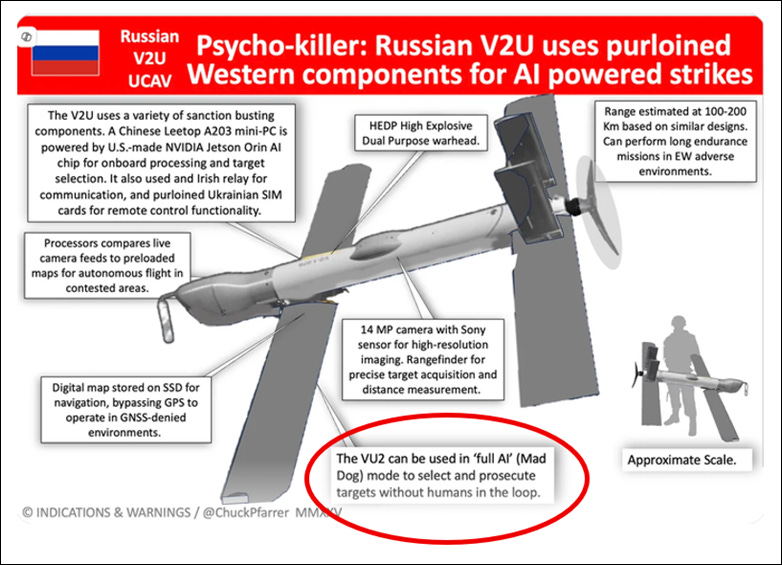
American restraint in this development would restrain only Americans.
The question is not whether these weapons exist, but whether the US can shape the terms of engagement.
For a country that backs Israeli genocide, that is a pretty big moral ask.
America right now is producing platforms too late, too expensive, and too few.
It can choose to rebuild how the Pentagon buys and sustains the capabilities the next war will demand.
The technology will arrive either way.
The only question is whether the US or its adversaries decides what it does.
America is equipped to fight the pervious war: a Cold War of expensive weapons and privileged suppliers.
Now we are in a free-for-all where the skills of individual soldiers using fast-changing weapons will decide a conflict.
All I can add is that we are very lucky to have the Ukrainians on our side. They are holding off an entire horde of mass-marching men, and they are armed only with their innovation and courage.
In the meantime the US watches its weapons gauge run down on expensive items that are of diminished use against an enemy that fights with economy at a fine-grained level.
We know the US can change; it has does so before, and quickly. Any country that can decide to land a man on the moon and do so within a year, can do anything.
But not if they are hindered by a leader who is using taxpayers’ money to buy shares in private companies. That is an entirely new level of grift – and it will slow down and squander America’s response to the weapons crises.
Obviously, Step One would be to end the war.
There has to be a follow-through Step Two: dismantle the current purchasing system and follow the Ukrainians.
They are going places…and they have the weapons to show for it.
Thank you for following Barry’s Substack, focusing on the meaning behind the headlines. A regular summary of a topical book will provide more depth to enable full subscribers to stay ahead of the conversation.
In the coming weeks we will look at WHAT IF THE PRESIDENT IS AN IDIOT – Trump, power and the death of serious politics – How a reality show became a presidency.

PS - If you have enjoyed this article, please consider buying me a Coffee!
No posts
Comments
Nothing yet. Say the first thing.
Sign in to join the conversation.