
I would like to thank Patti for supporting the Substack!
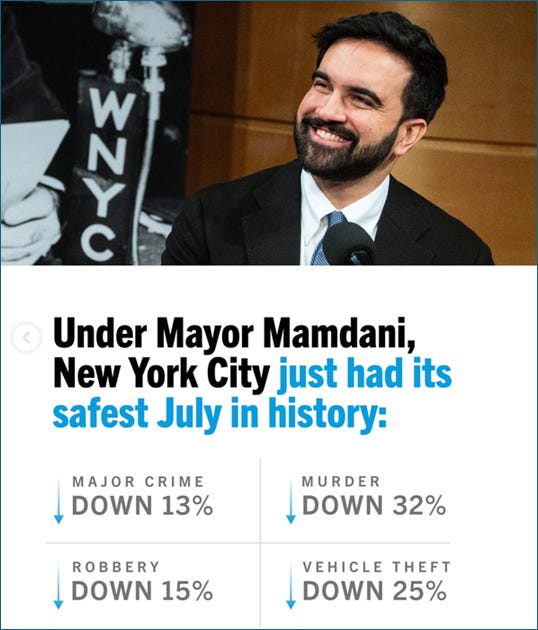
The crime rate in New York City has now dropped to the lowest level since statistics were kept.
This remarkable achievement did not come from adding to the police force, or imposing curfews on its citizens, or rounding up illegal immigrants.
It came by having a government that met unmet needs.
Because unmet needs lead to violence.
Or as one Thriend put it:

Achieving an advanced degree of chillness is probably not among the crime-fighting stats, but should be. It says it all.
A more professorial label might be “the achievement of root-cause solutions”.
Instead of building Data Centers, for example, NYC is building affordable homes. Mamdani has announced that NYC will build 50,000 new affordable homes on city-owned land!
The ultimate goal, as another Thriend noted was to become:

Take each social cost one-at-a-time.
The cost of NYC’s 35,000-person police force is $11-billion annually, when you factor in fringe benefits, pensions and legal claims. That works out to $314,285 per officer.
Mamdani did not reduce the count, but he cut out the planned expansion of 5,000 officers. That is a saving of more than $1.5-billion.
He has sought to broaden the city’s public safety strategy through a new Office of Community Safety focused on violence prevention, mental health services and neighborhood partnerships. It is backed by a coalition of 47 organizations that have called for the new office to receive investments in services. It is headed by a behavioural heath specialist, Dr. Ayesha Delany-Brumsey, who has overseen citywide behavioral health programming, including mobile crisis teams. It is an initial step toward Mamdani’s campaign pledge of creating a $1.1 billion city agency. Mamdani pulled $260 million from existing city programs to launch his new Office.
The Legal Aid Society welcomed the change: “For too long, New Yorkers experiencing homelessness, mental health crises, and substance abuse have been met first by law enforcement, often with tragic outcomes — particularly in low-income communities and communities of color. The work ahead…must focus on changing that reality by building robust, community-based responses that de-escalate crises, connect people to services, and reduce harm.”
He expanded the hate crimes office along the lines of a plan authored by Jews For Racial & Economic Justice. Their proposal called for between $26 million and $30 million in hate violence prevention initiatives, including expanded reporting systems, proactive relationship-building and anti-bias education. According to the NYPD, antisemitic incidents accounted for 57% of all reported hate crimes in 2025.
He also called for all agencies to find 2.5% in savings.
In return, he took a lot of the stress out of people’s lives: there is now a phased program for free universal childcare, $34-million pulled back from landlords, a tax on absentee wealth, restitution for small businesses, 4.3 million more workers with expanded protected time off, 6,000 people signed up for the city’s Emergency Snow Shoveler program, rent affordability, a city-wide grocery initiative, youth clinics … and so on through a list that would seem reasonable to any socialist country.
Focusing specifically on crime, NYC has just recorded the fewest shootings and murders in its history.
Major crime fell 13%, across all major crime categories, including a 14.7% decrease in burglary and a 24.6% drop in auto theft.
Let’s extend that achievement nation-wide.
The cost of crime in the U.S is $2.6-trillion. That includes Direct Victim Losses like Medical care, stolen or broken property, and lost work time; Criminal Justice System costs of billions spent yearly by local, state, and federal governments on police, courts, and prisons; Intangible Costs such as pain, trauma, and a general loss of quality of life for victims and communities; and Private Prevention money spent by citizens and businesses on security systems, guards, and safer neighborhoods.
Mamdani’s changes have measurable impacts on all these levels of crime, although it must be acknowledged that borrowing these numbers to apply nationally is an exercise in approximation. It would take a full-on university or consultant study to get more precise numbers…by which time Mamdani will have moved on anyway, to add new and improved actions.
So we will do the best we can, applying Mamdani’s percentages to national crime data. We admit up front that it is very loose – but it is instructive.
Murders decreased in NYC by about 30%.
The total annual cost of murders in the United States is estimated at roughly $150 billion to $180 billion per year. This figure is calculated using the Department of Justice and National Institute of Justice estimate that a single murder costs society approximately $9 million in medical bills, lost productivity, legal expenses, and quality-of-life losses, applied across roughly 16,000 to 20,000 homicides annually.
Decreasing $189-billion by 30% would save $54-billion.
Auto theft costs Americans more than $8-billion per year.
Saving 24% of that would put $1.9-billion back in the pockets of Americans.
Shootings dropped 21% in NYC.
Shootings cost America an estimated $557 billion annually, which equals about 2.6% of the country’s gross domestic product. This total includes direct expenses like medical care and criminal justice operations, alongside indirect costs such as lost work productivity and reduced quality of life.
Decreasing $557-billion by 21% saves us $117-billion a year.
Retail theft in NYC dropped 25%.
Retail theft in America costs $100-billion annually. The Mamdani social solution would save $25-billion.
Burglaries in NYC were down 15%.
Victims of burglary in the U.S. lose an estimated $3 billion to $3.4 billion in stolen personal and commercial property each year. The average financial loss for a single residential burglary ranges from roughly $2,400 to nearly $7,800 per incident.
Cutting $3.4-billion by 15% would save about $500—million.
Public housing developments in NYC recorded an 8.5% drop in major crime.
The economic costs of all criminal offenses tied to public housing in the US total roughly $290 billion per year, Cutting that by 8.5% would save $24-billion.
Cost of police: No further expansion of police forces. The cost of policing expands by 5% to 12% each year. Let’s use 10% as a good guide.
Direct local and state police operations cost roughly $135 billion per year, with another $100-billion for homeland security and broader public outlays. Of this $235-billion, we would be saving 10%, or $23.5-billion.
All together, Mamdani’s changes applied nationally would save the US some $245.9-billion.
PER YEAR.
Over four years, that would knock a trillion dollars off the new dept that Trump has loaded onto the nation’s debt level ($7.8-trillion). Over 30 years, this Democratic Socialist measure would unwind all of the monetary harm that Trump has done to the national debt.
And you wouldn’t notice that anything was missing in services delivered to people; in fact, Mamdani’s changes are a bonus for everyone.
Here is the difference between America’s current “individual” approach and a collection of social democratic states:
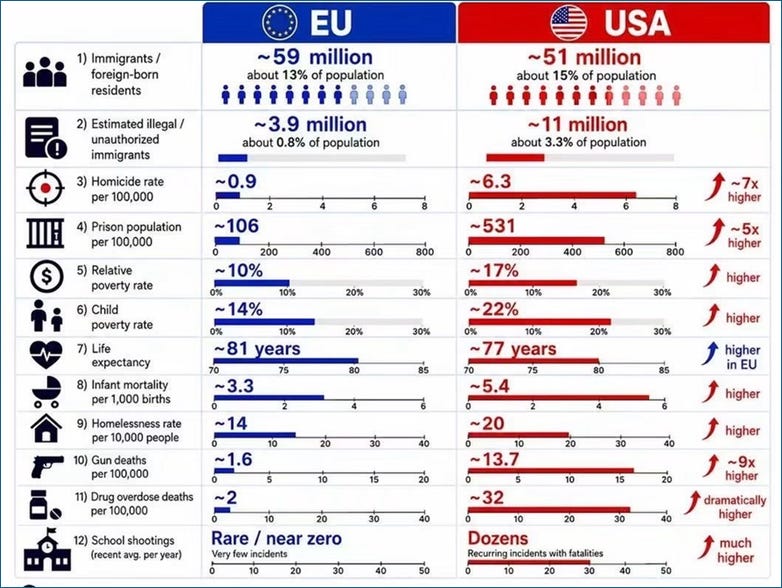
Features jump out at you in the EU, like longer life, fewer incarcerated people, fewer deaths by violence, lower prison rates… These would happen in America as well.
The Wharton School’s 2026 Best Countries Index surveyed over 15,000 people across 33 countries and ranked 85 nations on quality of life — safety, healthcare, education, economic opportunity, public services.
The United States, the largest economy in the world, came in 27th.
Behind Canada (3rd), behind Germany (9th), behind the UK (13th) and behind Japan (14th).
There is a reason these countries have much better ‘happiness’ rates.
An alternative scheme to the conventional tax program would apply the savings to everyone’s taxes.
At the moment, when factoring in all federal, state, and local levies, lower- and middle-income Americans can face overall tax rates comparable to or exceeding the total effective rates paid by ultra-wealthy households.
The Mamdani savings would pay the taxes for all of the lower 50% of wage earners.
A beautiful move forward for income equality!
And the money they save would go right into the economy. Double win.
In an environment where federal Republicans are cutting crucial services while still adding trillions to the national debt, Mamdani’s ability to achieve social goals while improving everyone’s finances looks like next-level magic.
And from a socialist!
The icing on the cake for New York?

Maybe with a “National Mamdani Plan”, the American team will win the FIFA Trophy!
OK, let’s not get giddy.
Soccer is not America’s game.
Neither is hockey; if it wasn’t for your Canadian players America would not have a hockey team.
The above numbers are a clumsy attempt to quantify the humanistic approach taken by a Social Democrat.
Equally important are the measures that cannot be quantified: the mental health of the children, the joy of having streets fee from cars on certain days, the relief from tension among adults. Those things are hard to show on a balance sheet. But they matter just as much, if not more, than the money.
On that note, perhaps the most important change in a Mamdani-style regime is the sheer feeling that citizens count! That things can be done that people had given up on asking politicians to accomplish.
That we all are all heard and appreciated.
I know it doesn’t add up, but it’s there!
And spreading across America as the election cycle unfolds.
You are entering a new world.
Prepare to smile again.

Thank you for following Barry’s Substack, focusing on the meaning behind the headlines. A regular summary of a topical book will provide more depth to enable full subscribers to stay ahead of the conversation.
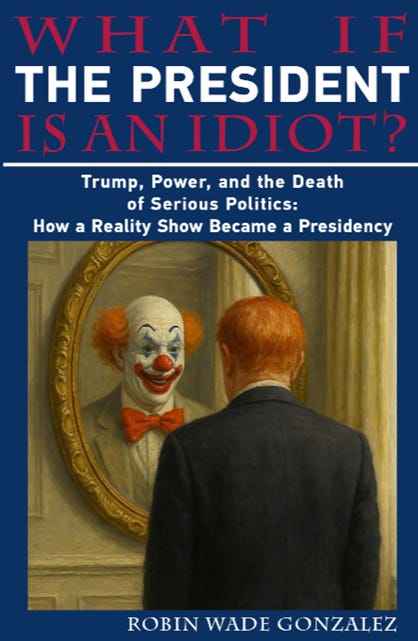
In the coming weeks we will look at WHAT IF THE PRESIDENT IS AN IDIOT – Trump, power and the death of serious politics – How a reality show became a presidency.
PS - If you have enjoyed this article, please consider buying me a Coffee!
No posts
Comments
Nothing yet. Say the first thing.
Sign in to join the conversation.