

The latest US jobs report is very bad news for Trump – the numbers showed a decrease of 24,000 jobs.
North of the border, Canada had a jobs spurt of 75,000.
In an economy that is one-tenth the size of the US.
Bloomberg’s Matt Winkler explained it all in complex economic terms:
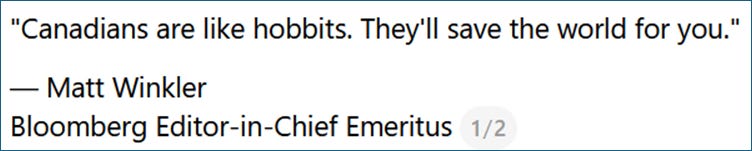
Winkler used the hobbit analogy to describe the national character of Canadians— people doing the quiet work, showing resilience, and possessing integrity, commitment, and gratitude without always seeking the spotlight.
He noted that Canada and figures like Prime Mark Carney are frequently underestimated on the global stage, much like Tolkien’s hobbits, yet they end up proving resilient and effective during broader economic and geopolitical shifts.
His commentary coincided with Bloomberg analyses highlighting Canada’s economic outperformance, robust investment inflows, and currency strength despite external pressures like trade tariffs.
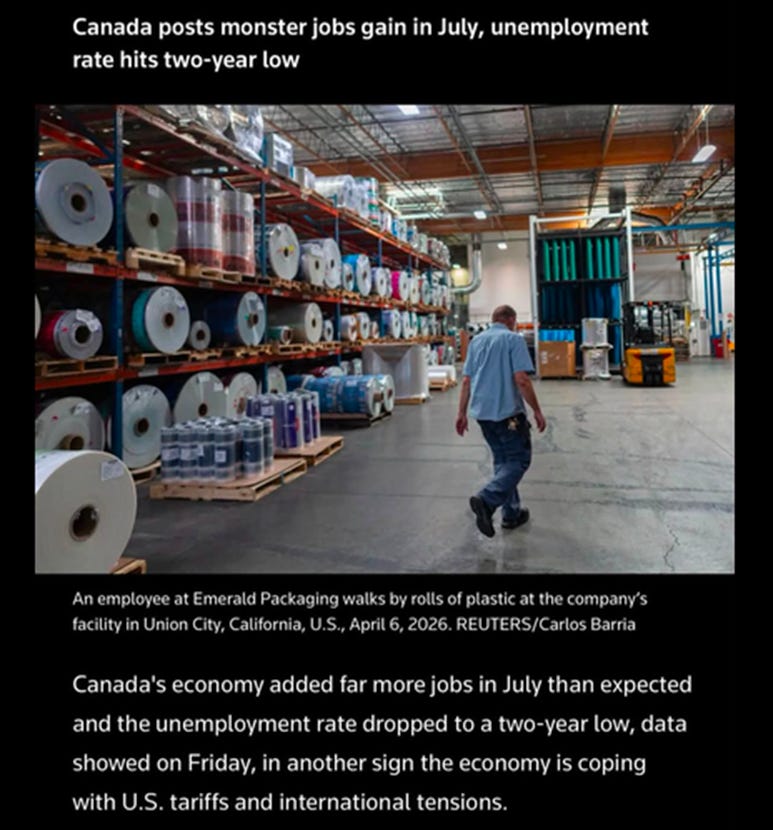
To understand those figures better, let’s compare them on a per capita basis.
In July the US lost 94 jobs per million people,
while Canada gained 1800 jobs per million people.
It takes a business genius like Trump to nose-dive an over-performing Biden economy so quickly and completely. Trump was handed about as good a situation as you could ever dream of. Love or hate AI, the investment was going to make the economy boom short term, and inflation was basically reigned in. He just had to sit back and grift and enjoy the unearned praise.
But there’s no exercise of power in that.
So he invented a world tariff policy and made enemies out of everyone.
This would be a five alarm fire during any other era. The jobs market used to be 80% of American politics until Joe Biden had so many jobs created on his watch the media had to give up reporting on it.
The Republican talking point now is that the losses are due to AI: American businesses are making more competitive use of AI and it’s giving them a global advantage. More AI = less jobs.
No one has evidently told Trump that this is not perhaps an ideal election-year message.
The US Labor Department also revised down Trump’s May and June reports by more than 100,000 jobs. The downward revisions to the last two months subtracted a total of -103k.
So over the past three months, the US economy created about 200,000 fewer jobs than had been thought.
Average hourly earnings are also growing at a slower pace than at any point since early 2021.
This will not help the Repulsicans as they head into the November mid-terms. The public’s negative mood about the economy is likely to persist.
Measures of consumer sentiment and confidence have been weak. Cost-of-living issues have consistently kept Trump’s approval rating near record lows. Real disposable income has been flat, and the personal savings rate has fallen by almost half since early 2025.
Scrambling to find pieces of good news among the ashes of their expectations, senior deputy press secretary Kush Desai said that sectors like manufacturing and construction are expanding at a faster rate than inflation. He leaned on it to say “industrial resurgence is on schedule.”
But the Labor Department has also reported that hourly earnings for nonsupervisory and production workers fell by a 10th of a percent over the last year.
Treasury Secretary Scott Bessent said that the usual weekly earnings of low- and middle-income workers have outpaced inflation through the bulk of the president’s second term. The share of economic output linked to worker pay had fallen to a record low.
Bessent said the jobs report released today underestimated the potential strength of the real economy.
The real issue with the artificiality of the economy, however, comes from the huge amount of money being invested in AI systems. Big companies are swapping money with each other, and it makes the economy look hot. Without that AI component, the economy would be struggling.
Someone I trust far more than Bessent is former U.S. Secretary of Labor Robert Reich. He frequently criticizes official jobs numbers, arguing that headlines mask underlying economic weakness, low wage growth, and declining labor force participation. He contends that the economy suffers from a structural power imbalance favoring corporations over workers rather than a healthy, tight labor market.
In addition, official reports, he says, often trumpet monthly job additions while ignoring downward revisions, slowing hiring rates, or job losses concentrated in low-quality sectors. Drops in the unemployment rate are often misleadingly driven by discouraged workers dropping out of the labor force entirely rather than robust hiring.
In this context, the loss of jobs in July is doubling concerning – the damage may have been even greater.
Overall, Reich figures that the U.S. economy has lost 1 million workers since January.
It’s the lowest level of labor participation in 50 years outside the pandemic.
He calls it ‘the incredible shrinking workforce.”
The biggest reason for concern is the scarcity of stable, well-paying jobs.
“Lots of people have concluded it’s not worth it,” says Reich. “The cost of commuting to — or paying for childcare in order to hold down — a shitty and insecure job has led them to give up on paid work altogether. They’re living more simply, moving in with parents or friends or adult children, or just doing without.
“The best measure of how America is doing isn’t the unemployment rate, or the stock market, or the rate of economic growth, or the inflation rate, or the average wage.
“It’s how well most Americans are living. The reality is that most Americans are struggling.”
Around 40% of Americans report that they are struggling to meet basic needs or feeling financially vulnerable. Driven by cumulative cost-of-living spikes in housing, gas, and groceries, about 57% of the public believes the economy is worsening.
This may be one of the factors behind Trump’s deflating numbers and the recent rise of the Democratic Socialists in the primaries. People want real solutions.
Across the border, in the land of Hobbits, Canada, since Mark Carney became Prime Minister, has outperformed everyone in America, the Eurozone and anywhere else in the world, says Matt Winkler.
Malcolm Gladwell wrote a good piece in New Yorker Magazine that puts into perspective the Canada-US trade war, why Canada ‘holds all the cards,’ and why the US is in such a weak position.
Since Trump the Canada-US story has been less “friendly competition” and more “Goliath throwing a tantrum because David won’t just roll over.”
The U.S. is picking fights, throwing tariff punches, and blaming literally everyone but itself for its problems. And Canada? We’re just standing here, taking the hits, shrugging, and quietly preparing to win the long game. Like Hobbits.
Here’s how it’s playing out:
· The U.S. economy is in shambles. $36 trillion in debt, corporate greed at an all-time high, the middle class getting squeezed out of existence.
· Rather than fix its own problems, the U.S. starts blaming its allies. Suddenly, Canada is a trade villain.
· Tariffs get thrown around like confetti. First, it’s dairy. Then it’s aluminum. Then it’s oil. Next, it’s probably going to be maple syrup because why not?
The reality is:
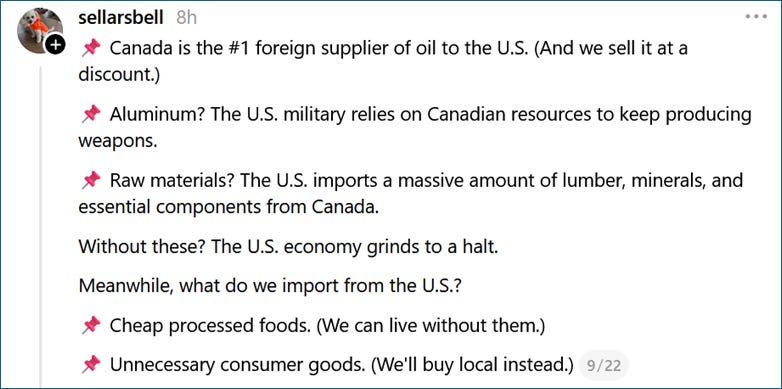
Trump says, “America should be self-sufficient! We don’t need Canada!”
Again, the reality is different. Trump has been pushing fossil fuels and torpedoing green energy, but U.S. oil refineries CAN’T handle domestic US shale oil. They are built for heavier crude which is why they rely on Canadian oil sands crude to function properly. Switching over to refine U.S. shale would take years and hundreds of billions of dollars. In the meantime, energy prices would skyrocket, and the U.S. would need to import even more oil from the Middle East.
So yeah, America can become “self-sufficient,” but at what cost? Unless people are willing to pay double for gas, this argument is just empty rhetoric.
Then Trump whines that America is paying for Canada’s defence.
Hello?
Canada defended world democracy in WWW1 and WW2 for years before America got involved.
The only time Canada itself was invaded, was by America. In 1814 the Northern Hobbits even attacked Mount Doom in Washington and burned the White House. That’s why it’s “white”. White-wash paint was used to cover the smoke scars. You’re welcome. Then America surrendered. That’s what it’s called when you don’t achieve any of your war objectives and call off the war instead. Like what’s happening in Iran. And Trump will surrender as well.
To fix its economy and its relationship with its neighbours, the US needs to fire Trump, break up the billion-dollar companies, confiscate the wealth of the top one percent, invest in education, and stay focused on economic growth driven by a strong middle class.
Just like the Hobbits.
And Canada is cheering you on!
Here’s what Trump himself forecasts…
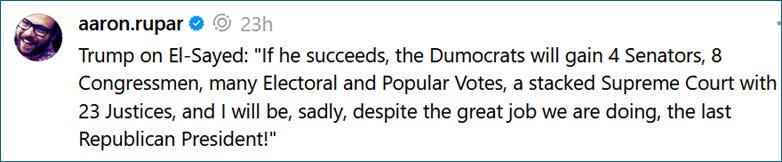
“The last Republican president”.
It’s not as much of a threat as he thinks it is.
The excitement over the prospect of a real change in American policy in November is dazzling. You will vote yourselves Universal Healthcare, Free Education (at al levels) and Equitable Incomes.
Just like everybody else on Middle Earth.
We’ll get our friends back!
Canadians will cross the border again, and visit the Trump Mausoleum And National Urinal.
It will all be behind us, like a bad dream of Sauron.
You have the Power. Use it.
Thank you for following Barry’s Substack, focusing on the meaning behind the headlines. A regular summary of a topical book will provide more depth to enable full subscribers to stay ahead of the conversation.
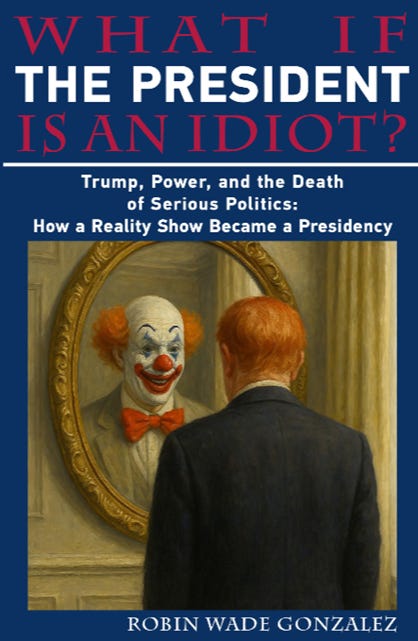
In the coming weeks we will look at WHAT IF THE PRESIDENT IS AN IDIOT – Trump, power and the death of serious politics – How a reality show became a presidency.
PS - If you have enjoyed this article, please consider buying me a Coffee!
No posts
Comments
Nothing yet. Say the first thing.
Sign in to join the conversation.