
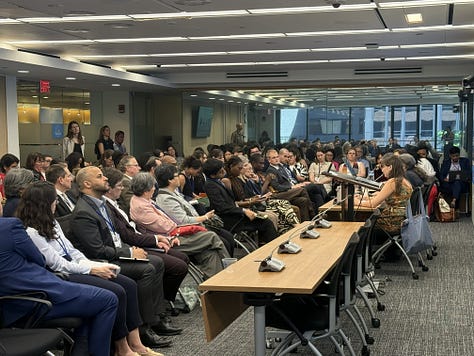
Last week, Bank Information Center joined partners from around the world for the World Bank/International Monetary Fund Spring Meetings. The week is always busy, but beyond our packed schedules, what stays with us are the conversations we had about how policies and projects impact communities on the ground.
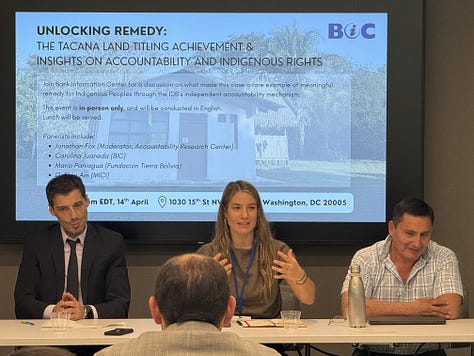
We began by reflecting on a rare and meaningful example of remedy. The Tacana II Madre de Dios Indigenous Peoples in Bolivia secured legal recognition of their ancestral lands after years of advocacy and engagement with the Inter-American Development Bank’s independent accountability mechanism, the MICI. This achievement required sustained community leadership, a functioning dispute resolution process, and an institutional willingness to productively and openly engage with project-affected communities. It was a powerful reminder that remedy is possible when institutions engage in good faith and recognize their responsibility to act.
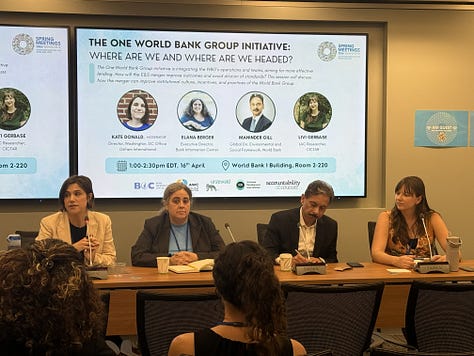
That message echoed in subsequent conversations. At a World Bank panel on accountability, BIC’s Executive Director, Elana Berger, discussed a core tension: independent accountability mechanisms can investigate harm, but cannot deliver remedy alone. That responsibility rests with management. When Management Action Plans are weak or not fully implemented, communities pay the price. An institution’s commitment to facilitate remedy is a critical component of effective accountability, along with the willingness to adopt institutional changes that prevent harm.
Meanwhile, at the Civil Society Policy Forum (CSPF), discussions on integrating the environmental and social policies and operations across the World Bank Group raised similar questions. Structural reform and policy alignment may look promising on paper, but the success of this integration will be measured not by organizational charts, but by whether environmental and social outcomes improve in practice.
Our final panel of the week focused on the International Finance Corporation’s interim Remedial Action Framework. One year into its pilot phase, the framework signals recognition that the institution has a responsibility to facilitate remedy. At the same time, important questions remain about transparency, implementation, and timelines. The next phase will be critical in determining whether lessons from past harms are shaping institutional culture and providing remedy.
If you were not able to join us at our CSPF panels, recordings of those sessions are available below.
Taken together, last week’s conversations underscore the important interdependence of policy design, implementation, and accountability mechanisms. Communities should see tangible improvements in how the World Bank Group implements projects, and whether they receive remedy when harm occurs. Dialogue grounded in good faith and shared understanding of the rights of communities is essential, and we were encouraged by the openness of many of these discussions.
Thank you to everyone who participated, shared insights, and engaged with us throughout the week. We are energized by our collective commitment to pushing for accountability systems, policies, and project implementation reforms that deliver real results for communities.



No posts
Comments
Nothing yet. Say the first thing.
Sign in to join the conversation.