
“Burke’s the butcher, Hare’s the Thief, Knox, the man who buys the beef.”
Nineteenth-Century Nursery Rhyme
In honor of Halloween, this month’s topic is somewhat macabre: Grave robbing (aka body snatching).
Grave robbing, as an “industry,” was a phenomenon which started in the eighteenth century, but had its heyday in the nineteenth. At its height, it is estimated that as many as 10 bodies a night were being snatched in cities with medical/anatomy schools.
The rise in grave robbing is a direct result of the expansion of medical schools (both in number of schools and number of men enrolled). As medicine moved from lore into science, an understanding of anatomy became essential. In the words of pioneering surgeon Astley Cooper (1768-1841), “Without dissection there can be no anatomy, and…without anatomy, a surgeon can do nothing.” Cooper, a fellow of the Royal Society and surgeon to three monarchs, created an England-wide network of informers and body snatchers and boasted that there wasn’t a person in Britain whose body he couldn’t get hold of after their death.
In the United States, it is estimated that up to 40,000 corpses were dissected each year. But corpses were hard to come by. Laws and an overall aversion to dissection kept the supply low. Surgeons were limited to executed murderers, and, only a portion of those made it to the dissection table. Often, smaller private institutions were denied access to these corpses and only those with long-standing reputations were supplied by the gallows. British law in the eighteenth-century considered dissection a vile act and, in crimes considered particularly heinous, it was included as part of their punishment. Acceptance of human dissections (and the donation of bodies for medical study) is a twentieth-century phenomenon.
The best, and most reliable, supply was stolen corpses. From this demand an industry rose. In its early days, medical students themselves participated in and organized the exhumations of the recently deceased, but by the nineteenth century this was rare. Grave-robbing was so integral and so important that, with their fluctuating promises and prices, the resurrection men (aka grave robbers) could destroy a school of medicine/anatomy simply by refusing to do business with it.
Grave robbers were paid a fixed rate which ranged between 8 and 10 guineas depending on the condition of the corpse (damage done to it as well as its “freshness,” and, to a lesser extent, its age). That fee was equal to what they could earn in a year as a workman. Children and fetuses were priced by the inch.
They had to be quick. Some teams could exhume a body in 15 minutes. They dug a hole at the top of the grave and pulled the body out using a hook. They stripped the corpse of clothes, valuables, and the shroud in which it had been wrapped and, discarded them beside the grave. This was important. Bodies had no legal value, so, under the law, they couldn’t be “stolen.” So, odd as it sounds, it wasn’t illegal to be traipsing around a city with a dead naked person. It was illegal to rob a corpse which is why items were left at the grave, to prove nothing had been stolen from the deceased. If something as insignificant as a sock was left on the corpse, then you would be arrested for theft.
There were dangers other than arrest. There were high walls covered with broken glass, spring-guns hidden in the graveyards, sextons (officers of the church) with cudgels and firearms, and colleagues who would steal the body you had just stolen. One father filled his child’s coffin with gunpowder as a deterrent. If a passerby suspected that you were in the act of grave robbing, it didn’t take much to rouse a mob. Grave-robbers were beaten and whipped, sometimes to death.
Other precautions against a loved one’s grave being pillaged were metal coffins, stone or cement slabs, a framework of metal over the grave (called mortsafes), or hired watchmen. Bodies were only at risk of being stolen during the first ten days after burial. After that, they were too decomposed to be of use to the medical profession.
The end came in stages. In America, individual States passed laws to allow unclaimed corpses to be used for dissection beginning in the mid-nineteenth century. Thus increasing the supply and decreasing (but not eliminating) the need for grave robbers. In Great Britain, it ended in 1832 with the passing of the Anatomy Act which allowed for similar access to corpses. The Continent wasn’t plagued by the phenomenon of body-snatching. There were no laws which limited access to bodies and there was less societal aversion to dissection itself.
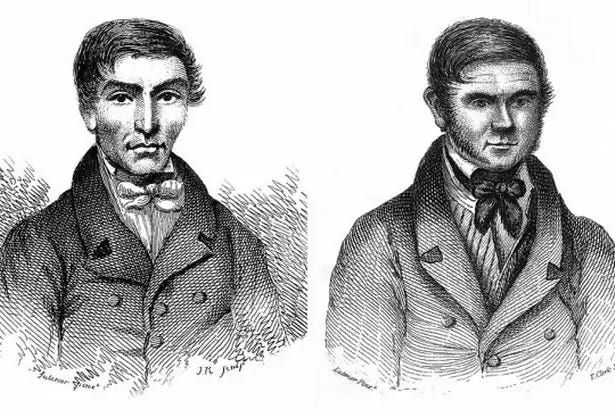
As mentioned, digging up graves was risky and more than one resurrection man thought it safer, easier, and more profitable to make his own corpses. (The fresher the corpse the more it was worth.) The most notorious of them were William Burke and William Hare, in Edinburgh. (In the etching, Burke is on the right.) Their fame was such that Burke gave his name to the practice of murdering someone to sell their corpse to medical/anatomy schools. It was referred to as “burking” and people walking through the poorer areas at night were warned to be careful they weren’t “burked.”
Unlike others who murdered for the anatomists, Burke and Hare were never grave robbers. They ran a boarding house. One of their guests died with an outstanding bill and, to recover the money lost, they sold him to the local medical school which proved more profitable than running a boarding house.
The two are believed to have killed 16 people. Burke plied his victims with alcohol or opium then pinched their nose while he lay on their chest so he wouldn’t cause any damage which might decrease their value. They were caught when the body of Mary Docherty was found stripped, dead, and hidden in the straw of Burke’s bed. In 1829, Burke was hanged and dissected for his crimes. His skull is still on display at the Edinburgh College of Surgeons.
Dr. Knox, the third member of the nursery rhyme, was known to have purchased “things” from Burke and Hare, as well as from others. Though opposed to experimenting on animals, considering it morally questionable, he was perfectly happy to buy corpses that were freshly murdered and use them in his anatomy classes.
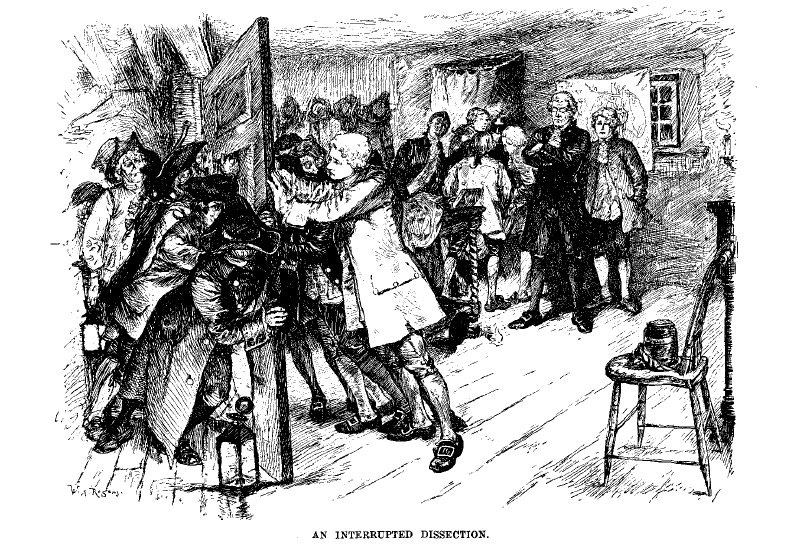
A little bit before our time, it is an interesting incident nonetheless, and related to body snatching.
On April 13, 1788 a group of children was playing outside the New York Hospital close to the dissection room. Richard Bayley, a known procurer of the recently buried, was teaching his anatomy class. His student John Hicks, was annoyed by the noise. Perhaps as a prank or as an attempt to frighten them away, he leaned out the window, waved the arm he had been dissecting and shouted, “This is your mother’s arm. I just dug it up.”
As chance would have it, one of the children had recently lost his mother. He reported the incident to his father who went to her grave, exhumed the coffin, and found it empty. A riot ensued (numbering up to 2,000 people) and lasted for days, first at the hospital, then at the jail where some doctors had fled for safety, and then in the streets as rioters searched house to house to find the doctors. The militia was called in and medical students fled the city, not returning for several weeks.
By the end, between three and twenty rioters were killed. In January 1789, a law was passed that made grave robbing illegal, imposing a penalty of public whipping, fines, and imprisonment. It also allowed the bodies of executed criminals to be used in dissection. That didn’t stop the practice. When legislation was passed in 1854, making it legal to use bodies abandoned in hospitals for dissection, grave robbers were stealing around 700 bodies a year in New York City alone. (Between 1765 and 1884, there are documented at least 25 crowd actions against American medical schools in protest to their students dissecting the dead.)
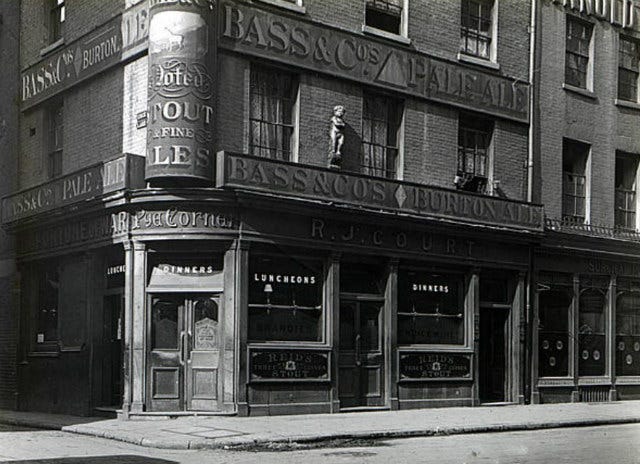
Although the public was appalled by the practice of body snatching, it was a poorly kept secret; both the act and the individuals who performed it. One of the places body snatchers frequented was the Fortune of War pub (demolished in 1910) on Giltspur Street, Smithfield, conveniently located across from St. Bartholomew’s Hospital. Many of them began their day drinking here. The Royal Humane Society designated it a place “for the reception of drowned persons.” The landlord is said to have shown the benches with the resurrection men’s names on them while they waited until St. Bartholomew’s surgeons could appraise the bodies kept there. The grave robbers who frequented the pub were known as the London Burkers.
As well as being a hangout for resurrection men, its is the place where, in 1666, the Great Fire of London allegedly came to a halt. It was mentioned in William Makepeace Thackeray’s Vanity Fair.
The Italian Boy, by Sarah Wise
In 1831, an orphan was murdered on the streets of London. In itself, the killing was unremarkable. What gives it substance is the reason for which he was murdered and what followed. His was life was ended by body snatchers John Bishop, James May, and Thomas Williams for the purpose of selling to a medical/anatomy school. When the crime was discovered, the country rose in protest. Ten months later, Parliament passed the controversial Anatomy Act.
Bishop, May, and Williams were long-time body snatchers who worked for the aforementioned Astley Cooper who had them procure specific corpses for him.
Sarah Wise provides a detailed, intimate look at the world of body snatching. The book is thoroughly researched and written in narrative form. Wise introduces us to the characters on the day the “Italian Boy” was murdered, showing us their lifestyle and providing a picture of the type of men who engaged in the business of bodies. Wise takes us into the underbelly of early nineteenth-century London, creating a vivid picture of what life and the people were like. She takes us into the squalor which made grave robbing an “attractive” occupation, and allowed for the deaths of an unknown number of individuals to supply the growing demand of anatomists.
What I like about the book is the view that it provides into the phenomenon as a whole. It doesn’t limit itself to the individuals who dug up the graves. It paints a picture of a disturbing “industry,” how widespread it was, and, unfortunately, how essential it was to the progress of medical knowledge. She introduces us to all stages of the process from hospital porters, night watchmen, church employees, doctors/anatomists, and medical students. Hospitals would leave hampers lying around their precinct to make it easier for the resurrection men to deliver their product.
She shows us the culture and the business of body snatching. How Bishop and May went from one medical/anatomy school to another looking for a buyer. How they presented the value of their “fresh ‘un” and negotiated a better price. She shows the “market factors” which drove up the price of a fresh corpse. She even explains how the presence of dirt played a role in determining if the body on offer had been “body snatched” or murdered. It is a comprehensive look at a morbid practice that was a fundamental and essential ingredient in the progress of medical science; one which doesn’t always appear in the medical history books.
Shooting into water. It makes for a dramatic scene. The hero/heroine is fleeing the villain and, for whatever reason, they end up underwater. The camera follows and we see them swimming as bullets stream through the water around them. Occasionally, one of them gets hit. Not fatally, that would end the story too abruptly, but enough to heighten the tension. Yeah. No.
In a different realm of fiction, I’ve seen commercials for a reality show where hunters are killing alligators by shooting them when the animal is submerged. Except they can’t happen.
You cannot kill your villain, or put your hero/heroine in danger by having someone shoot them while they’re underwater. Not even if your villain has an elephant gun. The force of the impact when the bullet hits the water shatters it and slows its momentum. Even if the bullet remained intact, there’s not enough force left for it to pierce flesh. So, if you want to keep your hero/heroine in peril, or make sure your villain actually dies at the end, keep them out of the water.
A bit of morbid slang this month, and a bit of Frankenstein.
Resurrection men or resurrectionists: Synonymous with grave robbers. The obvious play on words is a reference to their habit of digging up the dead, but there was a darker aspect to the name. Scientists and medical men were raising questions about life and death and the line which divided them. Some believed the dead could be returned to life in a process referred to as revivification. Mary Shelley’s Frankenstein is an excellent illustration of the questions being raised and the uncertainty around the answers. One scientist was John Hunter, the greatest experimental physiologist of his time. He was uncertain where to mark the point when life became death, and believed that it was possible, if only theoretical, to reverse the process. Therefore, the men who procured the recently deceased, the resurrectionists, were participating in the process of literally trying to raise the dead.
They were also referred to as body-snatchers, exhumators, lifters and grabs, sack-’em-up men, resurgam homo.
Corpses: The obvious term used to refer to the “commodities” of the resurrection men, but not the only one. Euphemisms were necessary to allow both sides of the transaction to discuss price, quantities, and delivery. Other terms were things, subjects, stiff ’uns, and bodies. While adults were referred to as “larges,” children were called “smalls.”
No posts
Comments
Nothing yet. Say the first thing.
Sign in to join the conversation.