
“A good knowledge of tattoos and scars was most useful to a Victorian-era detective.”
E.J. Wagner, The Science of Sherlock Holmes
Marks upon the flesh...
It is commonly thought that contemporary tattooing was introduced to Europe after Captain Cook’s voyage of the 1770s. Though it helped make tattooing vogue among the upper-classes, tattooing had existed in Europe for close to two thousand years by the time Cook set out. Thracians wore tattoos to indicate status and the Greeks adopted the practice from them, though they used them to mark someone as a slave. We have record of the practice among the Picti (the name meaning painted people). Christian crusaders and pilgrims to Jerusalem got tattoos to commemorate their journey. As early as the sixteenth century, pilgrims to the Italian shrine of Loreto were being marked with religious imagery. Historians argue that the practice of tattooing among sailors was well-established by the end of the eighteenth century. (It was referred to as pricking prior to Cook’s voyage.)
Two things impede our study of tattoos. First, the people who were getting tattooed were not the people who were recording history. Second, no one took much notice of the practice until the nineteenth century. What does this have to do with crime?
In the 1800s there were three groups who became very interested in tattoos: Doctors, government and law enforcement agencies, and “scientists” seeking explanations for crime. The first group I’m going to ignore because it isn’t very crime related and our largest collection of tattoos was assembled by the other two.
For government and law enforcement their interest in tattoos stems from their obsession with repeat offenders. Unlike today, identifying someone was not straightforward in the 1800s. In some respects, it was nearly impossible, even in France where passports/ID papers were in existence throughout the century. False names were given, and appearances could be changed fairly easily. What was difficult to alter were tattoos. They, along with scars, were seen as the best means of identifying repeat offenders.
The Victorians kept a tattoo index and in 1869 Britain passed the Habitual Criminals Act, creating the Register of Distinctive Marks which maintained detailed lists of every convict’s tattoos.
Gruesomely enough, it was penal tattoos which triggered the earliest attempts at tattoo removal which included pouring acids onto the marked skin, or just cutting it out.
Along with recording physical features upon arrest, the appearance and location of scars and tattoos were recorded. This is on particular display with convicts who were transported to Australia between 1817 and 1853. They were stripped and all tattoos were noted prior to leaving the UK. Upon reaching Van Diemen’s Land, another examination was carried out, noting any tattoos which were acquired along the way.
These “prison” tattoos were not like today’s. Excluding those imposed by the government as part of their punishment, the tattoos chosen by convicts were not a catalogue of the crimes they had committed. A considerable number of those who were tattooed during the passage to Australia were marked with anchors to symbolize hope, both for safe arrival in Australia and for a possible return home.
Tattoos during incarceration were for the purpose of joining a community or from boredom. The same is believed to have been the motivation for soldiers and sailors, though identification after death also played a role.
In terms of numbers, it’s a smaller percentage than you might think. For those transported the number never rises above 40 percent. Not every convict had a tattoo.
Which leads to the third group obsessed with tattoos: The medico-legal experts and criminologists. The most celebrated of these “scientists” were Italian Cesare Lombroso and French Alexandre Lacassagne. Lombroso, who believed crime was inherited the same way eye color is, went so far as to claim that criminality could be identified by the presence of a tattoo. If you had one, you fell into one of two groups (according to Lombroso): you’d committed a crime, or you eventually would.
The results of their studies were published in the 1880s which created a frenzy of interest and debate. The discussion was not isolated to tattoos; it was part of the greater search for the explanation of why some individuals (predominantly the lower classes) committed crimes while others (read the wealthy) were law-abiding. There are many prejudices involved in these studies (hence the quotation marks around “scientists”) which are beyond the scope of this topic. Suffice it to say, these studies, like other investigations in to crime, limited themselves to members of the working class.
Both Lombroso and Lacassagne closely linked tattoos with criminality and it was this aspect of their research that was given the greatest attention. It created another layer to the scandalous nature of tattoos and for many it became the mark of the criminal. Prior to their studies, there had been no such association, and in England even after their appearance, the link was not given much credence.
Lombroso’s studies were flawed. The sample of people studied extended no further than convicts. Data like the percentage of convicts with tattoos versus those of the general public was never collected. Most strikingly, he ignored the presence of tattoos on individuals such as army and naval officers (aristocratic sphere), nobility like Lady Churchill (Winston’s mother; hers was around her wrist), and royalty. The last of these included Victoria’s sons Albert and Edward, the Grand Duke Alexis of Russian, Prince and Princess of Denmark, Queen Olga of Greece, King Oscar II of Sweden, and the Duke of Newcastle.
If you want to view a sample of nineteenth-century tattoos, the Wellcome Collection has a number of them online. A word for the squeamish. They’re not representations of the tattoos; they are the actual tattoos with skin still attached.
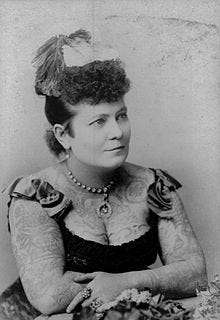
The first recorded tattoo salon in North America was opened in 1870 (or 1872 depending on who you reference) by Martin Hildebrandt who is also recognized as the first professional tattoo artist. A German immigrant, he learned his craft while serving in the United States navy on the USS United States. During the Civil War he worked as an artist and claimed to have tattooed thousands of soldiers both Union and Confederate. At that time, tattoos cost between $0.50 and $2.50.
After the Civil War, he worked with some of the most famous of the Tattooed Ladies who toured with the circus sideshows, and were “spectacles” in dime museums, and carnivals. This included his common law wife, Nora, described as the “mother of all tattoo circus ladies” (whose picture I used in the absence of one of her husband).
Hildebrandt opened the atelier on Oak Street (now called Monroe), between Oliver and James Streets, in New York’s Lower East Side. The shop was located in a tavern and is described as having “finely sanded wood floors” and its walls were “lined with paintings of odalisques” (images of concubines in a harem). Hildebrandt used India ink (considered the best for tattooing because it didn’t cloud like common ink) which cost $1.50 an ounce.
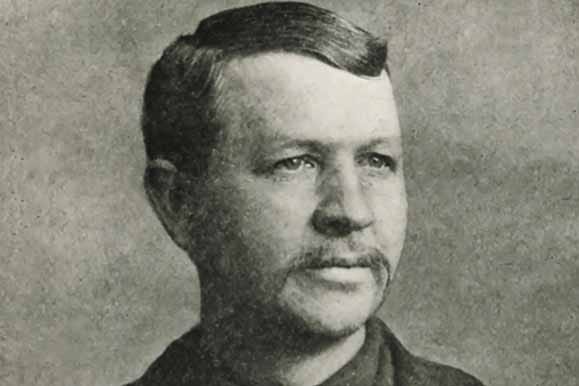
The electric tattoo machine was invented (patent granted) in 1891 by Samuel F. O’Reilly who had opened a tattoo shop in Chatham Square in the Bowery section of New York in 1875. It is now commonly referred to as the tattoo gun. The machine was adapted from Thomas Edison’s electric stencil pen used for sign painting and embroidery, and the rotary action was based on that of a sewing machine. It was battery operated and handheld and the motor controlled either a single needle or a row of up to five. The “reciprocating needle” made shallow wounds and pushed ink into them. Before Mr. O’Reilly’s machine, tattoos were applied the same way they had been for thousands of years. Tiny pricks were made into the skin with either a needle, small hammer with a sharp point, or a pointed stick. The area was then smeared with pigment which remained in the dermis when the wounds healed.
The tattoo gun made the process faster, producing up to 3,000 pricks a minute. When done by hand, the fastest tattoo artist could only make 150 to 200. The gun made the process less painful and allowed for greater detail in the designs and more subtlety in the coloring and shading. This allowed for more technical proficiency and facilitated the movement toward “works of art” and away from their crude designs of their predecessors. Tattoos became more artistic, some describing them as like paintings and the artists were being trained in informal apprenticeships.
There has to be something gruesome or unsavory cause I’m evil that way. In this instance, it’s the risks that came along with getting a tattoo in the nineteenth century. Not all of them were genuine. Even into the early part of the twentieth century hospitals quarantined patients with tattoos from a fear that they might spread disease and infection. Some cities went so far as to ban tattoos because it was believed they spread cancer.
There were genuine health risks involved. Gangrene was a possibility which could end in amputation or death. Then there was syphilis. In 1861, M. Ernest Berchon was one of the first to investigate the connection between syphilis and tattoos.
In 1877, James Kelly, like other tattooists, was in the habit of moistening ink by putting his needles into his mouth, passing on syphilis through his saliva. It is not unreasonable to believe that this was how he had contracted the disease. Bercheron suggested that such carelessness should be “treated as an unlawful wounding.”
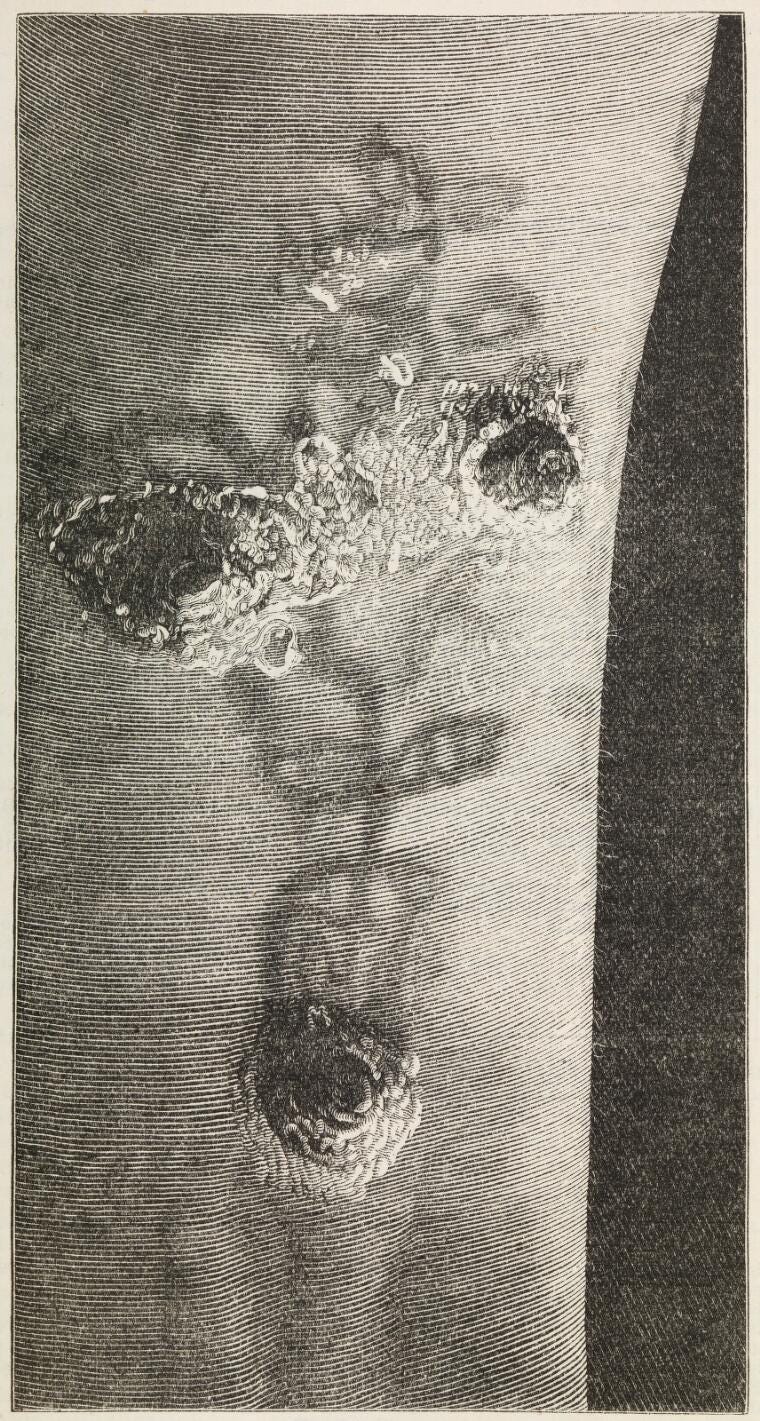
Another tattooist, likely a former soldier known only by the initial ‘S,’ used designs on paper printed in copying ink that required moistening before application. He did this with his spittle. He would also keep his needles “clean” and the ink moist with his spit. The French and British navies tried to discourage the practice of tattooing after outbreaks of syphilis spread through a number of their barracks. In Portsea, Hampshire, in 1888, twelve soldiers were infected. The attached picture is of a tattoo with signs of syphilis.
Of Particular Interest:
I, Pierre Rivière, having slaughtered my mother, my sister, and my brother… Edited by Michel Foucault
I love this book.
On June 3, 1835, Pierre Rivière went to the house where his mother lived with his younger sister and brother. (Pierre lived elsewhere with his father.) And he murdered them. This book is a retelling of the investigation and trial through the documents of its contemporaries.
The front section is the “narrative” of the investigation and the trial. It’s like being a tag-along, listening in on the conversations of those tasked with finding and prosecuting Pierre. It’s almost the nineteenth-century’s version of reality TV, only not fake. Though the book is a step-by-step guide to what followed a horrendous crime, it is also an investigation into legal insanity. Foucault is mute about whether he believes Pierre was or wasn’t insane; he leaves that to the reader, which I think gives the book more potency. A bit of a spoiler: It’s not as easy as you’d think.
The book begins with the report of François-Eduard Baudouin, cantonal judge, who visited the scene of the murder. He had been informed of the crime by the mayor of the commune of Aunay. He described the bodies as they lay where they had died and the wounds which had killed them.
There are statements by witnesses, letters notifying law enforcement and calling for them to search for Pierre (including how he was described), reports of the prosecutor, and newspaper articles about the crime. It takes you through the investigation from the beginning to Pierre’s conviction and death.
During his incarceration Pierre wrote a memoir to explain his actions. This is presented as a prelude to three medical reports (one of them from Matthieu Orfila of toxicology fame). Each report presents a different conclusion about Pierre’s sanity. Presenting it in this order allows you insight into Pierre’s thoughts before you read the “specialist’s” position. This was the era when concepts of insanity versus legal insanity were being debated. This case, and this book of contemporary documents, provides insight into that debate, what contemporaries thought about insanity, and how they determined it. It is a fascinating study of nineteenth-century medicine and its understanding of human nature.
The back end of the book is an examination of the social and political contexts of the case. I didn’t agree with many of their “findings,” but the commentaries were interesting in how social historians viewed such a crime and the trial which followed.
If you want to get a feel for how a nineteenth-century investigation and trial were carried out, this is an excellent and invaluable resource. Though occurring in the first half of the century, there are aspects which are applicable throughout. The medical theories toward insanity will evolve the further you get into the 1800s, but the appearance of the government official (here the cantonal judge; in England the coroner) to inspect the scene, the role of police, the manhunt, and the mechanisms of the investigation will be similar at the beginning of the century until almost the end.
Of equal value, is the access it gives us to the minds of those who carried out the investigation and were tasked with the responsibility of determining Pierre’s fate.

Pet Peeves
The Cold. This is a nod to Toronto’s first snowfall of the season which happened a few days ago. Cold in itself can be an annoyance if the wind is throwing snow into your face and you realize you forgot your gloves at home. But that’s not what I want to talk about.
I grew up in a place with lots of snow and cold temperatures. (Regularly hit -40F/C.) There is a quality to cold that you have to experience to understand. With that understanding comes the knowledge of how quickly it can kill you. I’ve read stories about individuals walking for miles through the snow without shoes and not suffering frost bite and not dying. There was a reality show I was subjected to (against my will) set in the north of Canada. They interviewed an individual who had apparently been out on the frozen lake for about an hour. I know it was fake because he was Caucasian and his face wasn’t red. I’ve seen movies where people lie in the snow (sometimes without a coat) for prolonged periods of time and then get up and walk around without any difficulty. When you’re lying in the snow, it melts, and that water seeps through your clothes and is like ice. And it burns.
I remember heading home to North Bay on the late bus up from Toronto. It was about -36C/-32F and the heater wasn’t working properly. By the time I got home (over 5 hours later) I could barely stand up. I couldn’t walk without assistance. My knees wouldn’t straighten and I was bent over at the waist. My fingers were crooked into claws that I couldn’t move. I didn’t have the strength or dexterity to undo the zipper on my coat or untie my bootlaces. It was a few hours sitting in front of a fire, but not too close, before I stopped shivering and a long time before I felt warm again. And that was without being directly exposed to the elements. (A bit of explaining. We heated our house with a wood stove; as for proximity, if you’re really cold, you only sit too close to a fire once, cause the pain that follows keeps you from ever doing it again.)
So, if your characters are sent into the snow/cold be certain to include the impact and damage that the cold will have on them. And remember, they aren’t going to live for very long if they don’t get somewhere with heat, especially if they’re not properly dressed.
This Edition’s Slang
A bit of pseudo science.
Atavism: A resemblance to remote ancestors rather than to parents in plants or animals; reversion to an earlier type (Oxford Canadian Dictionary; have to get my Canadian quota in). The Oxford English Dictionary defines Atavistic as relating to or characterized by reversion to something ancient or ancestral. Nineteenth-century origin and based on the Latin atavus “forefather.”
As noted, one of the “scientific” obsessions of the nineteenth century was explaining why some individuals committed crimes while others didn’t. “Scientific” interest in crime did not extend to what we would refer to as “white-collar” crimes. A popular explanation, put forward by Italian physician Cesar Lombroso in his book L’uomo delinguente, published in 1876, and championed by other scientists, was the belief that individuals of the working classes were “evolving backward” which made them “savage” and uncivilized and predisposed to crime. This theory was referred to as atavism.
Recidivism: A person who relapses into crime (Oxford Canadian Dictionary). Recidivist a convicted criminal who reoffends. Origin nineteenth century from French récidiviste, from récidiver “fall back.” (OED)
Those engaged in law enforcement (from the beat cop to the judge to the members of government) were concerned about crime prevention and part of that was the identification of repeat offenders. Transportation fell into this category—lower crime by removing the repeat offender.
Because the same name was never given twice when someone went to prison, other methods of identification were needed. Tattoos were one way of doing that. It was why the British government was so thorough in its recording and description of tattoos on convicts before they left the UK and upon arrival in Van Diemen’s Land. As a result of their fixation on identifying repeat offenders, law enforcement created one of our largest collections of nineteenth-century tattoos.
Comments
Nothing yet. Say the first thing.
Sign in to join the conversation.