
“I have executed and perfected such an apparatus or Machinery as will make Coin not only superior in Beauty & Workmanship to that of any Nation in Europe but also so manufactured ... that Counterfeiting will be prevented.”
Matthew Boulton, to the Privy Council Committee on Coin, December 1789
This month it is counterfeiting, but with a focus on coins. I’ll talk about paper money in a future issue.
As soon as there were coins there were people trying to counterfeit them. The nineteenth century was no exception.
The majority of forged coins were the smaller denominations. There were a couple of reasons for this. First, was in their creation, the second, in their distribution.
Before I talk about the fake ones, let’s talk about the real ones. Small denomination coins are the cornerstone of any economy. Even today, few of us walk around with $100 bills in our wallets. In the nineteenth century, as the population grew, the demand for such coins increased and not all governments were able to keep pace with it. Coin production (see below) was labor intensive and expensive. Some governments were unwilling to invest the money required to create massive amounts of small coins to keep pace with the demand. This meant that they remained in circulation longer than they should have which wore down the images on them and made them easier to counterfeit. In England, between 1773 and 1821, workers made up for the shortfall of small coins by purchasing tokens made from private diesinkers. Most were made in and around Birmingham. These tokens were easy to duplicate and, for a time, the term “Birmingham coiners” was synonymous with counterfeiting.
Let’s begin with distribution because there’s less to say about it. The more fake coins you can put into circulation, the greater the return on your investment. It was easier to flood the “market” with counterfeit pennies than it was the larger coins.
Counterfeiters were not drawn from society’s elite and neither were the people who distributed or uttered their coins (see below). A gold sovereign was the equivalent of £1 or 20 shillings. In 1867 the average income for a working-class family has been estimated at 31 shillings a week. Many had to survive on 10-12 shillings. The majority of the population was too poor to possess gold coins which meant that in the grand scheme of things, they weren’t used very often. When they did appear it was notable, which meant it was suspicious, which meant greater scrutiny, which meant it was more likely to be detected. A shopkeeper lost considerably more money when he accepted a fake sovereign than he did a fake penny. In turn, it made gold coins less attractive to the individuals paid to distribute them who, in turn, paid the coiners a smaller fee for each one.
That didn’t mean it didn’t happen. Places that were busy, like racecourses, where coins changed hands quickly and with little more than a glance at the denomination and color (make sure it was gold), were fertile environments for distributing fake currency.
In terms of their creation this can be divided into two groups: what they were made of and how well they were made.
The coin you created had to be the same size (diameter and thickness) and weight as the legal tender. This was not as great an obstacle for coins made of silver or copper/bronze as the difference in weight was so slight it would be difficult, if not impossible, to detect without specialized equipment. Not so with gold coins.
Gold is dense and, therefore, heavy. There are few metals that could imitate its physical qualities. Platinum is one of them, and in the 1860s its value was considerably less than gold; in some instances, about half its value. Counterfeiters got very good at making gilded platinum sovereigns and half-sovereigns. So much so that, occasionally the real thing was presented to the Royal Mint under the belief that they were fake.
The other challenge was recreating their appearance, and this is true for all coins. This is often where counterfeiters fell short. One method of creating a cast was to press a genuine coin into heated metal; what resulted was simplistic compared to the real thing. In the 1800s, that failure to produce a perfect reproduction became the primary method of detection. More about that below.
The other method of discovery was the shape and size of the coin. Coin counterfeit scales became popular with vendors. (An example shown below.) The coin would be inserted into the relevant slot to ensure it was the correct diameter and thickness. Then its weight would be compared to one known to be legal. A fake coin will pass one of the tests, but not both.
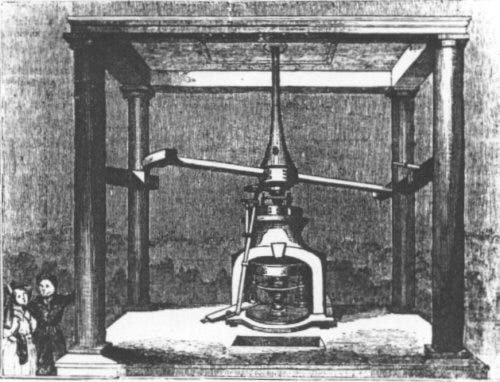
As mentioned, one of the main defenses against counterfeiting was the production of high-quality coins that were exact replicas of each other.
The world’s first mechanized mint, invented by James Watt and Matthew Boulton, came into use in 1786 and was capable of producing between 400 and 920 coins per minute. By 1789 there were eight steam-powered presses working at the new Soho Mint. (Between 1789 and 1809 the Soho Mint had produced 600 million items including coins and medals.) Boulton eventually earned the title: Master of Modern Minting.
Prior to this, coins were made either by imparting a heavy blow from coining dies onto a smooth metal disk, or to use a screw press which was operated by between four and six strong men. It was time-consuming and labor intensive.
Of relevance to counterfeiting, with the manual presses each genuine coin was slightly different (some weren’t even perfectly round). This made it almost impossible to distinguish legitimate coins from forgeries just by looking at them.
With Watt and Boulton’s machine the strike upon the die was more accurate which created coins of uniform size with straight edges and high-quality standardized images. This made them more difficult to copy and provided a guaranteed template against which to compare suspected counterfeit coins. This visual comparison is used today to separate the real from the fake.
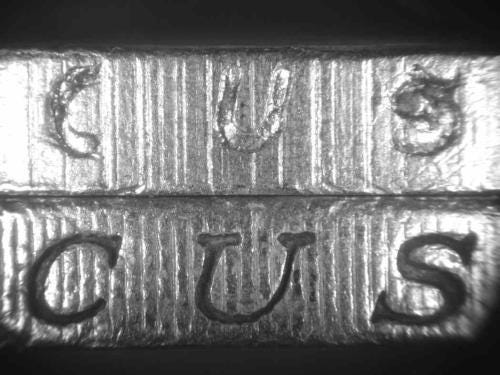
Watt and Boulton’s machine, and other steam-powered presses were adopted by government mints throughout the world, revolutionizing currency both in how money was created and in its appearance.
To get an idea, the image of the stacked coins is from this century, but the principles are the same. You can see how the quality of the counterfeit (top) falls short of the legitimate.
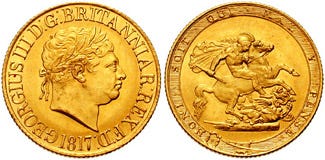
Counterfeiting was a serious crime. Today, it isn’t considered high treason, but in nineteenth-century England you could be charged with that.
In the 1820s a group of six individuals known as the Vauxhall coiners worked with a punch to create sovereigns of George IV. They were Daniel and Mary Ann Buckley, Jeremiah Andres, Shadrach Walker, Daniel Pycroft, and Mary Ann Patrick. Suspicion was aroused when on several occasions they were seen loading/unloading carts and delivering heavy baskets to different London locations. A stakeout ensued in the autumn and on December 23, 1826 a raid was carried out on their houses. Coining tools and a few thousand counterfeit coins were found and they were arrested. It has been estimated that they were making about £100 a week.
The men were charged with high treason and the women with minor crimes. Pycroft brought a character witness to his trial who did a remarkable job of creating sympathy within the jury because Pycroft was set free. Buckley and Andrews weren’t so lucky. They were found guilty and on April 23, 1827 they were hanged.
In the Royal Mint Museum there is a coin punch and below it is a slip of paper from the 1800s. It reads: Two men named Buckley and Andrews were arrested while working on this punch and were afterwards executed. Theirs was the last execution for forgery.
Even in the nineteenth century counterfeiting was an international enterprise.
Between 1876 and 1877 the Royal Mint was in correspondence with the Bank of France regarding British coins they suspected were being manufactured in Spain. They believed that the sovereigns and half-sovereigns were being made to order and sent to North and South America. A number had turned up in Rio de Janeiro and Venezuela. This was not the first time that the French and British governments worked together against counterfeiters.
The situation was a little sketchy, but considered legitimate enough for Detective Sergeant Charles Von Tornow to be sent to Barcelona, to meet with a Monsieur Deschanel. This is a friend of a friend story, for, although Deschanel claimed not to know the identity of the Spaniards who were forging the coins, he claimed to be a close associate of a man who was. Deschanel said that 800 sovereigns were to be dispatched to Buenos Aires. What was known for certain was that the platinum used to create the coins had been purchased in Paris and transported to Barcelona.
The arrangement fell apart when Deschanel insisted on an advance of 10,000 francs before providing details such as names and the location of the factory.
Von Tornow was not convinced and he refused to pay the money and the deal fell through. The problem of counterfeit sovereigns and half-sovereigns eventually went away on its own. By 1905 the price of platinum was higher than the price of gold, thus making the counterfeits more expensive than the genuine article.
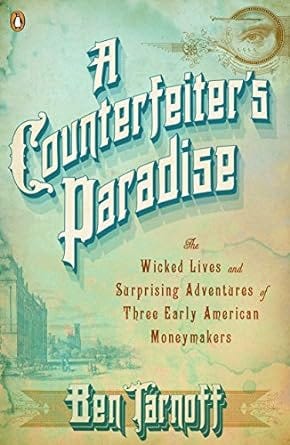
A Counterfeiter’s Paradise, by Ben Tarnoff
Something a little different this month. Rather than a review of a single book (which I will do), I’m going to offer a larger overview of books which contain either a collection of stories, or case studies.
This month’s book is A Counterfeiter’s Paradise. All of the counterfeiters are from the States and the circumstances under which they operated and succeeded were particular to American. As Tarnoff states “Few countries have had as rich a counterfeiting history as America.” It starts in the eighteenth century with Owen Sullivan (c.1720-1756), moves on to David Lewis (1788-1820), and ends with Samuel Upham (1819-1885).
Each story highlights a different aspect of the counterfeiter’s world. For example, part of Sullivan’s success was the result of weak law enforcement. Lewis is described as a bit of a Robin Hood hero who lived in the backwoods of Pennsylvania. Upham lived during the free banking era when counterfeiting of bank notes (and other illegal banking activity) ran rampant through the States.
The book begins with a brief introduction set in 1876 when a group of counterfeiters tried to kidnap Abraham Lincoln’s corpse to hold it in exchange for the “gang” leader Ben Boyd who had been arrested by the Secret Service. It moves on to provide an overview of the banking, economic, and political circumstances which made America such a profitable breeding ground for counterfeiters (and other swindlers).
Tarnoff’s book is comprehensive, informative, and an easy read (which is always good when you have lots of research to do). He presents pictures of the individuals involved and places them firmly in the context of their society. He discusses the financial aspects of counterfeiting and banking without getting bogged down in the lingo or with the technical aspects of the actual forging.
I am not a financial person and, in researching for this newsletter, sometimes got lost in the heavier articles which delved into the nitty gritty of currency. That can be difficult and discouraging when you are gathering information for your book; wading through things you sort of understand, but don’t, and then wondering if you need to become an expert to create an accurate portrayal of your character and their crime.
Books like Tarnoff’s allow you to see how those facts played out in real life which adds realism to fiction. You see how the counterfeiters worked, thought, schemed, what opportunities they took or created, and how they used the circumstances to their advantage. You can create richer more realistic characters, on both sides of the law, and you get to see examples of those dense historical facts that you’ve been reading. The other advantage is they “lighten” the reading and allow you to enjoy well-written prose while you gather information for you own work.
This is not the only book of this sort. Currently, I am reading Stephen Bates’s, The Poisoner: The Life and Crimes of Victorian England’s most Notorious Doctor, and up next is George Cooper’s, Lost Love: A True Story of Passion, Murder, and Justice in Old New York (recommended to me by author Carrie Hayes). Bate’s book shows how all the academic discussion on poisons played out on.
If you need a brain break from intense academic articles and books explaining life, crime, and the law in the 1800s, pick up a book that puts it all together and shows how the theory translates into reality. As you are scouring the academic books and journals, don’t forget the “case studies” that help you put it all into context.
People falling through the ice. Because it’s still winter (and because I discovered my waterproof winter boots are no longer waterproof) this month’s annoyance is about the cold and water. More specifically when people go through the ice into the water.
Lots of TV shows and movies have characters falling through the ice or falling into streams, getting themselves out, and then walking to wherever. When ice is present, the water is at freezing (0oC and 32oF) unless its bracken or salt water. It lowers your core temperature quicker than being in a cold coming-off-of-the-prairies wind. Once out of the water, it’s time which decides whether or not you survive; that is, how quickly you are able to get somewhere warm and into dry clothes. And it’s not measured by hours, but by minutes. If you’re walking, you’re not going to get very far.
Worse, are the rescue scenes. They depict people crawling or, worse, standing at the edge of the water. To rescue someone, you drop to your belly and keep your arms and legs extended to distribute your weight over as large an area as possible. You do this whether you’re running away or being heroic. If the latter, you go close to, but not right up to the edge of the ice or you’ll also end up in the water. If it didn’t support their weight, it isn’t going to support yours, especially after it’s broken. You use a belt or whatever else you can stretch between them and you and you pull. If they come toward you, you move away until you know you are on ice thick enough to support the weight of two people.
Don’t get me started on people punching their way through the ice once they’ve gone under. We’ll be here all day. Suffice it to say: Impossible. No human is capable of punching through more than a foot of ice, less so when in water (think about what it’s like running in water), even less “less so” when the water is cold.
So, to sum up, if your character falls through the ice, you better get them somewhere warm very quickly. Despite what James Cameron thinks, you don’t live long in freezing water.
I crossed the North Atlantic quite a few times when I lived in England and travelled back and forth to Canada. I recall one plane journey when the stranger beside me was annoyed because I was reading rather than paying attention to the flight safety speech. He said, in a condescending voice, something about needing to know these things if I hoped to be rescued. I responded that, if we went down, it would be into iceberg-infested waters where our life expectancy would be very short and that the little lights on our life jackets weren’t for rescuing us, but to make it easier for the salvage team to find our bodies. He didn’t talk to me for the rest of the flight.
A bit misleading to call it slang. (Okay, it’s entirely misleading.) Instead, it’s vocabulary related to the topic of counterfeiting.
Uttering: According to the Oxford Canadian Dictionary, it is to issue or circulate a forged document, counterfeit money or cheque. For our purposes, it’s to put forged money into circulation. To be pedantic, when a forger gives counterfeit money to their “distributor,” that is not uttering. It requires an exchange of the coins for goods or services. Let’s turn to the Canadian Criminal Code: “If you made a counterfeit $100 bill, that would be forgery. If you gave the counterfeit bill to a convenience store in exchange for groceries, that would be uttering.” An individual could be arrested for one or the other or both. Uttering can include trying to pass coins that are not current.
Counterfeiters often used utterers rather than distribute the money themselves and on many occasions they used women as it was thought they appeared more honest.
(Three charges are associated with counterfeit money: forgery, possession, and uttering.)
Tokens: A form of money whose intrinsic value is less than its face value. In other words, our paper money are tokens.
Counterfeiting was one problem faced by governments with regard to currency, melting the coins down was another. This occurred when the value of the metal in the coin exceeded the face value of the coin. For example, in France, copper was used for coins valued at two, three, and five centimes (100 centimes in a franc). But when the price of copper went up, the coins were melted down and the metal was either sold or “refurnished” into new coins that contained less copper.
To prevent this, mints issued coins whose intrinsic value was less than the face value of the coin. English pennies had an intrinsic value equal to 44% of their face value. It didn’t always work. In 1807 France created a 10 centimes coin containing 10% silver (intrinsic value 95% of face value). They weren’t melted down, but the counterfeiting of the coins was so extensive and so convincing that it was removed as legal tender a year later.
No posts
Comments
Nothing yet. Say the first thing.
Sign in to join the conversation.