
The first public forensic laboratory in the world was founded in Lyon, France, in 1910 by Edmund Locard (a giant in the history of forensics) in the attic of the Lyon police station. It took another two years before the local government recognized the usefulness of the work done there and accepted the Laboratoire de Police Scientifique. Labs funded using taxpayer money did not appear in the United States until 1923 (Los Angeles, California). Canada created two forensic labs in 1914. The first was in Montreal, Quebec. The second was established in Vancouver, British Columbia when the Vancouver Police Department moved its location to a new building located on East Cordova Street. They installed John F. C. B. Vance in a laboratory on the top floor. (Vance is known as Canada’s Sherlock Holmes.)
The first private forensic laboratory in the United States was established in Berkeley, California in 1910 by Edward Oscar Heinrich. Lucas May founded his laboratory in 1919 as an extension of his private investigation business in Seattle, Washington.
Thanks for reading Bandit's Roost! Subscribe for free to receive new posts and support my work.
For some strange quirk in history, the laboratories which shaped (and created) modern forensics were on the west coast. On America’s east coast reforms in crime scene investigation focused on replacing the coroner’s system with a medical examiner rather than the processing of physical evidence. In other words (and perhaps unfairly), they were focusing on reforming the existing system, rather than introducing the scientific examination of evidence.
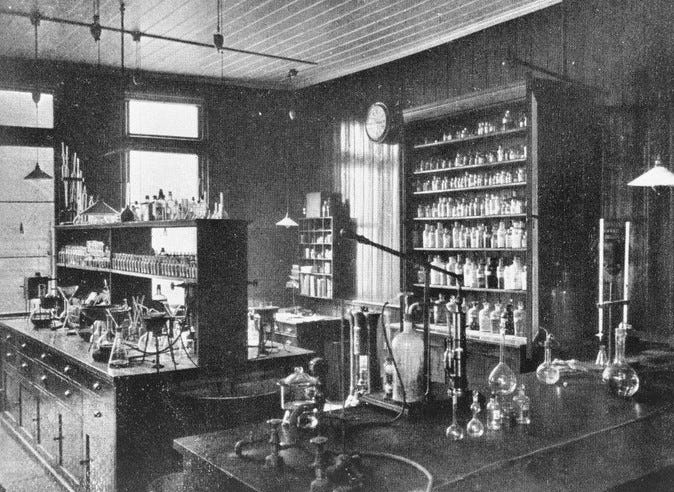
Except for the presence of scientific equipment, these labs did not much resemble those in existence today. Modern law enforcement, lawyers, judges, and forensic scientists would be mortified by them. For one thing, along with commercial buildings, they were located in apartments, basement of houses, and even a cottage. The Head Quarters for May’s Institute of Scientific Criminology was on the ground floor and basement of his house. He and his wife lived on the second floor above the laboratory, photographic shop, dark room, tool room, and a large room which was fully equipped with individualized working stations. Heinrich moved his lab, Heinrich Technical Laboratories, into his house in 1921. It consisted of three rooms: a combined lab and camera/darkroom, an office for his secretary, and a library.
Along with the usual equipment a scientist needs, these labs contained an odd collection of items, most of which would probably not be allowed to reside in someone’s home today. May kept a large collection of firearms (for testing), hundreds of test-fired bullets. Though in a police building, Vance had a collection of live bombs, narcotics, counterfeiting equipment, safe cracker’s tools, and blood-stained clothing.
It was in these labs that modern forensics was born. Methods, standards, and expertise were built and perfected on a case-by-case basis, and if a piece of equipment did not exist, then it was here that some of them were invented. Vance invented the portable ultraviolet-light box which allowed him to detect fingerprints, counterfeit money, drugs, and various bodily fluids at the scene of the crime. Calvin Goddard, a ballistics expert, invented the comparison microscope which allowed scientists to view two bullets at the same time.
Sometimes they attempted to stretch the bounds of science in order to provide the police with new and novel methods of identifying criminals. Vance dedicated a number of years attempting, and failing, to invent what was referred to as the “Robot Nose;” a “mechanical bloodhound” that was intended to hunt down criminals based on their scent.
Another, significant, difference between the labs of yesterday and those of today was the absolute absence of oversight, standards, procedures, or policies, not even for how evidence was to be labelled and handled. It was a free for all. The quality of the lab depended on the diligence and the meticulousness of the man in charge. May had a “habit of taking his work from his lab…getting on his power yacht and going to “the island” [where his cottage was located] to work on Wednesday afternoons.” (Filby, American Sherlock) When a case was over, storage of evidence was the responsibility of the individual who owned the lab as it became their property. Eve Lazarus was able to write her book (Blood, Sweat, and Fear) on Vance’s contribution to forensics using files and items of evidence kept by the family.
There was some self-regulation. May’s staff logged and stored evidence, but this was done according to their systems, rather than a policy or system imposed by law enforcement.
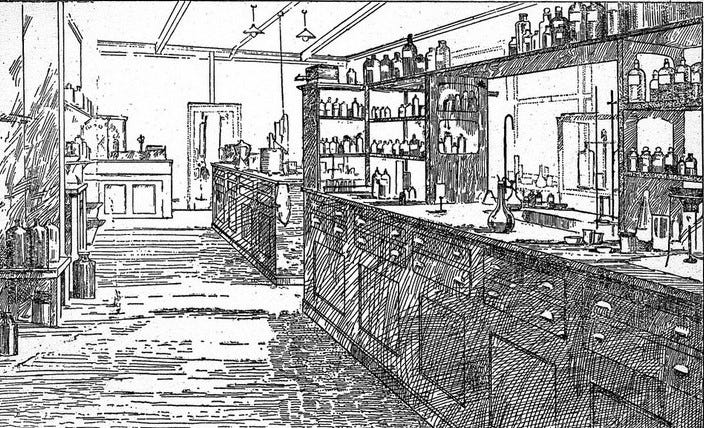
These early labs did not restrict themselves to forensic science. Even in 1949, when he retired, Vance’s lab was processing and testing items for the Health Department, Coroner’s Office, Engineering Department, Fire Department, the Society for the Prevention of Cruelty to Animals, the Smoke Inspector, Vancouver General Hospital, the Purchasing Department, and the Parks Board. Throughout the existence of May’s lab, his staff were interviewing witnesses and running routine assessments, acting in the role of private investigators.
Business flourished. A lab with a good reputation could earn considerable amounts of money. The lifestyles of these three leaders in modern forensics (Heinrich, May, Vance) are proof that companies and police forces would pay significant quantities of money for their services.
Their range was also quite substantial. Each of the men attended to cases which were hundreds of miles from their base of operation. Business was so good that Heinrich and May opened locations in other cities. Their reputations were known far beyond where they worked, which resulted in calls from far afield requesting assistance.
Despite their existence, their reputation, and their success in providing evidence that ensured convictions, they were not used to examine every crime scene, not even every murder scene. Vance and May were independent contractors and their participation in an investigation had to be justified before the coffers would be opened to pay their fees. Most often it was for high-profile cases like the Fatty Arbuckle murder trial. In other instances, they were brought in days, sometimes weeks, after a major crime was committed and the police were stumped. On October 11, 1923, the DeAutremont brothers blew up a tunnel on the border of California and Oregon, trapping the Southern Pacific Railway Train, No. 13. They believed it contained half a million dollars in gold. The local sheriff’s department was ill-equipped to handle a murder investigation (four men died), so the SPR and the U.S. Postal System brought in their own law enforcement. After six days of examining the evidence they declared all of it useless. On October 16, two federal investigators went to Heinrich and enlisted his help. After examining the evidence, he was able to provide proof of the brothers’ guilt and secured their convictions.
Along with forensic advances, these labs had a significant impact on how policing was done. Their success convinced local governments and law enforcement agencies that the collection and examination of physical evidence resulted in more convictions. Larger cities with progressive police chiefs were finally being granted the funds they needed to build their own forensic labs. But the process was slow. The first municipal lab in the United States was in Los Angeles, founded by August Vollmer, in 1923. New York got its crime lab in the early 1930s. Oregon got a state-wide lab in 1939. Toronto got its lab in 1932.
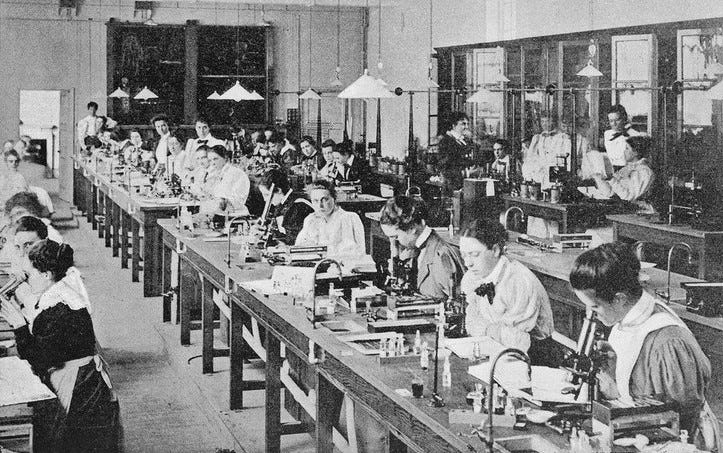
Northwestern University Law School created their own lab—Scientific Crime Detection Laboratory—as a result of the 1929 St. Valentine’s Day Massacre. Members of Al Capone’s gang had dressed up like policemen to carry out the murder of seven individuals. The reputation of the Chicago police was on the line with no traditional methods to prove their innocence. Calvin Goddard used his invention to compare bullets and determined that no police officer had been involved. As a result, he was given funding to create the first public independent forensic lab in the United States. Chicago followed soon afterward, then Columbia.
In 1932, perhaps the most famous forensic lab was founded by J. Edgar Hoover; that of the FBI. It was quite an accomplishment considering the economic impact on public funds during the Great Depression. The RCMP received approval to create their lab in 1931, but the Depression prevented its establishment until 1937. It was set up in an attic bedroom of an officers’ mess.
In the same year, Vance opened a new 6,000-foot lab that was one of the largest and best-equipped labs in North America.
These labs were instrumental in changing crime investigation, and created the foundations of forensic methods and equipment used today. Their success changed the way police forces approached crime scenes and evidence. Though police initially resisted and resented their presence, rates of conviction convinced them that science had something valuable to offer. Because of the attention the labs received for providing the “smoking-gun” which resulted in convictions, forensic evidence processed through specialized labs ceased to be a rarity and became a necessity.
For more historical crime tidbits, follow me on Instagram @acuriosityofcrime
Thanks for reading Bandit's Roost! Subscribe for free to receive new posts and support my work.
Comments
Nothing yet. Say the first thing.
Sign in to join the conversation.