
“Photography, in Byrnes’s conception, exposed as criminal those faces which looked most respectable.” [Thomas Byrnes, head of NYPD Detective Division, Police Chief 1880-1895]
Simon A Cole, Suspect Identities, 2001
This month I’m talking about photography in crime, focusing on the (in)famous Rogues’ Gallery. A quick technical note before I dive in. From 1839 to 1850s the images were daguerreotypes and from 1850 to mid-1860s they were ambrotypes. For ease, I will refer to all of them as photographs. (See Vocabulary for descriptions.)
Almost from the time photography was invented, police were using it (or trying to) as a means to identify convicts, most specifically, repeat offenders, aka recidivists. The Belgians were reported to have used them from 1839, the French in 1841, and the British in the 1840s. In 1854, Lausanne, Switzerland, expanded the field to suspected criminals.
In 1858, the New York Police Department employed the earliest recorded “rogues’ gallery” (notorious criminals displayed to acquaint police with their appearance). By this date, the NYPD had collected 450 ambrotypes. In 1859, Albany joined the practice, but constables had to finance it from their own pockets. Theirs often included photos they had taken themselves. Shortly after this, cities began sharing their photographs. From America, the “gallery” spread to Europe arriving in Danzig, Poland, in 1864, Moscow in 1867, and London by 1870.
Much of policing involved constables and detectives recognizing (both in person and descriptions) known criminals. It was hoped that, by providing photographs, police and the public would become familiar with more criminals. Though police forces boasted that their detectives could recognize hundreds of “rascals,” identification through accessing archived photographs was not as easy as it is today.
Interestingly enough, it wasn’t the violent criminals who found their pictures prominently displayed in rogues’ galleries, nor the ones police were most interested in identifying. Most of those found in the rogues’ gallery were forgers and confidence men (an American term coined around 1849). These were the “poster criminals” of the era. One reason for this is forgers and cons tended to travel, whereas thieves, for example, remained within a single city and became known to police through personal contact. Moving between cities and adopting a new identity in each, kept forgers and confidence men anonymous and hidden from police. By circulating photos of such convicts between cities, it was hoped to counteract their anonymity.
Gustave Macé, head of the Detective Division of the Paris Police, required all criminals to be photographed. By 1880, they had collected around 75,000. They were kept in filing cabinets, boxes, and loose along corridors.
Much as we see the advantage of photographs for identification, in the nineteenth century the rogues’ gallery never evolved into a functional system of identifying repeat offenders, or suspects from witness descriptions. Two shortcomings prevented this: the photographs, and the filing.
Daguerreotypes were expensive, cumbersome, and required skill and specialized training. Slow lenses required that convicts remain absolutely still for prolonged periods of time, sometimes as long as twenty minutes, this often resulted in them being strapped to a chair. All a convict had to do to obscure their image was to move their head slightly.
For photographs to be usable they had to be taken in good light, optimally in sunlight which was not always possible. Even when multiple artificial sources were employed, the quality of nineteenth-century lighting was substandard. As technology improved (the lenses got faster), images got clearer, and the cost of creating the images went down, police employed them to a greater extent.
Even with these advances, the images were often of poor quality, overexposed, blurred, or of the entire body (rather than just the face) which made identifying features difficult to see. Problems with the technology were exacerbated by a lack of consistency in how the photographs were taken. In the absence of guidelines, such things as distance between camera and subject, the angle of the face, the direction of the lighting, and size of the image depended on the mood of the photographer.
In 1882, a neurasthenic clerk in the Paris Police, Alphonse Bertillon (creator of system of identification using eleven body measurements which became known as bertillonage), standardized the mug shot. He employed photographs as part of his system, but remained sceptical of their effectiveness as a system of identification. He instituted guidelines for photographs insisting that all were taken from the same angle, lit in the same manner, and that profiles be included. The reason was his belief that everyone’s ears were unique and that made them one of the most useful features for identification.
Creating a workable filing system eluded nineteenth-century police. Though images were kept alphabetically by the name the convict provided, the method of retrieval was cumbersome and ineffective. It was said that no criminal ever went to prison with the same name twice. A single convict could be present in the photographic collection multiple times under multiple names. This created a list of convict’s names and a quantity of photographs so vast that mug shots were rendered useless as a means of identification.
If a detective were (delusional) determined enough to find a known convict or a suspect, up to 8 hours of searching was required. Considering the Paris police had 75,000, that was a monumental task. It could not function like today where police gather mug shots of suspects and present them to victims and witnesses and ask them to point out the assailant.
The Rogues’ Gallery became more useful when overall methods of identifying people improved; criminal and law-abiding. Before then, there were great in theory, but of limited use in reality.
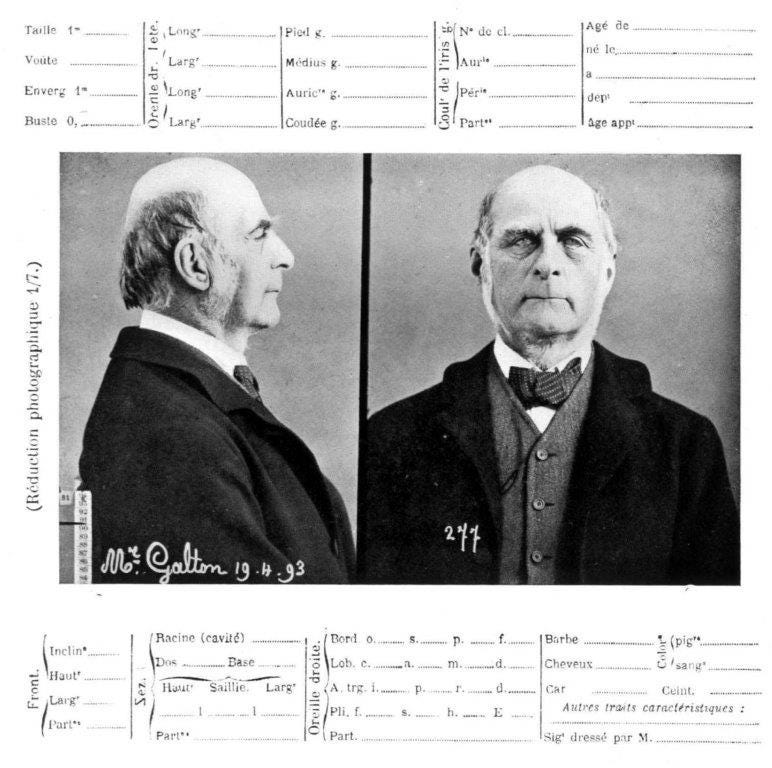
Identifying recidivists was not the only use that the rogues’ gallery was put to. The other was to identify outward signs of deviance (criminality). This was a form of physiognomy, the study of facial features. Though, through technological advances, the former lived up to its potential (identifying criminals), the latter (luckily) did not.
Photographs were a godsend to criminal anthropologists; those who believed that criminality was an inherited trait like eye and hair color. Today, we would say someone was born bad. These “scientists” believed that there must exist an outward manifestation of “criminality.” If they could identify it, they could remove from society all those who possessed the trait and rid the world of crime. Photographs allowed them to test their theories using a method known as composite photography.
Francis Galton, British statistician, was obsessed with this theory of inherited criminality (also known as atavism) and he created this method of examination. The technique involved layering multiple exposures of mug shots onto a single photographic plate. By doing so, he hoped to identify a physical trait that was shared by them all.
Needless to say, their experiments amounted to nothing.
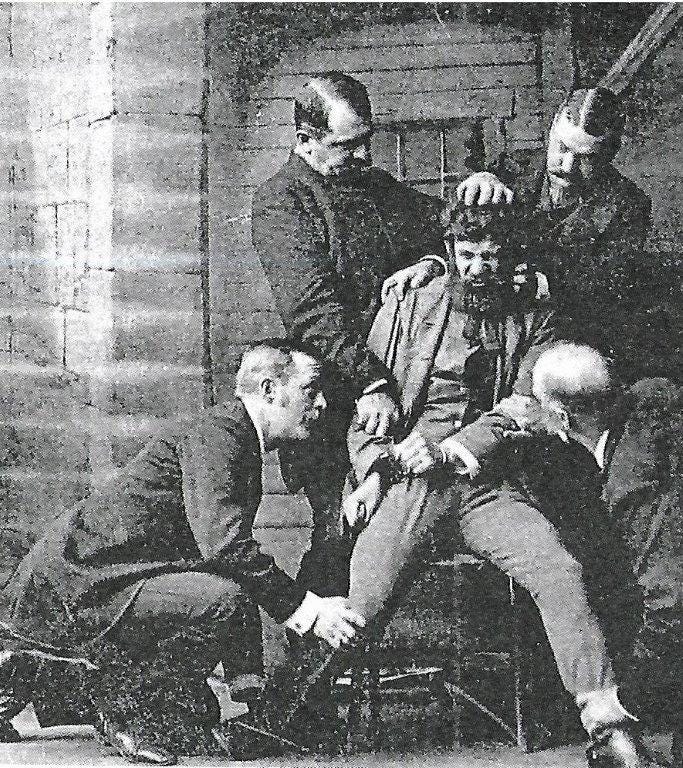
Throughout the nineteenth century, photography was time consuming. As the century went on, lenses became faster, but even in optimal conditions with studio lighting on bright sunny days, it took several seconds. When the weather was not conducive to picture-taking, the process took considerably longer. During this time, the subject could not move. In one early instance, with daguerreotype portraiture, a Swedish amateur almost caused his subject to go blind in one eye from staring into the sun for the five-minute exposure.
Studios had a daylight room on the roof which resembled greenhouses to allow in as much light as possible. Once electric lighting became available, photographers were less dependent upon the weather. This helped in the quality of the photo, but also lowered the amount of time the subject had to remain motionless.
Specialized chairs were created to provide support to make it easier to sit completely still. It had a mechanism against which to rest the head and often the subject was arranged so they could lean their elbows on a support. This could be a posing table whose height could be adjusted. This created stiff, severe poses.
Convicts were not always as cooperative and, on occasion, had to be tied to the chairs.
[The above photo was staged and used to highlight the difficulty of photography as an effective means of identification.]
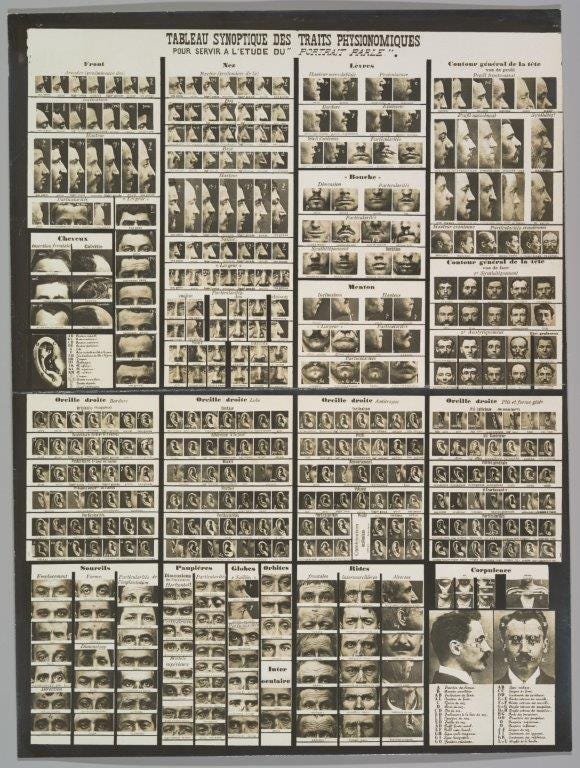
As noted, Alphonse Bertillon’s system of identification used photographs for more than “mug shots” which were included alongside the document which contained a description of the individual.
One of the shortcomings of bertillonage was the inconsistency of description. What one person considered a long nose, another operator might consider medium. Given that there were no parameters for the categories, there was no consistency for either the individuals writing the description or those reading it. This created difficulties in filing and retrieving. Cards were filed according to body specifications, not the name the convict gave.
To counter this, a series of “tableaux” were created. Collections of photographs showing different shapes of facial features to impose some consistency in how features were described as well as display the different shapes for each. These collections included noses, ears, hair styles, shapes of the head in profile, facial hair, and eyebrows. It had minimal success.
(Photo provided by the Wellcome Collection)
A Guide to Improvised Weaponry, by Terry Schappert and Adam Slutsky
This book is so much fun. Part of me thinks it should be called “How to MacGyver Your Main Character.” It was written by Terry Schappert, who is a U.S. Army Special Forces (Green Beret which is nothing to sneeze at), and Adam Slutsky. It is useful to those writing historical as well as contemporary fiction. It provides methods of defense and escape “by deploying the hidden tactical uses” of common everyday items.
The book includes 100 improvised weapons arranged in alphabetical order. Some of them are obvious: hammer, pool cue, rolling pin, and broom/mop. But there are others which I would never have thought could be either a weapon or a means of defence. A drinking straw, a comb, an oven mitt, and, my personal favorites, a bag of dog poop and dirty diapers. (What does that say about me?)
It offers advice such as getting titanium, steel, carbon fiber, or fiberglass chopsticks from the internet, or ones with sharpened points or concealed “needle-like daggers.”
They provide a fun, theoretical situation for each weapon: “You’re at the local coffeehouse writing the great American [Canadian] novel on your laptop when in comes a robber intent on making off with the cash register and all the patrons’ wallets. What do you do?” These are followed by a variety of ways you can use the improvised weapon to defend yourself or escape and what advantages it will give you. In this instance, the everyday item was a laptop.
Expert Advice is offered such as not holding a hammer too tightly or you will weaken your fingers, hand, and forearm too quickly.
The book is not only about how to use common items. There are sections with “Green Beret Guidance” about attitudes and mindset of those who make their living putting themselves in dangerous situations. Things you can use to make your bad-ass characters more realistic. Items like: “If you act like a victim you’ve already become one...When going anywhere, if you feel eyes on you, instead of averting your eyes and conveying cowardice, return the gaze.”
Best thing about it is that the advice does not require you to be specially trained or familiar with martial arts or any other style of fighting. Anyone can do what the authors suggest. So, if you’ve got your protagonist in a sticky situation and you’re looking for a realistic and creative way to get them out of it, check out this book.
And, hey, maybe they’ll be able to thwart your bad guy with a bag of dog poop.

“The blood belongs to your vic.” This is a specific annoyance, but I’ll do my best to expand it beyond a single show. It comes from a Canadian crime drama set in the interwar years, Frankie Drake Mysteries, decades before DNA technology. The show is about a female private investigator and she visits her friend, an ME-in-training, when there’s a corpse in the morgue related to their case. On more than one occasion, the ME-in-training informs Frankie that the blood found at the scene is from the victim.
In 1901, Karl Landsteiner of Austria discovered three of the human blood groups: A, B, and O. In 1902, he added the fourth group, AB.
I am old (I mean young) enough to remember crime dramas and real police cases when the most blood evidence could do was eliminate someone. You could not point to someone and say: “It’s their blood.” And yet, this show does just that.
I don’t know if the writers didn’t realize forensics couldn’t do that or they just didn’t care. Either way, it’s sloppy.
That doesn’t mean you can’t play with history when you’re writing fiction, sometimes you have to to make it relevant and interesting. But if it is something this significant to your story, probably best if you get it right.
What is the bigger peeve? It’s bringing the future into the past. Be careful not to solve your plot problems by looking at what technology we have available today and transporting it back in time. Might just be me, but I prefer it when problems are solved using the technology and scientific knowledge of the time. I find it much more interesting. So, don’t be like this Canadian show, or another one that created a long-range listening device from a phonograph and used it in a public setting, and managed to record only the conversation of the bad guys. Don’t get me started on that...
A bit misleading to call it slang. (Okay, it’s entirely misleading.) Instead, it’s vocabulary related to the topic of early photographic technology.
Daguerreotypes: An early form of photography named after its inventor Louis Jacques Daguerre, a French artist and chemist. It was the first type of photography available to the public. They were popular in the 1840s and 1850s.
The process required the operator to polish a sheet of silver-plated copper to a mirror finish; treat it with fumes to make the surface light-sensitive; expose the plate in a camera (a few seconds if in bright sunlit space, up to five minutes in dimmer environment); fume the plate with mercury vapor (removing its sensitivity to light); rinse; dry; and seal it behind glass in an air-tight frame.
One of the drawbacks was that the process could only produce a single image; unlike today’s negatives, duplicates were not possible. (For those old, I mean young, enough, think Polaroids.)
The daguerreotype produced a reverse image which complicated their use for identification; any writing would appear backwards. Identifying marks on an individual’s right side, would appear on the left side in the daguerreotype. This could be remedied by pointing the camera at a mirror, rather than the subject. For the image to have any amount of detail (therefore, identifying features) the subject had to remain still for a long time, even after improvements to the lens were made.
In the 1850s, they were no longer used and were replaced by new easier, less expensive processes such as the ambrotype.
Ambrotypes: Introduced in the 1850s it was invented by James Ambrose Cutting and within a decade had replaced the daguerreotype. It is a positive image photograph.
Because the image used the iodized collodion system, it had to be coated, sensitized, exposed, and developed within the span of fifteen minutes, requiring the darkroom to be portable. The process was as such: a clean glass plate coated with a thin layer of iodized collodion; dip it in a solution of silver nitrate; expose the plate while still wet; develop the plate, which fixed it. A glass plate was put on the emulsion side to protect it before being mounted in a metal frame in a protective case.
To produce a quality ambrotype, the plate needed to be overexposed. For how long depended on the brightness of the setting and the speed of the lens, and varied from five to sixty seconds.
Like the daguerreotype, the process produced a single image. To obtain a copy, the ambrotype was “photographed.” So, copies were pictures of pictures.
They were less expensive than daguerreotypes and lacked the mirror-like metallic surface, thus making them easier to view and features easier to see. As a drawback, they appeared drabber and duller than their predecessor.
Ambrotypes did not last long; they were replaced in the mid-1860s by tintype (image on a thin, sturdy black-lacquered iron sheet).
No posts
Comments
Nothing yet. Say the first thing.
Sign in to join the conversation.