
A tale of honour and of swords. Of an aging master and a young prodigy. And, above all, of duelling.
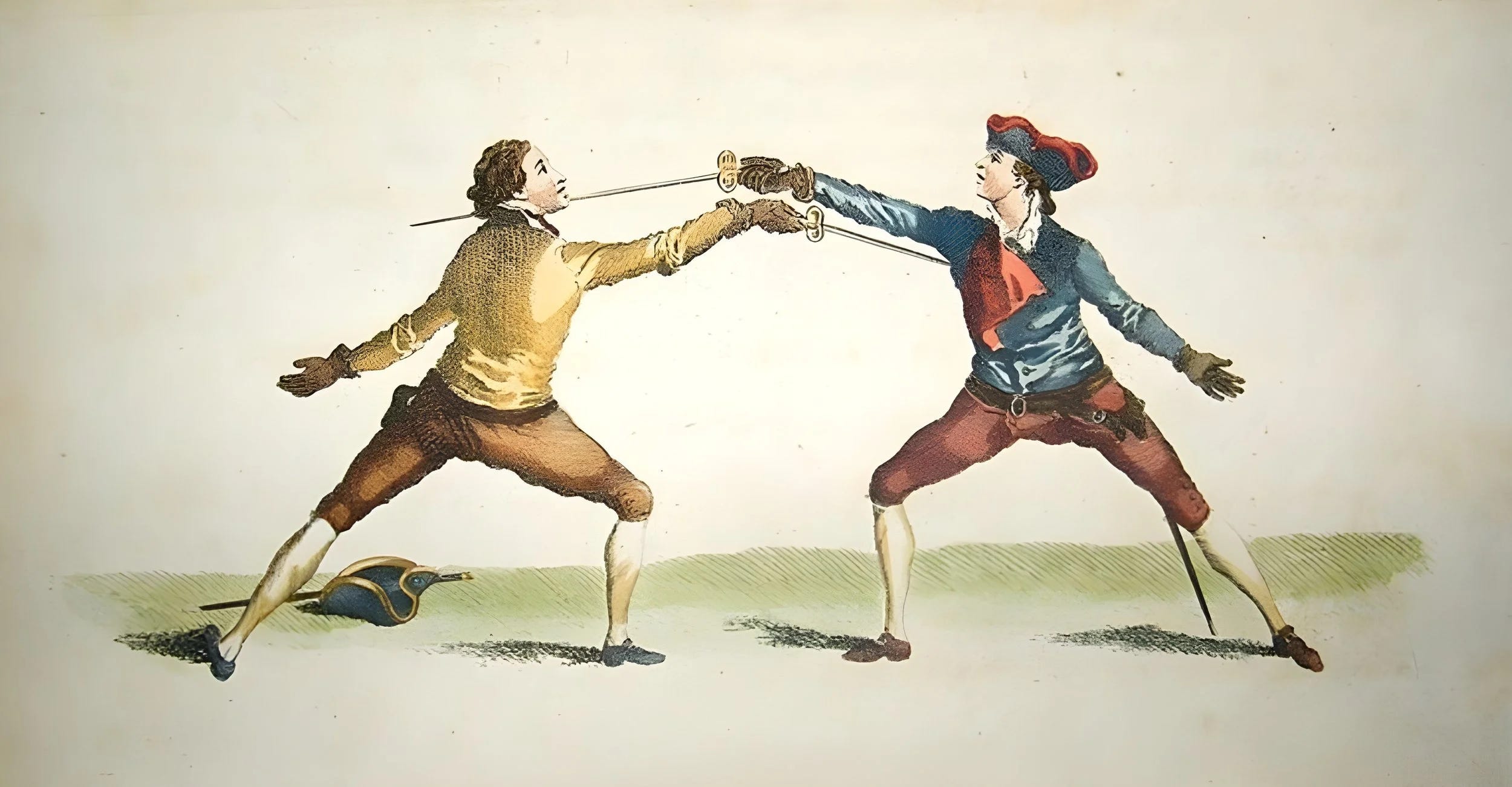
The duel is the forge of honour. There, it is battered. That of lesser men shall break. Yet, in victory and defeat, the honour of superior men emerges only sharper, better tempered, and gleaming. – The Reflections and Advice of a Humble Swordsman, by Charles-Marie Eppay, the Lord Eppay, published in 3,830.
‘How are they, these young men of Prolais?’ asked Charles-Marie as they stepped into the hall. ‘Is the grand duchy’s honour secure in this next generation of noblemen?’
Before them, a score of young men practicing at smallsword, each pretending not to have noticed their masters’ entry.
Commandant Saix shrugged his broad shoulders. ‘They’ll do. None to match you, my lord.’
‘Don’t flatter, old friend. If they lack, perhaps their teacher is at fault. What do you think? Should I dismiss you and find some other man to train these young sops?’
Saix opened his mouth in the facsimile of a smile. He was an excellent fencer and a better teacher – talents that had been wasted on the Grenadier Guards, where Charles-Marie had found him – but utterly humourless in spite of every attempt to correct the fault.
‘None to match you in your prime,’ Saix corrected. ‘But a few… aye, a few are more than serviceable. Two in particular.’
‘Which?’
‘Him, of the dark complexion.’ The commandant – a title he still insisted on, years after he left the army – nodded towards one of the boys.
‘Very dark,’ Charles-Marie replied in surprise. The youth in question was well proportioned, a look of strength without bulk. Under tight white stockings, a well-shaped calf. Black curls above a determined face. He practiced alone, dancing through his movements with grace and pride and not a whiff of exertion.
‘Nabkai mother. He has their look.’
‘But a nobleman?’ A silly rule, but none would think Charles-Marie’s the best, most prestigious fencing academy in all the world if they let in commoners, no matter the skill and reputation of its founder.
‘He’s Count il’Proveux’s son. You’ve heard the story?’
‘I have not.’
‘Years ago, before he was the count, he ran off to Nabkuun. Rumours of theft, covered up by the family. Then his father died. Then his brother. Upon hearing of it – how he heard at all is a mystery written only in the Apocrypha – he rushed home to claim the title and property, this boy in tow.’
‘A bastard, then. Which makes him noble only if his mother was too. Was she, by whatever standard they use on the southern continent?’
‘Perhaps not,’ said Saix. ‘The boy insists his parents were married. That, thereby, he’s high nobility, his father’s heir, and properly styled Viscount Proveux to boot.’
‘What does the father say?’
‘Little. He seems to grant the boy is noble, educated him as befits it, and wrote a letter ensuring me nothing should stop his son from attending your academy. At the same time, he’s found himself a young countess and would hardly claim to bigamy. He’s neither confirmed his son’s use of the courtesy title nor denounced it.’
‘Leaving the boy’s status rather uncertain,’ Charles-Marie mused.
‘Aye, but not his sword arm. He’s Nabkai of look, but Prolaisian in bearing. Whatever the law might or might not say, converse with him and watch him fight and you’ll feel his nobility.’
‘You appear quite the admirer, Saix. But two, you said. Where’s the second?’
‘The second, of course, is he of the greatest pedigree here. Lord Leofric il’Prolais, whose father is Count il’Saisan.’
‘The grand duke’s cousin. He’s fourth in line to rule us all, is he not? Making this boy fifth, or am I mistaken?’
Ridiculous that he could not remember the grand duke’s extended family, but Charles-Marie had spent so much time outside Prolais as he toured the world to display his swordsmanship.
‘Sixth: he’s the younger son,’ Saix replied. ‘Either way, a man of consequence. Of the two, I’d call him the lesser, but that might be nothing more than the influence of the year between their ages.’
‘And my nephew? How does he progress?’ asked Charles-Marie.
‘He’s unlikely to emerge undefeated from two dozen duels, or live up to any of your other feats, but nor shall he disgrace the Eppay name,’ Saix replied. ‘Truly, if not for the other two, he’d be the best we have.’
‘Pair them all up, then. Put them through their paces.’
At a word from their master, the youths froze. Saix rattled off names and they scrambled to find their partner.
Charles-Marie smiled, his hand gracing the familiar leather of his sword’s hilt as he remembered his own time sharpening his skills to a razor’s edge. Long past, it all was. He had not fought a duel, or even fenced in public, for half a dozen years. Those years, they had caught up to him, and it wouldn’t do to mar his reputation with an embarrassing defeat resultant only from limbs devoid of youthful vigour.
In his younger days, he had jumped at every opportunity to duel, not for honour but for the love of swordplay and to prove his skill. Now, he studiously avoided matters of honour. Scores of young swordsmen would, he was sure, jump at the opportunity to call him out – or force him to call them out – and so test themselves against the greatest fencer Prolais – nay, the world – had ever known. He refused to give them the opportunity.
A disturbance. Shouting. Charles-Marie’s fencing reflexes settled immediately upon two young men: the dark boy and, paired up with him, his own nephew.
‘I won’t disgrace myself by crossing swords with some common bastard,’ said Jacques, son of Charles-Marie’s older brother.
Quick as a viper’s lunge, the other boy’s steel was out, devoid of the piece they would affix to the end for sparring, to safely enclose the sharp point.
‘Give me my title, Master Eppay. It is not difficult: Viscount Proveux.’ The youth spoke Prolaisian perfectly, his face charmingly disarming. The sword, he held light, nonchalant, under Jacque’s chin.
Jacque pushed the sword away. ‘How dare you. When my uncle hears that you are merely the spawn of some foreign harlot, he’ll have you thrown out of here on your ear, and we will all laugh at your pretentions.’
The sword returned to its previous position. ‘My title, Master Eppay. Or I shall call you out.’
‘I don’t recognise your right to duel me, Thomas. And no other name shall I give you, for you have a right to none.’ Jacques leaned into the sword’s point, pressing it against his skin. ‘Harm me, and I’ll have you beaten like a dog.’
‘Gentlemen!’ Saix’s military bark echoed through the hall.
‘This is unbecoming,’ Charles-Marie said into the silence as he stormed up to the pair. ‘Put away your steel and fiery words.’
The sword disappeared and its owner turned and bowed.
‘Lord Eppay, this man might be your nephew but he is a dishonourable coward, unworthy of his blood.’
‘Uncle, please have this cur escorted out. I already told your lackey that he should never have been admitted.’
Beside him, Charles-Marie sensed Saix stiffen.
‘The commandant is your instructor, not a lackey. Show him, and your fellow students, some respect, nephew.’
‘He’s not a student, uncle. He’s base! Not worthy!’
The other boy, whatever his proper address might be, honed burning eyes into Jacques.
‘Satisfaction,’ he said. ‘I demand it!’
‘I tell you again, you have no more right to it than you do to that title you parade around.’
‘Then perhaps the flaw is not yours,’ the other retorted. ‘Perhaps it is in your father, who failed to instil either courage or etiquette into his progeny. Perhaps it is in your uncle, for allowing such a creature to pollute his academy’s reputation.’
‘Young sir,’ Charles-Marie cut in, anger rising. ‘Viscount Proveux I shall name you, for I have no reason not to. But here you go too far. Withdraw all insults and apologise, the both of you.’
‘You ask the impossible, uncle.’
‘If he does not withdraw, then neither do I,’ said Proveux or Thomas or whatever else it might be. It was to that boy that Charles-Marie turned.
‘You have insulted more than my nephew, you understand? You have insulted my absent brother and, I fear, you have insulted me. These insults at least, you will withdraw. You claim to be a man of honour, so prove it.’
The youth seemed not to have cooled in the slightest.
‘My lord,’ he said, ‘I have said no word that is not true.’
‘You insist upon an infringement of my own honour, and that of my family?’ Charles-Marie asked, hoping to keep the note of desperation from his voice. This was everything he had been avoiding for years.
‘If you choose to understand it that way, sir, then yes I do.’
The rest of the hall faded. There was but the two of them. Charles-Marie, still lean and agile, quick of wrist and of eye, but with a pain in his back and a stiff shoulder and that knee which had never fully healed. And the boy, who had two inches on him and a flawless physique and a reckless, angry bravado that radiated from his every movement.
‘Then it is I who must demand satisfaction.’ And damn his honour for forcing such a thing. But letting an insult pass uncontested would savage his reputation more than losing a hundred duels.
‘Uncle, don’t demean yourself.’
Charles-Marie grabbed Jacques and pulled him in close.
‘It is you who have demeaned yourself and this is the result.’
He released his nephew with a shake of the head.
‘Swords,’ Proveux said, taking away Charles-Marie’s last hope, that they might opt for pistols and so save him the possibility of losing in a contest of blades to the boy. But no, the boy wanted it, of course. Besting the great Lord Eppay would be, unlike titles and blood, an achievement none could take away from him.
‘Very well. Command Saix shall second for me. And for you?’
Proveux looked unsure. He glanced around the hall.
‘I do not… there is a man, perhaps. I would have to write to him.’
‘Better not to delay,’ said Charles-Marie.
‘I’ll second for him, if he’ll have me.’
All eyes turned to the speaker. Another tall boy – were they all so tall, these days? – though blond of hair and something familiar in the features.
‘Don’t be ridiculous, Lord il’Prolais,’ said Jacques. None paid him mind.
Of course. The scion of the grand ducal house. Yes, there truly was something of Grand Duke Abellon V’s deep blue eyes and full lips there, and in those light curls too.
‘Truly, my lord? You would second for me?’
‘I would, Proveux, if only to see you tested against the master.’
‘Lord il’Prolais,’ Charles-Marie said with a deferential nod, ‘you do understand that—’
‘That one of my station should not condone a practice His Grace my cousin has attempted so rigorously to stamp out? Yes, sir, I understand it. Nonetheless, I shall second.’
‘Very well. I trust you and Command Saix can make the arrangements.’ Charles-Marie spared his final look for his challenger. ‘I shall see you on the field of honour.’
‘I am gratified to hear it, sir.’
***
Early the following morning, mist still swirling above frozen grass. Half a league south-west of Tabresorteux’s Tessenquey Quarter. Charles-Marie had fought another duel on the same ground, a decade and a half ago. He couldn’t remember— no, it had been against that naval officer. The one who couldn’t hold his wine. What had been his name?
Saix’s hand on his shoulder forced Charles-Marie back to the moment. That long defeated man’s name didn’t matter. This man’s did. Or, no, no it did not, for that name might be Mr Thomas Davy or Lord Thomas il’Proveux or Viscount Proveux and it mattered not at all compared to what he could do with a smallsword.
The seconds came together. Lord Leofric il’Prolais wore an easy smile, mirrored on the face of his principal, and a coat of the boldest royal blue.
‘Might your principal withdraw the insult?’ asked Saix, loud enough that both principals could hear.
‘He shall not,’ il’Prolais replied. ‘He is resolved to blood.’
‘Very well then.’
The inspections began. Charles-Marie and his challenger discarded coats and waistcoats, leaving them shivering from the cold and nervous energy in their shirts. Well knowing that shaking muscles were liable to fail, Charles-Marie busied himself rubbing at them as the swords were brought out. Charles-Marie’s, it was found, was the longer by half an inch. il’Prolais declared it no issue. With Proveux’s advantage in height, it would render their reach almost even.
As the principals watched, the two seconds busied themselves with handkerchiefs and stones, marking out the field of honour. It created something not unlike a summoning circle, of the type witches of the bygone ages were alleged to have used. Something to trap terror and evil within. A circle of violence, where all other rules of conduct were to be forgotten, and promptly remembered upon leaving. It was a melancholy thought, like Charles-Marie had never been plagued with before in all his previous duels.
He forced himself to look at his opponent instead. The duel, he firmly believed, had already begun, though contained only to the mind for the moment. Many times had he won that duel of the mind so completely that, upon entering the circle, there was no longer a contest. His opponent had become so demoralised, so afeared, as to be sure of losing.
The young Viscount Proveux was jumping in place, arms relaxed, and seemed not at all to notice Charles-Marie’s gaze. He stopped, glanced at his opponent as if seeing him for the first time, and opened his mouth.
‘We could have chosen a warmer hour, my lord.’
‘Blame our seconds, young sir. Or the necessity to be covert.’
‘In truth, this Prolaisian sun is always too weak for comfort.’
‘Different to that you grew up under, I am sure.’
‘Aye. Hiltak of the golden rays favours their children.’
‘You keep your mother’s faith?’ Charles-Marie asked, surprised.
The boy shrugged. ‘I do and I don’t.’
‘This won’t make them respect you, you know. Win all the duels you like. Your faith, your colour, your birth will still be wrong.’
‘There is no law against my colour.’
‘Who mentioned the law? What we are about to do is against the law, and yet we do it. Law is for the rabble: it means nothing to a nobleman.’
‘And my birth is as legitimate as yours.’
‘That may be true, and it may not. What will you do, duel all who deny it?’
‘If I must. Duel them. Kill them.’
‘There is no honour in that.’
‘There is no honour in those who spit on my name. They can all be so many corpses beneath my blade, for all I care.’
‘And none of that will change the opinions of those who remain. Threat of violence, you see, only hardens hearts, never alters them.’
‘You may take the field,’ Commandant Saix interrupted. ‘There to battle until one or both of you can no longer continue, or until you can be reconciled in honour.’
‘Eynas Idarniso protect you,’ Charles-Marie said. Proveux returned the courtesy before taking his glove and blade from Lord il’Prolais.
The duellists took their places, no more than two feet separating the tips of their shining blades. They dropped into mirroring stances, though Proveux held his off-hand a little higher. A theatrical move; Charles-Marie had long believed such a position was inferior for maintaining balance.
‘To your guard. Prepared? Begin!’ shouted il’Prolais, and then there was no more time for thought.
Charles-Marie struck first. He always did. It was surprising how many were unprepared for it. But not this boy. He parried lightly and stepped forwards, closing the gap between them and flicking his wrist for a jab at Charles-Marie’s upper arm.
A twist brought the blade past him, exposing his opponent. Charles-Marie centred his blade and stabbed, aiming towards the youth’s shoulder. It should have run him through. Instead, Proveux arrested his own momentum with an enviable poise and threw himself back, raising his sword to Charles-Marie’s and knocking the attack away with a hair’s breadth to spare.
Or perhaps less than that. Proveux grimaced and took another step back and held his sword in a warding guard. His off-hand went to the shoulder and tarried there a moment.
‘Hit,’ said Lord il’Prolais. ‘Halt.’
Charles-Marie rose from his guard position and took a breath while his opponent spoke to the seconds. The boy was quick, agile, strong, and of no mean skill. First blood may have gone against him, but Charles-Marie had no delusions of the duel stopping there.
‘Viscount Proveux can continue,’ said Saix. Sure enough, he returned to the circle without even consulting the physician. ‘Back to your guard. Prepared? Begin!’
Lesser duellists would have hesitated, or overcompensated in protecting the little wound. Not Proveux. He lunged and Charles-Marie executed a perfect sixth parry but had no time to riposte as Proveux redoubled the attack, luring their blades low.
Another exchange and Proveux’s sword penetrated Charles-Marie’s guard and scraped along his glove but couldn’t bite into it. Charles-Marie forced him back with an attack designed to be deflected and took a step back to allow himself a moment of respite. Endurance, ultimately, would make the difference between them. The longer it all went on, the greater the advantage to the younger man.
‘You’re good for your age,’ the younger man murmured. Charles-Marie chuckled in spite of himself.
‘And you, for yours,’ he replied, seizing the moment of potential distraction to lunge, aiming high.
Taking a step to the side, Proveux parried and riposted, forcing Charles-Marie on the defensive. He took a step back, eying a gap in his opponent’s guard. Before he could exploit it, he cried out and fell to the ground, his knee aflame.
He couldn’t have been hit – it made no sense – but his instincts took over, smothering thought, and maintained a guard to knock away the next attack. It didn’t come. Proveux stepped back.
‘Halt,’ cried Saix from outside the circle. ‘What happened?’ he asked, approaching and helping Charles-Marie up.
‘Unsure,’ Charles-Marie said. ‘My bad knee gave out, I think. Wonderful timing.’
‘Can you continue?’
‘I must. How can I yield without a scratch upon my person?’
Nonetheless, Saix called over the physician, who fussed and clucked and bound the defective joint for whatever good that would do.
‘Back to your guard. Prepared? Begin.’
Proveux launched into a furious assault, and no less skilful for it. Charles-Marie parried three strikes in quick succession, fainting an attack of his own merely for the moment of respite it gave him. His footwork was slower. Less sure. Duels were won and lost with the feet just as often as with the arm. It did not bode well.
Bold and dexterous, Charles-Marie’s opponent slipped behind his guard until they were toe-to-toe and the lengths of their weapons an impediment rather than advantage. Each pulled back their sword arm, yet here age showed, slowing the movement by but a blink and yet that blink an eternity.
The sword took Charles-Marie in the leg. That same, already failing leg. The boy was ruthless and clever, then, as well as all the rest. The mark of the true fencing master. The thought passed in the moment after the sword bit but before the pain began.
‘Hit. Halt.’ Saix’s voice as he hurried over with the physician and helped Charles-Marie to hobble out of the circle.
‘How deep?’ Charles-Marie asked the physician inspecting and binding the cut. It was bleeding profusely, but in Charles-Marie’s experience even the smallest nicks could do that. The leg could still support his weight, he was sure.
‘Shallow enough, I think. Nonetheless, I would advise withdrawing.’
‘Advise or demand? May I continue or not?’
‘Against my advice, you may, sir.’
‘Then your advice is noted and disregarded. Commandant, help me up.’
Without voicing the opposition that was so clearly written on his face, Saix did as he was bid and announced that his principal would resume the fight.
‘Back to your guard.’ Charles-Marie grimaced as he dropped into the position. ‘Prepared? Begin.’
His footwork reduced to a shuffle, Charles-Marie let the thrill of the duel dull his pain as he parried the first attack and returned with his own. Seeing the boy’s sword rising to meet his own, Charles-Marie turned the strike into a faint and flanked Proveux’s blade to jab high. The boy’s reflexes saved him but he overcorrected – something to practice – and exposed a vulnerability.
Exploiting it, Charles-Marie kissed their blades together oh so softly, breaking the other man’s guard just enough to push through the questing point of his blade. It took Proveux on the outside of the forearm and scraped along, opening the skin in a long, neat line.
To his credit, the boy returned to his guard. Many a swordsman would have withdrawn the arm, leaving himself entirely vulnerable to a fatal follow up. Letting not a flicker of pain show, Proveux took two steps back and declared that he had been hit.
The halt was called and the two withdrew to their seconds. Charles-Marie accepted a few gulps of water and wiped the sweat from his face. The physician, he allowed to reexamine and readjust the bindings over his wound.
From across the length of the field of honour, he caught and held his opponent’s eye.
‘We could reconcile with honour, young sir. Few have lasted so long against me.’
Proveux smiled. ‘No, sir. Not for my life. I am ready to return to the field.’
The ritual once more: principals to their places, guard and prepare and begin, and then the flash of steel. Charles-Marie waited to receive the attack, wondering if the youth might be more cautious with his injured sword arm. No such luck. Yet it was slower, and moving the wrist caused some considerable pain if Proveux’s knotted brow was anything to go by.
Proveux lunged, forcing Charles-Marie back onto his bad leg. He took another step away in spite of the pain, turned on the ball of his foot, and launched himself forwards. Parry, riposte. Question, answer. Insult, retort.
Charles-Marie struck again and Proveux deflected it with a sidestep before attacking from his new angle. The older man’s slowing feet were showing and he was forced to weather another quick succession of attacks, parrying each one less convincingly than the last, his body twisted awkwardly.
Another strike. Charles-Marie managed to get his sword to it but without enough conviction to push it entirely away. Proveux lunged into it and took Charles-Marie in the breast, just below to collar.
Gasping, Charles-Marie heard Saix call the halt. The cut was deep. He had enough experience to know that without needing confirmation. The confirmation came nonetheless.
‘Sir,’ said the physician, ‘I would once again advise a withdrawal. This wound is serious.’
‘I must concur,’ Saix added. ‘You fought well. It is time to admit defeat.’
‘I’m not sure I know how,’ Charles-Marie admitted. ‘No. I cannot. Bind me up, tight as you can, and let me back at him.’
The principals returned, a note of surprise in Proveux’s eye.
‘Are you sure, sir?’ asked the young duellist.
‘Worry for your own person and let me concern myself with mine,’ Charles-Marie replied.
Saix called the resumption and Charles-Marie forced himself to strike first, beginning an offensive that used every trick he had learnt through years of experience to make up for the fatigue and pain – and oh was there pain.
The boy was slow to parry high. The fault of the injuries to his arm, no doubt. A low faint and then a strike at the vulnerability. Proveux’s feet saved him where his sword arm failed, moving off Charles-Marie’s line and countering with a vicious strike at the arm.
Charles-Marie had no time to parry but, blessedly, the attack caught his sword’s guard. Proveux followed up but Charles-Marie was prepared to block, and then again, yet was forced to give ground until he felt one of the perimeter stones against his heel.
Unable to step any further back, Charles-Marie struck, hoping to force Proveux back but the strike was weak and the young man stood his ground and parried. The slim chances of scoring a hit were growing slimmer. Was he merely waiting for the boy to kill him? Would that be better than marring his reputation?
Anger at the thought fuelled him for one last effort. Charles-Marie went for that same vulnerability he had noticed again. This time, it appeared, the youth was prepared for it.
The response was a wonder. A masterwork. Half a step back and to the side. A parry light yet forceful, like the wind. A flash of the wrist, faster than the eye could track. And a determined jab that slipped through Charles-Marie’s defences to bury the point into his forearm.
Charles-Marie collapsed, his sword discarded, clutching the wound.
‘Hilt,’ cried Saix. ‘Halt!’
All crowded around him and the physician set to work, tutting as he inspected and dressed the limb.
‘Can you move your fingers?’ the man asked.
Charles-Marie tried.
‘With pain,’ he replied.
‘Grip my hand.’
Again, he tried.
‘Little force. Sirs, the Lord Eppay is, I fear, unable to hold a sword any longer. He must withdraw.’
There was anger and there was acceptance and there was, though it made Charles-Marie feel half a coward, relief. He let his head fall back in exhaustion.
‘Thank you,’ said someone above him.
Charles-Marie forced himself to sit back up. It was the victor. He wore a daring smile and, as he knelt beside his opponent, brushed away the curls plastered to his forehead with sweat. Light, he seemed, and joyful. Unlike Charles-Marie had seen him thus far, and yet it seemed closer to his natural disposition than the grim anger and resentment.
‘Thank you,’ he repeated. ‘You taught me much, these past minutes. I am almost sorry to have forced your withdrawal.’
‘No, you’re not,’ Charles-Marie replied, hoping to show levity even through the pain. He inhaled sharply as the physician tightened a bandage. ‘This will give you a reputation. Use it well.’
The boy’s smile widened.
‘But it won’t matter in the end,’ continued Charles-Marie. The smile faded. ‘It’ll fascinate them, and perhaps reflect poorly on myself. But they’ll still see the southern bastard. Fight them all, kill them all, it’ll only make them hate you.’
‘You may be right,’ the youth said softly. And there was bitterness again, and something sadder too.
‘They’re silly, these prejudices. But they are the price we pay for an ordered society.’
‘If that is so, the price is too high, I think. Too ready accepted by those who do not have to bear them.’
‘Perhaps. But what can any of us do to change that?’
The young man shrugged.
‘Something,’ he suggested. ‘Everything.’
A brief glance and Charles-Marie saw something in the other man’s eyes. Something to make his heart sing and to grip it with terror. Something. Everything.
Lord il’Prolais came up behind the victor and clasped him on the shoulder and shared a laugh with him, and whatever Charles-Marie had seen was broken. But it stayed with him, and as the two boys – one half-foreign and of dubious lineage, the other with the blood of their sovereign ruler – walked away, he saw them showered in wreaths and he saw them consumed by fire.
Thank you for reading. It behooves me to mention that the character of Viscount Proveux, later to go by the name of Thomas Dumas, is inspired by the real historical figure General Alex Dumas, famous as the only black man ever to attain the highest rank in the French army. This story is inspired by two incidents from his early life: his fencing bout against the Chevalier de Saint-Georges and a racist attack he suffered at the theatre. If you enjoyed this story and would like to read more like it, feel more than welcome to subscribe.
In two weeks, I’ll be expanded on the theme of duelling to post a longform article on the early modern duel and the culture of honour that it existed within, and which was another large inspiration in this particular story. Two weeks after that, I think I’ll be returning to naval fiction with the story Fortune’s Favour, a cat-and-mouse chase on the high seas.
Looking for direction as you read through my stories and articles? Look no further:
Comments
Nothing yet. Say the first thing.
Sign in to join the conversation.