
Does anyone remember when, months ago, I wrote a note about duelling and the early modern honour culture? And how I promised a dedicated article about it? No, just me? Well too bad because here it finally is. Today, let’s learn about the early modern conception of honour and how duelling was integral to its maintainance.
Duelling is a distinctly early modern phenomenon, and specific to Europe and the settler colonies thereof. That’s not to say that people before that era and in other places didn’t fight each other one-on-one. They did, of course, and this may even have been the result of some insult or as part of some contest. But the early modern duel is something different, inherently tied up with a conception of honour that is distinct to that era and area.1
Honour was everything to a gentleman (that is to say, a man of the upper classes during this period). It was his sense of self; his sense of masculinity. To lose honour was to be emasculated and quite possibly ostracised from the society of other gentlemen. Maintaining honour was, therefore, paramount. More valuable to many gentlemen even than their very lives. In part, this was because a dishonoured man reflected poorly on those around him: his family, his friends, and any institution he was a part of. This further fed into a concept of collective honour which each man within an institution was supposed to protect, or it would lead to loss of honour for the entire institution and every man within it.
But what actually was honour? Mostly, it had to do with the respect of others along with masculinised ideals of physical courage and polite conduct. As such, it was most readily infringed upon by insults, usually of a verbal nature, and most commonly those calling a man’s integrity or bravery into disrepute. Physical harm was an even greater infringement. Once honour was infringed, it could only be maintained by forcing a retraction of that infringement. In the case of an insult, this meant an apology. In the case of physical harm, an apology by itself might not be enough. This is important: it wasn’t being insulted that caused a loss of honour, but instead allowing that insult to go unaddressed.
Another important aspect: only he who has honour can infringe on the honour of others. Being insulted by a woman, a child, or a man of the lower classes might be embarrassing, but it didn’t formally impact a gentleman’s honour. (Though, in the case of women, they had their own passive variant of honour which could be infringed upon by men, after which men close to the woman in question were expected to defend her as if their own honour had been infringed. The inherent paternalism of this idea needs hardly be expanded upon.)
But what if the aggressor (the term for he who creates the insult) refuses to apologise? What if the infringement goes far enough that even apology isn’t enough? In that case, the only way to maintain honour was through a duel.
That is what many people today misunderstand about the duels of this period; a misunderstanding that seeps into the media they create. Duels were not, at a fundamental level, about causing harm or proving superiority-at-arms. No, they were about maintaining honour.
By agreeing to a duel, both the aggressor and the injured party prove their bravery in their willingness to risk physical harm and death for the sake of their honour. This in itself is enough to maintain that honour. After that, who actually ‘won’, if anyone could be called the winner at all, was largely besides the point.2
For example, a gentleman gets insulted. He was called a cheat or a liar or a coward. His fidelity, or that of his wife, was questioned. All were common insults of the period. He challenges the insulter to a duel, they fight, but he comes off worse. His honour has been challenged and then he failed to win the subsequent duel, so surely he’s lost that honour, right? No, absolutely not. The very act of taking up arms to defend his honour was enough to maintain it, regardless of outcome.
As an extension of that, the point was almost never to kill. There were some infractions considered so extreme that only death might avenge them. In that case, a duel was usually to be avoided. Nonetheless, though all official rules either banned or discouraged them, duels to the death did happen. They were the minority, however, and most deaths from duels were accidental. (Even when you’re not trying to kill someone, stabbing or shooting at them often has that effect.) Normally, the point was merely to show a willingness to bleed for honour. We’ll see later what specifically this might mean in terms of when and why a duel was terminated and who might be said to have ‘won’ it.
The other misunderstanding is about how duels were actually fought. They were not free-for-alls. Instead, they were highly systematised, even ritualised, affairs with at times absurdly specific rules. There was never a single system — duels changed in nature over the period, differed from country-to-country, and there were always various distinct, even contradictory, rulesets — but nonetheless they did follow a system, be it a single ruleset or an amalgam of them. No matter the specific system, however, rules were strictly followed to separate a duel from a mere brawl.
Duels get at an interesting part of legal theory: can you consent to a crime in such a way that it stops being a crime? Often, consenting to something does indeed stop it from being a crime. Consensual transfer of property, for example, is a gift, where nonconsensual transfer is theft. If the supposedly aggrieved doesn’t actually regret what happened, then no real harm is done and thereby no crime committed. At least, according to John Stuart Mill’s ‘harm theory’, a legal doctrine rooted in his utilitarian philosophy.
Except, that’s a prescriptive doctrine that doesn’t describe the law as it actually works. Legally, a crime is not an infraction against an individual but an infraction against the State — conceptualised as the crown (in a monarchy) or the people at large (in a republic). Something being done to someone against their will does describe a large number of crimes, and yet not the totality of crime. Many systems have crimes you can commit against yourself, like taking certain drugs. In other circumstances, something done to another person, even with their consent, is nonetheless a crime.
Consenting to being attacked or being seriously harmed does not, in most circumstances and under most legal systems, stop that attack or harm from being a crime. The law is not omnipotent, however, and so if no-one reports a crime, no-one can be charged with one. Hence, in many circumstances, those consenting to such mutual harm would be able to get away with it. Yet, if egregious harm results — requiring serious medical care, say — it would be difficult to cover up and agents of the state might investigate. If death is the result, that’s murder or, at best, manslaughter. Consenting to dying is a slightly muddier issue in the 21st century but, in the early modern period, when even taking your own life was illegal, this was no defence against a murder or manslaughter charge. And ‘self-defence’ won’t cut it if you consented to being in that situation.
So, killing or seriously harming someone in a duel was always absolutely illegal, covered by the more general crimes of murder, manslaughter, and assault. However, as duelling became more common, the specific act of duelling was increasingly legislated against as well. Practicing at fencing was, of course, not illegal. Yet, if it could be proved that two people had specifically duelled, rather than just practicing their swordsmanship, then that itself was a crime regardless of the result. Even just issuing or accepting a challenge was criminalised. It was also often a specific crime in a military.
Why this was is obvious. The gentlemen of this period were duelling constantly, and it killed them at an alarming rate. In the military, it was even worse. Duelling was a frequent cause of death amongst military officers, undermining the overall quality of leadership within the military and leading to rivalries and grudges. Even where the political and military leaders of the time understood duelling — they were as immersed in the culture of honour as any other gentlemen — they nonetheless had to do whatever they could to stamp it out. (Though, in some cases, blind eyes were turned.)
Did this stop duelling? No, of course not, though it did have an impact. Legislation probably limited duelling to an extent and of course made it a more secretive practice. Nonetheless, the willingness even to break the law to defend honour was in itself something that further showed the gentleman’s willingness to place honour before all else. For some, the illegality added to the romance of the thing. And, besides, there was a widespread culture of silence to protect the practice as much as possible. ‘How did you get that wound?’ ‘Um… tripped? Yeah, definitely tripped. Into my sword. Twice. Yup.’ It was, nonetheless, an awful inconvenience, sometimes forcing duellists to cross a border before settling their differences (crossing state lines was common in the US, as was taking a boat to Calais for Englishmen), or go into exile abroad once the affair was concluded to avoid arrest.
Once there has been an infraction of honour, he whose honour was infringed may issue the formal challenge to a duel. This was referred to as ‘demanding satisfaction’ or ‘calling out’ the other man. At this point, and usually at any point up until the duel began, it was possible for the insulter (the challenged) to issue an apology and thereby avoid a duel while maintaining the honour of all involved. If the insult was a public one, the apology might have to be too — for example, it often had to be printed in a newspaper or posted at a gentleman’s club. However, it wasn’t always so simple.
First, it might be unclear who exactly had the right to challenge. This might be the case if two people had mutually insulted each other, for example. In such cases, most rules stated that he who was first insulted has the right to challenge. A physical attack was always treated much more seriously than a mere verbal insult, and so always took precedence. In the case of mutual blows, again the right of challenge usually went to he who was first struck. In these cases, apologies were usually required from both parties. No matter the insult, returning or escalating an insult was ungentlemanly, after all. One other case where the right to challenge might be unclear is if two people were not permitted to duel because, under many rulesets, people over and under a certain age were not supposed to duel. In such cases, in might be permissible for someone else (e.g. a son or brother) to accept or issue a challenge in their place.
Secondly, it might be unclear what the specific insult was. In the case of of the famous Burr-Hamilton duel, Burr called Hamilton out without citing a specific offence. The entire Federal political and journalistic apparatus had insulted Burr repeatedly during the 1804 election, but what specific insult he was objecting to and why he was calling out Hamilton in particular was unclear. If Hamilton had wanted to apologise, then, it would have been difficult to do so. Most duelling codes would not allow such a challenge to go ahead but, nonetheless, it’s clear from this example and others that if the principals wanted to duel, they would duel. In these cases of unclarity, it was generally up to the seconds — we’ll get to them soon — to sort out the details.
As a last note on challenges, though it’s more dramatic for challenges to be issued in person, they were also often issued in writing. If the insult didn’t take place in the presence of the insulted, but instead they heard about it after the fact, for example, then it was more common to have to send a challenge in a letter. Otherwise, an insult might take place in person but a challenge nonetheless not be immediately forthcoming. Someone might not realise they had been insulted or might not be sure if the level of insult necessitated a duel, and so would discuss with their friends before deciding whether to issue a challenge of not. In cases where a challenge might soon be issued, this was acknowledged by the interested parties informing each other of where they were staying so that the other would know where to send his challenge. Some rulesets actually preferred a written challenge to one issued in the heat of the moment.
Though you might not expect this, most duelling codes are primarily rules for this part of the duel: who can challenge who, over what, and in what circumstances. In contrast, the rules for the actual duel itself seem almost an afterthought.
At the start of the period, there was just one type of duel: the sword duel. However, as the period went on, two others were added: the pistol duel and the sabre duel.
What’s the difference between a sword and a sabre? If you know modern fencing, you’re already aware.
A sword (or, to use the French, épée) meant a straight, stabbing weapon without a sharp edge. Beginning in the 16th century and throughout the 17th, the primary civilian sword, worn at court and used for self-defence, was just such a stabbing weapon with a long, straight, thin blade and an elaborate guard to protect the hand. In English, it’s usually called a rapier, probably from the Spanish ‘espada ropera’. Espada, sword. Ropera, robe or dress. A dress sword, a courtly sword.
By the end of the 17th century, people got rather annoyed at carrying around such a long, unwieldly weapon. Daintier versions were created, much smaller in length. In English, they are creatively referred to as smallswords and were the primary swords worn at court, for self-defence, and by infantry officers for most of the 18th century. Modern épée fencing simulates fighting with these weapons (which is why a ‘hit’ only counts when landed with the point of the weapon) and, in the 18th and early-19th centuries, it is this, the smallsword, that was meant by ‘sword’. Before this, however, when duelling was less systematised, you could fight with whatever swords you wanted so long as both principals used similar weapons.
Earlier sword duellists, as well as using more varied weapon sets, often used another implement in their off-hand, intended to parry. This might be a buckler (small shield covering the back of the hand) or some form of long knife / short sword. Some manuals even show how a cloak might be used to parry. However, by the time of the transition to the smallsword, this practice had come to an end. Under some rulesets, the participants in a duel could agree to using their off-hand to knock aside their opponent’s sword (though not grab it). If this wasn’t agreed to, however, the off-hand was to be used for balance alone. (Using the off-hand to strike or grab was never permitted.) If this rule was broken, the infringing participant could have their hand literally tied behind their back to prevent further foul play.
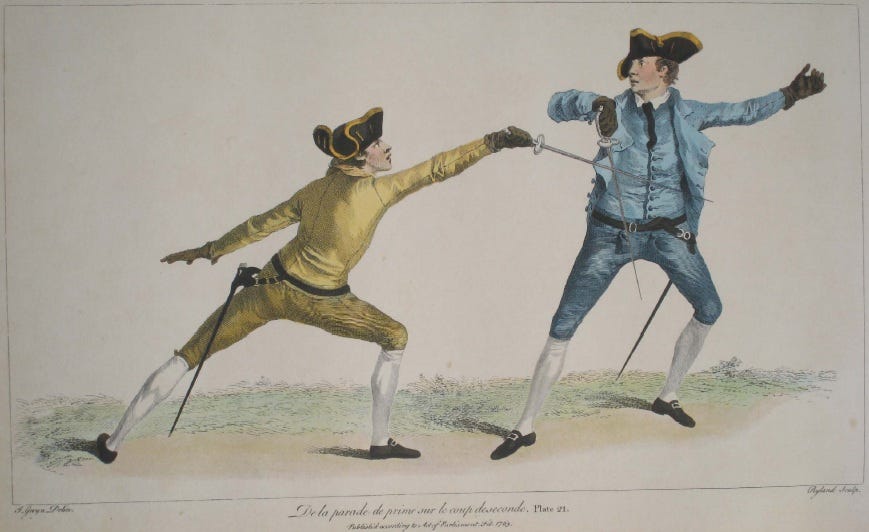
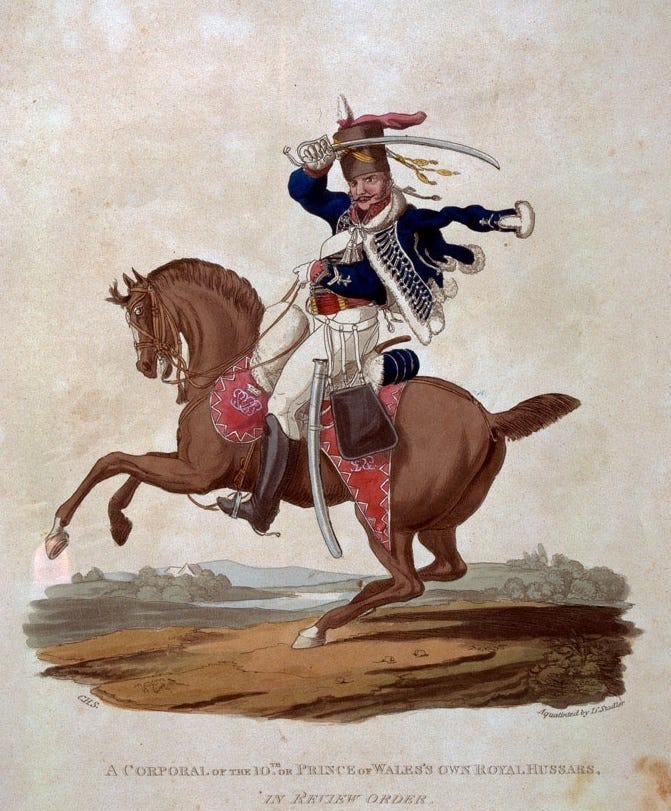
In contrast to a ‘sword’, a sabre, refers to a sword with a sharp edge, which can therefore cut/slash as well as thrust. Using modern sword-nerd terminology, a sabre is something more specific: single edged, curved, and with a sabre-style guard, meaning a knuckle-bow (a single bar of metal protecting the knuckles) or half-basket (a more elaborate guard which also protects the back of the hand).
However, in the late-18th and early-19th centuries, the term sabre usually meant any edged sword, including the types that we might otherwise call a backsword (any sword with a sharp front edge and a flat back one) or broadsword (otherwise called a basket-hilted sword, this term refers to swords sharp on both sides and with elaborate guards to protect the entire hand). Even more specific terms like ‘hanger’ and ‘cutlass’ would likewise be placed under the ‘sabre’ umbrella at the time. Again, modern sabre fencing reflects this, allowing ‘hits’ with both the point and edge of the weapon.
Swords and sabres used slightly different rulesets reflecting the differences in the weapons — that one had an edge, and the other didn’t — and cultures around them — in particular that the sabre was more of a military weapon and sword more of a civilian one. One obvious difference is that there were no rules for using the off-hand to parry in sabre duelling because, well, slapping away a sharp edge is a very, very bad idea if you still want to have a hand afterwards.
And then there’s pistols, and frankly I’m disappointed that I have to explain this to you. It’s a thing you hold in one hand and it fires a bullet when you pull the trigger. More specifically, by the time pistol duels started to be opted for in the 18th century, these were flintlock firearms. That is, they used a spring mechanism to force a piece of flint against a piece of steel when the trigger was pulled. The resultant sparks ignited the gunpower, causing an explosion and forcing out the bullet.
By this point, gunsmiths had figured out rifling (spiral grooves inside the barrel that make the bullet fly straighter) but rifled pistols were strictly banned in duels because their increased accuracy made them too dangerous. (Because, again, the point wasn’t to kill.) Secretly bringing a rifled pistol to a duel was a great dishonour, yet some tried to get away with it. Pistols were inspected for rifling by the seconds — more on that later — but DIY rifling, called scratch rifling, was less deep and more likely to pass inspection. Whether scratch rifling actually made a weapon more accurate, though, is debated. Regardless, it was the general custom for one side to provide both pistols and for them to be, wherever possible, a matched set so as not to give either principal an advantage.3 With swords or sabres, on the other hand, both principals could usually use their own weapon if they wanted, though they would be inspected to ensure they were of a reasonably similar length and style. This was easiest if both principals were officers in the same military regiment, as then they could use their regimental pattern weapon.4
One principal got to choose the weapons — under some codes that’s the challenger and, under others, the challenged. While this was his right alone, there was nothing stopping him from deciding in consultation with his own second, that of the other principal, or even the other principal himself. Even once he had decided on the weapons, the other party may have the right to refuse them. Civilians, for example, might have the right to refuse sabres (they being, as stated, primarily a military weapon). Disability may also allow the refusal of a certain weapon set: men missing limbs may refuse sword and sabre; those missing eyes may refuse pistols. Sometimes, principals brought multiple weapons: starting with the pistols but potentially moving onto swords or sabres if neither could land a hit.
I’ve already used the terms, so let’s explain them. The principals are the duellists themselves — the insulter and the insulted who have decided to fight a duel about it.
Assisting them are their seconds. The principals just have to turn up and fight. All the rest is the seconds’ job. When a challenge to duel is issued, both sides will immediately name their seconds and, if the principals haven’t already agreed to it, it is the seconds who will discuss the time, place, method, and rules of the duel. Which side got to pick which depended on the ruleset. Under some rulesets, a particularly severe offence (like a physical attack) allowed the challenger to name all of these.
Seconds bring and inspect the weapons, and load them in the case of a pistol duel. They additionally act as go-betweens for their principals. If one side wishes to withdraw, or to formally apologise (potentially averting the duel), or if anything needs to be altered, all of that goes through the seconds. Some codes even required that the seconds seek an apology or amicable settlement from the principals, only progressing to a duel if this could not be achieved.
During the duel itself, the seconds act as referees. They inspect the principals, ensuring they are not concealing armour or a hidden weapon. In a pistol duel, they mark out the ground (where the principals will stand, or start, depending on the method) and say when the principals can fire. In sword and sabre duels, they announce when the duel can commence, a break should be taken, their principals have been hit, and if their principals can no longer continue. No matter the duel, they keep a watchful eye for rule breaking and at any time may stop the duel to address an infraction.
Additional people are also expected to attend. Some codes required two seconds per principal. Some required one or two witnesses per principal. Even if one isn’t formally required, it’s always good to ensure a physician is there to administer first aid. (Actually, there were usually two doctors so both principals could be treated simultaneously.) Getting all these people to the field of honour (that is, where is duel is to be fought) is, once again, the seconds’ task. In some earlier rulesets, seconds might even fight alongside their principals — though in such cases further seconds might be required to act as referees.5
The earlier in the period, the more common the sword duel. The later, the more common the pistol duel. But, throughout, similar rules were followed.
For sword and sabre duels, the first task would be to mark out the duelling ground. This might be done with handkerchiefs weighed down by stones. Next, preparing the principals. As already stated, they were checked for armour or other protections and, to avoid any advantage that heavy clothing might give, often duelled in their shirts or topless. (Which had the added benefit of protecting the principals’ expensive coats — clothing being a much larger expense in those days.) The only explicit protection they were allowed was a heavy glove on the sword hand. If neither principal had a glove, or they agreed not to use them, they were nonetheless always permitted to use something to protect the hand, even if that was merely wrapping the cord on the end of their pommel around their knuckles, or doing something similar with a handkerchief. The only rule there was that no part of the cloth could hang down, as their opponent’s sword might get caught on it.
Once the duel began, it was generally fought until one or both principals either could not continue or voluntarily withdrew. ‘First blood’ was not the usual end point, though that depended on the wound: a small nick could be ignored, though a larger cut might cause a withdrawal. Remember that the point was to maintain honour and prove that you were brave enough to risk your life, which meant fighting until you had given a good account of yourself. The most common cuts were small ones to the forearm, which usually would not end the duel. On the other hand, a deep stab to the torso most likely would. Naturally, the line between a small cut and a mortal wound is often a thin one, and one might even be mistaken for the other. Though not intended to be, the outcome would therefore not infrequently be deadly.
The seconds, with either a cane or sword in hand, would raise the implement and call a halt when the principals were hit, stepped out of the field of honour, dropped their weapon, or broke a rule. This could lead to distinct ‘rounds’ of short action, followed by periods to catch the breath, get any wounds treated, and reset, not dissimilar to modern boxing.
In general, the conduct for sword and sabre duels was fairly straight forward: stab at each other until someone gives up. By contrast, the pistol duel.
There are infinite ways to conduct a pistol duel. How far apart should the principals stand? How many shots should they fire? When and how should those shots be fired? And when should the duel end? For obvious reason then, pistols duels required far more rules than sword and sabre duels.
The most common form of pistol duelling in modern media depicts the principals as starting back-to-back, walking a certain number of paces, then turning to fire as quick as they could. This method isn’t listed in any duelling code I’ve ever found, so my assumption is that it is either of dubious historicity, or was very uncommon, or had fallen out of use by the time our surviving codes were being compiled. Personally, I think it was just made up, though I’m happy to be proven wrong.
In reality, the seconds would measure out the points from which the principals would fire, marking out the field of honour. How far apart the principals stood was up to them but there was a minimum distance separating them to limit the danger of the duel. How far? The influential French system established by the Comte de Chateauvillard in 1836 always maintains at least 15 paces between the combatants. On the other hand, John Lyde Wilson’s The Code of Honour (1838) allows just ten paces, but defines a pace as three feet (a little longer than the usual definition of two-and-a-half feet). This gives an overall minimum distance of 30 feet or, to use a real measurement system, a little over nine meters. If we assume Chataeuvillard was using something closer to the more conventional definition of a pace (despite being — presumably by no fault of his own — French), then his 15 paces are 37.5 feet or about 11-and-a-half meters.
The most common form of pistol duelling had each principal stand at their mark, an agreed number of paces from each other, and then fire an agreed number of shots (anywhere from one to three each) at each other. They might fire simultaneously or one after the other after drawing lots to determine who would fire first. After each pair of shots, the principals could agree to reconcile and end the duel but, if not, the seconds would reload the pistols (seconds always load for their principals, and were allowed to inspect each other doing so) and hand them back to the principals. On the other hand, if either was hit, that was also the usual end of the duel. If one was hit but had yet to discharge his pistol, he might be permitted to do so, assuming that he could perform this act in a timely fashion. (One code gives a wounded principal two minutes to return the shot before the duel is terminated.) Misfires, not uncommon with flintlock pistols, were counted as shots.
An interesting variant of this system, little used in the Anglosphere but more popular on the continent, was the duel ‘at pleasure’, also known as the barrier duel. In this system, the principals, upon being told to begin, would walk slowly towards one another. At any point, they were allowed to stop and fire. Upon doing so, however, they had to hold their place. Their opponent could then walk right up to their mark — the end of their line, separated by a minimum distance from their opponent’s mark — before firing. He who fired first could potentially avoid being shot at entirely but, if he missed, gave his opponent complete freedom to close the gap and take aim in their own time. There were even variations on this variation, like one in which the principals walk, not directly towards one another, but along parallel lines, starting at opposite ends. The principal who fires first must once again stand still, allowing the opponent to walk until they are directly opposite (though still separated by the distance between the two lines) before taking their shot. Another, listed by Chataeuvillard, has the principals approach in a zigzag rather than straight towards one another, making it harder to land a shot as you walked.
The idea of standing calmly while someone shoots at you seems a little unhinged, and yet the pistol duel became only more popular as the period marched on. Unlike with swords or sabres, where a withdrawal with honour could only come after one or both principals had sustained serious injuries, it was entirely honourable for both sides to walk away from a pistol duel without a scratch. Having fired the agreed number of shots, the duel would end no matter the outcome. And, if either principal was hit, no matter how superficially, the duel would end (perhaps with them returning fire first).
A possibility that this opened up was to intentionally miss. After all, duels aren’t about winning but about proving a willingness to duel. If both sides felt the need to duel, but equally did not want to actually harm each other, then why not agree to both fire wide? This was called deloping and seems to have been a common practice during the heyday of the pistol duel. Though, of course, it can be difficult to ascertain when someone has intentionally deloped as opposed to when they have merely missed. As an example, the Wellington-Winchilsea duel, which was the second (and last) example of a sitting British prime minister engaging in a duel. The Duke of Wellington felt compelled by honour to call the Earl of Winchilsea out for various very strong and public political attacks. Winchilsea, for political reasons, did not want to back down and apologise but nor did he actually want to harm Wellington, nor indeed be harmed by him. Hence, they were forced by the rules of honour to duel, despite neither really wanting to, and both fired well clear of the other man.
To round off, let’s discuss a few lesser known duels. These are all from The History of Duelling Volume 2, by J. G. Millingen, which is a compilation of duelling accounts complied largely from letters, newspapers, and court transcripts, skewed towards the late-18th and early-19th centuries. I hope they help show the reality of duelling and the kind of offences that led to it.
The Earl of Lonsdale and Captain Cuthbert, 1792
Cuthbert, a captain in the guards, ordered a road closed. Londsdale, wishing to pass through it in his carriage, shouted, ‘You rascal, do you know that I am a peer of the realm?’ Cuthbert replied, ‘I don’t know that you are a peer; but I know you are a scoundrel, for applying such a term to an officer on duty; and I will make you answer for it.’ At the subsequent duel, they each fired two pistols but neither was injured and they settled their dispute.
Colonel King and Colonel Fitzgerald, 1797
King’s 16-year-old sister eloped with the already married Fitzgerald. King challenged Fitzgerald and they exchanged six shots at a distance of just ten paces without injury. Still unable to amicably settle, they agreed to return the next day but were arrested before they could do so. The story takes a more tragic turn after their release: the King family went to Ireland but Fitzgerald (encouraged by a letter from Miss King) followed them. There, he was confronted again by Colonel King, they struggled over a pistol and King’s father, the Earl of Kingston, came across them. Fearing for his son’s life, he shot Fitzgerald dead.
Lieutenant-Colonel Montgomery and Captain Macnamara, 1803
While riding separately, the two men’s dogs attacked each other. Not seeing Macnamara, Montgomery declared he would ‘knock down’ the owner of the other dog. Macnamara took offence to this and they agreed to duel. Both their shots hit, Montgomery died, but Macnamara survived and was put on trial for manslaughter. Nonetheless, the jury returned a not guilty verdict. (Which appears to be a case of jury nullification, as there’s no question as to whether or not he actually did the crime.)
And, while I’ve lambasted duels as sometimes portrayed in fiction, it would be remiss of me not to mention some great examples.
First, obviously, Pierre’s duel in War and Peace. It’s an example of a barrier duel and perfectly plays with the tension of the two walking towards each other, gauging when to fire. The insult — the allegation that Dolokhov is sleeping with Pierre’s wife, something he has to respond to even though he and his wife don’t get on at all — also gets at this being fundamentally a matter of honour, and that honour is of such critical importance that even mild-mannered and enlightened men like Pierre feel required to participate in its precepts. Of course, it helps that Tolstoy was writing at a time when duelling was still practiced and so understood this culture personally.
For a more modern example, the novel HMS Surprise by Patrick O’Brian. It’s the third in the Aubrey-Maturin series but, if you haven’t read them, you should. Again, we see the kind of situation that leads to a duel and how a duel was carried out. We also see how, though a duel wasn’t supposed to be about killing, it could be used by men who genuinely did want to murder each other. Others might look askew at such duels, but they did happen, of course. This is just one of the thousands of reasons to read one of the greatest series of historical novels ever written.
I’ve also tried my own hand at writing duels. You can read my latest attempt here:
Honour's Forge
·
Feb 5
A tale of honour and of swords. Of an aging master and a young prodigy. And, above all, of duelling.
Duelling is of critical importance in my WIP fantasy novel, which I’ll be querying imminently. Two pistol duels set off the plot, one in which a king is killed and another that permanently injures our main character and forces him into the rest of the novel. The latter is even a duel ‘at pleasure’, one of the novel’s many nods towards War and Peace. Hopefully one day I’ll be able to share it with you all.
Thank you for reading. My next short story, releasing in two weeks on Thursday 5th March, should be Fortune’s Favour, a cat-and-mouse chase on the high seas. Two weeks after that, my next non-fiction will be a discussion of worldbuilding governments in fantasy and sci-fi — I have many, many opinions.
Unsure where to continue with my writing? Look no further:
Which isn’t to say that other regions and eras didn’t have their own, at times similar, concepts of honour.
That’s not to say that no-one cared about skilled swordsmanship. Victors of many duels and fencing bouts could become famous for their feats, of course. Sometimes, a duel might even been contrived by one party to test themselves against another duellist. Nonetheless, at a fundamental level, this was secondary to the primary reason for duelling, which was to maintain honour.
This wasn’t difficult as pistols during the period were often sold in a matched pair, or ‘brace’. Pistols were so slow to fire that it was common to carry two, and so they were sold that way too. Saddles, for example, might have a holster on each side to accommodate. This was common both for cavalrymen and for civilians travelling by horse who might carry firearms for self-defence purposes.
Officers had to purchase their own weapons, but ensure they conformed to the regimental pattern. The same pattern was frequently used by many regiments in the same army. All heavy cavalry, for example, might use the same pattern of sabre.
One of the last cases of this was the Hamilton-Mohun duel of 1712. The Duke of Hamilton killed Lord Mohun but, seemingly near simultaneously, Mohun’s second then ran Hamilton through. Both principals therefore died, Hamilton’s second was found guilty of manslaughter, and Mohun’s fled to Germany.
Comments
Nothing yet. Say the first thing.
Sign in to join the conversation.