
I’ve been away from the newsletter for a while. Puddock Hill, in any case, remains buried in snow and ice preserved temporarily by the extended deep freeze.
In their minds’ eyes at this point folks in the Northeast might be conjuring images of Fimbulwinter, the unbroken gelid final season of Norse mythology that ushers in Ragnarök, the end of the world. (By the way, that prediction ultimately involved fire and flooding. Sound familiar?)
Speaking of which, the polar vortex that brought the cold has often been attributed in popular media to climate change, but that’s far from certain, as expounded upon by scientist Zeke Hausfather in The Climate Brink. In fact, the cold snap is probably happening in spite of climate change, not because of it. “Sometimes it just gets cold,” he says. We’re not past the point of occasional reversions to normal.
On the bright side, the cold may set back some invasive insects like stink bugs (from Thailand) and spotted lanternflies (from China, India and Vietnam), and the snow pack, so rare now in our part of the world, should help protect shallow roots from the single-digit nighttime temperatures we’ve been experiencing.
A few items that crossed my feed have me thinking about the soil under that snow and ice.
One of the overarching revelations I had when studying for my masters in environmental studies was that everything that sustains and comforts humans comes in one way or another from the earth. (This was a revelation to me, not necessarily a revelation to others who may have understood this forever.) From the stone of our patios to the porcelain of our bowls to ubiquitous plastic and fossil energy, it all comes out of the ground. The food we eat, too, of course. And the plants we grow for beauty or those that continue to grow wild in nature.
Like all foundational statements, the fact that nearly everything comes out of the ground is so basic that it’s easy to overlook. But we do so at our peril. Scientists have only begun to understand the complexity of microbial and other life forms in soil and their role in sustaining healthy forests, meadows, and gardens. Yet they have been under assault for generations from the plow and from the poisons we allow to seep into the ground.
One pertinent reminder during this icy winter came from a professor at Villanova University, writing in Fast Company about our overuse of salt. He references a study by the Stroud Water Research Center in Chester County, PA that “found that chloride concentrations in southeastern Pennsylvania streams remained higher than levels recommended by the Environmental Protection Agency not only after winter snowfalls but also in many cases during some summer months—showing salt persists in watersheds year-round.” Watersheds are made up of soil, among other things.
“Once there,” he continues, the salt “can have a profound impact on fish and other aquatic life. This includes a decrease in the abundance of macroinvertebrates, which are small organisms that form the base of many freshwater food webs, and reductions in growth and reproduction in fish.”
If you click through to the article, you’ll find some advice on how to limit these impacts while keeping walkways safe.
In December, the journal Nature Communications published a study of European soils that reinforced the importance “of soil microorganisms in supporting multiple ecosystem functions (multifunctionality).” It found “the highest multifunctionality values in grasslands, woodlands, loamy and acidic soils, and temperate humid regions, and the lowest in croplands, alkaline soils, and drier regions.” It concluded: “Our findings highlight that ecosystem multifunctionality is jointly shaped by soil properties and microbial communities.”
A related study of farmland soils in England found the “antiparasitic ivermectin had the highest reported concentrations” in the soil of the 22 farms studied, perhaps not surprising given that animal husbandry takes place there. Those concentrations were followed, in order, by “the antibiotics oxytetracycline, ofloxacin, enrofloxacin, and plant protection products atrazine, and diazinon. Non-target screening identified 524 chemical entities… Prevalent contaminant classes included pharmaceuticals, plasticisers, polymers, fungicides and surfactants… Dominant pharmaceuticals included antibiotics…steroids…anticancer…and antipsychotic metabolites…”
(“Plant protection products” seems like a strange, unscientific way to describe atrazine, an herbicide that kills plants, and the pesticide diazinon, which is so toxic to birds and fish that residential use was phased out twenty years ago.)
What we use above ground ends up in the earth. And it follows that if we kill off the microbes in the soil or inhibit their function, the web of life above ground will suffer.
Our long list of concerns as backyard stewards includes an admonition to avoid putting poisons of any kind into the ground or water in our vicinity. A coating of snow won’t protect the land from our mistakes.
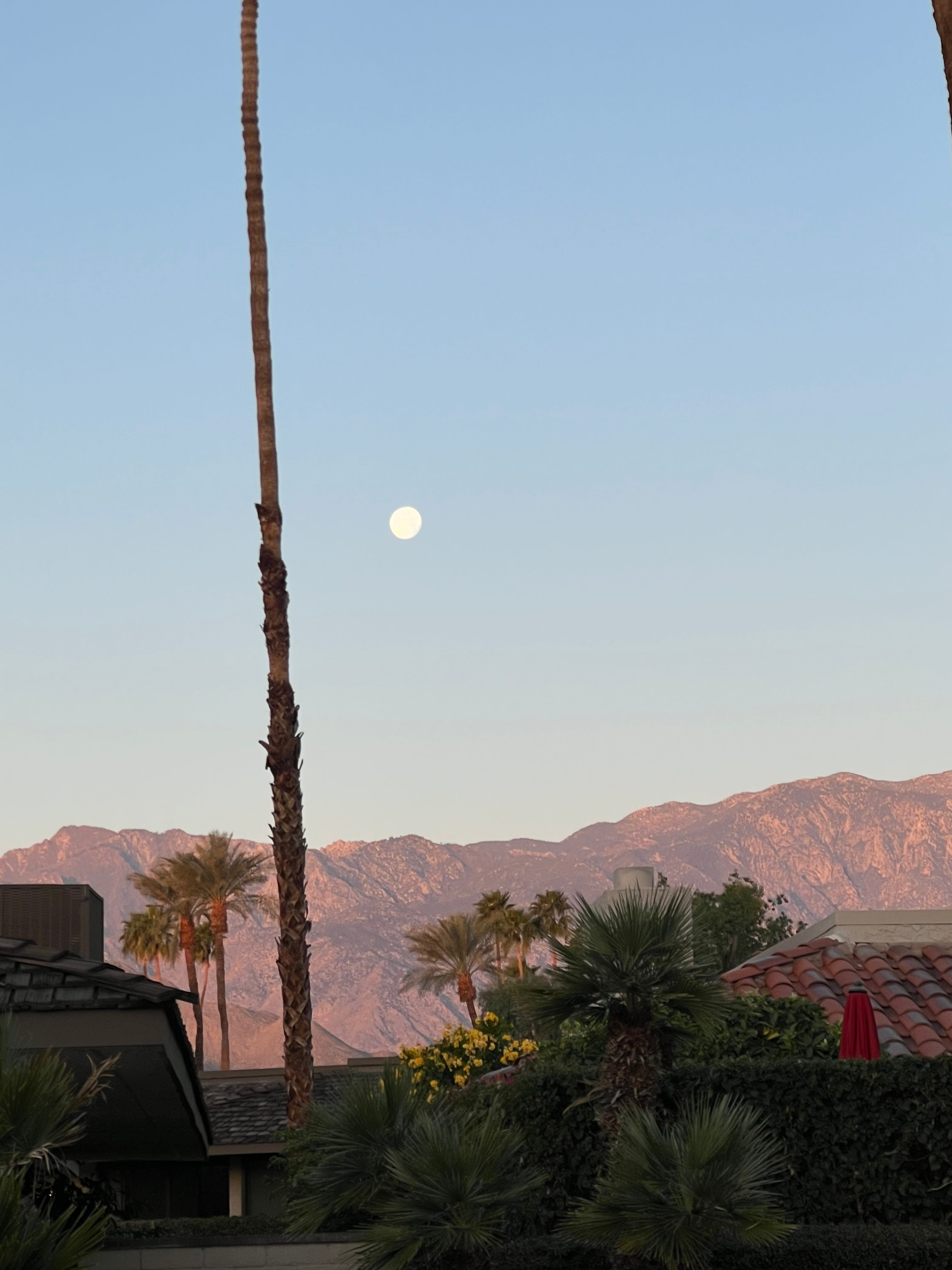
Far from the cold, here’s a picture of the morning moon over the desert:
Comments
Nothing yet. Say the first thing.
Sign in to join the conversation.