
To some people, in these fraught times, altruism seems so yesterday. But what if the best argument for promoting nature in our own backyards was a selfish one?
When ecologists argue for preserving natural systems, they often fall back on the value of the “ecological services” that nature provides to society, from cleaning our water to lowering ambient temperature on hot days.
Backyard Stewardship is a reader-supported publication. To receive new posts and support my work, consider becoming a free or paid subscriber.
In fact, according to Inside Climate News (via Mother Jones), “a growing number of economists and ecologists around the world are helping decision makers understand the full extent of the contributions to local and national economies made by plants, animals, or entire ecosystems—and what’s at risk financially if they are lost.”
“In many decisions, nature has been treated as essentially worthless or of negligible value when compared to other kinds of human activities,” says ecologist Lisa Mandle. “Natural capital accounting is an effort to correct that and to shine a light on the many different ways that nature and biodiversity supports human well-being and the economy.”
I have always had a problem with the idea of judging nature based upon its payoff to humans, not because the argument lacks weight but because it plays to our speciesism. It implies that people are so self-centered we can’t just let wild animals be because they are—we can’t protect habitat simply because it provides a home for other species—but only when we get something measurable out of it.
Indeed, the article quotes Casey Camp-Horinek, an elder of the Ponca Nation of Oklahoma and chairwoman of the Indigenous Council of the Global Alliance of the Rights of Nature as saying, “We do not own anything that is called Nature, we are Nature, and to participate in the commodification and financialization of our Relatives is an affront to the Natural Laws and quite simply wrong.”
If it takes financialization to convince people to do the right thing, the ecologists say, then so be it. But as more people detach themselves further from nature than ever before, arguments are arising to prove how natural systems provide something more than societal benefits. They promote individual wellbeing, as well.
Those of us with access to nature can find sanctuary there—benefits to our mental and physical health—and if you’re a backyard steward you don’t have to go far.
In January, a study published in the journal Environmental Epidemiology found that “higher percentages of visible trees” in cities was associated with lower rates of cardiovascular disease and, importantly, other kinds of green space such as lawns and shrubbery had the opposite impact, actually slightly increasing cardiovascular disease incidence. “Additional adjustment for diet, alcohol consumption, BMI, air pollution, population density, Census Division, Census Region, and noise did not change estimates substantially.”
Here’s how the scientists described what they believe drives their findings:
Potential mechanisms for trees to decrease CVD [cardiovascular disease] risk include decreasing stress; buffering from noise, air pollution, and extreme temperatures; and offering a setting for physical activity and social interactions. More specifically, visible tree canopy may directly mitigate stress via psychophysiological responses—including reduced cortisol levels and improved autonomic nervous system regulation—thereby lowering CVD risk. Additionally, trees excel at buffering environmental harms, providing protection from noise, air pollution, and extreme temperatures and tree-lined streets enhance neighborhood walkability and social cohesion, encouraging physical activity and strengthening social support networks, both of which are protective against CVD.
Other factors at play may include “improvements in sleep quality, reductions in inflammation, mitigation of urban heat, or exposure to bioactive compounds (e.g., phytoncides).”
In contrast, the idea that the presence of lawns and shrubs in an urban environment actually increase cardiovascular disease surprised the study’s authors, who postulate that several mechanisms that “might explain these unexpected harmful associations for grass and other green include the increased use of pesticides; air quality impacts through mowing; grass pollen; lower cooling capacity compared with trees; lower capacity to filter noise and air pollution; lower levels of biodiversity; or that these factors are a proxy for sprawl or lower walkability.”
If this explanation is correct, it suggests, among other things, that shrubs and meadows being cared for under the principles of backyard stewardship, which discourages mowing, limits use of pesticides, and promotes native biodiversity, would NOT contribute to cardiovascular disease, and in fact may have the opposite effect. The basic observation is pertinent, however: Tree canopy promotes good health.
Supporting the gist of this study, Nature reports that a Japanese immunologist “has detected changes to the nervous, immune and inflammatory systems after people spend time in the forest.” Perhaps this explains why Italian scientists documented that “in areas with more trees per capita, the number and severity of COVID-19 cases [during the pandemic] were lower than in places with fewer trees, even when accounting for differences in human population density.”
The aromas present in forests “come from phytoncides — biochemical compounds that plants’ immune systems emit to protect themselves from insects, bacteria, protozoa and fungi. And the human immune system has been shown to react positively to them.”
“The main components of phytoncides are terpenes, which make up the majority of biogenic volatile organic compounds (BVOCs).” And “Studies have shown that some terpenes have antibacterial, antifungal and antiviral properties.”
There are psychological benefits, too. An article in Psychology Today entitled “The Green Experience: Why You Need Nature” discusses our “drive to seek out nature” and its restorative effects. These can be so profound that “a series of studies in which adults were asked to name the places that were most significant to them in their childhoods” found that “an overwhelming majority of the participants selected outdoor settings such as parks, woods, or seashores as the most significant places of their youth.”
Imagine constructing a patch of ground using backyard stewardship principles that might go on to have such an impact on your children and grandchildren.
A second Psychology Today article takes this a step further—and perhaps a tad beyond the portfolio of a backyard steward—advocating for personal Wild Resilience, “using the wild as a real-time laboratory for emotional growth, clarity, and self-trust.” Wild places, the author argues, offer the opportunity for a reset from the stresses of modern life by allowing us to find safety, joy, awe, and connection.
The article goes on: “This isn’t just a feeling; it’s a practice. A systematic review found that time in nature is linked to lower stress, improved mood, and better health outcomes—including reduced neurological and cancer-related risks.”
By promoting nature in our own backyards, we can find awe in the little things, such as watching busy insects, observing tree growth, or listening to birdsong. A study conducted in Germany that measured heart rate, blood pressure, cortisol levels, and self-assessments of feelings of wellbeing concluded that “a walk in nature is beneficial in and of itself – but the sounds of natural birdsong can further boost these wellbeing benefits, especially if you make a concerted effort to pay attention to it.”
All these benefits may accrue to the backyard steward. But if that’s not enough for you, do it for the greater good.
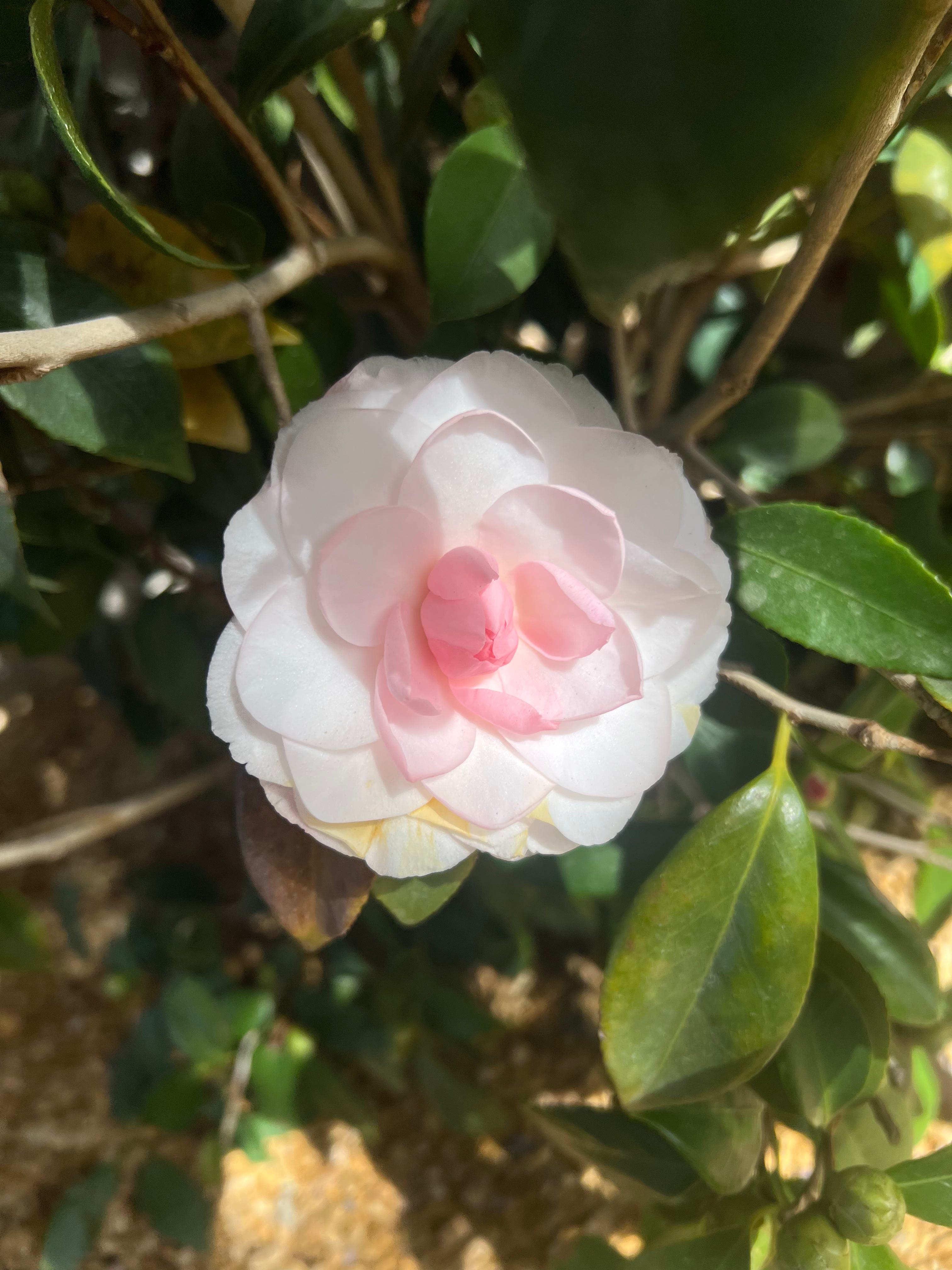
With Puddock Hill buried in snow (eight more inches this week), let’s enjoy this perfect non-native camelia flower we have growing in California:
Backyard Stewardship is a reader-supported publication. To receive new posts and support my work, consider becoming a free or paid subscriber.
Comments
Nothing yet. Say the first thing.
Sign in to join the conversation.