
By Achim Steiner
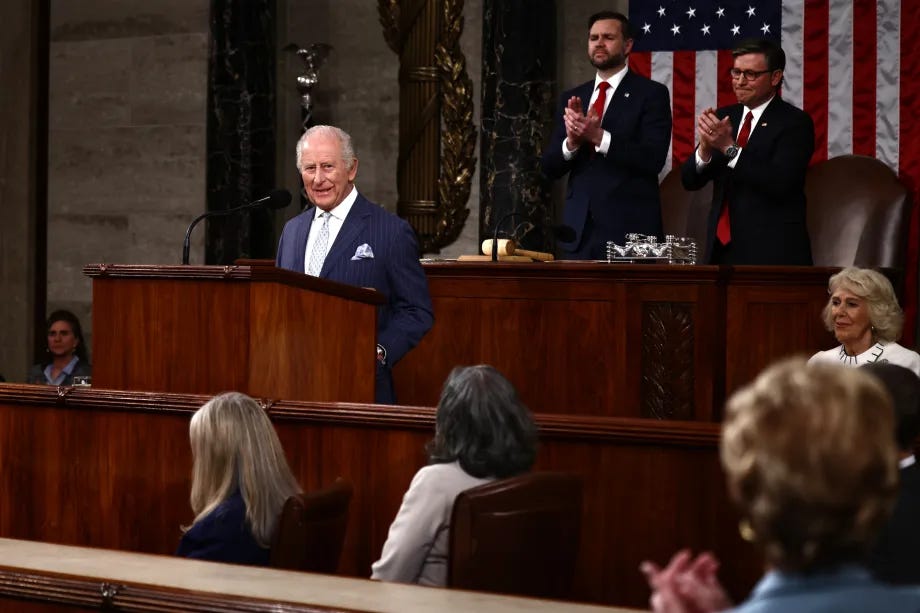
A single sentence in a long speech, in a chamber that does not often hear what it most needs to. King Charles III, addressing a joint session of the United States Congress, said that natural systems are “the foundation for our prosperity and our national security.”
Not just prosperity. Not just wellbeing. National security.
The chamber applauded. Whether anyone in it fully grasped what they were applauding is another question. Taken at its word, the sentence is an indictment of how security is defined, resourced and governed in Washington, in London, and across most of the major capitals of the world.
The contradiction is plain. This is not an argument against defence. Geopolitical rivalry is real. Deterrence matters. But a security framework that treats nature, health and the information environment as someone else’s problem is not a framework. It is a wager, and the evidence suggests we are losing it.
I spent eight years leading the United Nations Development Programme through a pandemic and a cascade of global crises. From that vantage point, I can speak to why most national security establishments have spent years avoiding the King’s sentence. Take it seriously, and a great deal of what currently passes for security policy stops making sense.
And nature is only the start. It sits inside a wider risk system: climate instability, pandemic vulnerability, biodiversity collapse, algorithmic disruption, the integrity of the information on which democratic life depends. These do not sit in separate boxes. They interact and compound, cascading across domains our institutions were never designed to track and that we, frankly, do not yet understand.
We know the interactions are real. Take one example. When ecosystems degrade, food systems destabilise. When food systems destabilise, people move. When displacement reaches scale, political systems fracture, and algorithmic platforms amplify fear faster than facts can be established, narrowing the space for any cooperative response. By the time governments react, they are reaching for military tools to deal with problems that began, years earlier, in a collapsing fishery or a degraded watershed.
None of this is theoretical. It is the pattern already playing out across the Sahel, the Horn of Africa, parts of South and Southeast Asia, and now, increasingly, Europe. In 2022, climate-related disasters displaced 32 million people, more than armed conflict. COVID-19 killed more than seven million and cost the global economy an estimated $12.5 trillion. Coordinated disinformation campaigns have been documented in over 80 countries, distorting elections and turning populations against the very institutions that might respond to any of it.
These are feedback loops in a single complex system. And the reality is that we do not yet fully comprehend how those loops operate. We do not know where the critical thresholds lie, or how a shock in one domain will travel into the others. What we know, from painful repetition, is that it does travel, faster than our institutions can move, and that learning these dynamics in real time, through crisis rather than analysis, is catastrophic.
What the King named is one thread in a larger reality. Natural systems are strategic systems. So is health infrastructure. So are the information ecosystems and the algorithmic architectures through which billions of people now make sense of the world. Pull any thread and the others move with it.
None of this is only an American problem. The same Congress that applauded the King has withdrawn from international climate agreements and gutted environmental and public health governance. And a strikingly similar instinct has been at work in the King’s own country. UK defence spending climbs while commitments to climate adaptation, nature restoration and overseas development are cut. The pattern shows up in Brussels, Paris and Berlin too. Record investment in military security; systematic erosion of nearly everything else broader stability depends on. In 2025, global military expenditure reached almost $2.9 trillion. The highest figure ever recorded.
The people who already understand that these cascading risks are a security crisis are overwhelmingly those who bear their consequences most directly. In the Sahel, the Pacific Islands, the flood plains of South Asia, systemic breakdown is not a future risk. It is lived insecurity. But those communities remain almost entirely absent from the institutions that define security and allocate the resources to address it. Any serious expansion of the security framework must start from that reality, not from the vantage point of those most insulated from it.
What the moment demands is not a rhetorical upgrade, in which “nature” and “climate” are mentioned in preambles before security documents revert to the frameworks of the last century. It demands a fundamental reorientation: one that treats ecological stability, health preparedness, algorithmic governance, and informational resilience as core pillars of national security, embedded in institutional mandates and reflected in budgets. It demands, above all, an honest reckoning with the limits of our current understanding, and a commitment to building the integrated analytical capacity that would allow us to anticipate cascading failures rather than responding to each one in shock.
The analytical tools to do this are more powerful than ever. Systems modelling, geospatial intelligence, behavioural science, AI-enabled foresight. What is missing is the institutional will to use them across the silos that currently govern security, health, climate, and technology as if they occupied separate universes.
King Charles invoked Theodore Roosevelt, a president who understood that protecting natural systems was a condition of national strength. Roosevelt was protecting landscapes. Today the challenge is planetary, and it is systemic. The risks are coupled, they are accelerating, and they will not wait for our institutions to catch up.
Institutions reform when the cost of the status quo becomes impossible to ignore, or when world leaders agree that the old thinking no longer holds. The question is whether the governments that applauded King Charles, on both sides of the Atlantic, are willing to act as if they believed it. Because the next crisis will not arrive from one domain. It will arrive as all of them at once: AI, climate, health, social division. And when it does, what we called it will matter very little. It will matter whether we were ready.
Achim Steiner is a Senior Fellow at the University of Oxford and Founding Director of the Security Futures Lab at the Oxford Martin School. He previously led the United Nations Development Programme from 2017 to 2025 and the United Nations Environment Programme from 2006 to 2016.
No posts
Comments
Nothing yet. Say the first thing.
Sign in to join the conversation.