
By Joab Okanda
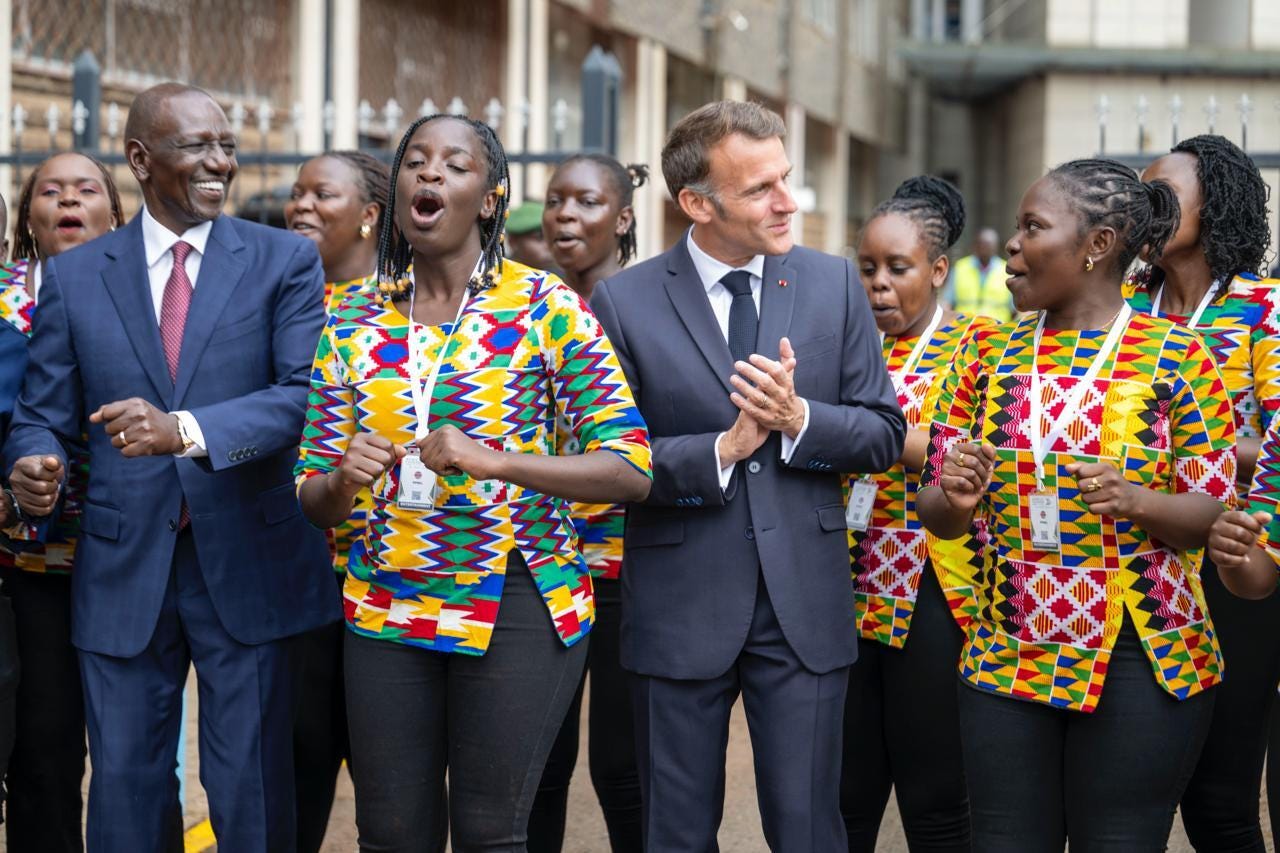
Last week under the gleaming Nairobi skyline, the Kenya-France hosted Africa Forward Summit was staged as a masterclass in political optics with more than 30 African leaders and 40 top French and African CEOs in attendance.
French President Emmanuel Macron arrived in Kenya seeking to pivot away from France’s crumbling influence in West Africa towards the high-growth markets of Anglophone East Africa.
The summit was sold as a shining example of environmental diplomacy. France pledged €23 billion in investment across energy, agriculture, and AI, with green industrialisation positioned as Africa’s path from raw material exporter to value-chain manufacturer.
But the headlines were not about setting the tone for this new future of Africa-France partnership. Instead they were dominated by a viral moment which showed Macron rising from the audience and taking a speaker’s microphone to silence the audience.
What we got was not so ‘forward’, but more of a rewind. What we witnessed from France and its CEOs was a continuation of the old, a rebranded version and pursuance of the same old double speak, the same old agenda.
Total Energies CEO Patrick Pouyanné extolled the importance of an Africa-France partnership whilst lobbying for European banks to invest in gas. “The partnership between Europe and Africa is even more important than ever, because we will produce all that we bring to our refineries in Europe; to produce fuels, we take energy from Nigeria, to provide it to Europe”, he said. That was before Pouyanné was caught in a verbal mêlée with security guards.
Also at the summit Rodolphe Saadé, CEO of CMA CGM, the world’s third largest maritime group, encouraged European governments to boldly and unabashedly pursue fossil fuel projects in Africa. CMA CGM is investing $800 million at the port of Mombasa, East Africa’s trade gateway with the French entity laying down deep-offshore gas and crude oil pipelines in the region.
This is in stark contrast to what the country needs. Today Africa is pitching for partnerships that enable sovereign, green industrialization. That means delivering access to energy for the 600 million people who still do not receive it. That requires significant investments to lower the costs for power generation and the deployment of decentralised grids
In the end, the summit concluded with a bank of “resolutions”: €23 billion in joint investments targeting energy, agriculture and infrastructure, strong push for global financial reform and renewed momentum for the establishment of an African credit rating agency. Also commitments towards renewable-powered manufacturing and establishing regional value chains.
All these represent a bold paradigm shift: one that argues that Africa should not just participate in the global energy transition, but lead it through “green industrialization.”
Success on the continent looks beyond Africa being a mere exporter of raw materials. Instead it means investing in local processing plants, energy sovereignty, justice to allow universal access to electricity by its people, and debt cancellation.
Energy sovereignty can be achieved by strategically ensuring Africa keeps the value-add within the continent. Such a model, if successful, would transform the green transition within the continent, and beyond, serving as a powerful engine for job creation and GDP growth.
Going forward Africa engagement by banks, countries and corporations need to underpin this. These engagements must move past extractive economic models that undermine Africa’s prospects for a genuine, sovereign green industrialisation and long term economic transformation.
Africa is home to a greater percentage of the world’s best renewable energy – its potential is 50 times greater than the anticipated global electricity demand for the year 2040 but currently it attracts only 3% of global financing into renewables.
Other key resolutions from the summit called for the strengthening of regional grids and clean cooking. Whilst these are vital, the capital expenditure required to modernize national grids as a public utility are currently enormous. The Africa Development Bank estimates that the continent needs about $300 billion by 2030 in grid investment for transmission, distribution and expanding access.
To make all these things happen, African countries cannot further entrench themselves in high-interest, debt-inducing loans; financing must be concessional and grants-based. The message from the summit was clear: Africa demands a stronger African voice in global decision-making on climate and energy -one anchored in Africa’s broader development needs.
There are several opportunities for Africa’s partners to acknowledge this. The EU’s recent Foreign Affairs Council conclusions on energy and climate diplomacy may offer an opportunity to move beyond purely transactional engagement toward partnerships grounded in economic transformation. But such partnerships cannot be built through extractive supply chain calculations disguised as cooperation. Europe must match rhetoric with provision of long-term concessional finance and genuinely treat Africa as a co-architect of the green economy.
The green industrialisation agenda is no longer a niche climate conversation. At its core must be joint implementation, joint rule-making, and joint investment. In the end, the “Africa Forward” resolutions are a sophisticated blueprint for a self-determined future. They move Africa from a “victim” narrative of climate change to an “architect” of change.
Going forward, the success of this green industrial revolution depends less on the high-level commitments made at glitzy gatherings than on real world signs that Africa’s partners are putting their best foot forward in the future, not the past.
Joab Okanda is a Climate Development and Energy Expert
Comments
Nothing yet. Say the first thing.
Sign in to join the conversation.