
By Andreas Sieber, head of political strategy, 350.org; João Enrqiue, Brazil country manager, 350.org.
Today’s war-driven energy crisis isn’t the first – nor will it be the last. The world’s seventh – and by far its worst – oil price shock in the last 50 years, this is a crisis bound to repeat itself unless our leaders finally decide to tackle it at its root cause: fossil fuels.
Many leaders – from UK Prime Minister Keir Starmer to South Korean President Lee Jae Myung and Indian Prime Minister Narendra Modi – are already calling for a shift to clean energy, recognizing that dependence on fossil fuels is an economic liability and a growing security risk. With oil prices back hovering around $100 per barrel and tensions around the Strait of Hormuz ongoing, Goldman Sachs warns prices could exceed the 2008 peak of $147 if disruptions continue.
These shocks quickly spill beyond energy markets—driving up food and transport costs, raising fertilizer prices, and squeezing household budgets. In the first month of the war alone, higher oil and gas prices added $104–112 billion in costs globally. With El Niño expected to intensify heat and energy demand, pressures will only grow—hitting the most vulnerable hardest.
The reliable, renewable alternative
At the same time, the crisis is accelerating a long-overdue shift. Gas-fired power is now 3–4 times more expensive than solar and wind, and over 90% of new renewable projects are cheaper than fossil alternatives. Governments are responding—through electrification, efficiency measures, and investment in domestic renewables—to reduce exposure to recurring shocks.
Countries that have invested in renewables are already seeing the benefits. Spain’s solar capacity has helped the country stabilize electricity prices despite gas volatility, while Pakistan’s solar expansion has helped the country save over $12 billion in fossil fuel imports. The lesson is simple: the less reliant you are on fossil fuels, the more resilient your economy becomes.
How quickly will governments act?
The question today is not if, but when, countries will accelerate their plans to wean off fossil fuels.
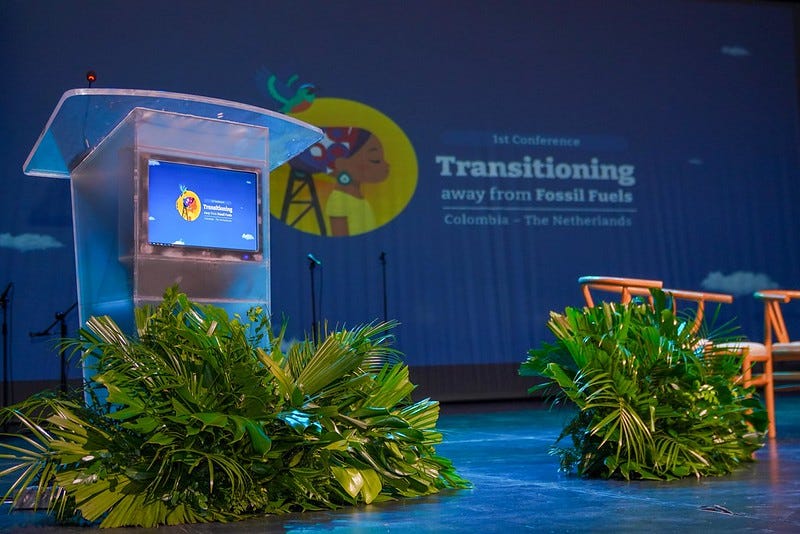
The First Conference on Transitioning Away from Fossil Fuels in Santa Marta is designed not just to answer that question, but to help countries make this a reality whilst maintaining momentum beyond one single meeting.
This week, ministers and officials from more than 50 countries, alongside subnational leaders, businesses, and academics, will focus on turning political commitments into practical next steps.
So, what’s on the agenda for this so-called ‘coalition of doers’? The agenda is deliberately concrete: tripling renewable capacity and doubling energy efficiency by 2030; reforming fossil fuel subsidies while protecting vulnerable households; mobilizing finance for developing economies; and supporting fossil fuel–dependent countries to diversify. Co-hosts Netherlands and Colombia say Santa Marta is not about declarations, but about delivery.
What success looks like
Countries need to converge around a focused set of priorities—policies, financing models, and legal frameworks that can be implemented now. That requires prioritizing what works over what merely sounds good.
Three outcomes are critical: first, a concise set of actionable solutions; second, a structured process to track progress and sustain momentum and third, concrete inputs into the global transition roadmap, including policy designs and financing approaches that can be adopted and scaled.
This is the gap Santa Marta is uniquely positioned to fill. While international climate talks have defined the “what,” they have yet to deliver the “how”—particularly for a just and orderly transition away from fossil fuels.
If successful, the conference can help shape national transition roadmaps into more than planning documents, turning them into blueprints for resilience that reduce exposure to volatile fuel markets, manage geopolitical risk, and ensure the benefits of transition are shared.
Santa Marta will not end the current crisis. But it can mark a turning point: from acknowledging the problem to systematically building a way out.
Comments
Nothing yet. Say the first thing.
Sign in to join the conversation.