
Hello,
Two minutes.
That’s how long this hormone lasts when your own body makes it. Released, does its job, gone, then made fresh at your next meal.
The injection lasts about a week.
That single difference explains more than anything else you’ll read about these drugs, and I’ll come back to it properly.
But here’s the part that gets lost in all of it: you already make this hormone. Your gut made some this morning. The injection everyone is talking about is a copy of something you produce yourself, for free, several times a day, every time you eat. So most of this issue is about how it’s made, and how to make more of it.
First, though, the part I’m not willing to leave out.
In the past two months, two people joined the programme without a gallbladder. Different ages. Different cities. Both had it removed recently. Both were on a weight-loss injection at the time.
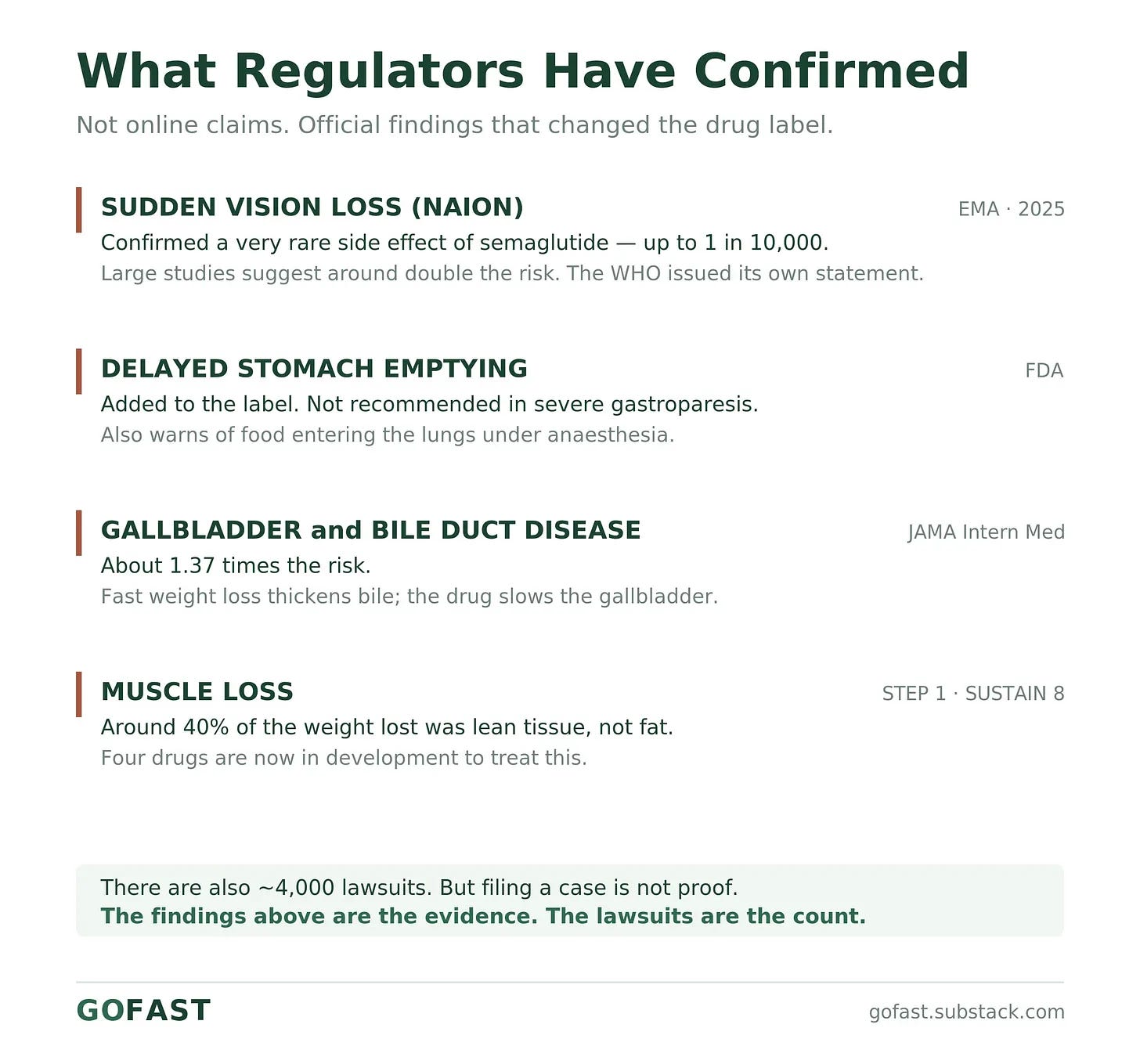
It’s in the data. A review in JAMA Internal Medicine found these drugs came with about a 1.37 times higher risk of gallbladder and bile duct disease.
The reason is simple. Losing weight fast pushes extra cholesterol into your bile. The bile can’t keep it dissolved, so it turns into stones. At the same time, the drug slows your gallbladder down, so it empties less often.
Thick bile. Sitting still. That’s how stones form.
I wrote about the gallbladder on its own, what it does, why it fails, and what to watch for 700,000 Gallbladders Removed Every Year in the US.
If you still have yours, read that one too.
There is a lot of noise online. So I’m only going to tell you things that official medicines regulators have looked at and confirmed.
Vision loss. In 2025, the European Medicines Agency reviewed the evidence and concluded that NAION — a type of sudden, usually permanent vision loss is a very rare side effect of semaglutide. Very rare means up to 1 in 10,000 people. Large studies suggested roughly double the risk. The label had to be updated. The World Health Organization issued its own statement the same month.
Stomach paralysis. The FDA added delayed gastric emptying to the label. Ozempic is now not recommended for people with severe gastroparesis. The label also warns about food coming back up into the lungs during anesthesia, which is why surgeons and anesthetists now ask whether you’re on one of these before they put you under.
Gallbladder disease. Covered above.
Muscle loss. In the STEP 1 and SUSTAIN 8 trials, around 40% of the weight lost was lean tissue. Not fat. Muscle.
These aren’t rumours or influencer claims. These are regulators updating labels after reviewing the evidence.
This is the part that bothers me most, and it isn’t really about medicine.
We are very good at believing that this time, the shortcut is safe. Because the early results are real, the marketing is excellent, and the damage takes years to show up.
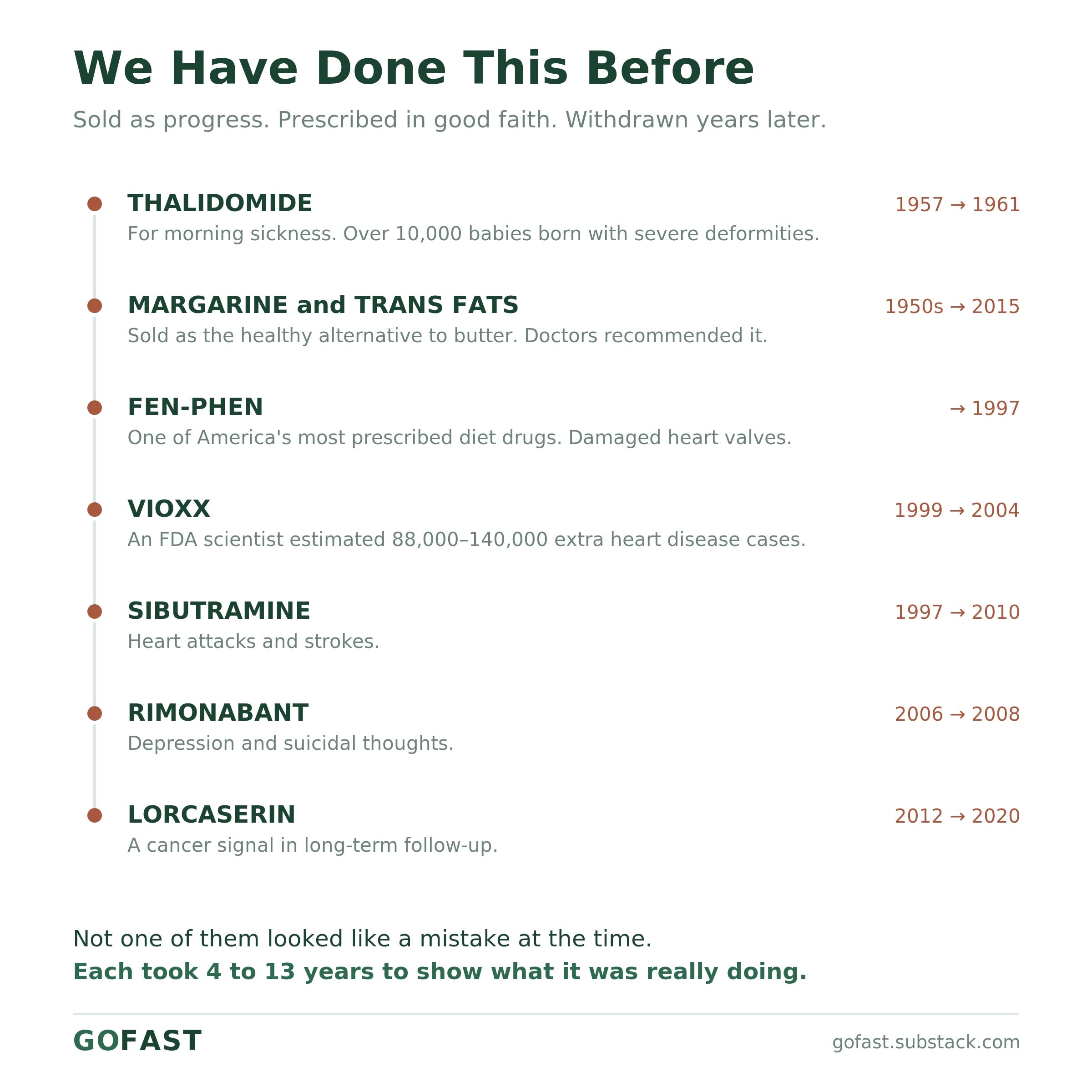
Thalidomide. Sold as a safe sedative from 1957 and given to pregnant women for morning sickness. Withdrawn in November 1961, after more than 10,000 babies worldwide were born with severe deformities. Around half died within months.
Margarine and trans fats. Sold for decades as the healthy alternative to butter. Doctors recommended it. The FDA finally ruled in 2015 that partially hydrogenated oils were no longer safe, and they were phased out of the food supply by 2021. This one is from my own field, and it still stings.
Fen-phen. One of the most prescribed weight-loss drugs in America. Withdrawn in 1997 for damaged heart valves.
Vioxx. A painkiller, approved in 1999. Withdrawn in 2004. An FDA scientist published an estimate in The Lancet of 88,000 to 140,000 extra cases of serious heart disease in the US. He said his own superiors threatened him over publishing it.
Sibutramine. 1997 to 2010. Heart attacks and strokes.
Rimonabant. 2006 to 2008. Depression and suicidal thoughts.
Lorcaserin. 2012 to 2020. A cancer signal.
Look at the pattern.
Not one of them looked like a mistake at the time. Each had real trial data. Each had good doctors prescribing in good faith. Each one took between four and thirteen years to show what it was really doing.
I can’t tell you these injections belong on that list. Nobody can; the long-term data doesn’t exist yet, because not enough long-term has happened.
What I can tell you is that we have a long, expensive habit of rolling something out to millions of people before we know what it costs. Betting that we’ve broken that habit this time would be a strange bet.
I’m not going to tell you what to do. I don’t know your body, your history, or what you’ve already tried.
And please don’t stop a prescribed medication because of a newsletter. Stopping suddenly has its own risks. That conversation belongs with the doctor who prescribed it, not with me, and not with the internet.
What I’m saying is this: you deserve to know all of it before you decide, not after.
And you deserve to know that your body was already doing this job. Let’s talk about how.
Waking at 3am. Hungry an hour after a proper meal. The 3pm crash. Something sweet after dinner, every night. Foggy after lunch. A belly that won’t move. None of these are character flaws. They’re data.
Two minutes. Score your symptoms, get your metabolic scorecard, and find out which system to fix first.
Comments
Nothing yet. Say the first thing.
Sign in to join the conversation.