

I went quiet for a bit (again).
Partly because life.
Partly because I was getting bored of the same sermons about AI, community, and creators.
I’m tired ofseeing “short video, authenticity, creators, sustainability”…
2026 feels different. And yes, we say this every year, I know.
The structure under social, marketing, and culture shifts this year.
I’m talking about the wiring though, not the cosmetics of it.
So here is my working map.
Blue sky.
Messy on purpose.
Use whatever serves your planning and ignore the rest.
1. Answer Engines Replace Social As The Front Door
I see less search and more questions.
TikTok search sends most video views to search results, not For You feeds, once content receives basic optimisation.
41% of Americans already use TikTok as a search engine, with 64% of Gen Z in that group.
Chat interfaces now pull brand answers directly into the box.
Search behaves less like “here are ten blue links” and more like “here is a verdict”.
So I expect three things.
• Generative Engine Optimisation replaces classic SEO
The question becomes “does this brand receive a quote inside answers”, not “does this brand sit on page one”.
• Reputation becomes a ranking factor
Models prefer sources with consistent, credible signals.
Your searchable reputation behaves like a rating.
• Every brand lives inside a knowledge graph
Mentions across news, Substack, Discord, Reddit, Glassdoor, Trustpilot feed the same beast.
Lazy content farms lose space.
Brands with clear, consistent, indexed behaviour move up.
2. Reputation Becomes A Performance Metric
We trained algorithms to reward engagement.
Now we train them to reward trust.
Regulation tightens.
Platforms face pressure for safer feeds.
Privacy law keeps marching
So reputation shifts from PR vanity metric to core performance input.
I see three layers.
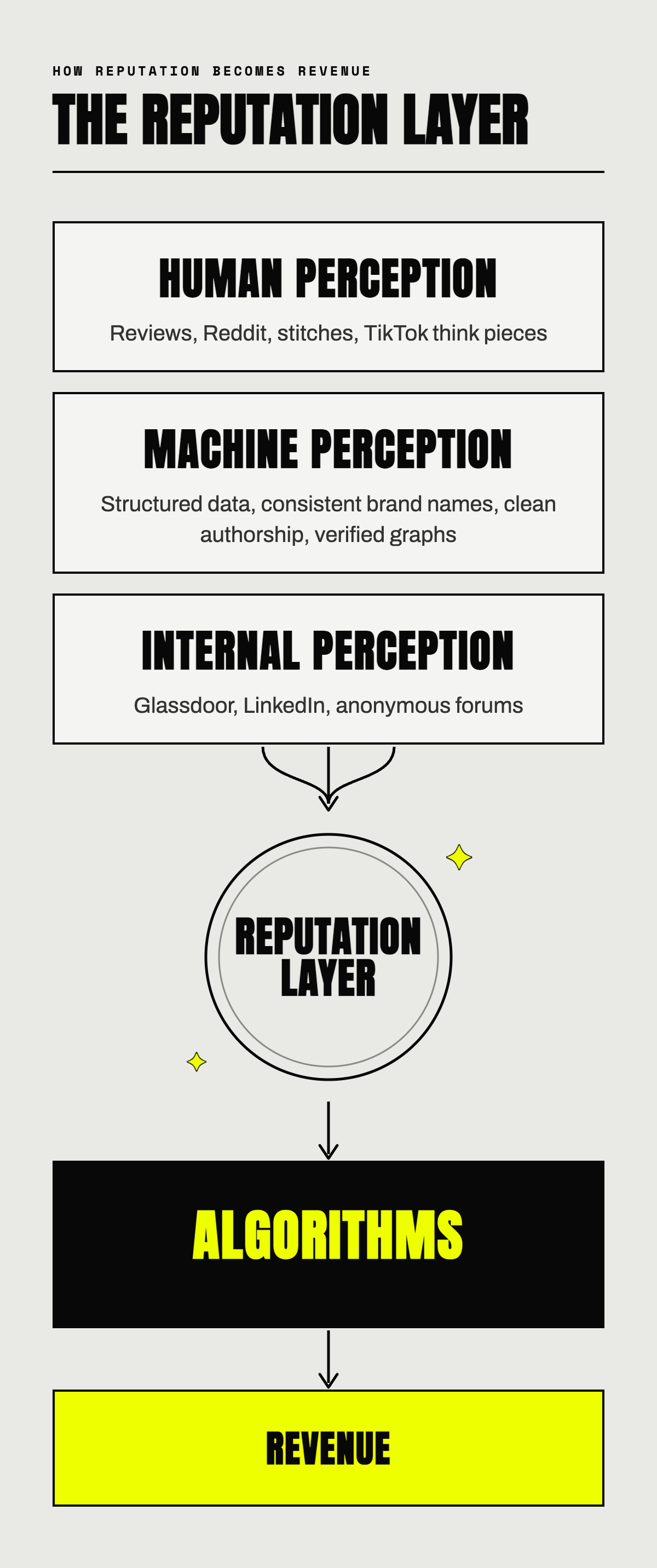
• Human perception
Reviews, Reddit threads, stitch culture, TikTok think pieces.
• Machine perception
Structured data, consistent brand names, clean authorship, verified social graphs.
• Internal perception
How your own staff speak on Glassdoor, LinkedIn, and anonymous forums.
Search, recommendation, and answer engines read all of this.
So “reputation as ranking signal” stops being theory and starts driving revenue.
Thanks for reading Thinking Out Loud ! This post is public so feel free to share it.
3. Community Behaves Like Infrastructure
Getting tired of community decks with screenshots of likes and comments.
It’s all, so, 2018.
I see more brands treating community as plumbing (kind of).
The good work happens in Discords, WhatsApp clusters, Substack comments, private live streams, Patreon feeds.
Public feeds still matter for reach, but retention lives in smaller rooms.
For 2026 I expect:
• Community budgets move from “awareness” to “retention and product” lines
• Teams hire producers and moderators, not only social managers
• Data from closed spaces shapes product roadmaps more than surface level sentiment
Creator ad spend reaches $37 billion in the United States, growing four times faster than the wider media market.
That money funds thousands of micro communities.
Brands that treat those spaces as research labs and loyalty engines survive the madness.
4. Privacy Led Marketing Grows Teeth
I have spoken about first party data for years.
The vibe finally shifts from conference panel to survival strategy.
Regulators demand stricter consent.
Cookie banners lose their lazy grey area
Marketers move toward:
• Zero party data
People share preferences in exchange for genuine value.
• First party data
Behaviour on owned channels with proper consent flows
• Light personalisation
Relevance without surveillance, clearly explained.
Privacy becomes a brand value and a performance lever.
Trust builds open rates and watch time.
Trust also keeps you away from regulators with sharp teeth.
5. Human Augmented Creativity Becomes The New Default
Half of professionals in legal, risk, and government already use generative AI in some form. And 70% of marketers expect AI to play a bigger role in their work
The experiment phase ends.
Hybrid workflows take over.
I see the most progress in teams that treat AI as junior staff.
Models handle:
• Rough drafts
• Concept boards
• Pull quotes
• Transcripts
• Variations
Humans handle:
• Taste
• Context
• Cultural reading
• Risk
• Final voice
The creative department turns into a control room that shapes and filters a tidal wave of AI material.
Brands that hand whole campaigns to generic AI stand out for the wrong reasons. We’re already seeing this.
Brands that treat AI as a high speed, low ego collaborator gain range.
6. Social Search And Answer Agents Rewrite Media Plans
TikTok, YouTube, Pinterest, and Instagram already work as discovery engines.
Search on these platforms supports product research and even life admin
2026 pushes this further through embedded agents.
Consumers ask a bot in DMs for festival outfits or vitamin advice.
That agent draws from search, creator content, brand catalogues, and reviews.
The answer arrives as a mini mood board or cart.
Media money follows.
Search, influencer, and CRM budgets blur.
Brands pay for presence in answer packs instead of flat placements.
Creator posts become more like ranked search results inside social feeds.
I am seeing more briefs ask for “answer coverage” instead of “reach”.
That phrasing feels accurate.
Reach without presence inside answers starts to look weak.
7. Analogue Resurrections: The Offline Counter Movement
Every algorithmic era triggers a physical counter culture.
Gen Alpha already shows a taste for sensory store experiences and cinema trips, even with heavy screen habits
I expect a rise in:
• Local listening sessions and salon style events
• Printed zines and mini reports for niche audiences
• Retail spaces designed as content stages and community houses
• Very small conferences with curated guest lists instead of bloated expos
Analogue formats gain value precisely because they refuse infinite scale.
They signal care, scarcity, and focus in a feed that feels overproduced.
8. Commerce As A War Zone
Advertising spend keeps growing into 2026, with global revenue expected to reach over one point two trillion dollars
More platforms chase that money.
Streaming platforms add ad tiers.
Chat interfaces prepare for sponsored answers
Commerce is beginning to feel less like a funnel… it’s like trench warfare.
Price, delivery, and availability shift in real time.
Personal agents haggle with brand agents.
Marketplaces prefer closed loops and lock in.
Consumer patience for slow checkout journeys hits zero.
Brands that still treat ecommerce as “the website” fall behind.
Commerce behaviour spreads across DMs, live streams, inboxes, group chats, and answer boxes.
9. Reputation, Community, Privacy: Your New Trinity
If you strip back the chaos, three levers keep surfacing.
Reputation as ranking signal.
Community as foundation.
Privacy as brand value.
Everything else feels tactical.
Predictive media, AI agents, answer engines, synthetic spokespeople, dark social measurement.
All useful, all noisy.
Without that trinity, the tactics help short term and hurt long term.
I am seeing more brands move spend from keyword bidding and glossy awareness films toward:
• Clean data and consent
• Long running community programmes
• Deep work on product and experience
• Transparent leadership
No fireworks on launch day.
Strong compounding over years.
That’s all for now folks!
Thanks for reading Thinking Out Loud ! Subscribe for free to receive new posts and support my work.
Comments
Nothing yet. Say the first thing.
Sign in to join the conversation.