

You pay your taxes on your initial investment capital (e.g. $100,000 after taxes).
Over time, you put that money in a Roth and invest it an ETF (e.g. in VGT). ☩
VGT earns 20% on average each year. Here is what compounding does to that investment over 20 years.
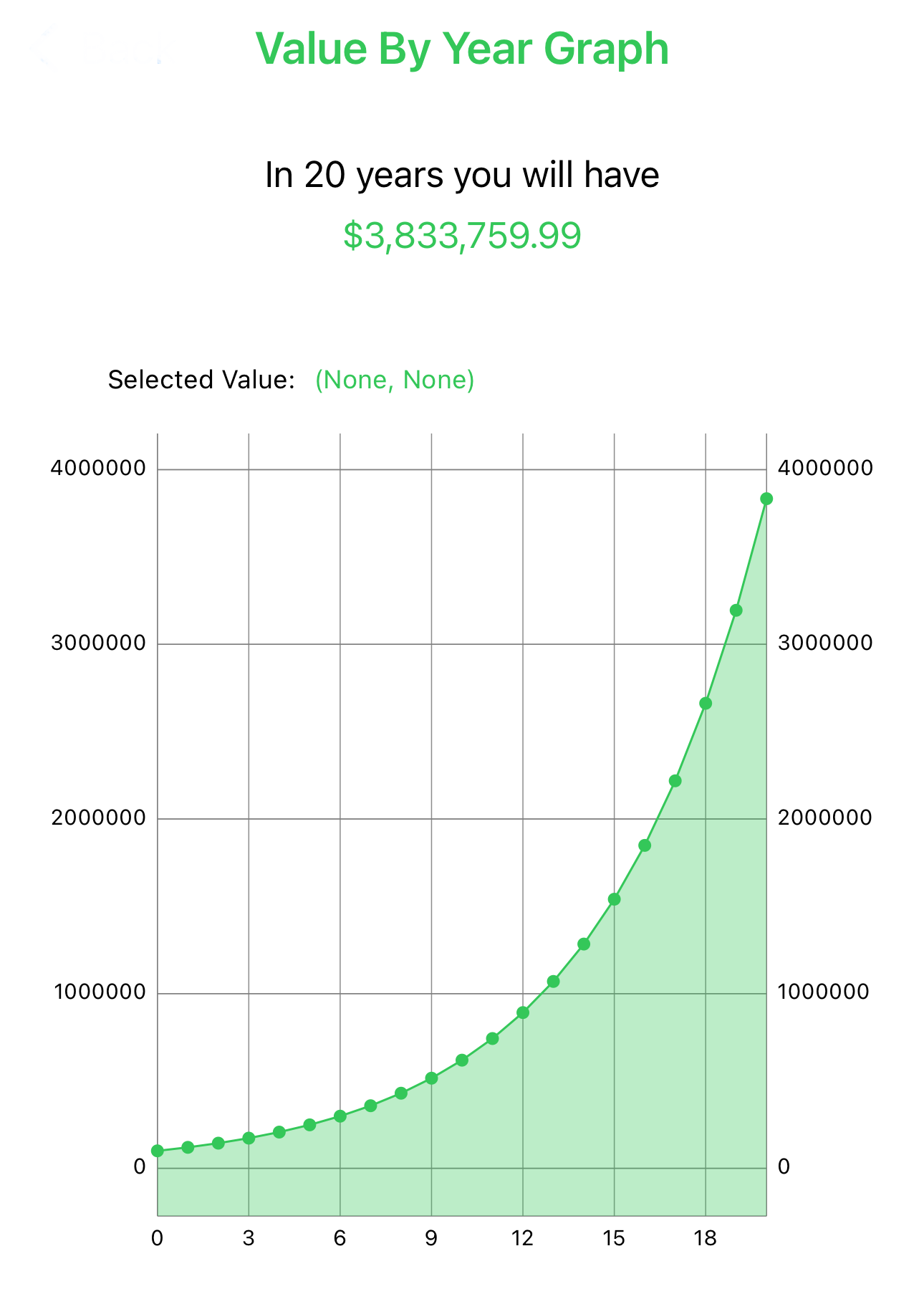
If you had placed your 100k in a normal IRA, you would now being paying long-term capital gains taxes on $3,733,759.99 in profit.
Instead, you could freely use as much of the total $3,833,759.99 as you want each year, while legally claiming no income, and paying no taxes.
However if you did that, it would result in a declining net-worth throughout your retirement, which could be stressful and perhaps dangerous.
Instead, just cash out the profit each year, and live off that.
In the above example, if we extended the compounding estimate to 21 years, in the final one year, you would have earned another 20% profit, or $766,752.
Each year, you could shave off $766,000 for living expenses without having any drop in net-worth (3.8M). Not too bad of a yearly passive income.
You do need to wait until you’re 59 1/2 years old to start pulling the passive income from retirement accounts, and the scenario above presumes a 20 year investment, so you would need to start things rolling in your late 30s ideally.
After you retire, you might still have a normal brokerage account (e.g. Robinhood). Any gains you get from those investments will be taxed at long-term capital gains rates if you sell them. This means that a normal brokerage account is very useful up to age 60, and becomes much less attractive afterwards.
You can continue to make the allowable yearly Roth contributions after age 60. Thus, it seems likely that gradually selling off your normal brokerage accounts (yes, pay the taxes) and transferring the proceeds into a Roth (for continued tax-free growth during a 30 year retirement), would be an optimal strategy. However it might be more complex to deal with.
Another option is to view your normal brokerage account as a pre-60 and post-death account. From retirement until 60 you use it and pay taxes, after 60 you rely on your Roth. Brokerage accounts are great items to inherit because the cost basis resets at the time of death of the original owner, meaning that taxes aren’t owed by the recipient. So if you can live comfortably off your Roth, then you have something significant to leave someone in the other account. You could also view the normal brokerage account as an emergency fund.
There are upturns and downturns in the stock market, so it is quite possible that there might be a 5-year recession sometime during your retirement. In this case you could scale back your yearly living expenses by 50% (383k), and expect that when the market returns to bull status, your VGT will be earning more than 20% / year to compensate. You might also consider a “guardrails” approach.
The crux of the problem with Roths is that you can’t use them until 59 1/2. If you want to retire early at 50, then that leaves 10 years without income to draw upon. After 60 you want as much as possible in your Roth, but not at the expense of having nothing to live off of for 10 years prior. ◇
☩ Roths have yearly contribution limits, but it is entirely feasible to get a 100k starting point for a Roth account with normal contributions, legal back-door contributions, workplace retirement plan benefits, and more aggressive investments within the account.
◇ There may be some advanced methods of withdrawing before 59 1/2, but it gets complex and may not be worth the effort.
△ Photo credit: AI-generated by Black Forest Labs
Disclaimer: I do not hold any financial degrees or certifications. I am not a tax advisor. Your investment decisions are your own, and it is best to test strategies with small amounts of money first, preferably after extensive back-testing. Question the dogma and discover the facts for yourself.
No posts
Comments
Nothing yet. Say the first thing.
Sign in to join the conversation.