
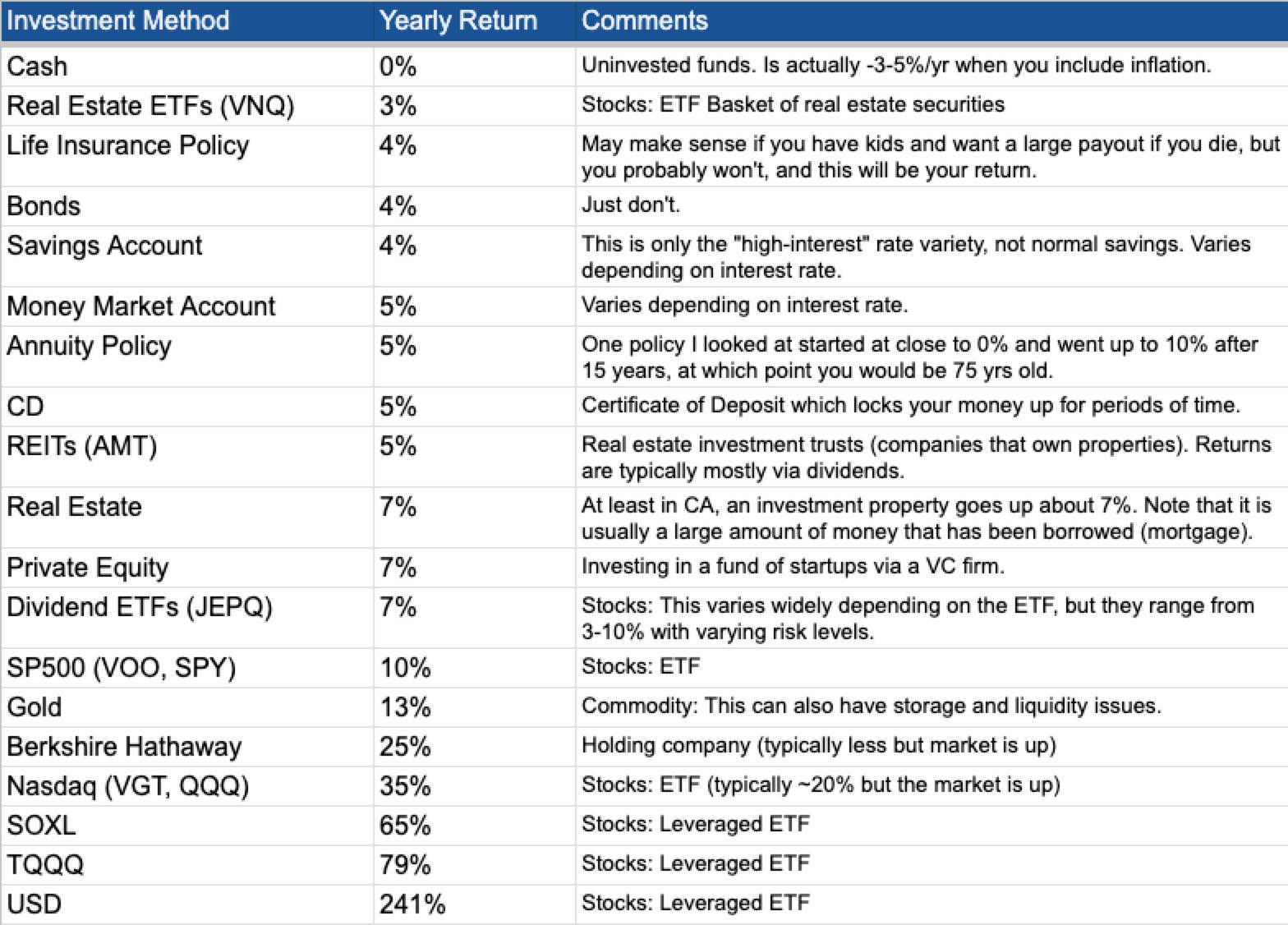
(Last updated: AUG 25, 2024 - Average Yearly Return values are roughly accurate across a 5-yr horizon but they do fluctuate. *)
“What is the average annual return?”
Impact Of Lower Returns: If you put substantial amounts of your net-worth into financial products with low returns, you will have significantly less money in retirement. When considering a new investment or financial product, first ask: “what is the average annual return”? If they don’t give you a straight answer, or that number is less than 10%, run away.
Compounding: Compounding returns mean that investments grow over time, particularly in the latter parts of the investment period. This is dramatically impacted by the initial yearly return rate.
Safety: Many investment professionals advocate “safe investments”. Risk/reward ratio is a real thing, and if you’re taking zero risk, you will likely have zero returns (e.g. hoarding cash). Overly-safe investments mean you have less money to retire with.
Profits: Investment professionals earn commissions on what they sell, so they earn nothing if you self-invest. Their bosses take whatever you invest and put it into other higher-risk investment vehicles, to claim the profit you passed on. Learn from their example.
Diversification: Not all forms of diversification are good. If you earn 20% on half your portfolio, and 3% on the “be safe” half of your portfolio, you need to average the two. This would essentially cut your returns in half. After compounding over 20 years, that could be millions of dollars lost.
Rates: Any time you can borrow money at a lower percentage rate, and put it in an investment with a higher rate of return, you make money. (E.g. house mortgage is 3%, rate of appreciation is 7%, or using margin with 8% rate to buy VGT with 20% rate of return)
Real Estate: While investment properties only appreciate at ~7%, they are unusual in that you are investing hundreds of thousands of dollars of other people’s money. In most of the other options above, it is your own money that is invested. For example: 20% return on 20k (4k) invested into an ETF is nice, but 7% return on a million dollar house investment (70k) is more significant, particularly when it came for free.
Risk: Conventional theory has it that you can’t earn 20% / yr without taking significant risk. However, VGT gets that and it is already diversified across the entire tech sector. If you’re even more risk-averse, you could put your money in VOO, which is the entire SP500, and gets 10% / yr. Thus, putting your money in any form of investment giving less than 10% / yr is doubtful, and yet many people swear by bonds and CDs earning much less than that. Even some of the leveraged investments shown above aren’t that risky - if you buy low, don’t use borrowed money (margin), and can resist the urge to panic-sell until the market turns around again.
Fear: Be wary of letting fear influence your investing decisions. This comes is various forms: fear of dying and leaving your children penniless; fear of “losing it all” and selling at a loss when the stock market is temporarily down; fear of “still having a mortgage” when you retire; fear of the dollar collapsing. Healthy amounts of fear in things such as “will I have enough invested to retire when I’m 60” can be helpful, but those selling financial products will generally use fear to guide you into lower-return investments.
*Average yearly returns are sourced from multiple places. For stocks I manually calculate the % increase in value from 5 years ago until present, and divide by 5. It is important to look at longer time frames than just the last 12 mos. Certain category values vary based on current interest rates set by the Fed. I update this chart fairly regularly, but it is approximate, and it will change over time. The main purpose is to show a rapid, rough comparison of approximate returns for various investment choice categories. There are no single stocks listed because they are higher-risk, are not generalizable, and are not as predictable as aggregate options. You may be able to find individual offerings that beat the average for the categories shown, but this roughly shows category performance.
Disclaimer: I do not hold any financial degrees or certifications. I am not a tax advisor. Your investment decisions are your own, and it is best to test strategies with small amounts of money first, preferably after extensive back-testing. Question the dogma and discover the facts for yourself.
No posts
Comments
Nothing yet. Say the first thing.
Sign in to join the conversation.