
Without doubt the two questions I am asked most often when I tell people that I write about wine are, “What’s your favourite wine?” and “Any recommendations?” The first invariably reduces me to tongue-tied inarticulacy: it’s impossible to answer in a way that doesn’t sound pretentious, losing your listener in anywhere between three and ten seconds. The second question is hopelessly broad, especially when you know nothing of the inquirer’s tastes – and they can’t usually describe what they like anyway, at least if they’re English, because of worrying about sounding silly. Thank goodness, then, for the likes of Guigal’s basic red Côtes du Rhône.
The wine is widely available in British supermarkets, off-licences and convenience stores. And while it isn’t the cheapest option, these days retailing at around £13-14, I’d argue that it’s the best red at that price on UK shelves which is so widely available.
I confess that very little of the wine I drink comes from convenience stores and small supermarkets. The selection on offer is almost always pretty dire. And when I do end up having to buy a bottle in such an outlet, I experience afresh what many casual wine drinkers do every time they’re faced with a wall of unfamiliar bottles: “Oh bloody hell…” For me, closer inspection makes things clearer, though not happier. Last month I pitched up in a small Co-op store on the Isle of Arran, in Scotland, having found that the restaurant we were eating at 200 metres up the road served no alcohol but allowed us to bring our own. That wall of bottles… and about two that were worth drinking.
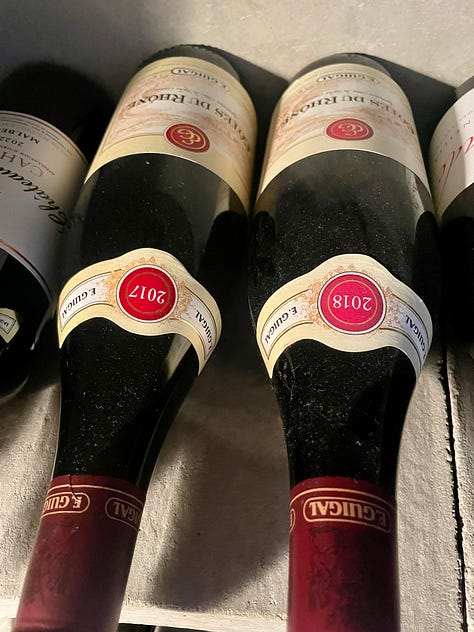
Guigal’s red Côtes du Rhône blend wasn’t among them, though had it been I would have immediately selected it. Why? It’s just a really decent red, real quality that can even age (look at the bottles in my cellar pictured above) – and incredibly dependable.
It doesn’t have the expression of terroir and place that you would expect from many single-vineyard bottlings, like those from Guigal’s own northern-Rhône vineyards. But what struck me at a tasting of the estate’s entire range in London a couple of months ago was this: even though the entry-level wine obviously isn’t on a level with, say, Guigal’s starry Côte Rôties, it’s strikingly good value, punching well above its weight. (They make white and rosé versions of the same entry-level Côtes du Rhône, in far smaller quantities, that are very decent too – especially the Viognier-dominated white blend.) And yet Guigal make four to five million bottles a year of the red: this is, at least in terms of volume, a mass-produced wine.
So how do they manage to maintain this level of quality, year after year?
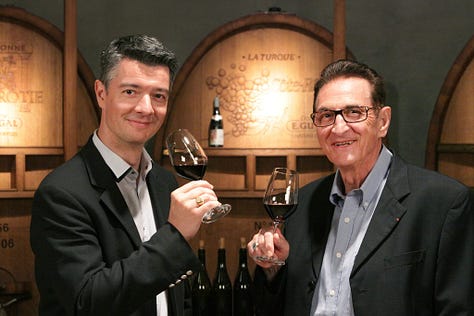
First, Philippe Guigal uses the best wines from hundreds of plots, of which he tastes thousands every year to make his selection. “Somebody said yesterday that I looked tired,” he told me when I spoke to him last month, “but I had tasted maybe 180 wines.” The estate makes a number of Rhône blends – including excellent Hermitage, St Joseph and Châteauneuf-du-Pape, as well as a range from single vineyards. Guigal tastes all of those wines and the blends’ constituent parts himself. But of these, he is assessing 35-40 samples every day of the year just for inclusion in the red Côtes du Rhône. It’s a fanatical devotion to quality.
Guigal’s father Marcel first blended the red Côtes du Rhône in the late 1960s; in the 60s and 70s he made the name of the company founded in 1946 by his own father, Etienne. Today the entry-level red blend makes up around half of the company’s total annual production. But, says Philippe Guigal, “The challenge isn’t to produce four million bottles of Côtes du Rhône but to achieve quality levels. It’s extremely challenging every year.”
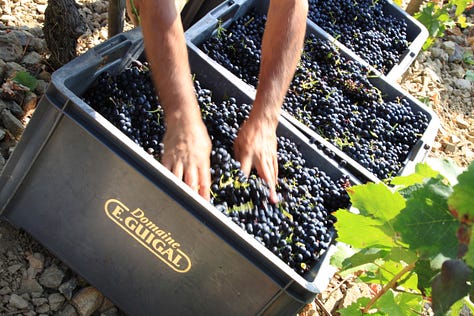
The blend is composed from around 800 wines bought in from, on average, 400 producers. “Our selection rate is around one per cent,” says Guigal. “It’s a lot of samples tasted for very few wines chosen.” Parcel selection for the blend can vary a lot by year, though he says that the right bank of the Rhône is particularly important. Around half of the blend or just over is always Syrah – “we’re northern-Rhône people making wine in the South,” he says – with most of the rest Grenache, and five per cent or less Mourvèdre.
Guigal works in the old-fashioned way with wine brokers, who in turn deal with négociants (merchants) – which the company prefers to going to producers direct. “First, the brokers sort the samples – they know it’s pointless sending us a basic quality,” says Guigal. “And if you go direct, then if the year is bad, it’s difficult to go back and refuse. So a broker handles all that.” But, he adds, “we recognise quality and pay for it” – far more than the average bulk price pid to growers.
The flow of samples is constant, tank and barrel samples as well as finished bottles: more intense from October to March, then slowing before starting up again after the vines flower, in late April-May. Guigal tastes all of them, every day, along with his father, now aged 83, two other oenologists and winemaker Jacques Desvernois. They taste all the samples blind: “I don’t know if its 60hl or 600hl, from right or left bank, or the price,” says Guigal. “I don’t want to have these expectations.”
At the same time, over the course of the year, Guigal bring in batches of wine they’ve decided to buy, in lots from 50hl up to 750hl – partly according to the available space in the winery. Although the company has three hectares of cellars, all the batches are kept separate, requiring a lot of space. For similar reasons, they also get offered wine at what might seem a surprisingly late point in the year. This July, says Guigal, “people are realising that 2026 will be significant in terms of volume and they won’t have enough space. So they need to offload wine to make space.”
He also hints that in terms of the wines available to them, they have benefited from President Trump’s constant flip-flopping on tariffs. “When he says these words, people get scared, they’re very cautious on the buying side, they don’t want to overstock. So these are opportunities for us.” Nevertheless, tariffs remain part of the firm’s commercial challenge: the US is their biggest export market, followed by either the UK, Canada or Japan in different years.
Unusually, Guigal ages all its red Côtes du Rhône blend for three years. Pre-blends begin 18 months in advance of release, though final blends can be done almost at the last moment. “For example, if I bring in 120hl of beautiful Mourvèdre and age it in two foudres [large barrels],” says Guigal. “It’s a question of continuous thinking about how to find each component at its best before blending.” There are other small changeable parameters in the blend to ensure the wine’s consistency as it develops.
Of course, Guigal must find time to taste other wines too. “I currently have 57 samples of Côte Rôtie 2023 to taste,” he says. “And we taste friends’ wines too – [Paul Jaboulet Aîné’s] Parallel 45, [Chapoutier’s] Belleruche and so on.” It sounds a punishing schedule.
“We are bad French people – we don’t have time for a three-course lunch,” he jokes. But the quality of this key supermarket wine is greatly improved for it. And if you are ever caught out needing wine at the last moment, maybe en route to a party, you could well be glad of this modest yet complicated blended red.
A shorter version of this piece appeared (paywalled) in Harpers Wine and Spirit last month.
I’ve been in Brittany for the past week, drinking a mixture of bottles I brought with me, things in local restaurants and bars, and Muscadets that I picked up on a trip down to the zone just south of Nantes last week (of which more in a dedicated Substack post shortly.)
Zuccardi Q Chardonnay 2024, Uco Valley – a serious Argentine Chardonnay from Mendoza’s high-altitude Uco Valley: lean and mineral, fine and long, with subtle, well integrated oak, very elegant. You’d pay significantly more for any white Burgundy of this quality (Virgin Wines, Vino Seleccion, Millesima, from £19.99. Other recent vintages available elsewhere.)
Mas du Dragon de Pierres, “Blanc de Dragon” 2023 Vin de France – I drank this unusual Roussillon white in the excellent Obbo wine bar and restaurant in Nantes, natural leaning like so many such joints in France nowadays. Made by Japanese winemaker Yoko Ogawa, it’s a blend of 70-year old, biodynamically farmed Macabeu and Grenache Gris – but what makes it different is its rich, strikingly oxidative character. That’s balanced by freshness, acidity, a touch of minerality and herby notes – individual and very enjoyable (N/A UK retail – somebody import this wine!)
Domaine de Bablut “Petit Princé” 2018, Anjou – the last of my bottles of Christophe Daviau’s wine, bought at Domaine de Bablut a couple of summers ago (I wrote about that visit here.) This is Chenin Blanc at it pretty much its most serious: concentrated, intense, rich but precise and balanced. Just lovely, especially with a bit of bottle age on it like this (Hackney Essentials, £30.21.)
Domaine Charles Pain “Cuvée Prestige” Chinon 2023 – fresh red fruit underpinned by chewy tannins, lovely balance – a perfect example of a slightly chunkier red Chinon (Pierre Hourlier Wines, £21.45.) If I’m honest, there are nice Chinons that are better value and easier to get hold of in the UK – eg Domaine de la Noblaie’s lovely, lighter “Temps des Cerises”, £13.50 from the Wine Society – but anyway, this is the one I drank with dinner in Nantes last week.
Transparency declaration: the Zuccardi was a free sample.
No posts
Comments
Nothing yet. Say the first thing.
Sign in to join the conversation.