


As Europe broils, south-east Australia’s winter weather – around 20℃ in Sydney this week – might sound inviting. Yet the warmest winter on record Down Under is a symptom of the same climate change now wreaking havoc across Europe. Australia’s adaptation to the new normal, and to changing consumer tastes, is proving painful. Despite all that, the success of many brilliant producers, especially those making cooler-climate wines, gives me optimism.
That’s an optimism that was shared by the most important British figure in Australian wine, Matthew Jukes, who died suddenly last week, aged just 58. I didn’t know him well, but he was an indefatigable evangelist for Aussie wine. It’s a measure of the respect he commanded there as well as here that Australia House flew its flag at half mast on Monday. The whole wine trade grieves for his family and wife Amelia, who has herself organised a series of landmark Australian tastings over the past year.
On the face of it, these are tough times for Aussie growers. This year’s harvest was the smallest in 25 years – the fourth in a row of poor crops, mainly thanks to extreme weather including late frosts, heatwaves and flooding. At the same time, prices paid to growers for their grapes have continued to drop – a result of the shrinkage in global demand for wine, especially reds. New figures last month showed that Australian wine exports have slumped to a 22-year low. As of last December, industry body Wine Australia estimated surplus stock at an eye-popping 262 million litres. Yet despite tens of millions of vines having been pulled up, and a shift towards white wines – a majority of grapes crushed this year – the squeeze continues.
The threat from climate change has been clear for more than a decade, heralded by a string of catastrophic weather events. This was the future predicted in 2020 in a groundbreaking report, Australia’s Wine Future: A Climate Atlas, by the University of Tasmania’s Climate Futures Research Group. It forecast Australia’s weather for the next 80 years: hotter and drier climates with more days exceeding 35℃, driving faster grape ripening. And it foresaw more frequent extreme events including drought (as in 2001-09, 2017-19), floods (2022-23, 2026) and massive wildfires, especially during 2019-20’s “Black Summer”.
I saw some of those pressures on the ground when I visited Victoria’s cool Mornington Peninsula earlier this year. They were suffering their driest summer in 20 years, getting just 3mm of rainfall in January against 60mm normally. As Port Philip Estate winemaker Tim Perrin told me, “the extremes are more extreme – it’s just more unpredictable.” Down the road at Moorooduc Estate, Kate McIntyre MW said their hottest day this year was 44℃: “we’re on cusp of behind able to grow Shiraz.”
As McIntyre suggests, one solution to heat is to plant different grapes better suited to it. At Tarrawarra Estate, in the Yarra Valley just outside Melbourne, viticulturalist Chris Beard told me how many growers are using the crisis of the valley’s phylloxera epidemic, requiring them to replant vines, to re-think: “the good operators are thinking, are we smart to be putting the same things back in?” He has planted Nebbiolo in warmer spots that get afternoon sun, as well as Marsanne, Viognier and Shiraz. He even has experimental plantings of Sicilian grapes Carricante and Nerello Mascalese.
Growers can also plant differently to cope with hotter conditions. A few miles from Tarrawarra, Yeringberg’s owner and winemaker Sandra de Pury has changed her new rows’ orientation from northeast to east, and even replanted a Pinot Noir vineyard facing south: “that was unheard of 50 years ago,” she says. An east-west orientation gets less damage to the grapes than does north-south, where the flanks of the rows are exposed to the hottest sun in late afternoon.
A more complete solution is to plant in cooler spots. In the Yarra, some bigger producers have been planting more in the higher, cooler upper Yarra Valley. “The lower Yarra is getting further away from being able to grow Pinot Noir,” says Stuart Dudine of Alkimi Wines. “It ripens too fast and you end up with clunky tannins.” But in Australia as in other regions, there are limits to simply moving vineyards: as de Pury remarks, “we can’t all move to Tassie [Tasmania].”
Those sorts of adaptations have also helped address the issue of changing consumer tastes and the demand for fresher, lighter wines. When Aussie wine first captivated Brits in the 1980s and 90s – and Americans too, with a boom starting in 2001 – they had a clear personality: big, ripe, fruity, oaky. Yet the changing consumer reaction to buttery Aussie Chardonnays in particular – I wrote about the “Anything But Chardonnay” movement earlier this year – has driven a remarkable stylistic shift.
The past two decades have seen a clear trend towards earlier picking and away from using lashings of new oak. Indeed at a fascinating tasting organised by Amelia Jukes in London last summer, I came away wondering if maybe the stylistic centre of gravity has even moved a bit too far towards leaner, Chablis-esque wines. In already cool-climate areas like the Yarra too, winemakers today make leaner Chardonnays than they did, using less oak. Even Oxford Landing’s mass-market Chardonnay, once a standard bearer for the big, oaky style, is today transformed: the 2025, which I tasted recently, is bright, fresh and citrussy with minimal oak influence.
We have seen an analogous shift in Aussie Shiraz – away from big, jammy, oaky fruit bombs and towards fresher wines with more acidity and less oak (which isn’t to say that all Aussie Shirazes were made that way previously – or that the fruit bombs aren’t still easy enough to find.) Cooler-climate Shiraz – today often labelled as “Syrah”, nodding towards the Rhône – is one of Australia’s most exciting developments. It comes from places such as Victoria’s Grampians region, pioneered by Mount Langi Ghiran (labelled “Shiraz”) and more recently Diletto (I was blown away in Melbourne by their Westgate Syrah 2021.) However for me, Australia’s cool-climate Grenaches, sharing that Rhône orientation, are the most elegant and interesting of the new-wave reds – such as those made in McLaren Vale by Vanguardist, or by Dylan Grigg from 130 year-old bush vines in the Barossa Valley.
The overall result is that Australia is today making a wider variety of styles than ever, including fresher, more modern wines – and making them better too. So how come both grape prices and overall exports are still dropping? The answer, as in France and elsewhere, is that the global wine crisis is hitting producers very unevenly.
Many cool-climate Australian wines command high prices – nowhere more so than in Mornington Peninsula, after a string of small harvests. In the cooler Adelaide Hills and Tasmania, it’s a similar story. Meanwhile earlier this year in London, Sam Barry and Mosel winemaker Erni Loosen presented a tasting of Wolta Wolta Rieslings from their Barry-Loosen partnership in the cool Clare Valley, critically acclaimed and selling in the UK at around £70. And even in the Barossa, a top-end producer such as Torbreck, whose powerful wines I tasted with winemaker Ian Hongell in May, seems to have little trouble selling its premium reds at around £90 [€105/US $121] and up.
The hardest-hit places are Australia’s warmer inland regions. These are the places that planted new vineyards to accommodate exploding Chinese demand in the 2010s – before Beijing imposed punitive tariffs in 2020 and the market collapsed. In Riverland (South Australia), where 95 per cent of independent growers sell their grapes to corporate winemakers rather than making wine themselves, prices for Shiraz grapes have plunged by more than two thirds wince 2020. Around 60 per cent of production here is red grapes – making the very wines hardest hit by the sales downturn. In neighbouring Murray Darling (Victoria/New South Wales) and Riverina, the huge region to the east in NSW, hundreds of millions of litres of unsold wine now sit in storage tanks.
The large majority are the bulk wines that wine critics like me take little interest in – but commercially, they’re the guts of the Australian wine industry. Which leaves a similar dilemma to the one Californians and Bordelais now contemplate: what does the future look like in regions with both a high-end and boutique wine industry that’s still doing nicely, thank you, and a bulk, commercial trade that’s getting hammered? I evidently don’t have the answer: but it’s hard to avoid the conclusion that a lot of wine businesses and growers at the mass end of the market are going to go bust.
Not that the future is simple in cool-climate regions either. But in the Yarra Valley, simultaneously trying to deal with climate change, new consumer trends and phylloxera, I found plenty of optimism about the future. As Yeringberg’s no-nonsense Sandra de Pury told me, of phylloxera but encompassing a wider state of mind: “Some people will go broke and some won’t replant, but it will force people to rethink. We’ll be stronger in 20 years’ time.”
Perhaps there’s a more fundamental question here about the future identity of Australian wine – that is, a different one than it grew up with in the 1980s-2010s. If producers switch the grapes they grow, might drinkers think of Nebbiolo or Gamay as distinctively Australian in 20 years’ time? Handpicked Wines, in the Yarra, have planted what is to date the valley’s only plot of northwest Spanish red Mencía; I asked Senior Viticulturalist Ben Bussell how he hopes to persuade Australians to buy Yarra Mencía. He laughed: “Make a good one!” With that kind of optimism and adaptability, I know Australian wine will survive – but it will be a bumpy road.
Mount Horrocks Riesling 2024, Watervale – from the Watervale sub-region at the southern end of the Clare Valley, this super-elegant Riesling, made from biodynamic fruit, features the region’s trademark lime flavours, along with floral and green-apple notes. Subtle, feather-light and so refreshing – and just 12.2 per cent ABV (VINUM, Winedirect, Berry Bros, from £24.65.)
Small Wonder “Landscape” Chardonnay 2024, Tasmania – Tasmania is an archetypal Australian cool-climate success story, with its production more than doubling over the past decade and its wines commanding relatively high prices. From the key Tamar Valley area, this is an elegant, modern Chardonnay: lots of fresh citrus and apple fruit and only very restrained oak, leaving it lean, crisp and longish (Grape and Grind have the 2023, £22.50.)
Ox Hardy Chardonnay 2023, Adelaide Hills – Andrew Hardy is reportedly a great-great grandson of novelist Thomas Hardy, though why he is nicknamed “Ox” is less clear from the technical notes provided at Amelia Jukes’s memorable “Australia takes on Burgundy” London tasting in June. Sourced from three vineyards in this key cool-climate zone, this wine is creamier and with a touch more oak than some new-wave Chardonnays, but elegant and beautifully balanced. Great value for this quality (ND John, David Bell McCraith, from £8.95 – offer price at ND John.)
Yeringberg Marsanne Roussanne 2023, Yarra Valley – this wine is such a one-off that it isn’t really new wave as such, but it is cool-climate. Sandra de Pury makes it from Australia’s oldest Roussanne vines, plus Marsanne, but the result isn’t quite like anything from the grapes’ native Rhône: a deep gold colour, impressive weight and texture but nicely balanced. This wine ages impressively to become deeper and more complex – I was wowed by the 2014 (Woodwinters have the 2019, £30.)
Giant Steps Pinot Noir 2024, Yarra Valley – from one of the Yarra’s best-known producers, made from grapes grown in their vineyards plus some grower fruit. Bright, spicy cherry fruit, quite plush but with fresh acidity – good (Noble Grape, £29.60. Other recent vintages fairly widely available, from £28.99. The same producer’s single-vineyard Sexton Pinot Noir 2024 is a definite step up, with serious concentration and finesse, though it’s £50-plus a bottle.)
Moorooduc Estate Robinson Vineyard Pinot Noir 2023, Mornington Peninsula – I love Kate McIntyre’s Pinot Noirs, made to give them a little more weight and tannin than many in the region. This boasts bright but rounded red fruit with savoury notes in a very Burgundian style. Just beautiful (Cambridge Wine Merchants, Evertons, from £39.95. Other recent vintages at NY Wines, and elsewhere, from £34.95.)
De Bortoli PHI Grenache Amphora Freeman’s Bridge 2022, Heathcote – this Grenache from Heathcote, a warmer zone in Victoria north of Melbourne, is in a distinctly modern style closer to new-wave Spanish Garnachas. It sees no oak, instead fermented and matured in clay amphorae, and is fresh, elegant, spicy, long. A fairly conventional 14.5 per cent ABV, though it doesn’t taste it (Cork of the North, £31.50.)
Whistler Wines “Divergent” 2023, Barossa Valley – a more Rhône-style Barossa red, this Shiraz/Grenache/Mataro (Mourvèdre) blend is in a lighter style at 13.4 per cent ABV. This is wonderfully fragrant and perfumed, brimming with gorgeous, juicy, sweet fruit (The Wine Society, currently on offer at £14.50.)
Bits of this piece appeared in an article in The Drinks Business on the Yarra Valley in May.
My recent book with Jane Masters MW, Rooted in Change: The Stories Behind Sustainable Wine, looks in much more detail at the challenges for wine globally of climate change and what we can do about it.

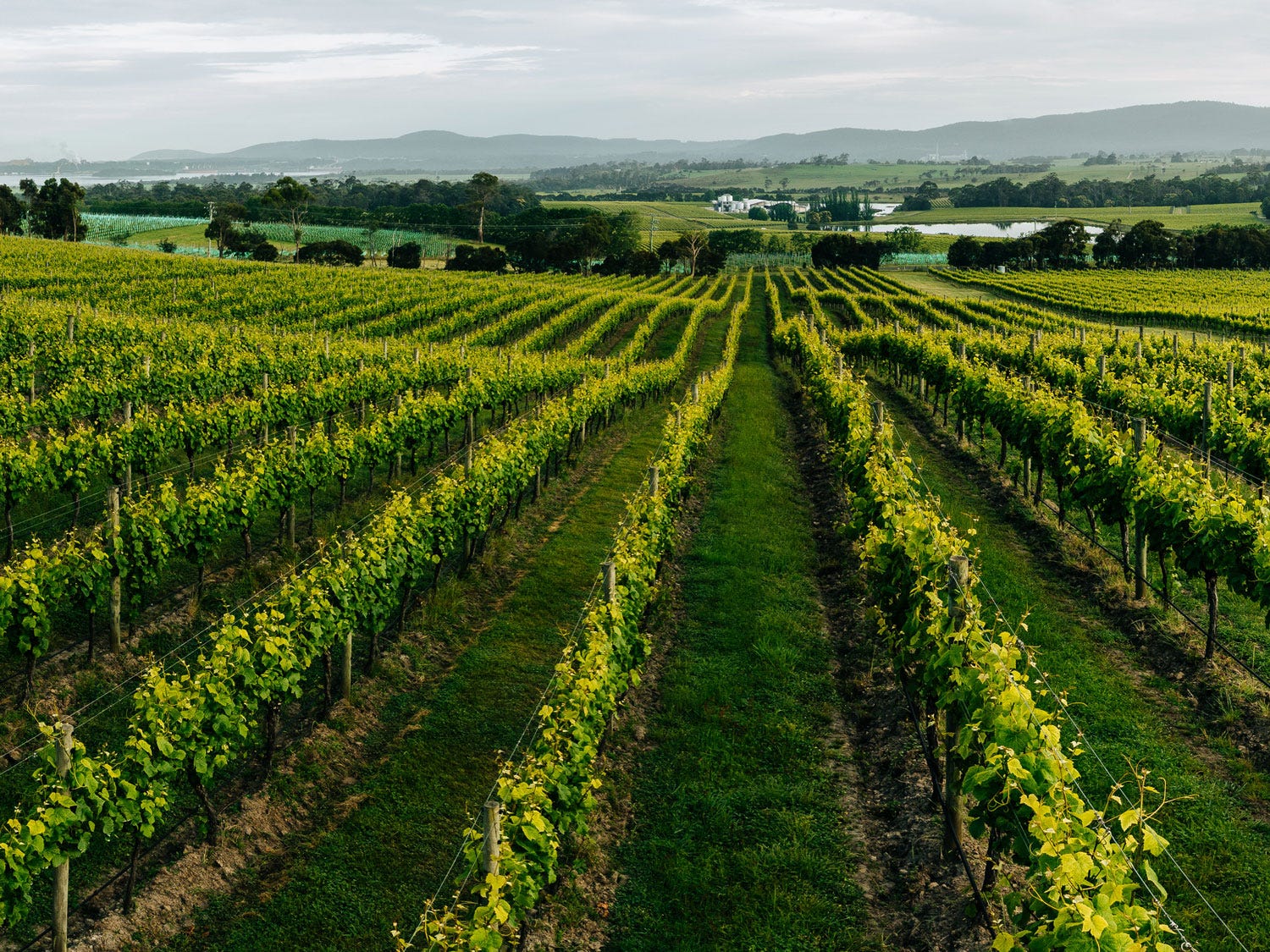
Hello grey skies: Small Wonder’s vineyard in the Tamar Valley, Tasmania
The latest episode of my Get Yourself a Glass podcast is out: The Greek wine revolution: Victoria Moore and I look at just why Greek wine is so exciting right now, talk to leading players and tell you what to look out for. On Apple, Spotify or wherever you get your podcasts.
As you’d doubtless expect from an on-trend drinker like me, I’ve been enjoying quite a lot of chilled red in this weather, as this week we enter what we are told is the fifth heatwave of the year (I hadn’t noticed much of a break between them.) The heat does create real challenges for drinking red wine: in an Italian restaurant in north London a couple of weeks ago, I resorted to putting ice in the glass of blood-warm wine I’d been served. The following are some Italian reds I’ve recently enjoyed properly chilled.
Marco Sara Schiopettino 2018, DOC Friuli Colli Orientali – Schiopettino is native to Italy’s far northeast and is works well slightly chilled, as this one was: fragrant, peppery, cherry fruit and clean, spiky acidity. Very moreish (I think I bought from the Wine Society but the 2018 appears to be available now only from Lay & Wheeler by the half case; other recent vintages available from Lay & Wheeler in bond, or from Call Me Wine, £21.)
Sa Raja “Inkibi” 2024, Cannonau di Sardinia – Cannonau, as Grenache is known here, is Sardinia’s most characteristic red. Bright, sweet fruit with a balancing undertow of earthy tannins. I drank by the glass at Bermondsey Street’s excellent Vine wine bar (All About Wine, Charlie’s Drinks Store, from £16.49. Other recent vintages available from NY Wines and elsewhere.)
Vino di Anna “Sfuso di Anna” 2022, Sicily – “sfuso” usually refers to bulk wines in Italy, though this is far from that. Made from biodynamically grown grapes, this is mostly Nerello Mascalese plus a little Grenache and Nerello Cappuccio. A natural wine – little or no added sulphur dioxide – which doesn’t taste like it: lovely fresh, sweet, expressive fruit with refreshing acidity and a seam of minerality (Les Caves de Pyrene, Monty Wines, Bottle Apostle and elsewhere, from £20.80.)
No posts
Comments
Nothing yet. Say the first thing.
Sign in to join the conversation.