
The latest episode of my Get Yourself a Glass podcast explores the Greek wine revolution. Victoria Moore and I look at just why Greek wine is so exciting right now, talk to leading players – and tell you what to look out for. On Apple, Spotify or wherever you get your podcasts.
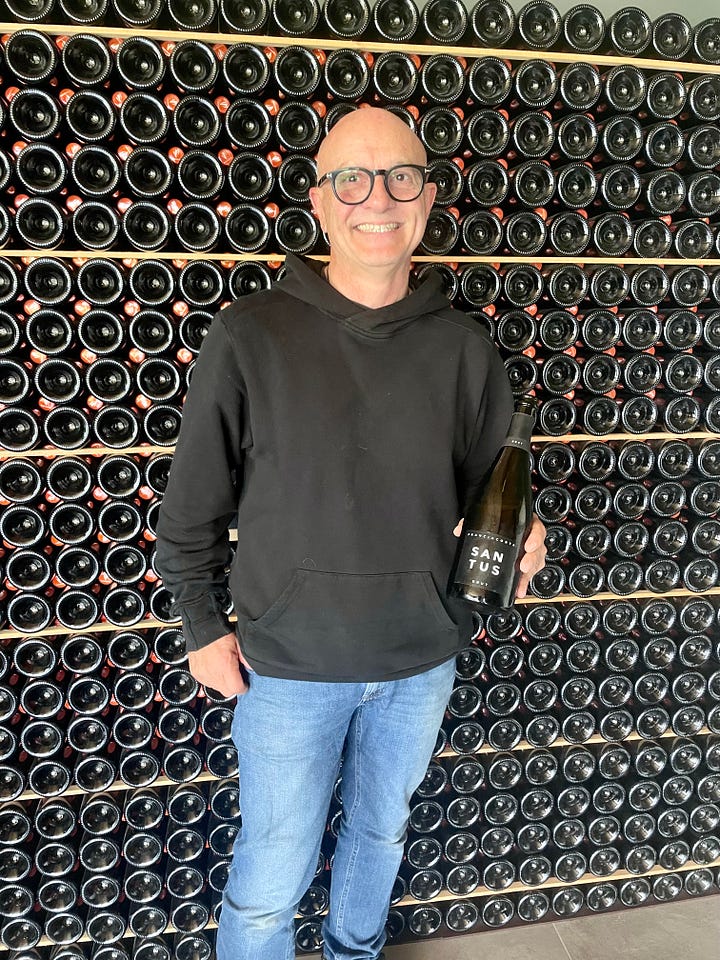
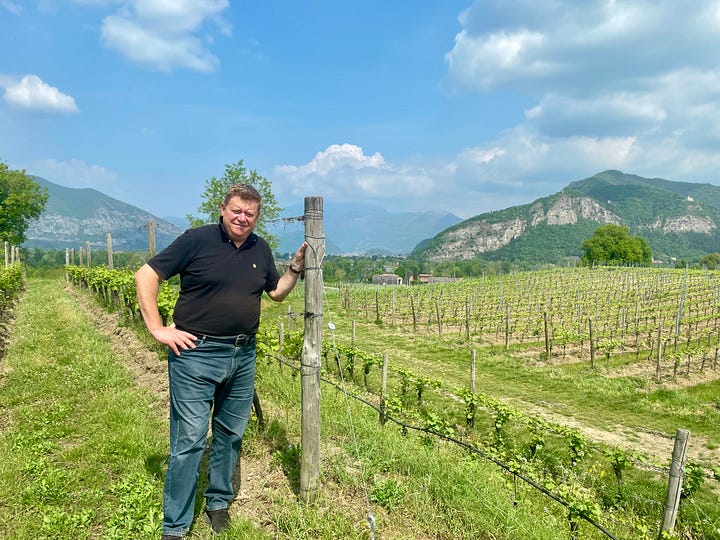

Silvano Brescianini is surveying his vineyards in Franciacorta when a Japanese sommelier, part of a tour group, approaches him excitedly to pose for a picture. Brescianini, CEO of Barone Pizzini, says he is leaving for Japan the next day: it is his number two export market. And yet at a big reception in a Verona palace the same week, at the Vinitaly fair in April, only Champagne and prosecco were on offer to guests: no sign of Franciacorta, Italy’s premier sparkling wine – but still far from its best known.
The quality of top Franciacorta is higher than ever. The best bears comparison with serious Champagne, and the fizz has a healthy following in Switzerland and Japan especially. And yet, says Bellavista’s Irene Verzeletti, “People in Italy still struggle to understand the difference between Champagne and Franciacorta.”
Franciacorta lies in the east of Lombardy and the Italian lakes, west of Garda and hugging the southern shore of Lago d’Iseo. The fourth-largest of the Italian lakes at 25 kilometres long, Lago d’Iseo plays a key role in moderating temperatures in the vineyards, keeping them warmer in winter and cooler in summer.
Sparkling wine is relatively new here, first made only in the late 1950s. The area was granted official Denominazione di Origine Controllata status in 1967: unlike any other Italian sparkling wine at that point, the rules specified that Franciacorta had to be made using metodo classico (like Champagne) rather than the cheaper and quicker Charmat tank method used in Prosecco and elsewhere. Still, Franciacorta didn’t really take off until the mid-90s.
Franciacorta’s grapes reflect that era of Italian winemaking: Chardonnay dominates, along with Pinot Noir, although a little Pinot Blanc is used in some cuvées. There are also tiny quantities grown of Erbamat, a near-extinct local white grape that has been partially revived – it is more resistant to hotter conditions appearing with climate change – though only around 11 hectares have been planted to date.
To this day, Franciacorta’s total production remains relatively small, at around 20 million bottles a year produced from 2,200 hectares – not a great deal larger than English sparkling wine’s total in a good year. That compares to 266 million bottles of Champagne shipped last year, never mind the 667 million bottles pumped out by Prosecco in 2025. Production remains mostly in the hands of family firms: as yet no big foreign player has moved in, unlike England with its investments by Champagne houses. The largest Franciaciorta producer remains Berlucchi, turning out around four million bottles a year.
As in Champagne, most producers lead with their non-vintage blend. “Non-vintages are your business card, the representative style of the house,” says Stefano Graffi, winemaker at Monzio Compagnoni. “I always say the Brut NV takes the most of my time – it has to be consistent.” Again as in Champagne, bigger producers will use many different parcels to achieve a non-vintage house style: Bellavista’s Assemblage 2 NV Extra Brut, for example, incorporates fruit from 93 different plots.
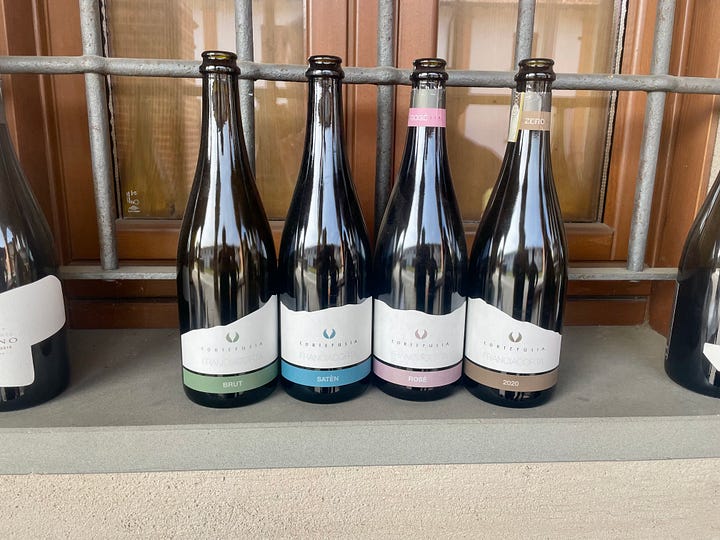
Also like Champagne, there is currently a trend towards drier styles, labelled as “Pas dosé” or “Zero dosage” wines (less than two grammes of sugar per litre added). Gigi Nembrini, agronomist at Corte Fusia, grows his grapes on the slopes of Monte Orfano, in the far southwest of the zone; the house’s style is bone dry and elegant, though he admits that “when we started [2010], it wasn’t what consumers wanted.” Today, tastes seem to be changing. Santus, by contrast, has a philosophy of picking grapes a little riper: “We don’t need to copy the Champagne style, we’re Mediterranean,” says co-owner Gianfranco Pagano.
Wine is also made in the “Satèn” style, peculiar to Franciacorta, with finer bubbles and slightly lower bottle pressure. This has to be made exclusively from white grapes, and given at least 24 months on its lees. But all Franciacorta has to spend a minimum of 18 months on lees while riserva wines must have at least 60 months. Some top cuvées can however spend 72 months (ie six years) or more on lees.
Such cuvées are pricey, and indeed one of Franciacorta’s challenges is convincing consumers that these price tags are worth it compared to prestige Champagnes. For example, Bellavista’s top vintage cuvée, Vittorio Moretti, retails at upwards of £80 in the UK. There is a sense among British wine merchants that Franciacorta is at the top end of price for what’s in the bottle compared to other regions and styles, even if the quality is good.
This is one of Franciacorta’s parallels with English sparkling wine: while Champagne remains the benchmark for quality, these wines have to convince buyers that they’re worth it when priced accordingly – especially when the more familiar Italian sparkler, Prosecco, is also the cheapest alternative. “It is a hard sell,” says David Gleave, Chairman of leading UK importer Liberty Wines and an Italian specialist. “The competition isn’t only Champagne. In the UK, it is English sparkling wine as well. There is only so much space on a wine list, so Franciacorta really needs to fight hard to get into that space outside of the ‘safe space’ of Italian restaurants.”
Franciacorta faces a similar challenge to English wines too in that it is expanding without any internationally recognised brands. “Berlucchi, Bellavista and Ca’ del Bosco are all good brands, but they don’t have sufficient resonance outside a small group of cognoscenti,” says Gleave. While hand-selling is a logical way to start off a brand, it can only take you so far in the luxury sparkling export market. To do well there, up against the deep pockets of the big Champagne houses, you need international brands and tens of millions of euros in marketing budgets.
Nobody in Franciacorta has that. Few producers export more than 20 per cent of their output; as a whole, the area exported 12.8 per cent of production in 2025. Nevertheless, increasing exports is one of the key goals of the Franciacorta Consorzio, the professional body for the region’s growers. Aside from Switzerland and Japan, leading markets include Germany, Belgium and the US: exports to the latter climbed by 1.7 per cent last year despite the challenge of tariffs.
The Consorzio has made a particular effort to exploit the international image of Italian design. At Santus, Pagano says that their elegantly minimalist design is crucial: “We got into Japan because of the label,” he thinks. Major producer Ca’ del Bosco is known for its sponsorship of art and especially sculpture. Franciacorta is a sponsor of Milan Fashion Week and is its official sparkling wine. At this April’s Milan Design Week, it ran an immersive installation as part of the Slowear brand’s show.
Nevertheless, it is the Champagne comparisons that are the challenge as well as the international benchmark. “We’re still finding a way to express ourselves without comparing the whole time,” says Bellavista’s Verzeletti – and to justify Franciacorta’s premium price positioning in Italy. Charles Lea, of London wine merchant Lea & Sandeman, imports Franciacortas from Federico Fossati’s Corte Aura estate: he is a fan but says that “there’s a lack of awareness of what it even is among our customers” and that “there has to be some issue of confusion with Prosecco too.” Says Monzio Compagnoni’s Graffi: “I don’t think [the UK] is the easiest market.”
It is a similar situation in the US. Michael Rioles is Italian Portfolio Manager at Ideal Wine & Spirits, Monzio Compagnoni’s Massachusetts importer. He say the wines “sell quite well, especially in the last couple of years where prices of Champagne have steadily climbed, and have been pushed higher by the combination of tariffs and a weaker dollar”. Rioles, who also owns a wine store, adds, “The [Monzio] wines are very much a hand sell, though we pour them at least a couple of times a year, always to a very positive response. It helps that that there is a story to tell for both the producer and the appellation.”
In other words, Franciacorta needs to show why it is different – because it certainly is. It’s a sparkler on a whole different level of quality to Prosecco or the other northern Italian alternatives, such as Trento. It’s a distinctively Italian alternative to Champagne, generally softer, more fruit forward and with less acidity than the French wine. It deserves to be on good restaurant wine lists.
“I never say that Champagne is a competitor – we were only born in 1996, so we’re different,” says Anna Zanardini of Ronco Calino, a smaller organic house producing around 80,000 bottles a year. “It’s about trying to tell a story, not being afraid of being different, and having a strong personality.”
A longer version of this piece appeared paywalled in The Drinks Business’s Italy Report last month.
Sadly, retail availability of Franciacorta is pretty limited in the UK and most of the wines I tasted there are not yet on sale in wine shops here – though you may see other producers I mention on restaurant wine lists.
Monzo Compagnoni “Alla Moda” Brut NV – Monzo Compagnoni’s straight non-vintage is one of the best I tasted. From a base of the 2023 with some reserve wines, it’s made from 90 per cent Chardonnay with just four grammes dosage (added sugar at disgorgement) – so pretty crisp and dry. Very fresh, peach and apple fruit, well balanced, super elegant (Harvey Leonards, £38.)
Barone Pizzini Satèn 2021 – the fruit for this is organically grown and comes from several different vineyards. Low dosage, so crisp and bright, apple fruit with bready notes, elegant with some length – good (Xtrawine, £34.)
Corte Fusia Dosaggio Zero 2020 – the fruit from this is 80 per cent Chardonnay, 20 Pinot Noir, from several different vineyards, and it has had over four years on its lees. Very much in the dry, crisp Corte Fusia house style: light and bone dry but balanced, elegant, and long. Classy (Xtrawine, £36. The 2015 is at Cépage, £36 – which will be better with five more years’ bottle age on it.)
Santus Brut NV – this is in fact made entirely from the 2023 vintage, though undeclared as such. A blend of 80 per cent Chardonnay and 20 Pinot Noir that has had two years on its lees, this is really good for what is ostensibly a non-vintage. Quite rich, subtle peachy fruit but fresh and well balanced, very appealing (the NV isn’t in UK retail but Dolce Vita Wine Club has the 2020 and 2022, £28.50.)
I’ve been on holiday in Brittany for the past two weeks: as my supply of bottles from home and a trip to the Muscadet country dwindled, I was depending on the area’s only serious wine shop, La Cave d’Erquy. Opened in the seaside town of that name in 2012 by owner Gaëtan de Bozzi, it offers a remarkable selection leaning heavily to organic, biodynamic and natural French wines. Inevitably, I’m afraid, most of the following aren’t available retail in the UK. But they’re what I’ve been drinking this past week.
Verdier-Logel “Petite Vertu” Viognier 2025, IGP Urfé – I had to look up Urfé, an obscure designation in the far reaches of the upper Loire, just west of Lyon. This family producer has been certified organic for almost 30 years; they grow mostly Gamay and a little white. But while it may be obscure, this is a beautiful Viognier at a great price: fragrant, light, classic apricot notes, lovely freshness (ca €12, N/A UK.)
Trinity “Le Temps des Copains” 2023, Vin de France – an oddity, made by leading Muscadet biodynamic producer Domaine de L’Ecu. The grapes are 80 per cent Grenache and 20 per cent Cinsault, organic, and seem to be from the Rhône – though from where exactly, and why Domaine de L’Ecu made it, is not clear. It appears to have been made only in this and one other vintage. Light, fresh, earthy, hard to pin down – though as the producer says (“un vin sans chichi ni tralala”), it’s an unpretentious wine for quaffing (ca €16, N/A UK.)
Château Boucarut “Pierres Vivantes” 2023, Lirac – from an organic producer, this is a blend of Grenache, Syrah, Mourvèdre and Cinsault: fresh, spicy, peppery, sweet cherry fruit underpinned with firm acidity and structure. A good example of why Lirac is the poor man’s Châteauneuf-du-Pape, just a couple of kilometres east of here across the Rhône (ca €15; the 2022 is in the UK at Vin Gusto, Salusbury Winestore, Cellar Door, from £25.95.)
Domaine de Rapatel “Clos Cyril” 2011, VdP du Gard – another oddity, and not just because of its age: made just outside Nîmes (it doesn’t seem that this cuvée is still made) it’s a Cabernet Sauvignon/Merlot blend, unusual for the Languedoc and especially for a biodynamic, low-intervention producer like this one. Not surprisingly, it has quite a Bordeaux character in its mature, leather and cigar-box notes, but with more power at this age, its fruit intensifying to deeper, pruney notes. But still fresh, balanced and complex. Beautiful: I’d have brought some home but it was the store’s last bottle (ca €20, N/A UK.)
No posts
Comments
Nothing yet. Say the first thing.
Sign in to join the conversation.