
The latest episode of my Get Yourself a Glass podcast is out: the Greek wine revolution. Victoria Moore and I look at just why Greek wine is so exciting right now, talk to leading players and tell you what to look out for. On Apple, Spotify or wherever you get your podcasts.

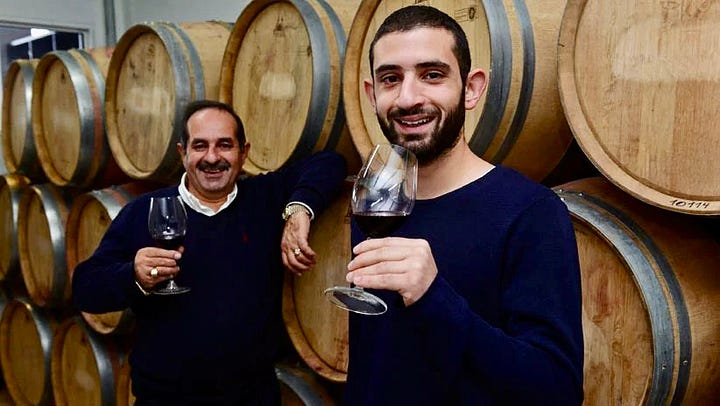
Considering the challenges of making wine in the occupied West Bank and exporting it to Europe, it seems a near-miracle as I sip Taybeh Winery’s “Nadim” Syrah 2022 with Franco-Palestinian chef Fadi Kattan in London. Kattan revolutionised Palestinian restaurant food with his Bethlehem eaterie Fawda in 2014; then he brought his modern take on family classics to London in 2022 with his Notting Hill restaurant Akub. But while he has long served Palestinian wines there, this year has seen the expansion of his importing business, Nabeeth Wine and Spirits, with a soon-to-be-live retail website and distribution to independent wine shops.
“I don’t want people to come to Akub or buy Palestinian wine because they feel bad for Palestine,” says Kattan. “I want them to because it’s an excellent product.” Certainly, Akub offers some of the best and most original Arab food in London, while the handful of operating Palestinian wineries make excellent and unusual wines. Yet life for Palestinian winemakers is becoming steadily harder.
Growing grapes and making wine have an ancient history in Palestine, with grape cultivation near Jericho as long ago as 9,500 BC and winemaking over the last 5,000 years. Grapes remained one of the most important local crops over the centuries, even if mostly for eating or use as molasses (they are still the second-most-important crop after olives.) Winemaking was frowned upon by the Ottoman authorities until the latter years of the empire.
The modern wine industry was started by German Christian settlers in the 1870s. Jewish settlers in what is today Israel first planted vines in the 1880s, while Italian monks established the Cremisan winery near Bethlehem in 1885. Though the Palestinian wine industry was and is owned by Christians, for obvious reasons, there was historically little tension between Palestinian Christian and Muslim communities prior to the rise of jihadist groups led by Hamas at the turn of the last century.
The establishment of the state of Israel in 1948 upended the Palestinian wine industry. Ashkar, in Upper Galilee, is today one of just two Palestinian-owned wineries inside Israel. Prior to 1948, the family had grown grapes and made wine for generations around the village of Iqrit. Then, like hundreds of thousands of Palestinians, they were forced off their land by the Israelis (the same thing happened in 1948 to Kattan’s family, who owned large orange groves near Jaffa.) In 1951, the Israeli army razed Iqrit. Only in 2010 did Nemi Ashkar finally re-establish a winery, in Kufur Yasif, making wine with grapes bought from the new Jewish owner of a vineyard in Iqrit.
However, Ashkar and the other Israel-based Palestinian producer, Jascala, at least have some formal legal protections as Israeli Arab citizens. Things are far harder in the West Bank, illegally occupied by Israel since 1967, whose Palestinian citizens are subject to military law (no wine is made in Gaza.)
“It’s been getting more difficult year after year,” says Taybeh Winery’s winemaker, Canaan Khoury. “Everything is affected by the security situation.” Khoury’s family set up first a brewery and then, in 2013, a winery in Taybeh, a historically Christian village 12 kilometres northeast of Ramallah. They now produce around 35,000 bottles of wine a year, for which they grow around a third of grapes, while buying in the rest from Palestinian growers.
One of the biggest challenges is water, in a region that is hot and getting hotter and dryer with climate change. Taybeh village depends for water on a well three kilometres away, operated by a Palestinian company. But it does not produce nearly enough water for local villages’ needs: the rest has to be bought at grossly inflated prices from Mekorot, the Israeli state-owned water company, who pump from a neighbouring well. Local Israeli settlers, meanwhile, have unlimited access to cheap water from Mekorot – even though neither the company nor Israel owns the water.
At the same time, getting around within the West Bank is difficult, with numerous flying Israeli military checkpoints that can hold up everything from supplies to commuting workers for hours. At other times, the army blocks access to land, sometimes during harvest. Meanwhile the Israeli army has bulldozed thousands acres of Palestinian farmland, some of it vineyards. Earlier this year they targeted vines, olive and fig trees in the Baqa’a Valley, east of Hebron, while extending Route 60, a military highway linking Israeli settlements across the West Bank.
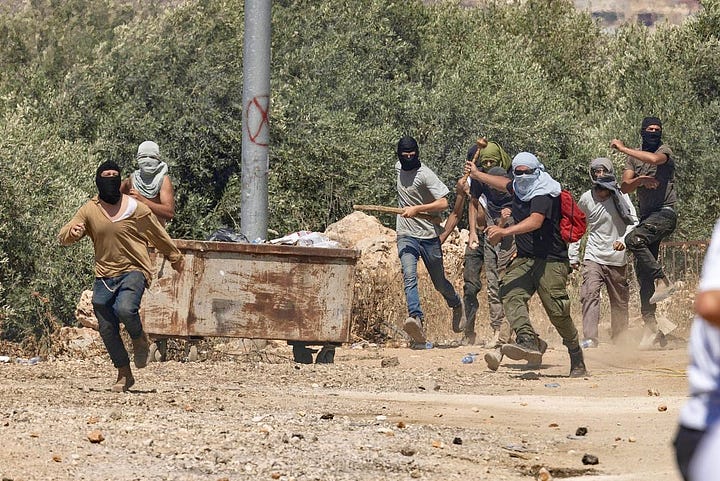
Palestinian farmers including grape growers are also facing a rising tide of violence from Israeli settlers. “We’re choked from every aspect,” says Khoury. Days before we spoke, a clash with settlers at one of their growers resulted in a fire that burnt the vineyard from which they source their Cabernet Sauvignon grapes. Settlers regularly attack Taybeh village’s water supply, breaking pumps and equipment.
Elsewhere in the West Bank, settlers have cut down vines and olives trees, stolen livestock, burnt cars and buildings, and attacked and killed Palestinian farmers – all with little or no intervention by the Israeli army. Back in 2018, Israeli human rights NGO B’Tselem documented settler attacks over a two-month period that destroyed more than 2,000 trees and vines. Some left behind graffiti in Hebrew reading, “There’s no place we won’t reach.” Last year members of the extreme-right “Hilltop Youth” movement from nearby illegal settlements destroyed a third of the vines at Domaine Kassis, near Birzeit. “This is part of a very organised programme of trying to chase us off our land,” owner Sari Kassis told the London-based New Arab website.
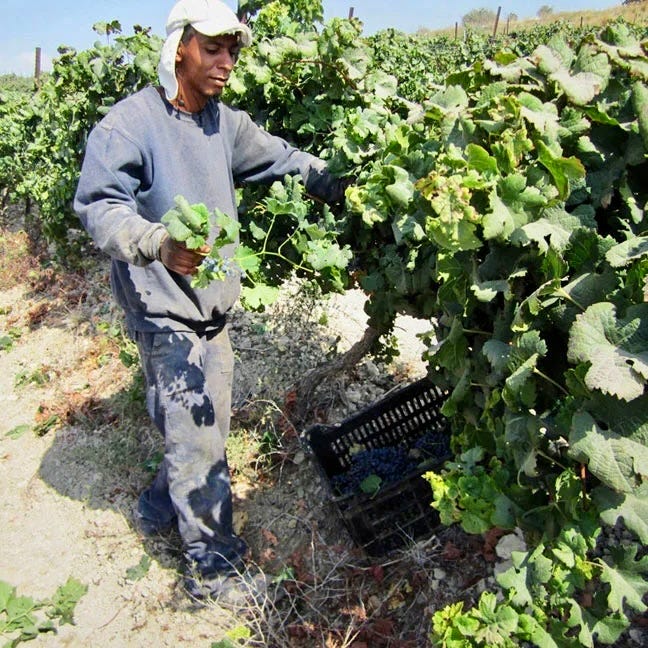
“Picking season is quite dangerous – there’s always a danger when we’re working in the fields,” says Khoury. His uncle was shot at by settlers while picking grapes. “It’s clearly a systematic process, army and settlers working together,” explains Khoury. “And while for example settlers grazing their sheep on your vineyard and eating the grapes is a bit different from the army bulldozing a water reservoir, both are pretty destructive.” The sum effect is that grape prices in the West Bank are eight times what they are in Lebanon.
The challenges don’t end with harvest. As the West Bank is landlocked, Palestinian producers have to export through Israel, via the ports of Haifa or Ashdod. Trucks can wait a day at Israeli army checkpoints, and the wine must then be transferred to another truck hired in Israel. The bureaucracy is a nightmare: “they come up with new regulations the whole time, there’s always something changing,” says Khoury. One day, the army told him that the wine bottles couldn’t be packed horizontally: he had to go back to the winery, re-pack the bottles vertically and come back the next day.
Most exports go to Europe, especially the UK, France, Norway, Denmark and Switzerland. In the US and Canada, Palestinian wine is banned from being labelled “Made in Palestine”: it must instead be marked, “Made in the West Bank”. Conversely, wine made in the West Bank by Israeli settlers, or made in Israel from grapes grown by West-Bank settlers, is often falsely labelled “Made in Israel”, a practice last year labelled “deliberate fraud” in an Oxfam report. In the EU, products made in Israeli settlements must be labeled as such – though most such wine is not.
In an investigative report earlier this year, French monthly Le Monde Diplomatique found that the Hebron hills are "among the fastest-growing wine areas" for settler vineyards. In this way the wider Israeli wine industry benefits from the occupations of Palestine and the Syrian Golan Heights. Indeed a 2011 report by the NGO Who Profits concluded that “all of the major Israeli wineries use grapes from occupied territory in their wines.”
“It’s about forcing people to think a bit about how they consume,” says Kattan. “I won’t source products from a place that doesn’t have human sustainability as well as environmental sustainability.”
One end result of the many travails of Palestinian winemakers is that their wine is comparatively expensive. Nabeeth’s Anna Patrowicz, also Akub’s sommelier, points out that the wines “are priced not by marketing, but by the true cost of making exceptional wine under exceptional circumstances. Yet our winemakers refuse to compromise on quality.” She adds: “When you buy a Palestinian wine, you're not paying a premium for a story—you're paying the honest price of craftsmanship, resilience and one of the world's oldest continuous winemaking traditions.”
And Palestinian wine is indeed different. Some wines from the four producers that Nabeeth imports are partly made from some of Palestine’s 23 unique indigenous grape varieties. Those ancient materials combined with modern winemaking techniques can create something new. It’s something like the way that Kattan describes his own take on Palestinian cuisine (I wrote about Kattan and Palestinian food in 2024.) He talks about giving Palestinians back their faith in their own cuisine: when Kattan ran the first Palestinian cooking competition in 2003, he says most of the food was still French. Now Palestinian winemakers are doing something similar with distinctive local grapes such as Baladi and Bitouni.
How do Palestine’s winemakers keep going under such conditions? “We feel like we have no choice but to continue,” says Khoury. “Either that or you quit and emigrate” – exactly what extreme-right Israeli Finance Minister Bezalel Smotrich has said he wants to “encourage”. But Khoury adds, “And on the other hand, when you do achieve something and export, despite everything, the satisfaction is higher.”
Kattan feels the same way. He lives in what was his great-grandfather’s house in Bethlehem. “Whenever I think, what am I doing here?” says Kattan, “I think of them [his grandfathers and great-grandfathers] sitting out Ottoman and then British rule, then the Jordanians, then the Israelis. And I’m thinking of leaving now?” Aside from anything else, this country’s wine and food is worth hanging on for.
Perhaps not surprisingly, Palestinian wines are not yet widely available in the UK: if you’re in London, your best bet is Akub restaurant, which serves a good range, including by the glass. Akub also sell Taybeh Brewery’s excellent beer, made by Canaan Khoury’s sister Madees, the Middle East’s only female brewer. Maramia Café in Portobello Rd, London’s other dedicated and very good Palestinian restaurant, also sells Taybeh wines and beers.
Cremisan Dabouki 2023 – Dabouki is probably Palestine’s most iconic (white) grape. White flowers and sweet peach fruit, distinctive but easy (Wild & Lees, £35). Wild & Lees also stock the same producer’s rosé.
Taybeh Bitouni 2021 – Bitouni is another local white grape. A little more weight to it than the previous wine, sweet, expressive fruit and nice balancing acidity (Cellar Door, £44.95)
Taybeh Zeini 2024 – the grapes for this white wine, native to Palestine and Lebanon, are sourced from 1,000 metres up in the Hebron hills. Distinctive herby notes, apple and pear fruit, a mineral seam to it (Cellar Door, £38.95)
Cremisan Baladi Red 2024 – made from the key local red variety, this wine from Palestine’s oldest operating winery is quite pale; lots of fresh cherry fruit, dusty tannins. Different and very good (Cellar Door, £37.95)
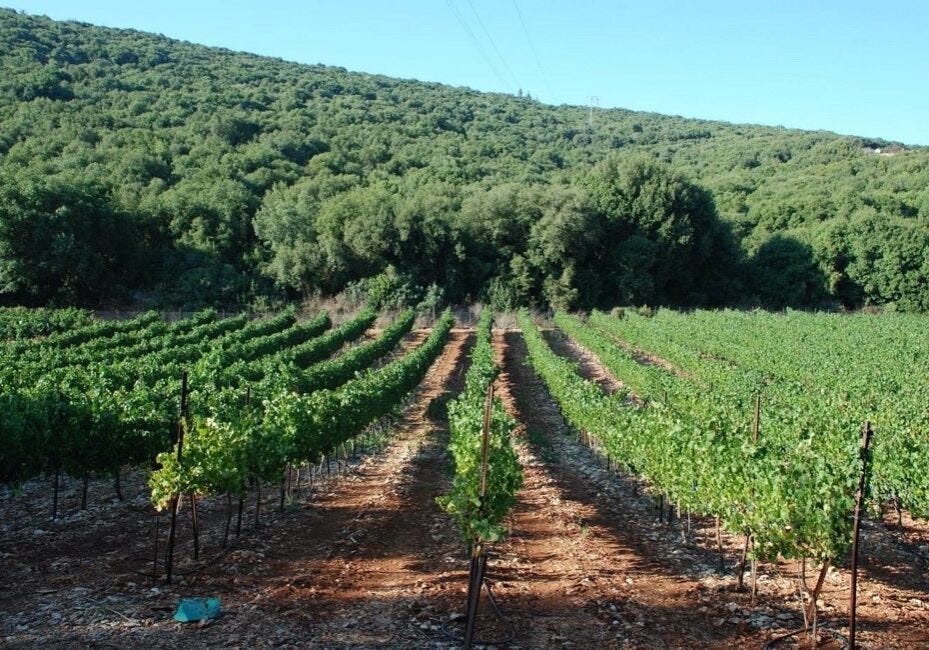
Lyrarakis “Queen” Vilana 2024, Crete – a crisp, citrusy white from ever-reliable Crertan producer Lyrarakis, made with one of the island’s indigenous grapes, Vilana. What sets this one apart from so many similar, herby local whites is that it has a little more weight to it and an almost oily note to its flesh on the palate (Roberts & Speight, Ellis Wharton, from £12.99. Other recent vintages available elsewhere.)
Cluricaun red 2024, Lisbon – Cluricaun is an organic, low-intervention side project of Quinta do Montalto (they make an orange wine too). I drank a glass of this chilled at my local wine shop, Wild & Lees, on a typically hot day last week and was thrilled by the bright, sweet strawberry fruit and spiky acidity (as well as the coolness). Lovely (Gnarly Vines, Wild & Lees, from £17.50.)
Bodegas Félix Callejo “Parajes del Callejo” 2020, Ribera del Duero – winemaker Noelia Callejo has carved out a name for the family firm as one of Ribera’s most serious producers. This is one of their higher-end cuvées which I brought back from a visit a couple of years ago (opened for old friends at the weekend.) Spicy, bright red berry fruit and fresh acidity balance silky tannins and nicely integrated oak. Excellent Ribera (the 2020 doesn’t appear to be available retail in the UK but the 2022 is at Virgin Wines, Cellar Door, Salusbury Winestore and elsewhere, from £27.99)
No posts
Comments
Nothing yet. Say the first thing.
Sign in to join the conversation.