
Hello Friends,
This post may not seem to immediately apply to the topic of building a Great House, but stay with me. I have been having a series of conversations about AI, aristocracy and why everyone is thinking about multi-generational structures, but before I can share with you I need to establish some definitions and distinguish what I find to be unhelpful confusion in some of the words that everyone is using. The first such word is Agency.
If you spend any time observing the culture of Silicon Valley or the modern corporate elite, you will inevitably encounter this modern “everything” word.
Now I want to preface this discussion by saying that there are INCREDIBLY useful and helpful discussions of agency, for example in this recent article by Johann Kurtz or in the book that Noah Revoy wrote some years back. These are helpful and positive framings of the word agency, and I am not taking issue with them.
What I am taking issue with is the assumption that the limiting factor (and therefore the thing that needs to be addressed) is ALWAYS agency or the lack thereof. It is important to understand that by the very nature of things there can be different limiting factors in a given situation.
The concept of a limiting factor in growth or processes refers to the idea that progress is constrained by the scarcest or most restrictive resource, preventing further advancement until that bottleneck is addressed, much like a chain is only as strong as its weakest link. This principle, often associated with Liebig’s law of the minimum, applies across various domains, from ecology to manufacturing, where the availability of essential components dictates the overall output. For instance, in the Solvay process, an industrial chemical method used to produce sodium carbonate (soda ash), key ingredients include sodium chloride (brine), ammonia, carbon dioxide, and water, along with limestone for calcium carbonate regeneration. If you have an abundance of brine, ammonia, and water but only a limited supply of carbon dioxide, the reaction sequence (which involves forming ammonium bicarbonate and then sodium bicarbonate) will halt once the carbon dioxide is depleted, limiting the yield of sodium carbonate regardless of the surplus in other reactants. However, once you resolve the scarcity of carbon dioxide by sourcing more, another ingredient, such as ammonia, which is recycled but can degrade over time, may emerge as the new limiting factor, requiring DIFFERENT SOLUTION to sustain or scale the process.
The same thing is true in management. In human resources and talent management, for example, a company might have strong recruiting pipelines that attract plenty of candidates, ample budget for competitive salaries, solid onboarding processes, comprehensive training programs, effective quality control in performance reviews, and even decent benefits packages. However, if poor management practices; such as weak leadership, micromanaging, or lack of empathy from direct supervisors; persist, employee retention will suffer dramatically, with high turnover rates draining resources and halting overall progress regardless of how well other areas perform. Once leadership quality improves through targeted manager training, better feedback systems, or cultural shifts, the limiting factor often shifts to something else, like insufficient career development opportunities or unclear advancement paths, which then caps engagement and long-term growth. Or consider quality control in a manufacturing firm: abundant skilled workers, modern equipment, and rigorous training might exist, but if raw material supply chains are unreliable and cause frequent shortages of a key component, production output stalls, quality suffers from rushed workarounds, and retention drops as employees grow frustrated with constant disruptions, until supply chain reliability is fixed, at which point another constraint, perhaps inadequate process documentation or skill gaps in newer hires, becomes the new limiter that must be addressed to sustain improvements.
My observation is that Agency is critical at solving human scaled problems, and is therefore necessary to every human. We might even say that Agency is another way of saying “the domain mastery of being human.” But not all of our problems are human scale, and this continues to increase. There are numerous intractable problems that agency not backed by actual skill in a domain (which often requires humility) cannot and will not solve.
As comedian Brian Regan once noted, “Catholics see Mary everywhere, Protestants see Satan everywhere.” Well, modern tech bros see agency, or more properly, the lack of agency, everywhere. But if you pause and ask them to actually define what this magical aura of “agency” is, you inevitably get a list of qualities that are remarkably specific to the success conditions of a 21st-century software developer living in California.
In a recent discussion with RosebudKane, he offered a brilliant insight: “the tech elite produced this term [agency] because they desperately want to believe that their specific skillset is universal. They like to imagine that their “agency” would have made them just as successful as a Yakuza member in 1962, a courtier at Versailles, or a General in the Roman Army.”
This is, of course, patently absurd.
I could multiply examples of the “software engineer enters new domain and struggles” trope, but suffice it to say that even when the MOST successful tech elites, men like Elon Musk or Peter Thiel, attempt to enter the alien environment of geopolitics, they often struggle deeply. When faced with domains where their core skills are devalued or contradicted by reality, they find it distasteful and quickly withdraw back to the narrow domains where they can safely exert their famous “agency”. They do this even when it is more expensive to retreat than to simply step outside their self-imposed limits.
To understand why this happens, and how we can actually build the kind of competence necessary to sustain a Great House, I want to suggest a more profitable frame than universal “agency.”
We need to talk about Domain Mastery.
The Magic of Automaticity
Domain mastery is the ability to grow in a task to the point where a novice could not replicate your output no matter how long they were given to do so. It relies on a cognitive science concept called automaticity. Automaticity refers to the ability to perform a skill rapidly, accurately, and without conscious attention. By engaging in long hours of deliberate, focused practice, (Malcolm Gladwell popularized a study that picked 10,000 hours as the headline) humans can literally offload skills from their limited short-term working memory to highly efficient, unconscious processes in their long-term memory.
Once you have properly encoded these skills through meaningful practice, your brain architecture becomes optimized for that specific task. You can respond to tiny details instantly, often faster than a calm, deliberative process would ever allow. This automatized foundation frees up your cognitive resources to perform complex, layered “meta” tasks. There are different levels of “meta-tasks” for instance in driving, there is the point at which the actual motions of driving the car become automatic (turning the steering wheel, pressing the gas, brake and other pedals). Then there is the point at which certain operations become automatic, passing a car, going through an freeway interchange. At a certain point entire routes can become automatized leaving the mental bandwidth for the person driving to focus on other things (like podcasts).
What we mean by “mastery” or “geniuses” or “experts” is probably at least two levels of meta-tasking, at which point the master can do things that a novice cannot replicate NO MATTER HOW LONG HE WAS GIVEN TO COMPLETE THE TASK. This is the case in domains like the piano where pressing the keys, then mastering sight-reading require two levels of automatization and only THEN can the pianist focus on affecting the emotions of the audience by subtle variations in his playing that someone with such experience simply could not duplicate. Another example is sharpshooting, which is to say long-range firearms. There are a number of factors about the rifle that you have to master beyond the point of thinking about them before you can learn to shoot at long-range, even with modern tools.
The main point to understand here is when you practice EVERYTHING WE CAN MEASURE both in terms of your body and your brain optimizes for performing that particular task. Then at a certain point, automaticity takes over. One of the interesting things to understand about the studies that Gladwell was reviewing is that almost everything in life comes down to being able to practice discrete skills. Some domains might only take 1,000 hours, and others might take 30,000. There does not appear to be much in the way of talent that affects the actual attainment of mastery.
There are two preconditions to practice. The first is simply time, which is to say the ability to devote yourself to a particular craft without material considerations preventing you from doing so, access to the tools of the trade (which may or may not be common or cheap). The second is harder, which is to say a mindset of genuinely wanting to improve. Too much fear or desire likely affects the ability of a person to get into the right mindset. You have to be interested in improving and in many ways you have to love the subject. Interestingly, you will notice that both of these factors are at a minimum heavily affected by the socio-economic status of the practitioner (more on that in a future article).
Likely, one of the biggest reasons why children learn more effectively is that adults lack the second condition, the right mindset due to the frequent presence of a strong emotion which is pride (the wounded kind).
As anyone who has tried to teach a second language to adults can tell you, the hardest thing about it is the constant shock of the status imbalance. You have to go from being a fluent, acknowledged expert in your own language to sounding like a babbling child or an idiot. Most humans, especially highly successful ones, will do absolutely anything to escape this painful loss in social status.
One of the most interesting things in modern cognitive science is that it is actually quite difficult to parse the difference between neuro-plasticity and the humility that is necessary to learn effectively. That is to say that it could be the case, that “faith like a child” is the primary qualification to learn at any age, or at least that the genuine age-related differences are so subtle that current science cannot distinguish the two.
This is likely what “talent” or “genius” is, some kind of early formative experience of a positive nature with the underlying skill or technology that leaves an imprint on the person that says, “I can do this, I am good at this, I am HAPPY and INTERESTED in this.” That mindset will allow someone to keep on practicing effectively until their body and brain really DOES optimize sufficiently to allow them to do something that others cannot do.
What this means is that differences in personality and interest (some subtle and some not so subtle) matter GREATLY in terms of who achieves mastery in a given domain. The demands of strong practice reward those who enjoy the process. When we recognize that some domains reward the peak performers (famously youtube), some domains reward general competence (famously plumbers), and some domains are actively disincentivized by the economic system (such as family formation and parenting) this means that the character and personality quirks of the people that are “successful” in a given technology stack are relatively predictable, with the following caveat.
One of the real things that I believe is responsible for the universal agency myth, is that if you have a high amount of skill in one area, and you approach another area it is FREQUENTLY BUT NOT ALWAYS the case that your skills in one domain transfer to another.
However, this transfer of skills is only efficient if the new domain is “near” or closely related to your original domain. For example, if you have mastered one Romance language, learning Latin or French becomes much easier because the domains are “near” in that they have an actual overlap in the skills certain words, the grammatical structures, the underlying phonemes.
Beyond domains where the actual technical skills transfer are domains where the skills appear to be related as a result of the mental frameworks involved. For example, several warriors from Asian cultures recorded a great deal of overlap between the mastery of the strokes of calligraphy and the strokes of swordplay. The Western world meanwhile is replete with comparisons between the skill of a general (particularly of infantry for some reason) and forging steel. The physical skills in these cases are almost totally different from each other and yet the insistence on an overlap of mental framework is widespread among practitioners.
It is possible that this metaphorical overlap is simply a confidence mechanism, like talent, giving the practitioner of a new and different skill an optimistic and enjoyable mindset of the practice of a different skill. The metaphor allows someone who does not naturally enjoy the process of practice in a given domain to trick his brain into doing the hard work.
But if you will permit me I will present a DIFFERENT theory.
Most of you will be familiar with the concept of the “elephant and its rider” metaphor, popularized by Jonathan Haidt and supported by research from Ian McGilchrist. This metaphor illustrates the profound divide between human logic and intuition. The rider represents the conscious, rational, and deliberate side of the mind that plans and analyzes, but it is relatively weak and easily exhausted. The elephant represents the automatic, emotional, and intuitive side, which is powerful, fast, and drives most of our behavior through deeply ingrained instincts and gut reactions. While the rider appears to be in charge, it ultimately serves the elephant; if the powerful elephant decides to go in a certain direction, the weak rider cannot stop it and instead often simply justifies the elephant’s actions post hoc.
Another way of thinking about this tendency is the difference between the GPU and the CPU in the computer context. The “rider” functions like a CPU: it represents the conscious, rational, and deliberate side of the mind that handles logic and planning, but it is relatively weak and easily exhausted. The “elephant” is akin to the GPU: it is the automatic, emotional, and intuitive side of the brain that operates with immense speed and power, driving the vast majority of our behavior. Just as the tech industry has repurposed the massive, specialized processing power of the GPU for complex tasks like cryptographic or AI functions, humans can leverage the highly trained, automatic, visual processing, parts of their brains to efficiently solve new problems across different domains. However, because the logical CPU (the rider) cannot simply command the powerful GPU (the elephant) to change its course by brute force, you must “train” or “program” this intuitive center by feeding it narrative-based analogies, images, and metaphors that it naturally understands.
I believe that what the persistent metaphors of calligraphy and forging steel are doing is accessing the amazing powers of the Elephant/GPU part of the human brain.
One of the most interesting examples of this is the House-Tree-Person (HTP) test, developed by psychologist John N. Buck in 1948. The HTP is a widely used projective psychological assessment technique in which individuals (especially children!) are asked to draw a house, a tree, and a person on separate sheets of paper, often followed by questions about the drawings to elicit verbal associations. Rooted in projection theory, the test assumes that these simple, unstructured drawings serve as a window into the subconscious, revealing personality traits, emotional states, family dynamics, self-image, anxieties, and interpersonal attitudes through symbolic elements: the house typically reflects one’s sense of home, security, and family relationships; the tree symbolizes growth, vitality, and inner strength (e.g. trunk for ego stability, branches for outreach); and the person represents self-perception and social functioning. In children, the drawings often display surprising detail and emotional accuracy, such as exaggerated features, missing windows symbolizing isolation, leaning structures indicating instability, tiny figures suggesting low self-esteem, or vibrant yet chaotic scenes betraying underlying turmoil, far beyond what their conscious verbal explanations might convey.
This phenomenon exemplifies “querying the GPU” in the Elephant-and-Rider analogy (extended to computer architecture): the child’s rational mind (the CPU/Rider) is minimally engaged in deliberate, logical planning or self-censorship during the task, allowing the intuitive, pattern-recognizing “Elephant” (GPU) to be directly queried through a simple, narrative-like prompt (”draw a house”). The GPU-like emotional/intuitive system, trained on a lifetime of immersive sensory and affective experiences rather than explicit reasoning, outputs richly detailed, symbolically loaded images that capture subconscious truths with startling precision and emotional fidelity, much like how a well-trained neural network generates vivid, contextually apt visuals or narratives from evocative cues, bypassing step-by-step analysis to reveal what the conscious Rider might suppress or rationalize.
There is no reason to believe that this effect goes away in adults, especially as they confront large data sets whose scale prevents conscious evaluation. While a general, particularly an ancient general, likely cannot consciously analyze sufficient data to understand if his troops are “combat ready” he likely CAN ask the GPU, the elephant, the visual processing parts of his brain, “If my troops were a sword, is it well forged?”
This is not to say that some psychic power is in operation, quite the opposite. The brain is only using the information that you have given it, as you walk through the camp. It also is using YOUR trained instincts. An unqualified general who does not know what a proper Roman drill looks like, will not be well served by even the best metaphor, because his instincts are not trained on what excellence in the underlying domains looks like. Likely this is a critical part of what it means for domains to be “related.” Implicitly, some set of instincts about what the success strategy for the old domain are true of the new domain, that is they ACTUALLY lead to success in the new domain.
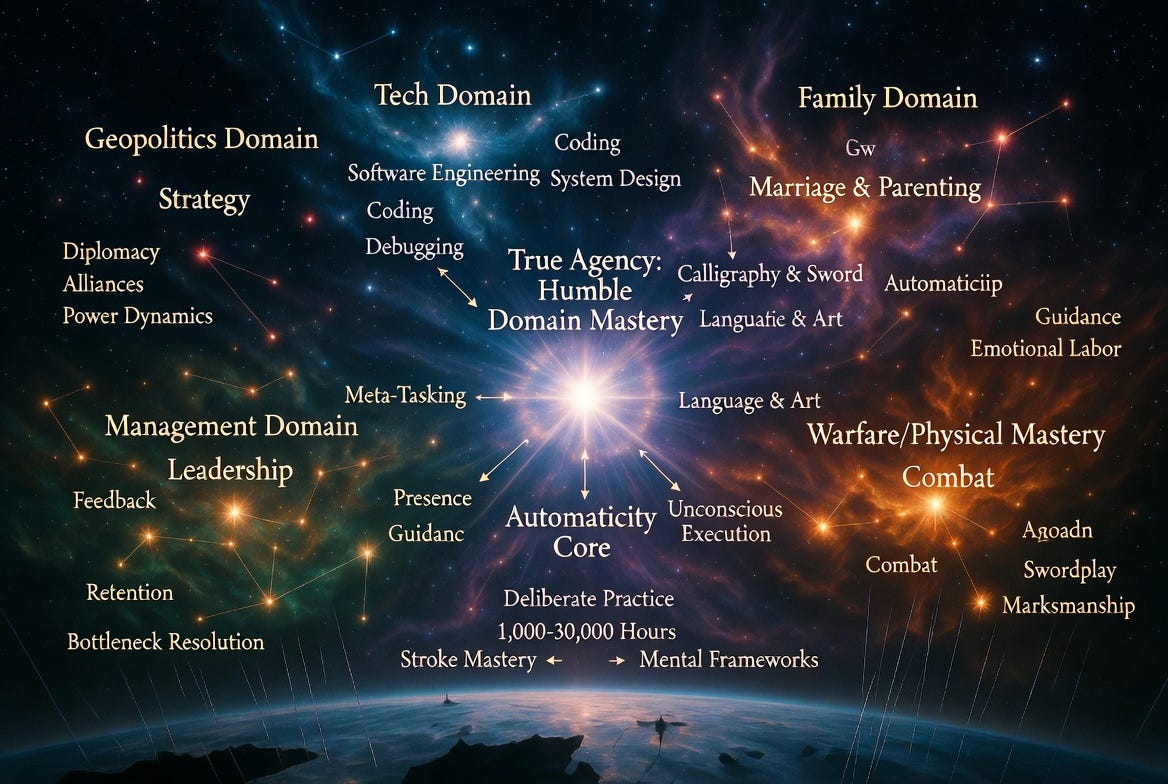
Distant Domains
But what happens when domains are “distant?” What if world in which you trained your instincts and the world you now seek to enter are foreign and alien to one another.
Your instincts will actually mislead you, because the rules of the game are completely different. This is why the illusion of universal “agency” is so dangerous. No matter what level of “agency” you approach the problem with, no matter how excellent the metaphor that governs your mental frameworks, if the rules work differently (as they apparently do between software engineering and geopolitics), then even the most talented people will withdraw in confusion.
Certain domains are so different that you simply MUST humble yourself and develop a whole new set of metaphors and skills that allow you to achieve success in the NEW domain. To be clear, I am very confident that such humility, and even a sense of allowing a piece of your identity to die in order to move forward, is what REAL agency looks.
But that humility is hard in a world where our society has fallen into a diseased mindset that I call the “Cult of the Expert.”
We worship authorized experts as assiduously as ancient pagans worshipped their priest-kings. In the West, public schooling has trained us to constantly seek “permission structures” before we act. The unwritten rule of modern life is this: If you are not one of the top ten experts in the world on a given subject, you have no legal right or moral responsibility to question the rules.
This causes organizational paralysis. For example, many elite consulting firms suffer from what we might call the “Harvard problem”. They know the Ivy League is producing worse and worse candidates, but if you suggest they hire talented people from outside those specific schools, they look at you like you’ve just asked them to commit a religious sin. They are terrified of making a discretionary judgment without the permission structure of an elite credential.
I believe this is because the apotheosis of the expert functions as the last initiation ritual in western society. In healthy cultures, an initiation ritual is a formative process in which cultural authorities provide men with explicit instructions regarding the specific domains they are expected to master. The primary purpose of these rituals is to instill a profound concept of duty that allows men to act with absolute certainty, firmly establishing that opting out or cowardice is not an option. The specific domains tested and imparted during these rituals directly reflect the skills a society deems essential for men, particularly those of rank, to uphold.
For example, in ancient Greece, young men were enrolled in a phratry (fraternity) where they were required to demonstrate physical prowess, such as holding a shield properly from thigh to neck (“thigh to neck!” says Leonidas), alongside mental and moral fitness, proving to the community that they were neither cowards nor liars before they could eventually ascend to political power or eldership. Similarly, the archetype of medieval European nobility required an aristocrat to master three specific domains of animal husbandry, the horse, hound, hawk; and three more of warfare: sword, bow, and lance (more on that in a future post). By requiring the rigorous mastery of these specific cultural and martial technologies, initiation rituals serve as the crucial vetting mechanisms that bind a man to his society and prepare him to execute its most vital functions.
But here is the truth that every builder of a Great House must accept: at no point in human history has the domains which your culture rewards with the social status of initiation (i.e. top ten “expert” in some highly technical aspect of computer science) been LESS related to the critical human domains of marriage, parenting, faith, leadership. Additionally, there are discrete differences in personality that will show up any type of domain mastery society. This again means, that the type of person that will be successful in our society is related to the type of person whose core interests allow him to master the dominant technologies (which frequently means the technologies that are economically rewarded, especially at the lower levels of success).
And yet, there are essential human domains, and this IS the case for the right type of agency. You are not one of the top ten experts in the world at being a husband. You are not one of the top ten experts in the world at being a father. You are probably not the number one manager on earth. And yet you MUST rise to the occasion.
Marriage, parenting, faith, and leading your local community require vastly more high-agency actors than there are available “experts”. If your only framework for taking action is waiting for an expert to give you a permission structure, you will fail in the domains that actually matter. You must act with agency in these everyday domains, even if you are not globally ranked in ANY skill. In fact, even if you ARE a domain master, or even a top ten “expert” having achieved the financial freedom and social apotheosis that status confers, you will STILL need to humble yourself and learn the real habits of agency that the domain mastery of the human skills represents.
It is time to stop pretending that master of one domain, or even the attainment of that lauded expert status is a universal magic wand that allows you to solve all problems in all domains. What holds our high status experts back is that instead of submitting to the humbling process of learning a new domain, they try to force the rest of the world to conform to the one domain they already know. Having said that, the rest of us have to recognize that mastery in certain domains does confer success advantages in earning power, in growing asset values, and in getting people financial freedom or even financial power.
We are still just beginning to try and understand the massive shifts that have come in our culture from AI. We also appear to be at a critical time as more and more people are talking about aristocracy and building Great Houses. My hope that this distinction between Universal Agency, and the more limited concepts of domain mastery provides benefit to you all. Critically, I think it is important to recognize that we WILL not go back to the technologies of yesteryear and therefore the personality profiles that were selected by prior “tech stacks” will NOT necessarily reappear… unless of course we make them. My hope is to share my thoughts on what that might look like in the coming weeks.
See you soon!
No posts
Comments
Nothing yet. Say the first thing.
Sign in to join the conversation.