
Hello Friends,
Over the last few posts, we have been laying the groundwork for what it actually takes to build a multi-generational legacy. In Civilization and Its Pillars, we established that the flat, safe spaces of our society only exist because vertical, hierarchical Great Houses bear the weight. In The Iterative Game, we discussed how these structures are held together by long-term bonds of honor and reputation. And most recently, in The Two Games: Are You Playing for Life or Running from Death?, we looked at the necessity of creating a bounded space where your people are secure enough to stop fighting for bare survival and start building for legacy.
But this brings us to a crucial question. Once you have built the Pillar, established the Iterative Game, and created a Game of Life for your people... how do you keep it?
The modern, managerial assumption is that once you acquire wealth and power, then you have arrived at a new state of grace. Wealth becomes a mathematical fact of your bank account or a natural law of your bloodline. You hit your exit, liquidate your relationships, and walk away with a pile of money to spend on whatever you want. You can be a passive investor and the “8th wonder of the world” compound interest along with all of the other growth opportunities of our modern financial system will keep funding your family forever.
‘Shirtsleeves to Shirtsleeves,’ the proverb that says that a wealthy family will find themselves reduced back to slavery in three generations or less has an almost 90% success rate (based on pre-Covid numbers). An often unstated corollary to this is an assumption that the fall of the family is precipitated by a loss of money. Something must have gone wrong in the business, or the money markets, or perhaps you entrusted your wealth to the wrong people. But there is a deep belief that money makes the man, wealth makes the family, and the only qualifications you need to keep money is having already made it.
I am here to tell you that if you want to build a Great House, you have to abandon this idea completely. Successful Great Houses interact with their wealth and power not as a natural right, but as the result of a covenant. They have struck a deal with God, the universe, or whatever higher power they believe in. And if they wish to continue enjoying the blessings of that deal, they BELIEVE that they must keep their end of the bargain.
The reality is that most families do not decline because they have run out of money they run out of money because their family has gone into decline. It is true that occasionally there are great injustices where a healthy, stable family loses their money before losing their virtue. However, over and over again, I have seen situations where the financial engine was still operating with great effectiveness, and the merely wealth realized too late that what they were running out of was family itself.
“Guard This Gate”
Let’s start with a phrase: “Guard this gate.” In our modern English, if an employer tells you to guard a gate, there is an implied ending date. You guard it until the end of your shift, or the end of the week, or the end of your deployment.
In the ancient world, “guard this gate” meant something entirely different. It meant: You and your sons, and your sons’ sons, will guard this gate until the ending of your lineage or the ending of the world.
The command to “Guard the gate” included an authorization, to live in the city, to wield weapons, to extract reasonable fees so that the gate could be maintained and so that the gatekeeper could be fed, marry, sire sons, and train those sons to train their sons to train their sons to…. Guard this Gate. Forever. World Without End (as the Anglicans say).
This is the essence of a calling, a covenantal duty. A Great House understands that its position in society is tied to a specific, enduring responsibility. They don’t view their wealth as a random stroke of luck or a mere product of their own raw IQ. They view it as a stewardship. They know, down in their bones, that their power and protection are downstream of the fact that they are guarding the gate. If they ever leave that post, the blessing will be stripped away.
Modern society struggles with this concept because we have internalized a false moral imperative that profit is inherently rapacious and immoral (as are all right-coded things). We falsely believe that aforesaid rapacious for-profit activity must constantly be balanced by non-profit activity which is good and nice (as all left-coded things are). If you feel this way, then first of all you have internalized communism and you need to repent as an absolute prerequisite to building or belonging to a Great House. Then, after you have repented, you must study the primary enterprise of the family upon whose virtuous strength your House is built. This is because the primary way by which a legacy family blesses the world is by guarding their particular gate, which almost certainly INCLUDES (but is not limited to)1 the primary enterprise of the family.
This is why so many founders and fathers have told me with tears in their eyes, about how after their exit, after their great big financial boost, that they “lost their calling” and frequently their children with it. So what do the legacy families that form great houses do differently?
Successful legacy families know exactly what their family purpose is. This does not mean that every descendant works in the same family business or even enjoys the family purpose. However, they all know exactly what the family is intended for.
Returning to the metaphor of guarding the gate, this is not a job that requires every single person in the bloodline to stand watch. If the original guard has five children, and they each have five children, with every generation an increasingly smaller percentage of the family will physically guard the gate. By contrast if disaster strikes and a family is lacking qualified adults, they may use extraordinary means to fulfill the family covenant. They might utilize their financial resources to hire a non-family member to guard the gate for a period of time until the children are old enough to take over the duty. (Though obviously there is serious risk of the family duty being breached or corrupted during this time).
There is immense freedom in this reality. Ensuring that the gate is guarded does not mean you personally must hold the spear. If a child has different gifts, they are not constrained, but the family as a whole must ensure the mission is completed. Because multi-generational structures require hierarchy, those who are closest to fulfilling the core purpose—those actually guarding the gate—must stand higher in the family hierarchy regarding wealth control and decision-making. The reason is (based on the covenantal theory at the heart of the family’s identity) if those actually serving as guards fail in their charge, the family as a whole will suffer.
The core identity of a legacy family is the unified belief that their wealth, power, and status are all downstream of the fact that the gate is actively being guarded. They know deep in their souls that if the gate is left unguarded, their protection will be stripped away. Families may frame this in different ways:
Mystical terms: We have a deal with God, and if we break it, we will be cursed.
Psychological terms: Keeping this promise is core to our self-identity; breaking it will cause us to self-sabotage and make foolish decisions until we are ruined.
Conspiratorial terms: If we do not keep our promises, “they” will come and get us.
Social terms: We occupy our position because society respects us; if we break our promise, we lose that respect and we will be harmed.
Regardless of the framing, the baseline truth is a claim, that is reinforced by EVERY LEVEL of the family’s identity producing activities, that if the family causes specific outcomes to persist, they will enjoy unusual success.
What does unusual success look like? There is an apocryphal story often repeated at legacy conferences regarding a shipping and logistics family in New England. A son had a terrible fight with his father and left on bad terms. The next morning, the family attorney handed the son a check for ten thousand dollars and informed him he was no longer welcome on family property. The son traveled to Houston and invested the money into the exact same type of business that his father ran. Within five years, the father and son reconciled. They went over the account books and calculated that the son’s business was now worth fifty million dollars. The father wrote in the ledger: “Five years. 5000 times ROI. Good investment.”
That is the absolute pinnacle of unusual success. It is the equivalent of a machine where you insert money and receive a five-thousand-times multiple in return.
When people ask how to find their family purpose, the answer is to look for where you (or your ancestors) had unusual success. You are looking for a domain, a calling, or a gifting where everything lines up perfectly. If you do not possess the capacity to found a Great House yourself (and to be clear not everyone is called to be a founder) you must look for a person for whom these gifts line up. Your path may be to form a group around a founder with the capacity for unusual success, push them until they establish a Great House, and trust that they will remember you when they come into their kingdom.
A less extreme example of unusual success is the chiropractor family. A father possesses a unique technique in chiropractic medicine. It is a true net good that improves the world. The father experiences unusual success compared to average chiropractors.
In our story let us say that the father has three children: an artsy child, an argumentative child, and an obsessive-compulsive child. Society might view this as a failure because none of the children are chiropractors. However, God gave the family those specific children on purpose. They are the marketing director, the lawyer, and the accountant. The family does not need three more chiropractors; they need fifty more chiropractors working for them. They need marketing to feed the clinics, legal contracts to manage the employees, and accounting to track the revenue across multiple locations.
The healthy legacy family viewpoint is one where the children view preserving and advancing the technique, the gift given by God, as their central mission and their direct source of wealth.
When a family experiences this kind of unusual success, they naturally want to pass it down. But inheritance in a Great House is never just about dividing up a pile of cash equally among descendants so they can buy luxury cars. Inheritance is for a purpose.
Imagine a magic kingdom. You have giants on the northern border and dragons to the south. The King grants your family a magnificent, glorious castle on the northern border. It has incredible stone walls, deep wells, and rich surrounding farmlands. It is a beautiful inheritance.
But the castle is not yours so you can sell it to the highest bidder and retire to a beach. The castle is yours so that your family can fight the giants.
If you see the dragonslaying lance, covered in gems, and carrying with it magical blessings of speed, strength and protection from fire. Asking for that lance is not a license to strip the jewels off or dance in magma for fun. He who wields the dragonslaying lance is assuming a responsibility to slay dragons.
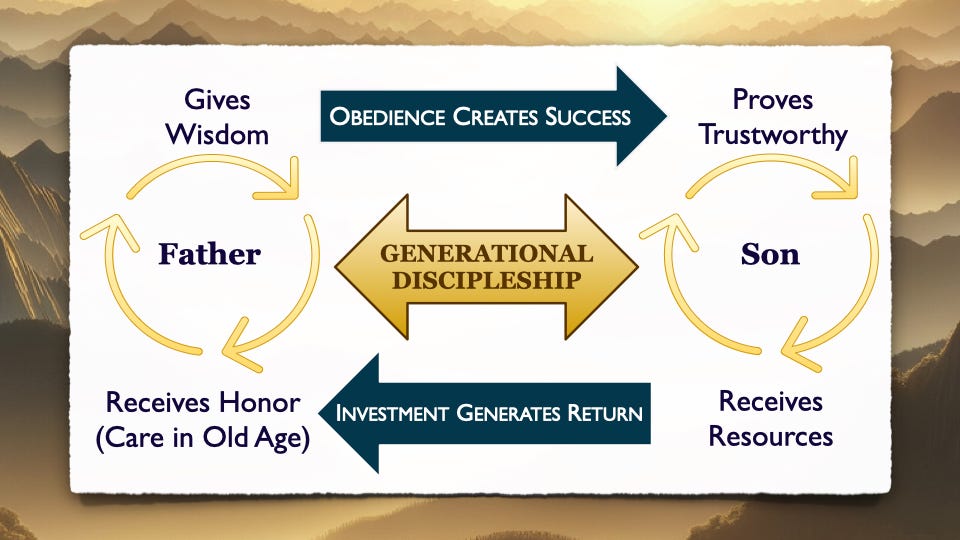
When a Great House passes down its wealth, it is passing down the castle or the lance. The father looks at the son and says, “Here is the mission, we have given you the wisdom, and we WILL give you the resources to be successful.” If the son obeys the wisdom and uses the resources to fulfill the mission, he generates success in the real world. He then returns honor back to the family, completing the cycle of inheritance and ensuring the covenant remains unbroken.
The Biblical figure Samson had three specific rules as a Nazarite: do not eat strange food, do not sleep with strange women, and do not cut your hair. Samson did not lose his grace and his unusual success until he broke ALL THREE RULES.
Now I want you to imagine that our dragon-slaying lance from above comes with similar rules, perhaps you must never drink alcohol on Sunday, or you must always sleep on a bed of straw, or some other fairy tale rules. But if you break these rules, no matter how strange or silly, then the magic will fail and the grace will depart from you and the next time you face a dragon… then, like Samson, you will die.
Now the point of the silliness of the fairy tale rules is because when people are young and immature, when they do not understand the BASIS of the power that their family wields, even the most reasonable rules seem silly. But there is no way to develop the character you will need to be successful without keeping them.
This is made harder because we now frequently hand young people an inheritance of pure liquid trouble (ie money). As Johann Kurtz mentions in his most excellent book “Leaving a Legacy” there is an incredible benefit to leaving illiquid assets to your children. In large part, I believe that this is because physical things have a telos, a purpose embodied in them. The nature of the land or the business, or the asset implies the noble character that is necessary to successfully keep that asset, and their ancestor’s success in managing the asset gives them a basis for understanding the core elements of his character.
But in the modern age, inheritances are forced by the modern financial and tax system to include ENORMOUS amounts of liquidity. And the great and terrible property of money is that it is fungible. That is, one bucket of money appears for all purposes identical to any other bucket of money. This makes it even more important that families explicitly lay out the mission that they believe that they are on. Again, this is because THE thing that will allow their descendants to continue accessing their unusual success it is keeping the terms of the covenant that their ancestors struck.
The Five Points of the Family Covenant
So how do you actually structure this deal within your own family? Successful legacy families usually have a family covenant, whether they call it that or not. Here is a framework drawn from Gary North’s short book God’s Covenants that is surprisingly relevant when analyzing the history of the families that built the best parts of American corporate culture.
The Transcendent Purpose: The enduring “why” of the family. What is the specific virtue or net good that God has tasked your family with bringing to the world?
Delegation and Hierarchy: Who is in charge of what? You need clear lines of authority to ensure the mission actually gets executed.
Ethical Guidelines: This is the list of virtuous things the founder did that created the success in the first place. These are your operating principles.
Obligations and Territory: What specific domain are you called to steward? (This is always subject to expansion as your children develop new gifts).
Succession: The goal is not to sell everything and exit. The goal is to successfully hand the keys to the next generation so they can continue to exercise virtuous authority.
Many of the leaders of the last century have written books detailing their understanding of their covenant with God. Joel Salatin, the godfather of the modern regenerative agriculture movement, documented his multi-generational plan in Family Friendly Farming: A Multi-Generational Home-Based Business Testament. Jim Wilson detailed how to take a strategic geographic spot in his book Principles of War. The Wilson family, led by their witty if controversial patriarch Doug Wilson, has by faithfully following his father’s God-given insight generated outsized influence not just in Moscow Idaho, but across the Reformed Christian world. The late Ellsworth McIntyre established a framework for profitable Christian daycares.
What many of these families have unfortunately NOT acknowledged is that these callings are highly attuned to specific examples. Ellsworth McIntyre is the best example. His book contains incredibly detailed business plans, IP, and essentially everything that someone needs to start a Christian daycare. In Ellsworth’s opinion ANYONE could do it, and it was one of the great unsolved mysteries to him why more people did not. In my view, the McIntyre family possessed (and possesses) a highly unique gifting that could not simply be handed to strangers, which aligns perfectly with the Great House framework.
The Challenge
In conclusion, I give you the metaphor of the great tree that reaches up to the heavens and provides stability and shelter for all who dwell beneath its branches. The tree I suppose is just another way of framing the pillar. Many of us grew up as the beneficiaries of these great pillars. We experienced well-ordered cities, respected private property, and guaranteed public safety. These blessings did not occur by accident. They existed because unseen Great Houses—families who operated local banks, managed urban development, and maintained the social fabric—did the heavy lifting to provide those blessings to the culture.
We are currently living in a time of peak change. The old trees are falling, and the ancient pillars holding up the sky are collapsing. You may be the only person in your entire county capable of possessing this vision. You are placed in the position of Frodo Baggins holding the One Ring. You may not have desired to be born into this specific era, but the burden has fallen to you.
We have two choices. We can allow the pillars to fall, resulting in our descendants living in economic collapse and urban slums. Alternatively, we can step forward and shoulder the immense burden of holding up a piece of the sky.
Inheritance is not given to a child simply for breathing. Inheritance must be given to those who are willing to shoulder a mighty burden and slay the dragons at the border. The ultimate goal is to defend, maintain, and support our civilization in her day of distress. If we succeed and serve as the foundational pillars through the next several decades of turbulence, our families will emerge on the other side as the Great Houses of the next historical cycle. It is a mighty task, but it contains enormous glory and is the greatest possible blessing you can bestow upon your descendants.
Let’s get to work.
Thanks for reading! Subscribe for free to receive new posts and support my work.
Can you tell this was written by a lawyer?
No posts
Comments
Nothing yet. Say the first thing.
Sign in to join the conversation.