
Recently, I have had a number of conversations with gentlemen of European or British extraction on the concept of a Great House. The conversations go on nicely until a particular word is used at which point it derails because we are using VERY different meanings for that word. The word is “Aristocracy.” What I have come to realize is that we are not merely disagreeing about a word, but about the underlying technological and social structures that produces such a class in the first place.
While I am not a full-blown technological determinist, it is undeniable that societies respond to technologies, especially technologies that are dominant over a long period of time. The longer that a technology is dominant the more that people can incorporate that technology into their planning, and build friendships, business entities, and even larger structures around it. As we discussed last week under the concept of domain mastery, people have an incredible ability to optimize for what they practice. This is true of groups as well as individuals. Just look at the improvement in small group urban warfare tactics enabled by games like Call of Duty, paintball, and airsoft.
Over time the entirety of a culture can grow to have an expectation that A, B, and C technologies will be dominant for the foreseeable future. This leads to an assumption that X, Y, and Z skills, and especially those skills in relationship with other people with compatible skills themselves, will be a “good career trajectory.” At some point the actual analysis of the technology ceases to happen, it is a fixed point, assumed. And this is okay, because the technology is SO dominant that it continues the techniques skill have a functional reality… until one day it doesn’t, and then so the story goes “everything changes.”
Except, in real life, everything does NOT change all at once. One of the terrifying realities of human culture is the concept of social inertia. Persons, lineages, and entities with wealth and power tend to retain wealth and power even after the original method by which they acquired that wealth and power has become technologically irrelevant or even outright illegal. This is the great weakness of most formulations of technological determinism, in that they assume an efficiency in the flows of information and human behavior that is simply not borne out by history.
A helpful way to think about this is to distinguish between a formal definition and a functional definition.
A formal definition tells you what a thing is called in law, custom, title, or social memory. A functional definition tells you what that thing actually does in the world, what realities it is equipped to govern, what powers it can reliably exercise, and what tasks justify its place in the social order. A thing may survive for centuries in the formal sense after it has already died in the functional sense. This distinction is essential if we are to speak intelligently about Aristocracy.
This problem is made worse by the corruption of words. Once a word ceases to describe a concrete and publicly recognizable reality, and instead becomes merely a term of praise or blame, coherent discussion becomes nearly impossible. People imagine they are debating facts when in reality they are only exchanging moral gestures. Before going further, it is worth perusing a quote from C. S. Lewis, which is one of clearest explanations of this process, that I am aware of:
“The word gentleman originally meant something recognisable; one who had a coat of arms and some landed property. When you called someone ‘a gentleman’ you were not paying him a compliment, but merely stating a fact. If you said he was not ‘a gentleman’ you were not insulting him, but giving information. There was no contradiction in saying that John was a liar and a gentleman; any more than there now is in saying that James is a fool and an M.A.
But then there came people who said—so rightly, charitably, spiritually, sensitively, so anything but usefully—‘Ah, but surely the important thing about a gentleman is not the coat of arms and the land, but the behaviour? Surely he is the true gentleman who behaves as a gentleman should? Surely in that sense Edward is far more truly a gentleman than John?’
They meant well. To be honourable and courteous and brave is of course a far better thing than to have a coat of arms. But it is not the same thing. Worse still, it is not a thing everyone will agree about. To call a man ‘a gentleman’ in this new, refined sense, becomes, in fact, not a way of giving information about him, but a way of praising him: to deny that he is ‘a gentleman’ becomes simply a way of insulting him.
When a word ceases to be a term of description and becomes merely a term of praise, it no longer tells you facts about the object: it only tells you about the speaker’s attitude to that object. (A ‘nice’ meal only means a meal the speaker likes.) A gentleman, once it has been spiritualised and refined out of its old coarse, objective sense, means hardly more than a man whom the speaker likes. As a result, gentleman is now a useless word. We had lots of terms of approval already, so it was not needed for that use; on the other hand if anyone (say, in a historical work) wants to use it in its old sense, he cannot do so without explanations. It has been spoiled for that purpose.”
-CS Lewis, Mere Christianity
This is why modern arguments about Aristocracy so often go nowhere. Though Lewis uses the term Gentleman instead of Aristocrat, I believe he is discussing the exact same historical progression. One side imagines hereditary parasites in lace and powdered wigs. The other imagines noble virtues like courage, honor, and stewardship. But neither image is yet precise enough. Both are mixing up formal remnants, moral aspirations, and functional realities. The question is not first whether aristocrats were admirable or contemptible. The question is: what did they do that gave them the power and wealth to be a real governing class in the first place?
I must insert here an obligatory quote from WrathOfGnon
When I say that Aristocracy was once real, I do not mean merely that there were titled persons, heraldic privileges, and inherited estates. I mean that there once existed a class whose domain mastery in certain technologies that were dominant for centuries gave them a genuine civilizational function. If that function disappears, the legal shell may remain for generations, but the thing itself is already mostly dead. The problem is not just with the difference between the millionaire who has bought his peerage with wealth acquired in a manner TOTALLY unrelated to the arts of war that once defined the rights and privileges of aristocracy.
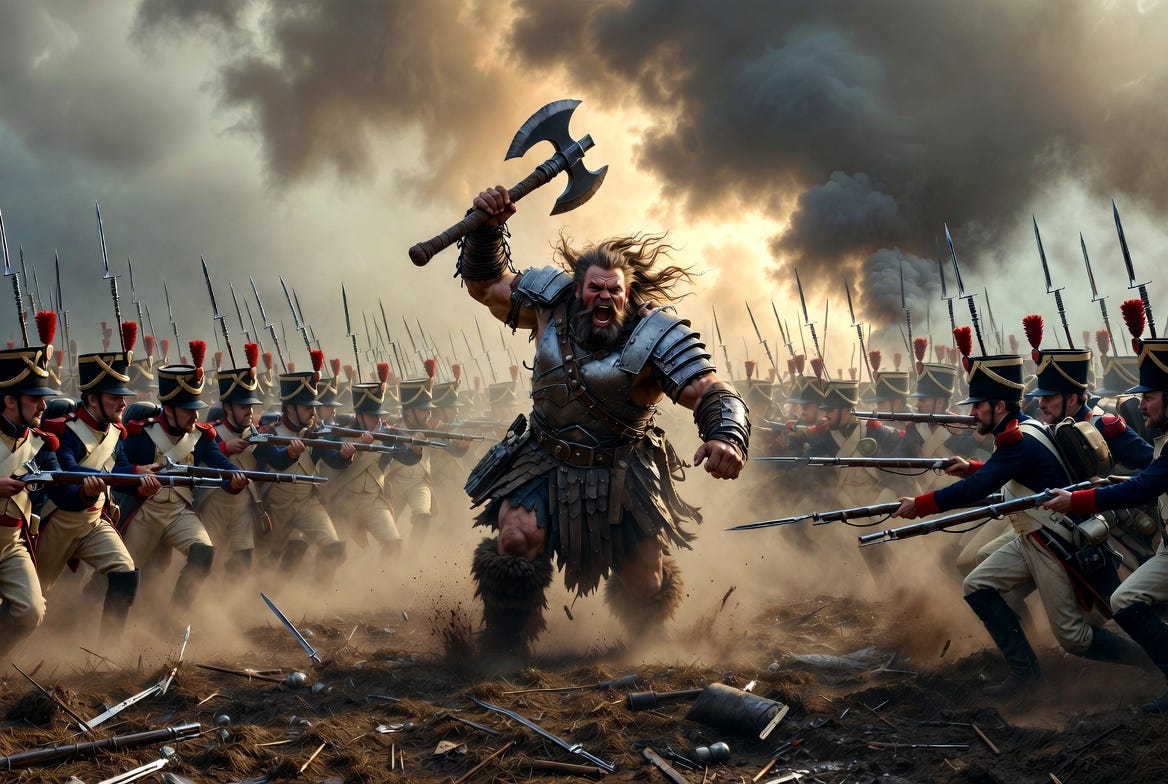
The larger problem is the gap, the often insurmountable abyss between the ancestor who won his position with the battle-ax and his descendant speaking on the floor of the House of Lords. The point is made even more poignant if we assume that the descendant has (under the requirements of his family no doubt) mastered the arts of wielding a battle-ax. But his mastery of that weapon means something TOTALLY different than when his ancestor acquired the same skill. Namely that for the ancestor the battle-ax was a state of the art weapons system, and for the descendant it is a vestigial skill with no military value to the nation in whose highest house he serves. To be clear, there was a time in which high-level personal skill in one of the weapons of the day could win you honors and titles on the ever-present field of battle. That battlefield was the ultimate reality check, the “natural meritocracy of extreme violence” on which all later forms of aristocratic privilege rested. It was certainly more real than the “artificial meritocracy of the spreadsheet” currently strangling the modern world to death.
Speaking of artificial meritocracies, in a deeply troubling way, the plutocrat who buys his title with money, and the speaker who inherited his oligarchical position are much more similar to each other than either is to the original lords who won their nobility on the medieval battlefield. This is the underlying truth that gives the sting to the leftist claim that aristocracy, plutocracy, and oligarchy are the same. But this is because for both of them, their security is provided by modern infantryman in an increasingly industrialized military. It is not the battle-ax but the bayonet that provides the safety in which they either managed their inherited wealth (and increasingly precarious position) or generate the sums to buy their way into an increasingly less rational status game.
As D. Elton Trueblood noted (and Os Guinness popularized) “cut flowers culture” is where a cultural idea or practice is cut away from the cultural roots or necessities that gave it power, meaning, and ultimately life. As with a flower, the beauty does not immediately fade, even though the plant is surely already dead. Barring some kind of planting in the original soil. When this happens with a technology, especially a technology whose practitioners are wealthy and powerful they frequently keep using the technology for secondary purposes. For most of these technologies, because mastery was useful in some functional domain, demonstrations of that mastery (or of skills that led to that mastery) were part of a cultural status game, or to put it more politely they were part of the “leadership pathway.”
Unfortunately, even when there is an underlying functional skill it is quite difficult to keep “metrics from becoming targets.” This is why you want frequent, repeated, (ideally low-impact) contact with reality, or at least with a feed-back loop that you do not control.
But status games in a purely formalistic domain can begin to behave very much like speculative bubbles in a market. Once the underlying functional reality is no longer disciplining the participants, status begins to be priced by status, prestige by prestige, signal by signal. Men begin competing not in the thing itself, but in the socially recognized markers that once pointed to competence in the thing. And because those markers are being evaluated by other players trapped in the same game, the process can spiral upward into absurdity for quite a long time. Just as in a financial bubble, the internal logic can appear self-validating right up until the moment that some harder reality intrudes and reveals that the entire structure has been floating on reflexive social valuation rather than substance.
So we might think of there being five stages of a dominant technology:
1. The initial period where that technology is new and exciting and is actively being analyzed and interpreted by both its adherents and detractors. It is not well understood.
2. The technology achieves functional dominance, and over time (especially if it remains dominant) it is incorporated into more and more social structures: educational, business, and (if it remains dominant for centuries) political, and even civilizational.
3. The technology is displaced as dominant in some or all of its core domains, but continues to be relevant (as a status symbol if nothing else) because its practitioners still have wealth and power, at least for now.
4. Bereft of its functional roots, the technology is altered, metrics become targets, and its practice devolves into a pure status game, at which point the cut flowers can frequently start to smell very bad indeed.
5. Finally (after the bubble pops) the technology lapses into a historical curiosity, practiced, if at all, by those academics whose sole purpose is to preserve otherwise irrelevant.
If this framework is basically correct, then several implications follow, and they deserve to be treated carefully rather than rushed past. In particular, when I talk about Neo-feudalism or the return of an aristocratic structure, I DO NOT MEAN, nor I think does any serious student of history mean that we will return to the technological habits of the medieval culture, or that the battle-ax will suddenly become a state of the art military technology once again.
To return to the topic of aristocracy as I have tried to parse out the break-down in these conversations (with friends and allies I should note), I have come to realize that in the European mind Aristocracy is seen in the same way that Americans are taught to see chattel slavery: as their culture’s original sin. Regardless of the actual evils of US slavery, and the much lesser evils of European Aristocrats, these are both intolerable to the leftist mind, because they are hierarchies, which is (to the leftist) the true original sin. It should be noted that strawmanning all European aristocracy as decadent, status chasing, unwilling to work, privileged “gentleman” is particularly helpful if you’re a communist agitator looking for a government to overthrow. But this again conflates the functional meritocratic aristocracy of the medieval period,
While I might note that the worthwhile aristocrats were almost entirely purged in the trenches of World War I, there is an enduring question here. How does a class of nobility, which was insanely dominant for almost a thousand years and produced unrelenting success over and over again, become so weak and ridiculous in such a short time? How do you go from El Cid to Don Quixote? From leading thousands of men and inspiring all of Europe, to being a figure of ridicule tilting at windmills? The answer cannot simply be moral decay; something more structural must have shifted beneath them.
I believe the answer lies in the death of Chivalry, which I would argue is at least as relevant as the “Death of God” and likely moreso. More precisely, it lies in the collapse of the technological system that made chivalry a source of real power.
To be clear the death of God would be wildly more important than the death of Chivalry but as the enemies of Christ seem to forget with hilarious regularity, rumors of the death of the Crucified God are always overstated. He (and his Church) just keep coming back. Chivalry however, is truly dead, and it is never coming back. The conditions that sustained chivalry were materially dependent on a specific form of warfare that no longer exists. But we will talk more about that, and what Chivalry actually is, in the next post.
No posts
Comments
Nothing yet. Say the first thing.
Sign in to join the conversation.