
Hello Friends,
In the last post, I introduced the concept of iterative v. transactional games. But the truth is that all of us are iterating, unless we drop dead at the end of a trade we do in fact continue on beyond any individual transaction. And so the transactional frame is just an illusion that is frequently used to justify bad behavior. The truth is that you ARE playing a long-term game, the question is: What ethic are you embodying?
As is hopefully clear, by now, in this circle we evaluate norms and outcomes by the desire to build a multi-generational Great House. By contrast, modern Western culture operates on a default setting that assumes every interaction, every business deal, and every relationship is a Death Game.
But if you play a Death Game with your family, your legacy will shatter. To build something that lasts, you have to learn how to play a Game of Life.
Here is the difference between the two, and why understanding them is the key to building a high-trust, unstoppable team.
The Death Game: War to the Knife
A Death Game is any game where you are wagering your life, your liberty, or your livelihood on the outcome.
You recognize that cadence, don’t you? It sounds a lot like the Declaration of Independence, “Life, Liberty, and the Pursuit of Happiness.” But I was raised Baptist, and I like alliteration, so I prefer “Livelihood.” And frankly, in the cold, hard reality of our economy, the “pursuit of happiness” usually relies entirely on your livelihood—your ability to put food on the table for your wife and children.
If you lose this game, you do not just drop a rank on a leaderboard; you lose your ability to feed your family, you go to jail, or you literally die. Because the stakes are existential, men will do almost anything—lie, cheat, and kill—to avoid losing. A Death Game is war.
Here is the terrifying reality of a Death Game: Men will kill rather than lose such games.
Unless a man has a profound, restraining religious conviction, if you threaten his life, his freedom, or his ability to feed his children, he will burn the world down to win. And when you structure a corporation or a society as a Death Game, you are incentivizing everyone around you to break any rule in order to win, or at least not to lose.
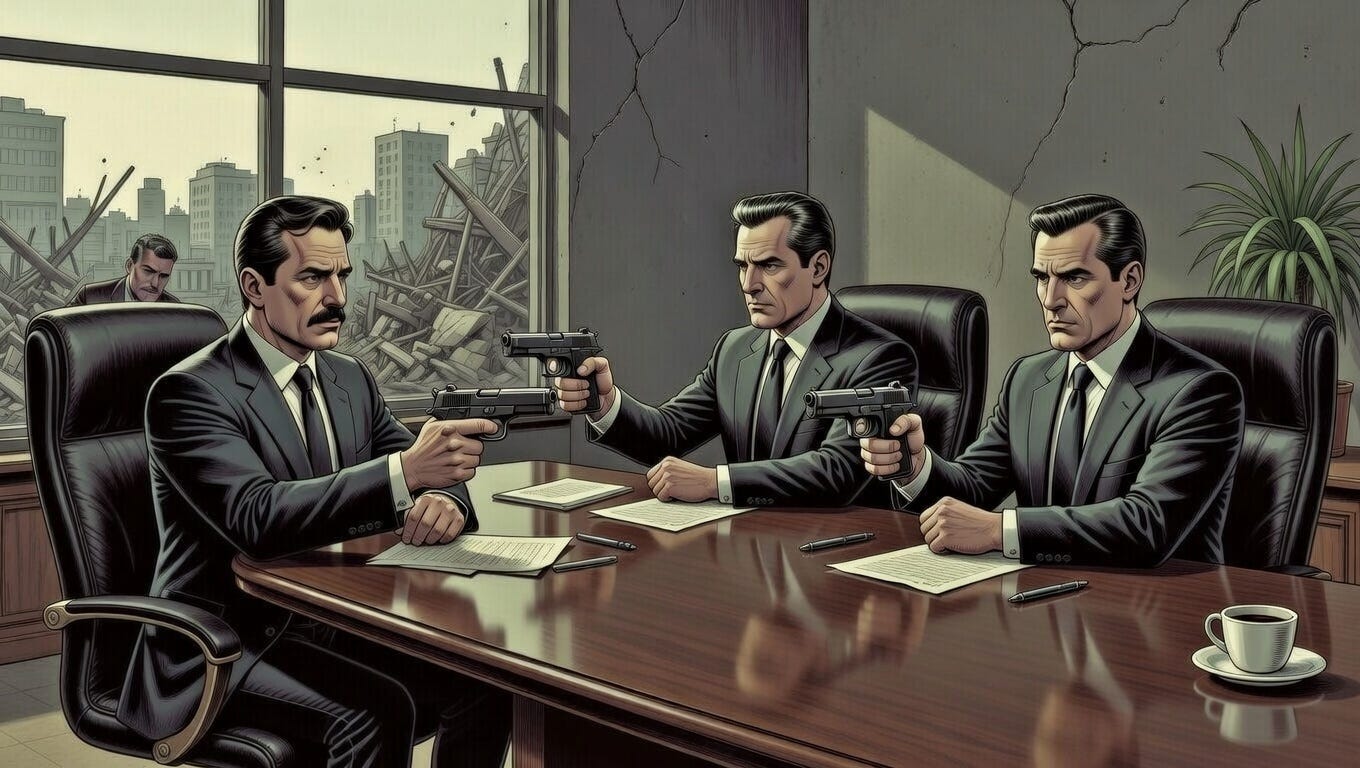
The tragedy of the modern corporate environment is that it is entirely structured as a Death Game. You are not just facing risks from outside competitors; there is malevolence inside the room. The people you sit next to in the breakroom—the people you rely on—might decide you are weak and “eat you” to advance their own careers. In this environment, you are constantly fighting on two fronts: the external market and your internal colleagues.
Corporate Sabotage
This isn’t just theory. I remember reading about a massive liability case involving General Electric years ago. It took them seven years of discovery to figure out what went wrong. Do you know what they found?
They found that there were three separate groups within the company actively sabotaging each other, and it was the COMBINATION of those three acts of independent sabotage, that caused the defect that went on to cost their company tens of millions of dollars. In theory they were on the same team! But because they were playing a corporate Death Game—where one guy’s promotion meant another guy’s demise—they destroyed their own product.
That is the modern industrial Economy. It means that the people you are in a room with people who you eat lunch with, people you joke with, might actually be actively working to harm you and the company upon which you are dependent. This omnipresent malevolence is a constant burden, creating stress, burnout and occasionally violence.
Escape is the Strategy
Because of this, people in a Death Game are motivated entirely by fear. They want to hit their number, get their “F-U money,” and escape the game forever. But there is a poison pill here. These people associate making money (and likely any other form of success or power) with playing a deathgame. This makes them conflate weakness with virtue, and leaves them unable to provide for their children. They either wind up either financially or morally bankrupt.
The great tragedy about the F-U people is that by withdrawing from the game entirely, they condemn their children to the default death game of our morally bereft culture. Certain key founders and funders such as Elon Musk, Peter Thiel, Marc Andreessen are the exceptions that prove the rule. As Palmer Luckey once said “are you going to be Batman? Or are you going to be you?”
When I talk to such people, the reason they withdraw from the game, the reason they refuse to “be Batman” is that they are universally CONVINCED that the Death Game is all there is, and many of them have heart-wrenching stories that demonstrate why they think that. But if all they can build is a death game, well of COURSE they are going to put their kids as far from that as possible. If their children must play a death game (which many of them believe) they want that to happen far far away, from them.
So I always start with, but what if you COULD? What if you COULD establish a game of life? Because of course we can build “Games of Life.” And interestingly enough some of the most successful organizations in history figured this out a long time ago.
The GM Strategy: Removing the Fear
Let’s look at General Motors. I’m not talking about the GM of today, but the industrial titan of the mid-20th century. They understood something about human nature that we have forgotten.
GM had a program for their top leadership—specifically for the men they wanted to run their massive factories. Before a man could become a plant manager, the company would do something extraordinary. They would structure his stock and compensation in such a way that he became, for all intents and purposes, independently wealthy.
Think about the psychology of that.
Before they handed him the keys to the factory, they essentially said to him, “If the game is survival, you have already won. If what drives you is the fear of going hungry, you can stop playing right now.”.
They took “Livelihood” off the table as a risk. Why? Because they didn’t want a manager who was making decisions based on whether he could make his mortgage payment next month. They didn’t want a man ruled by fear. They wanted a man who was free to make the hard, right decisions for the long-term health of the plant, without looking over his shoulder.
They elevated him from a servant working for wages to a partner playing for honor. While its hard to imagine this happening (or even being financially possible) in today’s cut-throat manufacturing environment, this occurred at several major American companies within living memory.
The Consultant’s Choice
We see a similar dynamic in the highest tiers of elite consulting firms, even to this day.
Now, anyone who has been exposed to the world of consulting or top level law firms can tell you getting there is a grind. The life of an associate is actually an almost perfect example of a death game. But once you reach that top tier, nearing the partnership level, where you are on the cusp of being a “made man” you enter a different kind of game.
Many of these firms will give a potential partner an entire year sabbatical, at full pay. This gives the potential partner time to mentally regroup. In many cases, frequently before the sabbatical is over the consultant will reach out to the firm with some variation of: “Please let me back in. I want to do the high-level consulting. I want to go get the clients. I want to handle the high-stakes situations.”
In some cases, these high level thinkers and workers discover a love for life and family, or a purpose outside of the high-stakes world of the firm that means they want to find a new direction in life.
Both of these outcomes are actually of benefit to the firm. While they can build systems to manage the associate slaves in their brutal death games, partners have to be a different kind of animal. You aren’t there because you have to be. You are there because you want to be.
Because a partner is secure, they are playing for the thrill of the game. They are playing for status, for victory, and for the satisfaction of excellence. They are playing a ultimately, a Game of Life.
The Definition of Honor
This brings us to the most critical definition for those of us trying to build a Great House.
When you are playing a Death Game—where losing means you lose your ability to feed your children—you will eventually cheat. You will lie. You will sabotage your neighbor. You will do whatever it takes to survive.
But in a Game of Life, we operate by a different rule.
Honor means we would rather Lose than cheat.
We can say that because we know that even if we lose this round, even if we lose status, we will not lose our brotherhood. We will not starve. Our children will not be cast out.
Because we have a floor, we have the luxury, and the duty, of Honor. We can afford to be Great Men, and Great Men build Great Houses.
The Ultimate Strategy: Playing the Death Game as a Team
Does playing a Game of Life mean we all hold hands and sing songs while the world eats us alive? Not at all. The Death Game of the outside world never goes away; it is the reality of a fallen world.
But a Game of Life is fundamentally a team sport.
A Great House is a bounded space. Inside the walls, between the band of brothers, there is absolute security. You are training, competing, and sharpening each other in a Game of Life. Even when you compete, it is a form of training, an honest metric to ensure that the best of your are going to face the outside world. But when you step outside those walls, you are facing the Death Game of the world together, as a unified team.
You look at the men and women in your House and you say, “Out there, it is a war. But in here, it is one for all and all for one. We win or lose together.”
If you want to build a legacy that outlasts you, you must stop treating the people you rely on as if they are disposable. You must build a House where your children and partners know they are safe from the knife, so they can turn their weapons outward and conquer the world.
No posts
Comments
Nothing yet. Say the first thing.
Sign in to join the conversation.